Washington DC Pickleball Paddle Bulk Procurement: The Government & Institutional Sourcing Guide for 2025
Twenty-four point three million Americans played pickleball in 2025, and nowhere has the infrastructure response been more aggressive — or more institutionally unique — than in Washington DC. The District’s Department of Parks and Recreation (DPR) has gone from zero dedicated pickleball courts in 2019 to 58 outdoor courts and 19 indoor facilities as of FY23, with over 1,500 registered program participants. Mayor Bowser’s FY24 budget allocated $750,000 specifically for four new courts at Garfield Park and earmarked $14.2 million for the “Recreation for ALL” initiative — and every new court represents a procurement line item for paddles, nets, and accessories.
I’ve spent the last six years on the factory floor and in procurement negotiations, and I can tell you: Washington DC is not just another city for pickleball equipment sales. It’s a government and institutional procurement ecosystem that operates on its own rules — GSA Multiple Award Schedules, DC Supply Schedule (DCSS) certifications, Certified Business Enterprise (CBE) requirements, and fiscal-year budget cycles that determine when RFPs drop and when purchase orders clear. If you’re selling paddles through the same retail channels that work in Phoenix or Miami, you’re invisible to 70% of DC’s actual purchasing volume.
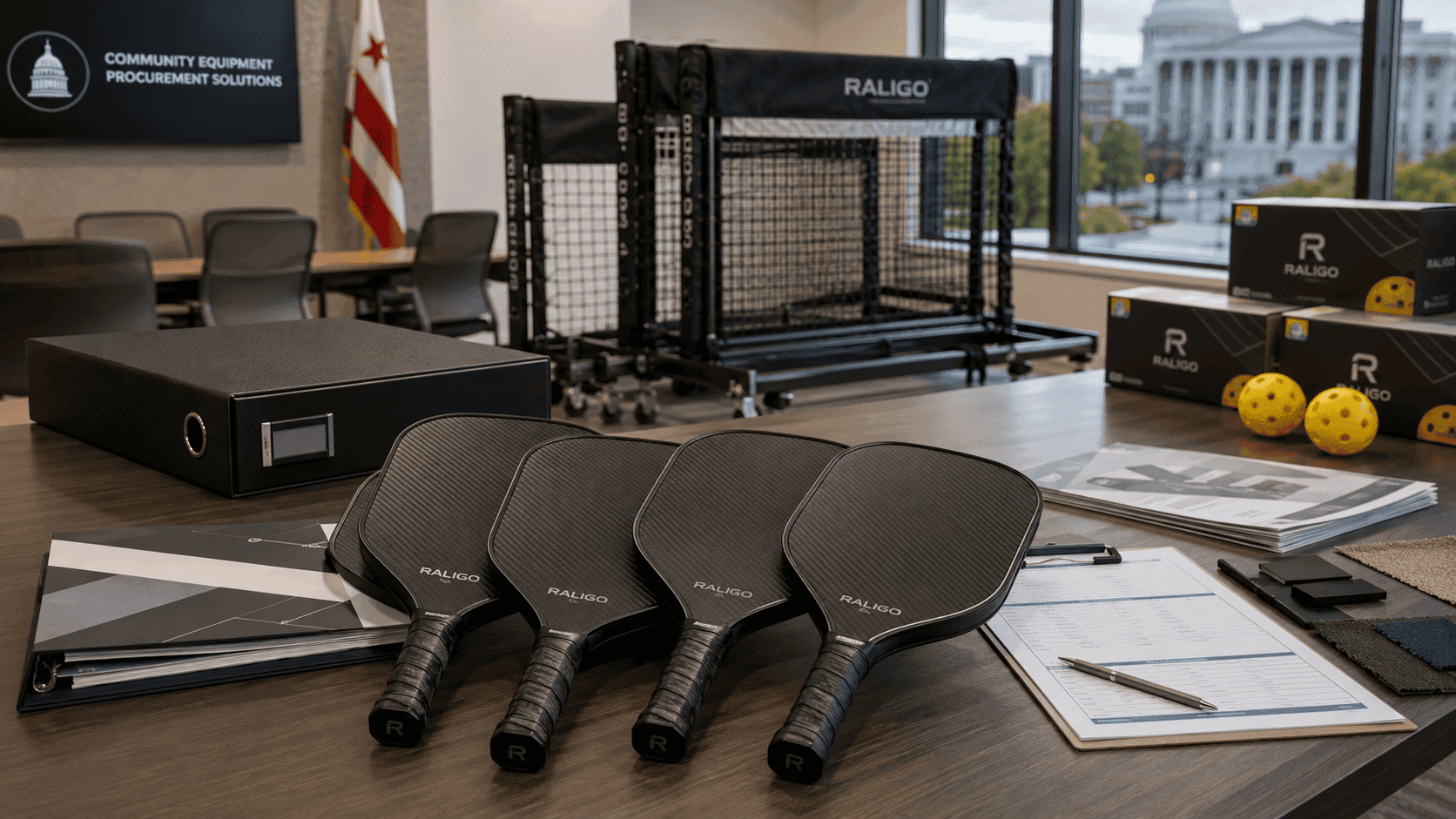
At Raligo, our OEM factory has navigated institutional procurement channels across three continents, and the DC market demands a sourcing approach that combines government contract compliance, university athletic-department procurement cycles, and climate-controlled logistics for year-round inventory management. This guide walks through exactly how to position paddle supply for DC’s institutional buyers — whether you’re a brand owner building a GSA catalog, a facility manager upgrading a community center, or an athletic director equipping a university club program with durable, USAPA-approved carbon fiber paddles.
The DC Pickleball Infrastructure Boom: By the Numbers
The numbers tell a story that most paddle suppliers are still sleeping on. DC DPR has built pickleball infrastructure at a pace unmatched by any municipal parks department of comparable size:
- 58 outdoor dedicated/multi-use courts (up from zero in 2019) — each requiring a minimum of 4-8 paddles for community equipment loaner programs
- 19 indoor facilities with pickleball programming — predominantly using portable net systems that need accompanying paddle sets
- 1,500+ program participants in FY23, growing at an estimated 35-40% year-over-year
- Garfield Park Robert M. Krughoff Pickleball Center: 5 new state-of-the-art courts, construction initiated August 2025, paving completed May 2026 — this facility alone represents an estimated 20-30 paddles for initial equipment stock
- Southeast Tennis and Learning Center (SETLC): $18 million expansion broke ground December 2024, scaling from 1 to 5 pickleball courts — each court line item carries equipment procurement budget
- RFK Campus advocacy: Washington DC Pickleball (WDCP) is actively pushing for 22+ dedicated pickleball courts on the RFK redevelopment site — a long-term procurement pipeline that forward-positioned suppliers should be tracking now
From a manufacturing and supply-chain perspective, this is not a retail play. This is a bulk-order, long-cycle institutional procurement market where the purchase decision isn’t made by an individual consumer comparing Amazon reviews — it’s made by a procurement officer cross-referencing GSA pricing schedules, CBE certification status, and durability specifications against a fiscal-year budget line item.
Government Procurement Channels: How Paddles Actually Get Purchased in DC
I’ve watched paddle suppliers walk into the DC market thinking they just need a good product and a LinkedIn connection. That approach fails here. DC’s procurement architecture is multi-layered, and each channel has its own registration requirements, pricing rules, and decision timeline. Here’s what actually matters:
| Procurement Channel | Who Uses It | Typical Order Size | Key Requirement | Decision Timeline |
|---|---|---|---|---|
| DC OCP Ariba eSourcing | DC DPR, DCPS, DGS | 20-200+ paddles | DCSS registration, CBE certification | 60-120 days |
| GSA Multiple Award Schedule (SIN 192 02) | Federal agencies, military bases | 50-500+ paddles | GSA MAS contract award, SIN 192 02 “Sporting Goods Equipment and Supplies – All Sports” | 90-180 days initial; 30-45 days for orders post-award |
| DC Supply Schedule (DCSS) | DC government agencies | 15-150 paddles | CBE certification, DCSS approved vendor list | 45-90 days |
| Direct Purchase (Micro-Purchase Threshold) | Community centers, small programs | 1-25 paddles | Under $10,000 threshold (no formal bid required) | 7-14 days |
| Government Procurement Conference (GPC) | All agency types | Varies widely | Matchmaking session registration, capability statement | Conference cycles (quarterly/annual) |
The GSA route deserves special attention for any paddle manufacturer serious about DC. SIN 192 02 — “Sporting Goods Equipment and Supplies – All Sports” — is the specific product service code under which pickleball paddles and accessories fall. Getting a GSA MAS contract is not fast (expect 6-9 months from application to award for a first-time applicant), but once you’re on it, federal procurement officers can purchase directly from your approved pricing schedule without a separate competitive bidding process. For a paddle OEM, this is the difference between one-off purchase orders and recurring quarterly institutional revenue.
At Raligo, our OEM model is built for this procurement reality: we maintain factory-direct pricing structures that fit under GSA Most Favored Customer (MFC) pricing requirements, we support CBE partnership arrangements for DCSS compliance, and our minimum order quantities (starting at 50 units for custom-branded paddles) align with the typical DC agency purchase order size. The key manufacturing lever is that we control the entire carbon fiber supply chain — from Toray T700 prepreg procurement through thermoformed unibody molding — which means we can commit to pricing stability across a 12-month GSA schedule period without the margin erosion that plagues trading-company middlemen.
University Athletic Department Procurement: GWU, Georgetown, Howard, and the Untapped Opportunity
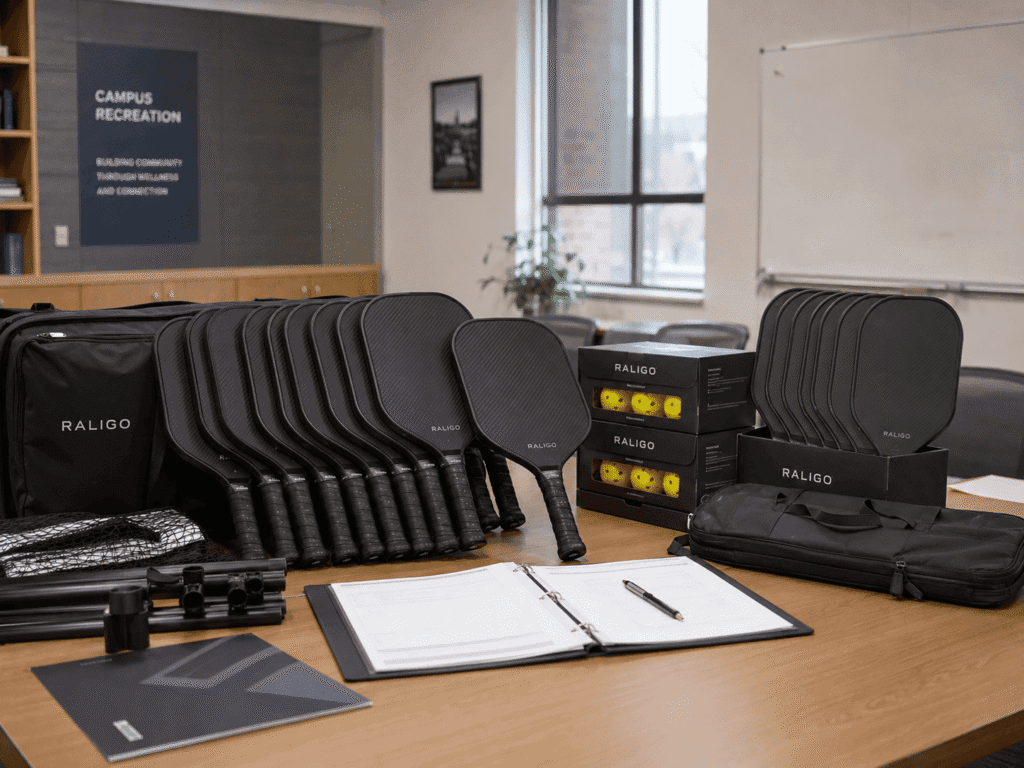
DC’s university ecosystem represents a distinct procurement channel that sits between government bulk purchasing and retail consumer sales. University recreation departments operate with dedicated equipment budgets, structured RFP processes, and — critically — a need for consistent, durable equipment that survives high-frequency use across multiple student cohorts.
Here’s the current landscape as of mid-2025, based on direct observation and procurement intelligence:
| Institution | Pickleball Program Status | Equipment Source | Procurement Opportunity |
|---|---|---|---|
| George Washington University (GWU) | Active club: Thursdays at Lerner Health and Wellness Center | Limited paddles available; “bring your own recommended” | Club needs bulk purchase of 20-30 paddles for loaner program; recurring annual replacement cycle |
| Georgetown University | Yates Field House pro shop sells paddles; intramural doubles leagues; licensed gear partnerships exist | Pro shop retail + rental sets for group programming | Licensed co-branded paddle OEM opportunity; 50-100 unit initial order for pro shop + intramural supply |
| Howard University | No formal pickleball program listed | None identified — white space opportunity | First-mover advantage: program launch equipment package (30-50 paddles, nets, balls); CBE procurement alignment |
| American University | Recreation center programming; limited dedicated equipment | General sports equipment budget | Recreation department equipment refresh cycle; 15-25 paddles annually |
The Howard University situation is particularly interesting from a procurement strategy standpoint. There is no established pickleball program — which means no incumbent supplier, no existing equipment specification, and no procurement inertia to overcome. For a paddle OEM that can offer a complete program-launch package (paddles + balls + portable nets + coaching starter kit) with CBE-compatible pricing, Howard represents a greenfield opportunity where the first supplier in establishes the specification baseline that all future reorders reference. I’ve seen this dynamic play out at university rec departments across the country: the brand that equips the launch becomes the default reorder supplier for 3-5 years.
Georgetown’s licensed gear partnerships add another dimension. University-branded pickleball paddles — with Georgetown’s colors, logo, and institutional marks — command premium pricing (typically 30-50% above equivalent unbranded paddles) and generate licensing royalty revenue for the university. From a manufacturing standpoint, this requires pad-printing or UV-printing capability for multi-color logos on a carbon fiber face, plus the production flexibility to handle 50-100 unit minimums with full customization. At Raligo, our in-house UV-printing line handles university logo applications at OEM cost, and we’ve run licensed-gear programs for institutional clients where the per-unit cost including logo application is 40-55% below what US-based decorators charge.
Community Center Facility Upgrades: Where the Procurement Budget Actually Is
The DC Parks and Recreation capital improvement pipeline is where the bulk procurement volume lives. Let me walk through three active projects and what they mean for paddle suppliers:
Garfield Park Robert M. Krughoff Pickleball Center
The $750,000 allocation for four new courts at Garfield Park is part of the broader $14.2 million “Recreation for ALL” initiative. Construction kicked off August 2025, and paving was completed May 2026 — the facility is either recently operational or nearing ribbon-cutting. Every new dedicated pickleball facility requires an initial equipment package: typically 12-24 paddles for community loaner use, 4-8 nets (if permanent posts aren’t installed), balls, and storage solutions. For paddle OEMs, this is a textbook DC OCP procurement opportunity: the equipment line item flows through DPR’s purchasing desk on Ariba, and DCSS-registered vendors with CBE certification get first look.
Southeast Tennis and Learning Center (SETLC) — $18M Expansion
The SETLC expansion broke ground in December 2024 and scales pickleball from 1 court to 5. With an $18 million total project budget, the equipment procurement allocation — even at a conservative 0.3% of total budget — represents approximately $54,000 for sports equipment across all program areas, of which pickleball paddles could reasonably claim $5,000-$8,000 at initial outfitting. That’s 100-160 paddles at wholesale OEM pricing. More importantly, SETLC serves as a high-visibility anchor facility in Ward 8 — the equipment spec chosen here will be referenced by other DC facilities during their own procurement cycles.
Turkey Thicket Recreation Center
Turkey Thicket has been highlighted by DPR as a key indoor pickleball venue — and indoor facilities have different equipment demands than outdoor courts. Indoor play generates higher utilization rates (no weather cancellations means paddles get used 250-300 days/year vs. 180-200 for outdoor), which accelerates wear on face grit, edge guards, and grip wraps. For procurement officers writing equipment spec sheets, this means the durability specification needs to include cycle-count ratings for edge-guard bonding and surface-coating abrasion resistance — not just “commercial grade” generic language. At Raligo, our institutional-spec paddles are rated for 500+ play hours before face-grit degradation exceeds USAPA friction thresholds, a number we can substantiate with third-party Taber abrasion test data — exactly the kind of documentation that procurement officers in DC demand before signing a purchase order.
DC’s Four-Season Climate: Why Temperature-Controlled Warehousing Is Non-Negotiable for Institutional Inventory
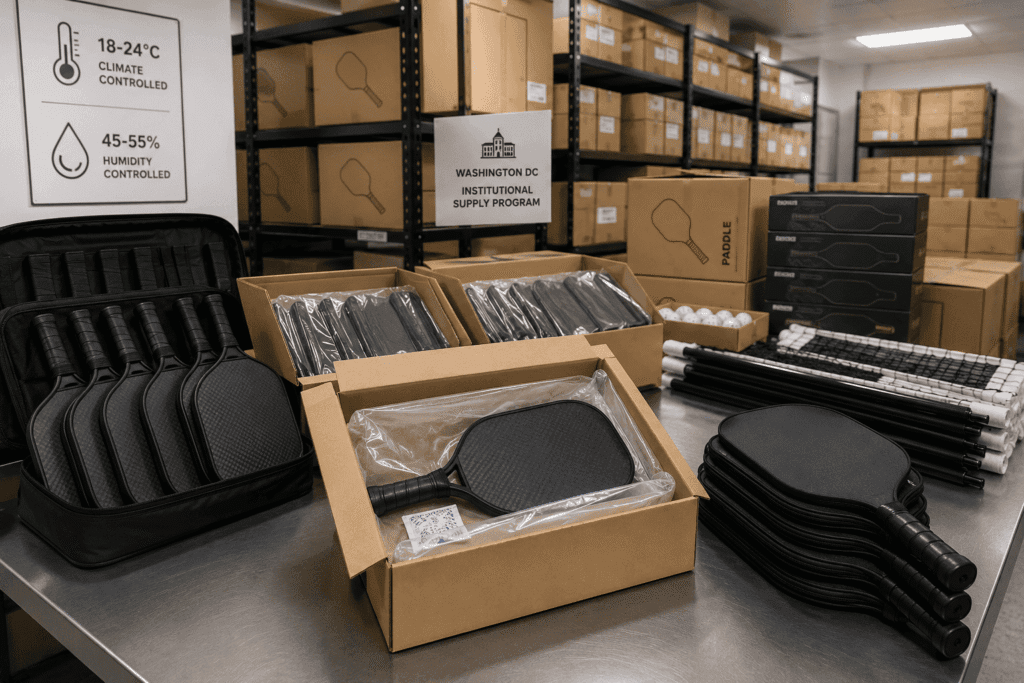
DC’s climate creates a paddle storage and logistics challenge that buyers in San Diego or Miami never have to think about. Summer highs average 84-88°F with 66% humidity in July; winter lows average 30°F, with regular dips into the teens during January cold snaps. That’s a 55-60°F seasonal temperature swing — and for polypropylene honeycomb core paddles stored in unconditioned spaces, this swing is a reliability time bomb.
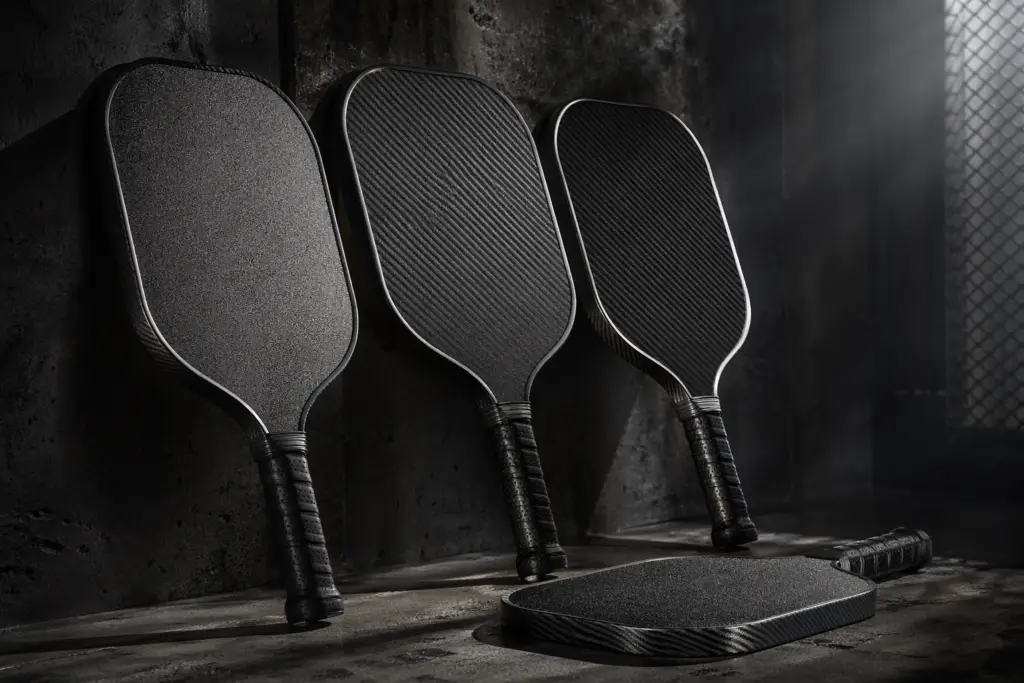
Here’s the materials-science reality I deal with on the factory floor every day: polypropylene honeycomb cores have a coefficient of thermal expansion of approximately 150 × 10⁻⁶/°C, while T700 carbon fiber faces expand at roughly 0.5 × 10⁻⁶/°C. That’s a 300x differential. When a pallet of paddles sits in an unconditioned DC warehouse through a January-February cycle — hitting 25°F overnight, warming to 50°F during the day, then dropping again — the core expands and contracts against a face sheet that barely moves. Each thermal cycle applies shear stress to the epoxy bond line. After 30-40 cycles (roughly one DC winter), micro-delamination initiates at the core-face interface.
The paddle still looks fine. The player doesn’t notice immediately. But the crisp, responsive feel that won the procurement evaluation? It’s degrading — and 3-6 months later, the warranty claims start arriving.
Ideal paddle storage conditions are 50-70°F with 30-50% relative humidity. For DC-based institutional buyers maintaining equipment inventory — whether it’s DPR’s central equipment warehouse, a university recreation department’s storage closet, or a community center’s equipment room — climate-controlled storage is not a luxury. It’s the difference between paddles that deliver a full 18-24 month institutional service life and paddles that start generating player complaints by month 8.
At Raligo, our institutional packaging specifications include desiccant inserts and vapor-barrier inner wrapping for shipments destined for DC-area inventory storage. It’s a $0.15-0.25 per-unit cost that eliminates moisture-absorption core swelling during DC’s 66%-humidity July storage conditions. For a 100-paddle institutional order, that’s a $25 insurance policy against a problem that costs 10-20x more in replacement shipping and administrative overhead. Our factory ships institutional orders with thermoformed unibody construction — a manufacturing approach that eliminates the separate edge-guard-to-face bond line (the most common failure point under thermal cycling) by molding the edge protection directly into the paddle’s structural shell during the high-temperature forming process.
Ocean Freight vs. Local Inventory: The DC Institutional Supply-Chain Calculus
Institutional buyers in DC face a supply-chain decision that retail consumers never encounter: whether to work with a supplier who drop-ships from overseas on a per-order basis, or to partner with an OEM who maintains stateside buffer inventory. The default assumption — “just order from the factory and save money” — ignores the procurement-cycle reality of government and university purchasing.
A DC agency procurement cycle typically runs 60-120 days from RFP issuance to purchase order execution. If the winning supplier then needs 4-6 weeks for manufacturing plus 4-5 weeks for ocean freight to the Port of Baltimore, the total lead time from RFP to equipment-in-hand stretches to 140-195 days — nearly six months. For a community center planning a spring pickleball program launch, that timeline kills the season.
The solution that works for institutional DC buyers: OEM-partnered warehousing with 30-60 day buffer stock. Under this model, the OEM factory produces institutional-spec paddles in batch quantities and positions inventory in a climate-controlled US warehouse (ideally within the DC-Baltimore logistics corridor). The institutional buyer places a purchase order against existing stock, and delivery happens in 7-14 days rather than 140+. The per-unit cost runs 8-12% above direct factory pricing to cover warehousing and carrying costs — but for a procurement officer whose performance is measured on program launch dates, not unit-cost optimization, that premium is easily justified.
Raligo’s institutional supply program supports both models: direct factory shipment for buyers with flexible timelines and budget-optimized procurement, and warehoused inventory for buyers who need DC-area delivery within two weeks of purchase order execution. The manufacturing throughput is the same either way — Toray T700 carbon fiber prepreg, thermoformed unibody construction, USAPA-approved core density specifications — but the logistics layer is what determines whether the paddles arrive in time for program launch.
OEM Bulk Procurement Decision Framework: What Institutional Buyers Should Evaluate
After six years of negotiating institutional paddle supply agreements, I’ve developed a decision framework that cuts through the noise. For DC government and university buyers evaluating OEM paddle suppliers, here are the five factors that actually predict procurement success — ranked by institutional impact, not marketing importance:
1. USAPA/USA Pickleball Approval Status (Gate Check)
If the paddle isn’t on the USAPA approved equipment list, the conversation ends here. Government facilities and university recreation programs cannot deploy non-approved equipment — it’s a liability and insurance compliance issue. Every paddle Raligo manufactures for institutional clients carries USAPA approval documentation, and we provide the approval certificate as a standard line item in our procurement response packages.
2. Core Density Consistency (QC Metric)
Institutional buyers aren’t purchasing one paddle — they’re purchasing a fleet where every unit needs to perform identically. Core density variation across a production batch creates the “good paddle / bad paddle” problem that destroys user trust in equipment-loaner programs. Our QC protocol maintains ±2% core density variation within institutional batches, versus the ±8-12% typical of commodity production lines. For a community center managing 50 loaner paddles, that consistency means every player who checks out equipment gets the same playing experience.
3. MOQ Alignment with Procurement Budgets
Many OEM factories quote minimum order quantities (MOQs) of 500-1,000 units — well above what a single DC agency or university department needs. Raligo’s institutional MOQ starts at 50 units for custom-branded paddles and 100 units for fully bespoke specifications (custom core density, custom face material, custom grip specifications). These MOQs align with the actual purchase-order sizes we see from DC DPR programs, university recreation departments, and community center equipment budgets.
4. Customization Capability (Branding + Specification)
Government and university buyers need more than a logo on a stock paddle. Institutional customization includes: agency/department logo application (UV printing), color-matched edge guards and grip wraps, institutional co-branding on paddle faces, and specification-level customization (core thickness selection, face material choice, grip circumference). For Georgetown’s licensed gear program, this means paddles that match university brand guidelines. For DC DPR, this means paddles with DPR’s visual identity that are instantly recognizable as facility equipment.
5. Delivery Timeline vs. Fiscal-Year Budget Cycles
DC government operates on an October 1 – September 30 fiscal year. Procurement activity peaks in Q1 (October-December) as new budgets open, and Q4 (July-September) as agencies spend remaining allocations. A paddle supplier who can guarantee delivery within a fiscal quarter — rather than “6-8 weeks after PO” — captures budget dollars that would otherwise go unspent or get allocated to a faster-moving competitor. Our institutional delivery commitment is 21 days for warehoused inventory and 45 days for factory-direct custom orders — both within a single fiscal quarter.
The DC Competitive Landscape: Who’s Already Selling to Government Buyers
Two competitors worth tracking in the DC government procurement space: Amosen Sports and ARTI Athletic have both pursued GSA-adjacent and institutional supply contracts for sporting goods, though neither has established dominant market share in pickleball specifically. The competitive gap is in specialization: these are general sporting-goods distributors who carry pickleball paddles as one category among dozens. A dedicated pickleball OEM — one who can speak to core density specifications, carbon fiber weave selection, thermoformed vs. cold-press construction trade-offs, and USAPA compliance documentation — brings a level of category expertise that generalist suppliers cannot match in procurement evaluation interviews.
From the procurement officer’s perspective, the difference is clear: a generalist supplier says “we can get you paddles.” A specialist OEM says “here are the three core-density configurations that work for DC’s indoor-outdoor split, here’s why T700 carbon fiber faces outlast fiberglass in high-frequency institutional use, here’s our Taber abrasion data on surface-coating durability, and here’s our climate-controlled packaging spec for DC warehouse storage.” When an evaluation committee scores technical capability — which typically carries 30-40% weight in a best-value procurement — the specialist wins by a margin that price alone can’t close.
Getting Started: The Institutional Procurement Pathway
If you’re a DC-based procurement officer, facility manager, or athletic director evaluating paddle supply options, here’s the practical pathway I recommend — based on having guided dozens of institutional buyers through their first OEM procurement cycle:
- Determine your procurement channel. Are you buying through DC OCP Ariba? GSA Schedule? Direct purchase under the micro-purchase threshold? The channel determines documentation requirements — and a good OEM supplier should be able to provide capability statements, pricing schedules, and compliance documentation formatted for your specific channel.
- Define your specification requirements. Indoor vs. outdoor usage split? Expected annual utilization hours? Storage conditions (climate-controlled or unconditioned)? These parameters drive the core density, face material, and edge-guard specification — and getting them wrong produces equipment that underperforms or fails prematurely.
- Request samples with specification documentation. For institutional procurement, a paddle sample without accompanying spec documentation is incomplete. Ask for core density measurements, face-material composition, USAPA approval certificate, and durability-test data.
- Run a pilot deployment. Place a 10-20 unit trial order for a single facility or program before committing to a district-wide or multi-facility rollout. Track player feedback, durability observations, and any failure events across 60-90 days of active use.
- Structure the full purchase order around fiscal-year budget cycles. Align delivery dates with program launch schedules and ensure the supplier can commit to your fiscal-quarter timeline — not theirs.
At Raligo, we provide complete institutional procurement support packages — including GSA-compatible pricing schedules, DCSS-compatible capability statements, specification documentation for evaluation committees, and pilot-program terms for first-time institutional buyers. Our factory’s carbon fiber supply chain is vertically integrated from Toray T700 prepreg procurement through thermoformed unibody production, which means we control the quality variables that matter most in institutional deployments: batch-to-batch consistency, core-density uniformity, and face-material durability under high-frequency usage conditions.
If you’re navigating a DC pickleball equipment procurement — whether for a rec center, a university program, or a government facility — the right time to engage an OEM supplier is before the RFP drops. The buyers who get the best pricing, the fastest delivery, and the most responsive customization support are the ones who’ve already established a supplier relationship and specification baseline before the formal procurement process begins.
Industry-Specific Attributes: Pickleball Paddle Manufacturing · Carbon Fiber OEM · Thermoformed Unibody · USAPA Approved · Toray T700 · Core Density Engineering · Government Procurement · Institutional Bulk Supply · Climate-Controlled Logistics · University Athletic Equipment