For a private label pickleball brand, packaging and bulk logistics are where margin is won or quietly lost — and where core density choices and Paddle Performance specs meet the realities of carton engineering. A “$3.50-per-unit factory price” can become a “$5.80 landed cost” in the space between the loading dock and your warehouse — and most of that bleed happens in carton construction, container fill rate, and freight-mode selection, not in the paddle itself. This guide walks the full chain for manufacturing professionals and B2B buyers: the packaging BOM, retail-ready versus bulk-shipping economics, mixed-SKU master carton strategy, container load math, freight selection, and the drop tests and damage-claim processes that protect the shipment.
What Is Private Label Pickleball Packaging? (The Atomic Answer)
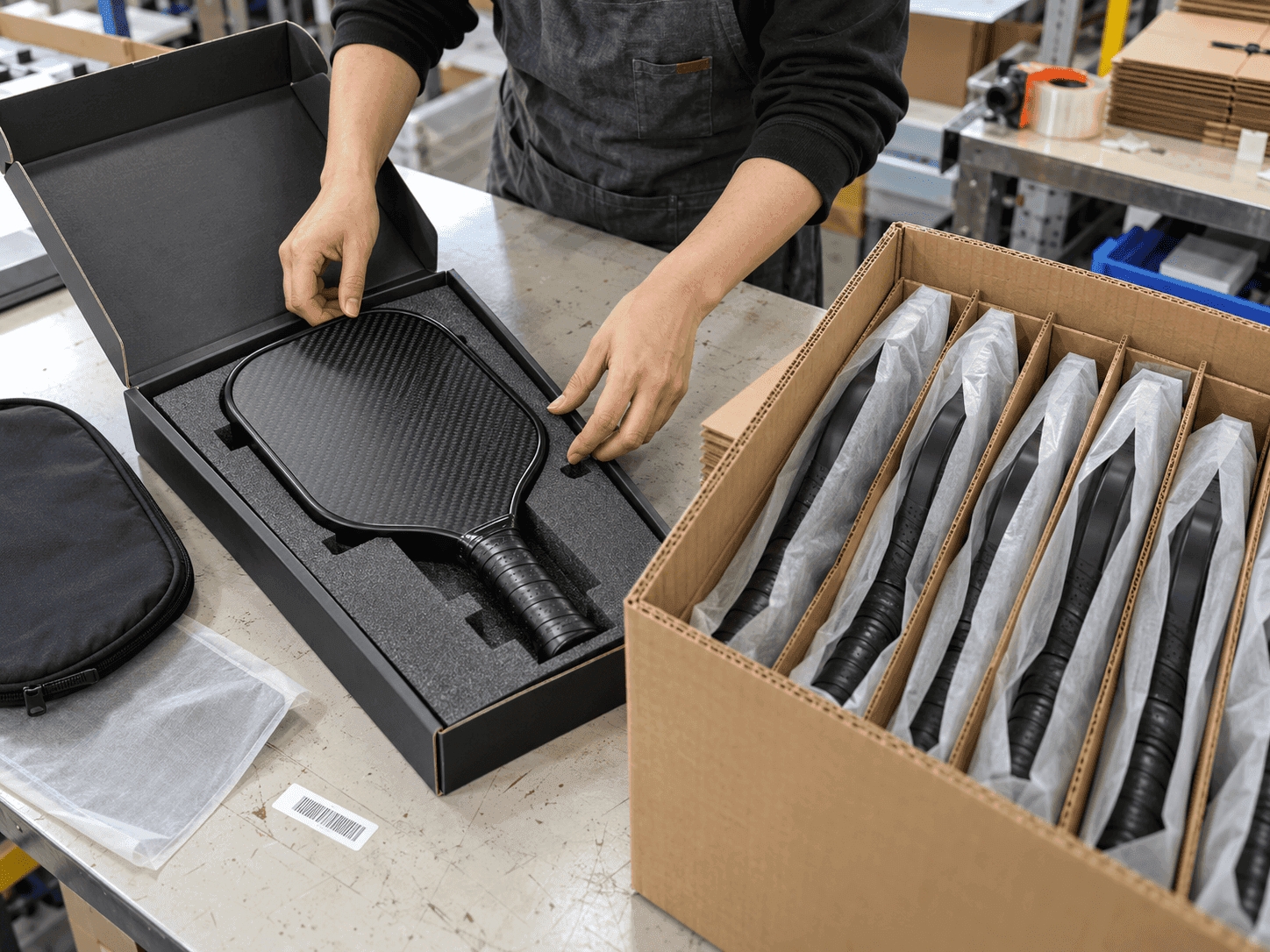
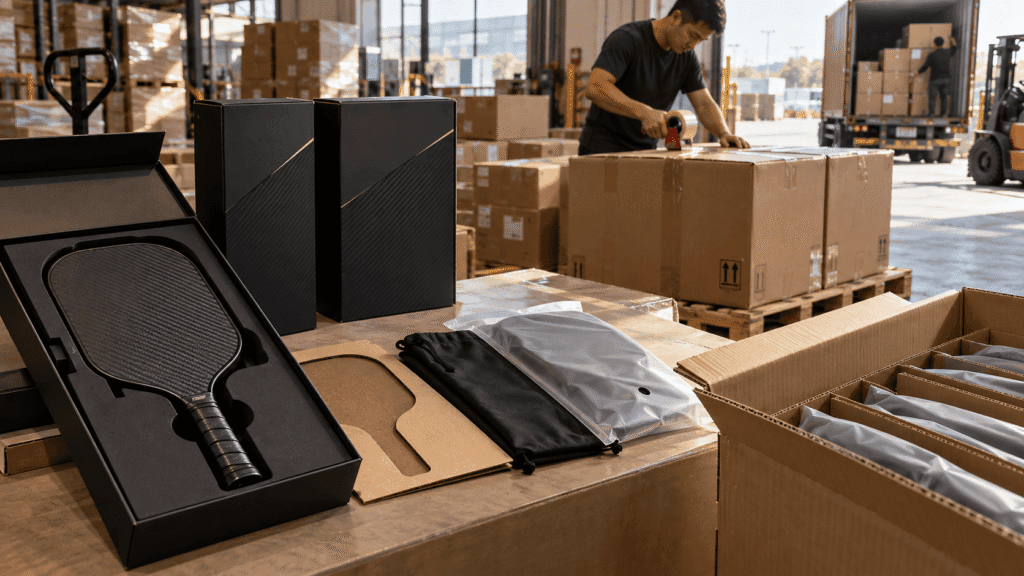
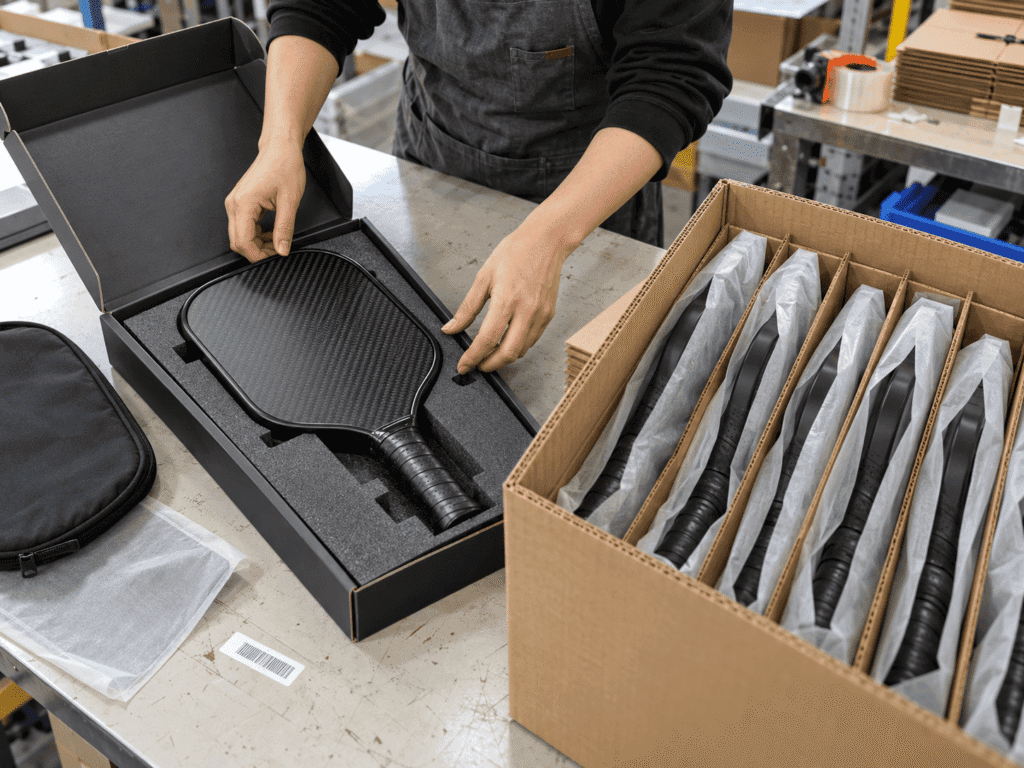
Private label pickleball packaging is the full outward-facing and protective bill of materials (BOM) that turns a bare paddle into a sellable, shippable unit. It consists of five mandatory components — a retail box or polybag, an interior insert or divider, a hang tag or pouch, a scannable barcode label (UPC/GTIN), and a compliance/legal label — plus the master carton that groups units for transit. In factory reality at Raligo, we treat packaging as two stacked problems: a *sales* problem (what convinces a shelf or an Amazon listing to convert) and a *physics* problem (what survives 6,000 miles of container vibration, humidity, and stacking). Get the first wrong and you lose the sale; get the second wrong and you lose the whole shipment.
| Packaging Component | Typical Unit Cost | Role in the BOM | Failure Mode Without It |
|---|---|---|---|
| Retail box (printed, tuck/lid) | $0.80–$6.00 | Shelf/listing sell + transit shell | Paddle ships loose, cosmetic scuffing, returns |
| Polybag (OPP/EVA, 8–10 mil) | $0.04–$0.20 | Moisture barrier, unit seal | Humidity ingress into carbon fiber face |
| Interior insert (EPE foam/brown kraft) | $0.20–$0.80 | Impact absorption in the box | Edge crush, face deformation on drop |
| Hang tag / brand pouch | $0.05–$0.25 | Brand story, care instructions | Generic look, lower perceived value |
| Barcode + compliance label | $0.05–$0.25 | UPC/GTIN scan, legal text | FBA/retailer rejection at intake |
The numbers matter because they compound. A paddle that retails at $79 with a $25 landed threshold can absorb a $1.80 packaging BOM without pain. A paddle competing at $49 with a $14 landed ceiling cannot — there, packaging must shrink to under $0.90 total or the margin disappears. This is why we treat Manufacturing and Core Density as packaging inputs, not just product specs: a dense, 16 mm core needs a firmer insert than a lightweight 14 mm face, and the carton count changes with it. It is also the single most common private label mistake we correct at intake — brands buy the packaging their *marketing brain* wants, not the packaging their *unit economics* can afford.
Retail-Ready vs. Bulk Shipping: The Cost Trade-Off Quantified
Retail-ready (RRP) packaging means each paddle arrives in its final, shelf- or listing-ready retail box — no repacking at the destination — while bulk shipping means paddles travel polybagged or in lightweight inner sleeves inside a master carton, to be packed into retail boxes at a US warehouse or 3PL. The decision is not cosmetic; it changes your container fill rate, your freight bill, and your labor cost, and the two modes frequently differ by $0.35–$0.90 per unit all-in.
| Decision Factor | Retail-Ready (RRP) | Bulk Shipping |
|---|---|---|
| Destination handling | None — pallet straight to FBA/shelf | Repack labor at 3PL ($0.20–$0.50/unit) |
| Container cube per unit | Higher (boxed volume) | Lower (polybag density) |
| Typical paddle fit per carton | 20–24 pcs | 30–50 pcs |
| Freight cost per unit | Higher | Lower |
| Damage risk in transit | Lower (box protects face) | Higher (face-to-face contact) |
| Best for | Amazon FBA, direct retail | High-volume, own-brand retail at 3PL |
Here is my blunt guidance from shipping thousands of OEM paddles: if you sell through Amazon FBA or drop into a retailer’s DC, ship retail-ready and stop debating — FBA inbound requirements and retailer intake will reject loose units, and the rejection fees swallow any freight savings. If you run your own 3PL or a US warehouse with reliable repack labor, bulk shipping wins on anything over 1,000 units because the $0.35–$0.90 freight saving per unit reliably exceeds the $0.20–$0.50 repack cost. In factory reality, the break-even is roughly 800 units for a single SKU; below that, the overhead of running a repack line erases the gain.
Mixed-SKU Master Carton Strategy for Mid-Size Brands
Mid-size private label brands rarely fill an entire container with one SKU — they carry 10, 20, or 40 paddles across models, weights, and core types. This is where mixed-SKU master cartons either save you real money or cost you a fortune in pick errors. The rule that survives contact with a real warehouse: **group by carton-compatible SKU family, never by marketing line**. A 16 mm honeycomb-core paddle and a 16 mm polymer-core paddle of the same handle length pack identically and can share a carton; a 14 mm paddle and an oversize 17 mm elongated paddle cannot, because the partial layer forces dead air into the cube.
The mechanics we run at Raligo: build a master carton around a “prime SKU” with a fixed count (say 24), then slot secondary SKUs into the remaining cells in identical orientation. Every carton carries a top-load “mixed” marker, and each unit pouch is labeled with the SKU code in a minimum 12 pt font so warehouse pickers do not have to open the box to identify contents. This one change — labeling the *pouch*, not just the carton — cut our clients’ pick-and-repack error rate to near zero. The alternative, single-SKU cartons for 40 different models, is how a brand ends up with 40 half-empty pallets and a container loaded to 78% instead of 92%.
The procurement takeaway: mixed SKU is not free complexity. It only pays when you have at least three SKUs within a shared dimensional family and you hold the count per SKU flat across the order so cartons stay uniform. If your SKU mix is genuinely heterogeneous — oversized paddles, different grip lengths, junior sizes — split the order into two or three homogeneous carton families and accept the small cube loss rather than forcing a single mixed format. Mixed-SKU cartons also interact with your per-SKU minimum order quantity, so plan the carton layout alongside the MOQ, not after it.
Container Load Math: How Many Paddles Fit, and Why It Matters
The number buyers actually need is “how many paddles fit in a 40ft container” — and the honest answer is 15,600–16,800 boxed paddles in a 40ft GP, or 19,200–20,400 in a 40ft HQ, and roughly half that in a 20ft. These figures are not fixed; they are a direct function of your carton dimensions and whether you floor-load or palletize.
| Container Type | Usable CBM | Cartons (24-pk @ 0.087 CBM) | Approx. Paddles |
|---|---|---|---|
| 20ft GP | ~28 CBM | 320–350 | 7,680–8,400 |
| 40ft GP | ~56 CBM | 650–700 | 15,600–16,800 |
| 40ft HQ | ~68 CBM | 800–850 | 19,200–20,400 |
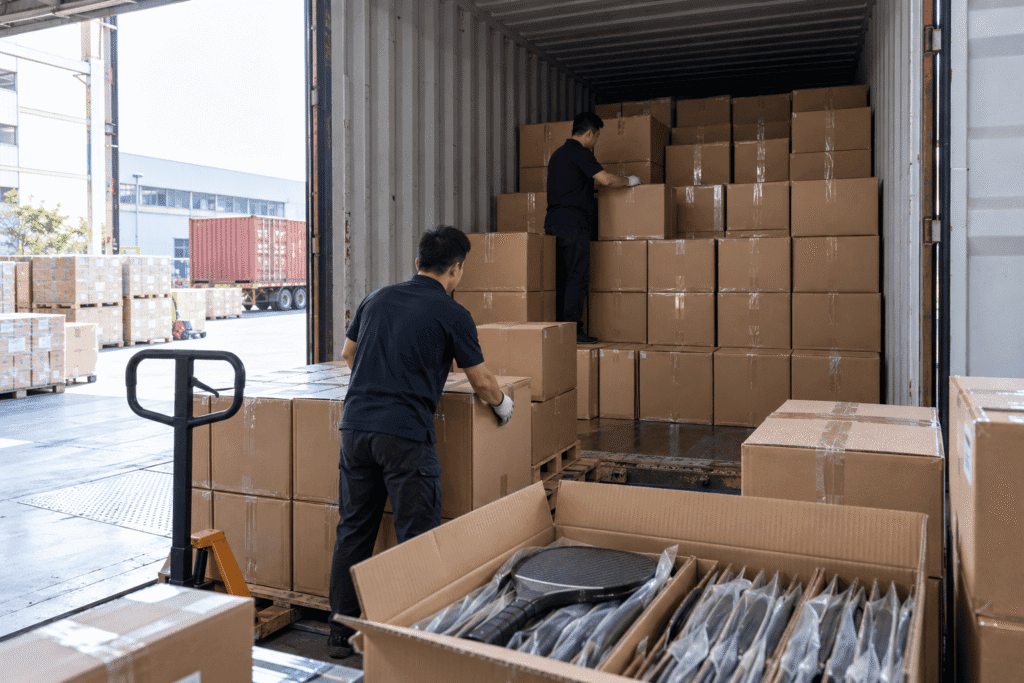
The reason the math matters is that **packaging cube is the single biggest lever on landed cost you control for free**. Cut a master carton from 52 × 42 × 40 cm (0.087 CBM) to 46 × 38 × 45 cm (0.078 CBM) and you fit roughly 11% more cartons in the same container — which lowers the freight allocation per unit by roughly the same proportion, before any negotiation. Two decisions drive this: carton height (tall, thin cartons waste vertical space) and palletizing. Palletized loading loses 15–20% of usable CBM versus floor-loading because the 48 × 40 in US pallet footprint and the 1.2–1.8 m stack height leave dead corners and head space.
My position, and what I tell every brand: floor-load whenever the destination can handle it — which means LTL/retail distribution partners who do not need pallets. For FBA, you must palletize to meet inbound requirements, so build that 15–20% cube penalty into your freight model from the start rather than discovering it on the carrier invoice. The cost of not doing this math is a container loaded at 78% fill paying 100% of the ocean freight rate.
Carton Spec, ECT, and the 15 kg Rule
The master carton is a specification, not a box. For a paddle carton we specify 5-ply K=K double-wall corrugated with an edge crush test (ECT) rating of at least 44 — roughly 7 kN — which is the floor we accept for a 20–24 paddle carton that will stack five high in a container. Flute structure (BC vs. EB) and board grade matter more than ink on the box; a weak 3-ply carton that collapses at layer three is how cartons at the bottom of a stack get crushed and how a whole pallet of carbon fiber faces gets scored.
Two hard constraints govern carton design in bulk:
– **Gross carton weight must stay under 15 kg (33 lb).** This is the FBA and warehouse-worker-safety threshold. A 24-pack of paddles with retail boxes can push 11–13 kg, which is fine, but a 50-pack polybagged carton will blow past 15 kg and force a redesign. We spec the carton count to land at 12–14 kg gross, not 14.9 kg, to leave buffer for variance.
– **Stack height tops out at 5 cartons** in ocean transit for a standard ECT-44 carton. Beyond five high, the bottom carton approaches its compression limit and you eat crush damage. If you must stack higher, step up the board grade, not the count.
The takeaway for a buyer: when a factory says “standard export carton,” that is a red flag, not a spec. Ask for the ECT rating and the gross carton weight before you sign, because those two numbers — not the price of the box — determine whether your shipment arrives intact.
Warehouse Climate and Carbon Fiber: Why Humidity Is the Silent Killer
What happens to pickleball paddles in a hot container is not hypothetical — it is the most under-reported driver of returns and warranty claims in the category. A container interior on a summer trans-Pacific route routinely hits 60–70°C, and the humid air inside is the real threat. Carbon fiber faces are dimensionally stable, but the *adhesive bond lines* between carbon fiber sheets and the polymer core are not indifferent to moisture and sustained heat. Humidity ingress through a non-sealed polybag can weaken bond integrity, soften edge-guard adhesive, and produce the micro-delamination that shows up weeks later as a customer complaint.
| Climate Control Measure | Cost per Unit | What It Prevents |
|---|---|---|
| Sealed polybag (8–10 mil, welded seal) | $0.04–$0.20 | Humidity ingress, surface scuffing |
| Silica gel desiccant sachet | $0.02–$0.08 | Residual moisture absorption inside polybag |
| Below-deck container stowage | $200–$400/container | On-deck 75°C+ heat exposure |
| Data logger (Testo 184 or equiv.) | $60–$120 one-time | Proof of environment for damage claims |
The priority order is non-negotiable in my experience: a sealed polybag plus one desiccant sachet costs under $0.30 and does 90% of the work; a data logger does none of the protection but makes you *provable*. Buy both, because the logger is what turns a denied freight claim into a paid one. And when your lane crosses the equatorial Pacific or the Gulf between June and September, pay the $200–$400 for below-deck stowage — it is trivial against the value of a 500-paddle shipment.
Freight Selection: FCL vs. LCL vs. Air — The Decision Map
Freight-mode selection is where packaging cube meets cash flow. The working thresholds we use are simple and proven: **ocean FCL for 500+ units**, **LCL for 200–1,000 units**, and **air express only when inventory is critically short**. The pivot is not “which is cheaper” — that is always ocean — but “what does a stockout cost versus what does freight save.”
Ocean FCL wins on 500+ units because you are paying for the whole 20ft or 40ft box, and your packaging cube directly determines your per-unit cost. Below ~200 units, LCL is unavoidable and its per-CBM rate is steep, which is why you should *never* LCL-ship a half-empty carton — optimize cube before you quote LCL, or you pay volumetric for air. Air express (3–7 days) and air freight (7–12 days) should be reserved for launch-critical inventory, promotional spikes, or replacing stock that a container delay stranded; at $4–$9 per kg versus ocean’s $0.10–$0.30, air erases packaging savings instantly.
The B2B reasoning layer most guides miss: **freight is a risk-transfer decision, not just a cost line**. Ocean FCL gives you a sealed unit under your control; LCL means your 10 cartons share a consolidated container with strangers’ cargo and can be co-mingled, misrouted, or delayed by someone else’s customs issue. If your delivery date is hard and your volume is mid-range, the small premium for a dedicated LCL grouping or a faster consolidator is often cheaper than the cost of a missed retail window. State your delivery-versus-cost priority to your forwarder *in writing* before quoting; it changes the routing they propose.
Drop Test, Stacking Test, and Pre-Shipment Packaging Validation
No private label paddle should leave a factory without a packaging performance test, and the standard is ISTA 1A or 2A. A drop test (a series of face, edge, and corner drops from 91 cm, or varying heights in ISTA 2A) and a compression/stacking test prove the carton and inner insert actually protect the paddle — not that they *look* protective. At Raligo we pull one carton per 100-unit batch, drop it, and open it to inspect for face scuffing, edge crush, and core deformation, and we log ECT verification against the labeled 7 kN spec with every shipment.
The specific things that a drop test catches before your customer does: the interior insert is too thin, so the paddle face bottoms out against the box floor on a corner drop; the hang tag’s metal pin scratches the carbon fiber face during vibration; or the polybag seal is weak, letting the paddle slide within the carton. These are $0.05 fixes in the factory and $8–$15 returns in the field. A brand that skips the test inherits those failures one container at a time, usually in the form of a one-star “arrived scratched” review.
The procurement action: require the ISTA 1A/2A test report *with* your production order, not as a separate marketing PDF. A factory that cannot produce a drop test on demand is a factory that has never actually verified its packaging, whatever the catalog claims.
Filing a Freight Damage Claim for Sporting Goods
How you file a freight damage claim determines whether you recover anything, and the single biggest mistake is signing for the cargo clean. The sequence that actually works: **note damage on the delivery receipt or BOL at the moment of sign-off**, photograph the damaged cartons and the container (if visible) before unpacking, keep the original cartons and packing materials, and file the carrier claim within the carrier window — typically 9 months for ocean (Hague-Visby) but far shorter for domestic LTL and last-mile carriers, often 5 business days for concealed damage.
For private label paddle shipments, the highest-leverage evidence is your climate data logger plus the packing list plus a photo showing the *carton* damage, not just the paddle. A carrier will deny a claim for a paddle “that must have been defective before shipping” if you hand them only a photo of a cracked face with no box; the same carrier will pay when the logger shows a 70°C spike and the carton shows crush creases consistent with stacking. This is why the $60 data logger is not optional — it converts your claim from “my word against the carrier’s” into a documented environmental record.
One caution specific to this category: concealed damage claims (damage you find only after unpacking at the warehouse) carry the tightest deadlines, and carriers lean on those hard. Unpack and inspect arriving paddle shipments *within the inspection window*, not “when the 3PL gets around to it,” or you forfeit the claim by default.
Compliance Labels, UPC/GTIN, and the HS Code That Clears Customs
The compliance layer of private label pickleball packaging is unglamorous and non-negotiable, because it is what gets your carton through customs and into a retailer’s system. Every paddle unit needs a scannable UPC (GTIN-12 in the US) or EAN (GTIN-13 for EU/global), and the master carton needs a carton marking with the same GTIN in ITF-14 or Code-128 format. The customs tariff classification is 9506.59 for rackets and composite paddles, or 9506.99 for sets and general sporting goods — and getting this single HS code wrong is the fastest way to a customs hold and demurrage charges you did not budget for.
The label itself varies by destination: the US needs the UPC and a country-of-origin statement; the EU adds the CE mark and a responsible-party importer line under GPSR; California and several states layer on Prop 65 warnings for any material that could contain listed substances. Do not attempt to print one universal label — a compliant US label is not necessarily a compliant EU label, and a retailer’s barcode gate will reject a GTIN it cannot read.
The practical route we steer brands toward: assign GTINs from a licensed GS1 prefix (not a resold or recycled barcode, which Amazon and retailers increasingly detect and reject), generate the artwork once per destination set, and treat the barcode verification report (ISO/IEC 15415/15416) as a required shipping document, not a nice-to-have. A $0.10 barcode label that fails to scan is a $0.00 label and a rejected inbound pallet.
Frequently Asked Questions
What box protects pickleball paddles in transit?
A 5-ply K=K double-wall corrugated carton with an ECT rating of at least 44 (≈7 kN), a fitted EPE foam insert, and a sealed polybag per paddle is the baseline that survives a drop test and five-high stacking. The carton, not the paddle, is the protective unit — a strong paddle in a weak carton still arrives damaged.
Should private label brands ship FCL or LCL?
Ship FCL at roughly 500 units or more, and LCL when a full container is not justified and your cartons are cube-optimized. The break point is driven by cube and delivery certainty more than a fixed unit count, so optimize packaging volume before choosing LCL, and reserve air for launch-critical or stockout inventory only.
Bottom Line: Packaging Is Your Cheapest Margin Lever
Private label pickleball packaging and bulk logistics are the rare lever that cuts cost and risk simultaneously. A carton redesign that recovers 11% of container cube, a sealed polybag and desiccant that prevent humidity-related warranty claims, and a drop test that catches a $0.05 insert flaw before it becomes an $8 return — these are compounding, low-dollar decisions that most brands skip because they are boring and invisible until something fails. The brands that engineer packaging as seriously as they engineer the carbon fiber face are the ones whose landed cost wins a price war and whose shipments arrive clean every time. That is the whole game, and it starts at the loading dock.