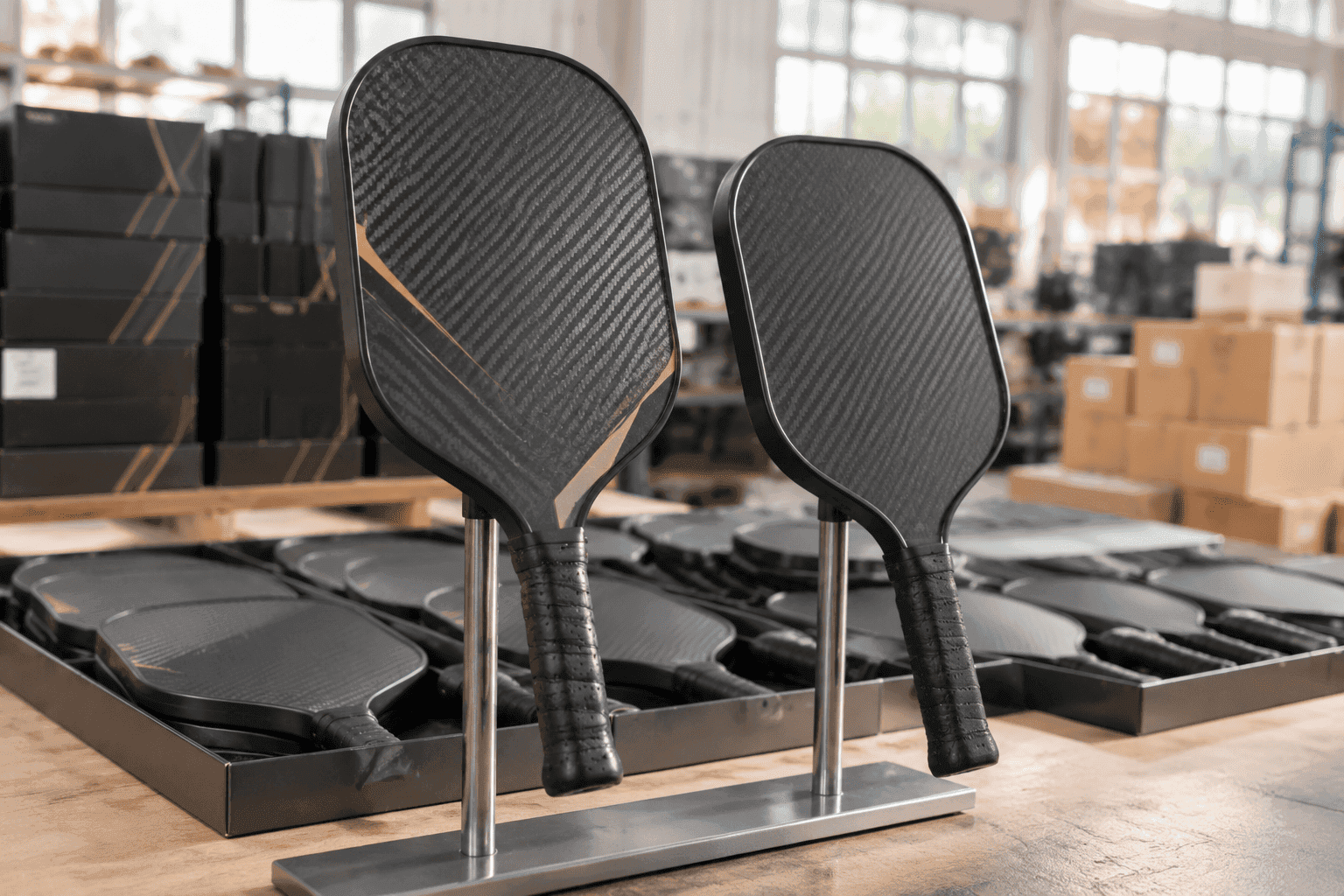
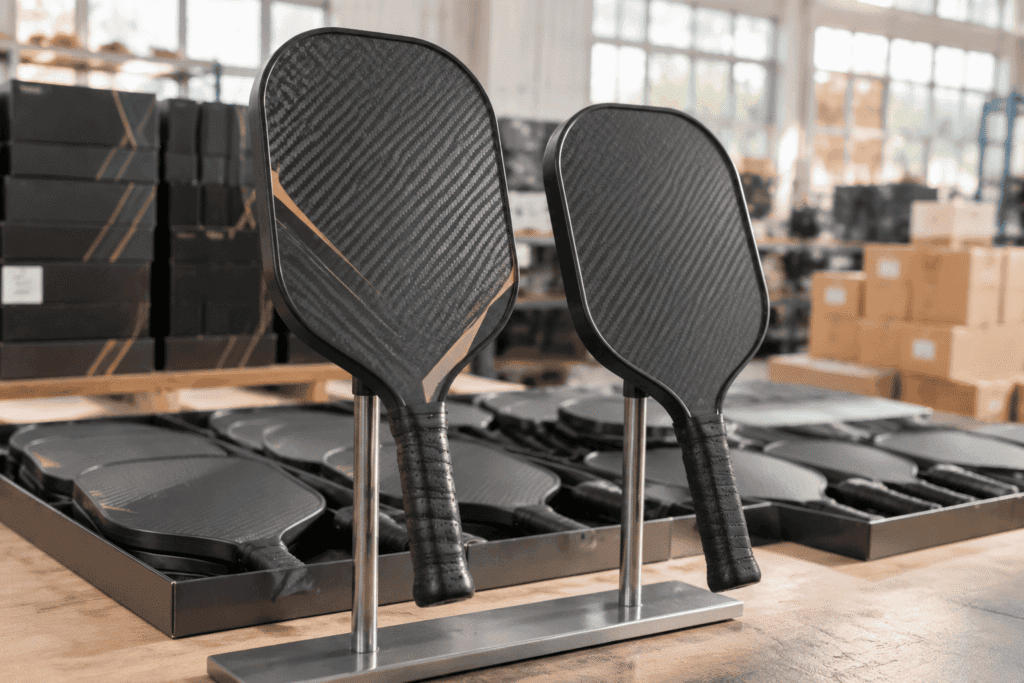
A pickleball paddle wholesale price list is not one number — it is the sum of material, process, volume, customization, and logistics costs, each with its own curve. Buyers who ask only “what’s your price?” give up the leverage to understand why one quote is 40% below another. This guide breaks the unit cost apart so you can compare quotes on equal terms.
The Real Equation Behind a Wholesale Unit Price
Wholesale unit cost = materials + process + overhead + (customization) + (packaging/logistics) − volume discount. Materials and process are the load-bearing terms; they anchor the floor. Volume, customization, and freight move the needle on top.
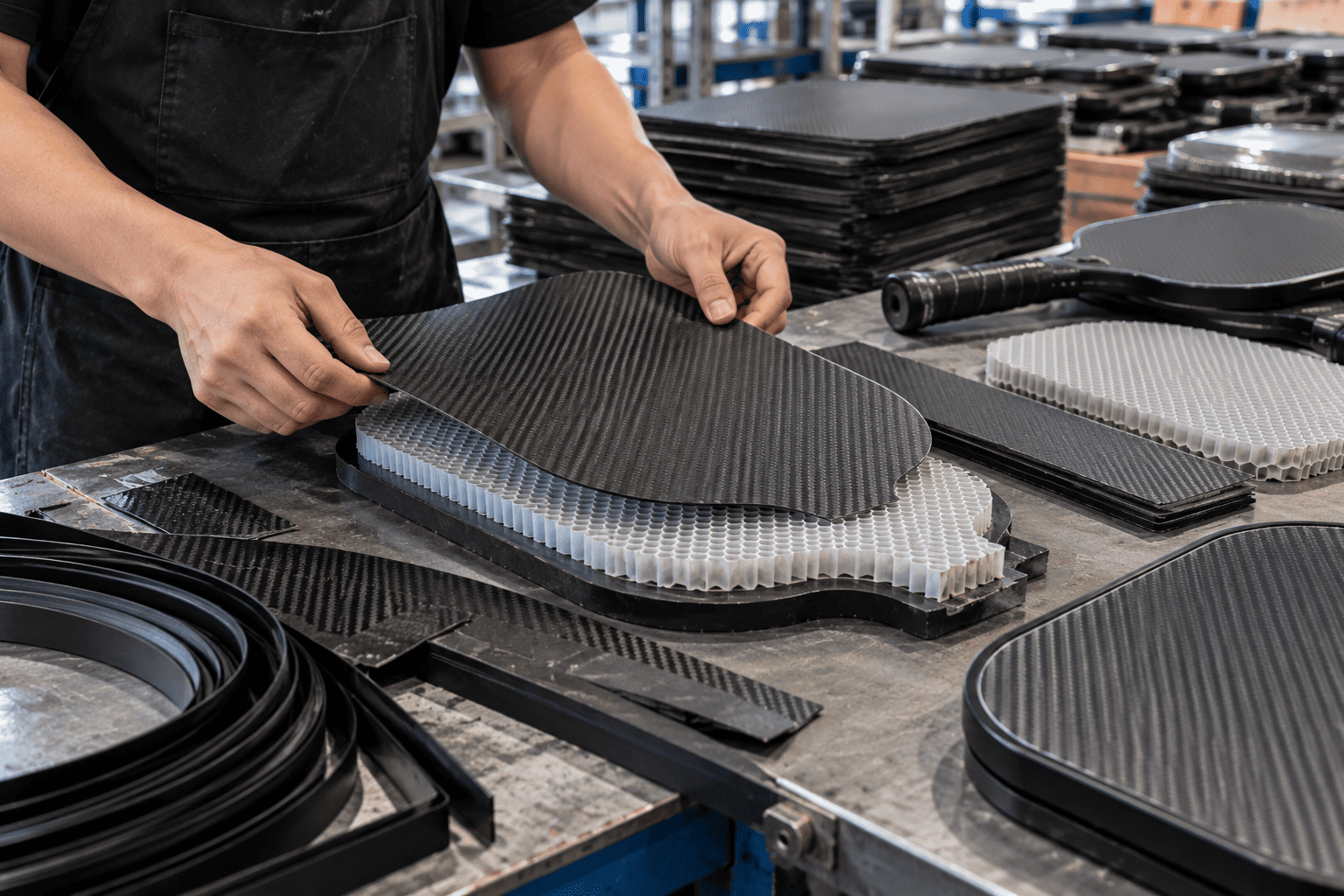
In a factory cost sheet, the paddle breaks into four physical inputs: two carbon fiber face sheets, one core, epoxy resin, and an edge guard with grip. The face sheets and the core together typically account for 55–70% of a thermoformed paddle’s bill of materials. That is where price differences between “cheap” and “premium” quotes actually live — not in marketing.
> In factory reality, a $5 and a $30 paddle can look identical in a photo and differ entirely in what is under the surface: the weave, the core density, and whether the face is raw or finished carbon.
Material Cost: Where the Bulk of the Money Sits
Materials are the single largest cost line, and the two dominant variables are the carbon fiber face and the core. If you want to know why two manufacturers quote different prices, look here first before anything else.
Carbon Fiber Face Sheets
Carbon fiber is quoted by grade and tow size. The three mainstream weaves — 3K, 12K, and 18K — differ in both cost and playing character:
| Weave | Relative Material Cost | Typical Use | Buyer Note |
|---|---|---|---|
| 3K | Highest | Premium textured faces, tighter weave | Highest cost per sheet, finer surface detail |
| 12K | Mid | Standard performance paddles | The volume-workhorse spec |
| 18K | Lowest | Budget/entry paddles | Lowest raw cost, coarser weave |
The tow size is not cosmetic. A 3K face costs more per sheet because the finer tow yields a denser, more uniform surface and a different texture profile under the same molding pressure. If a quote is suspiciously low, confirm whether the face is actually carbon fiber, or a carbon-look film laminate over fiberglass — a substitution that cuts face cost substantially while looking similar in a catalog photo.
Core: Density Is a Cost Dial
Core material — polypropylene honeycomb or polymer foam — is the second-largest lever. Core Density drives both price and paddle feel: higher-density cores add weight, stiffness, and pop but cost more per board.
– Polypropylene honeycomb is the industry default for thermoformed paddles; cell size and wall thickness determine density, typically spanning an 8mm to 16mm thickness range.
– Polymer foam cores trade some pop for a softer, quieter feel and vibration damping, at a generally higher per-unit cost.
– Density is measured (e.g., kg/m³), and a 10% density shift can move core cost by a comparable margin — while also changing Paddle Performance.
The right question to a factory is not “what core?” but “what density and cell geometry, and at what thickness?” Two paddles can share the same core material and have meaningfully different unit costs because of density and thickness.
Epoxy and Edge Guard
Epoxy resin, edge guard extrusion, and grip wrap are smaller lines individually but non-trivial in aggregate. Some factories bake the edge guard and grip into the “accessories” line so it does not appear in the face/core comparison — ask for the cost sheet broken out, not folded into one number.
Process Cost: How the Paddle Is Built
Manufacturing method is the second anchor of unit cost, and it is not a fixed constant — it is a processing-time and tooling-amortization decision.
– Thermoforming (heat + pressure molding) produces the structural, torsionally stiff paddle buyers now expect, but carries higher energy, mold, and cycle-time cost per unit.
– Cold press is cheaper per unit but delivers a different stiffness and durability envelope — a legitimate choice for budget SKUs, not a defect.
– CNC edge trimming and coating/painting add finishing steps; a textured peel-ply finish versus a spray-on grit versus a painted face are three different cost points, and each changes surface friction and spin.
– Edge guard application can be hand-wrapped or machine-applied; the labor content differs, and labor shows up as a cost when volume is low.
The takeaway: process cost does not scale down linearly at low volume. A $12 landed quote at 500 units may be $7 at 5,000 units not because materials got cheaper, but because setup, mold, and labor amortize across more units.
Order Tiers and the Unit Cost Curve
The unit cost curve is steep at low MOQ and flattens as volume rises — but it never reaches zero. Understanding where the steep part of the curve is lets you buy at the sweet spot instead of paying for volume you do not need.
A representative curve (thermoformed mid-spec paddle, illustrative):
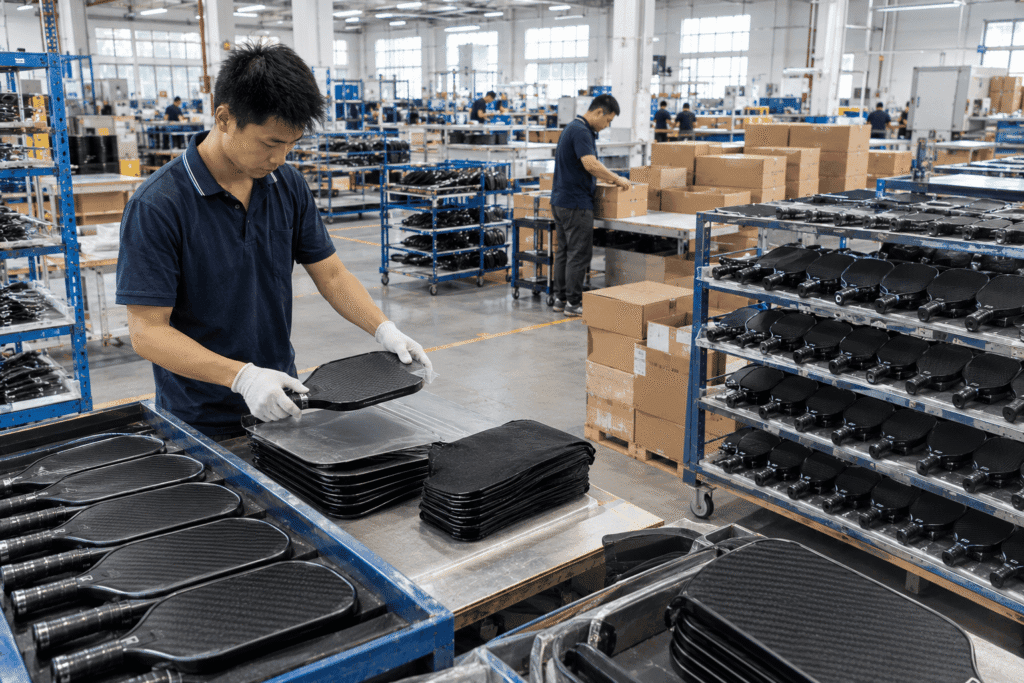
| Order Quantity | Indicative Unit Cost Trend | What Moves |
|---|---|---|
| 100–500 | Highest | Setup, mold, labor dominate |
| 1,000–3,000 | Steep drop | Amortization of fixed costs |
| 5,000–10,000 | Moderate drop | Material volume pricing kicks in |
| 20,000+ | Flattens | Approaching material floor |
The steepest cost reduction almost always sits between 300 and 3,000 units. Beyond that, incremental savings come from locking raw material contracts and line efficiency, not from moving the MOQ number.
> Buyers often conflate MOQ with price. MOQ sets the entry ticket; the unit cost curve sets what you pay per paddle once you are in. They are different negotiating levers.
Customization Add-Ons: Color, Logo, and Packaging
Every customization is an add-on cost, and the three that matter most are color, logo, and packaging — each with a setup charge and a per-unit increment.
– Color on face or edge adds a painting or pigment step; custom Pantone matching may add a one-time color-matching fee plus a per-unit coating cost.
– Logo embossing, pad printing, or UV printing carries a one-time plate/mold fee and a small per-unit printing cost. The setup fee is the price of exclusivity — it is paid once, then disappears into per-unit at volume.
– Packaging — retail box, hang tag, insert card, polybag — is priced per unit and scales with print runs; premium unboxing costs real money per paddle, so decide whether your channel (Amazon vs. wholesale vs. pro shop) justifies it.
Rule of thumb: setup fees hurt at low volume and vanish at high volume; per-unit customization persists at a flat rate. Ask for setup vs. per-unit split on every custom line, or you will undercount the landed cost of your first order.
Packaging and Logistics: The Hidden Landed Cost
A unit price is FOB — the cost loaded at the factory gate. Landed cost is what actually hits your warehouse, and it is routinely 15–30% higher than FOB. Buyers who compare only FOB figures are comparing two different things.
The gap between FOB and landed cost includes:
– Ocean or air freight — sea freight is far cheaper per unit but slower; air flips that tradeoff.
– Carton and pallet configuration — paddle dimensions and packaging density determine how many units fit a carton and a container, which sets per-unit freight.
– Duties and tariffs — a per-order constant that changes your effective unit cost and can swing with trade policy, so recheck annually.
– Inland drayage and warehousing — the “last mile” before your inventory is sellable.
Practical move: ask for a landed-cost estimate, not just FOB, and request the carton count per container so you can verify the freight math yourself.
Hidden Costs That Quietly Erode Margin
Beyond the invoice are structural costs — quality control, defect rate, and warehousing — that raise your true unit cost without appearing on any price list.
– Defect rate: a 2% vs. 5% defect rate changes how many sellable units you actually receive for the same invoice; a cheaper price at a 5% defect rate can be the more expensive paddle.
– Quality control: incoming inspection, batch sampling, and any third-party QC add labor and time, and time is working capital.
– Warehousing and carrying cost: stock you hold is capital you cannot redeploy; a slightly higher unit price with faster lead time can beat a lower price that sits in your warehouse for months.
> The cheapest per-unit price is frequently not the cheapest landed-and-sellable unit. Cost is decided by what you can actually sell at full margin, not what the invoice says.
How to Compare Wholesale Quotes on Equal Terms
Stop comparing numbers. Compare cost sheets. Demand a broken-out bill of materials and a landed-cost estimate, then normalize:
1. Confirm the face weave (3K/12K/18K) and whether it is real carbon fiber.
2. Confirm core material, density, and thickness — not just “honeycomb.”
3. Confirm the molding method and finishing steps.
4. Split every customization into setup fee vs. per-unit cost.
5. Convert every FOB quote into landed cost with the same freight assumptions.
Two quotes only become comparable when the underlying cost components line up. Once you know what drives unit cost, the wholesale price list stops being an opaque number and becomes a negotiation tool.
—
Ready to Get Started?
Talk to our OEM team about your pickleball paddle manufacturing needs. From spec development to bulk production, we handle it all at our ISO-compliant factory.