Singapore Pickleball Paddle Import Guide for B2B Buyers
Singapore has become the fastest-scaling pickleball market in Southeast Asia, and it is scaling on infrastructure, not just enthusiasm. Pickleball participation at the annual Pesta Sukan competition jumped from 424 players in 2022 to 2,106 in 2025, while ActiveSG — the national sports network — went from fewer than 20 court bookings a month when it piloted the sport in 2014 to nearly 8,000 a month through the first half of 2025, with peak-hour utilization above 90%. For a distributor, club purchasing manager, or brand owner, that is a supply opportunity that only pays off if the paddles actually clear Singapore customs cheaply and hold up on the island’s hot, humid outdoor courts.
This guide walks a B2B buyer through the practical path of importing carbon fiber pickleball paddles into Singapore from overseas factories. It covers the duty-free customs position and 9% GST, the correct HS code, certification and safety expectations for club buyers, the distribution and club channels that move volume locally, and the OEM manufacturing specs — carbon fiber face, core density, and paddle performance — that decide whether your stock clears customs and sells through.
—
1. Singapore Customs: Duty-Free Position and the 9% GST That Actually Applies
Singapore is a near-free-port economy, and pickleball paddles benefit directly from that. Sports equipment classified under HS code 9506 carries no import duty, so the only border cost a paddle importer confronts is the 9% Goods and Services Tax (GST), struck on the CIF (Cost, Insurance, Freight) value of the shipment.
Import duty in Singapore is reserved for four narrow categories — intoxicating liquors, tobacco products, motor vehicles, and petroleum products. A carbon fiber paddle is none of these, so the duty line on your customs declaration is zero. What a buyer does pay is GST on the full landed value, collected at the point of import for any shipment above the de-minimis threshold. For a bulk B2B order arriving by sea or air freight, that means GST is a direct cash-flow item to budget on the invoice, not something to negotiate away.
| Cost Element | How It Applies to a Paddle Import | Notes |
|---|---|---|
| Import duty | 0% (HS 9506, non-regulated category) | Singapore free port |
| GST | 9% on CIF value | Collected at import for bulk shipments |
| Customs broker / permit fee | Per shipment, licensed declarant | TradeNet declaration required |
| Freight + insurance | Included in CIF basis | Sea vs air changes the base |
The practical takeaway: because duty is zero, the landed-cost math in Singapore is simpler than in the EU or the US. A buyer should focus margin analysis on the CIF base — factory unit price plus freight and insurance — rather than on tariff complexity. The faster you can shorten the China-to-Singapore leg, the smaller the CIF base and the lower the absolute GST bill.
—
2. HS Code 9506: Getting the Classification Right the First Time
Pickleball paddles fall under Chapter 95 of the Harmonized System, specifically 9506 — “Articles and equipment for general physical exercise, gymnastics, athletics, other sports (including table-tennis) or outdoor games.” Within that heading, paddles sit in the 9506.xx subheadings that cover sporting rackets and similar equipment, though the exact subheading should be confirmed against the Singapore Trade Classification, Customs and Excise Duties (STCCED) schedule with your customs broker.
Getting the code right matters less for duty — which is zero either way — and more for the TradeNet import permit. Singapore Customs runs a fully electronic declaration system, and a mismatch between the description on the commercial invoice, the HS code on the permit, and the physical goods triggers a query that holds the shipment. The most common paddle-import hold is a vague description: “sports equipment” instead of “carbon fiber pickleball paddle, composite face, polymer core.”
| Field | Correct Entry | Common Mistake |
|---|---|---|
| HS code | 9506.xx (sporting article) | 4202 (bag/case) or misc. |
| Goods description | Carbon fiber pickleball paddle | “Sports equipment” / “paddle” |
| Country of origin | Actual manufacturing origin | Dropship’s origin |
| Value basis | CIF, transactional | Guessed / under-declared |
Declaring value honestly is non-negotiable in Singapore. Singapore Customs audits under-invoicing aggressively because GST is the revenue at stake, and a flagged shipment — even a duty-free one — is held, incurring warehouse charges that erase any imagined savings. List the true transactional value, provide the commercial invoice and packing list, and the permit clears in hours rather than days.
—
3. Certification and Safety Expectations for the Singapore Market
Singapore does not impose a hard pre-market certification regime on passive sports equipment the way the EU’s CE marking or the US consumer product rules do. Instead, product safety is governed under the Consumer Protection (Safety Requirements) Regulations (CPSR), which require that goods supplied in Singapore be safe, plus voluntary standards — such as EnterpriseSG and Spring Singapore guidance and relevant Singapore Standards (SS) for sporting goods — that club and institutional buyers increasingly ask for.
The signaling that actually moves a paddle in Singapore is USAPA / USA Pickleball approval. Because tournament play and club leagues reference USAPA-approved equipment lists, a distributor who can hand a buyer a USAPA-approved paddle has a trust advantage that outweighs a price premium. It is not a legal requirement, but in a market this young it functions as a de-facto quality certificate.
| Element | Singapore Requirement | Practical Action |
|---|---|---|
| General product safety | CPSR (goods must be safe) | Retain technical file + batch traceability |
| Sporting goods standards | Voluntary SS / EnterpriseSG | Align construction where possible |
| USAPA / USA Pickleball | Not mandatory, de-facto trust signal | Source approved models where margins allow |
| Material safety | Grips, coatings, adhesives | PVC-free grip, lab-tested elastomers |
The grip and coating are where a careless import defaults. Cheap phthalate-heavy PVC overgrips survive an audit nowhere customers have recourse, and a club in Singapore — where the buying unit is a membership body that asks pointed questions — will reject a paddle that smells of solvent on first unbox. Request material data sheets and, where a distributor demands it, third-party lab results before the production run. The saved unit cost is not worth a returned pallet and a burned relationship in a small, connected market.
—
4. Why Carbon Fiber Face and Core Density Decide Singapore Paddle Performance
Singapore’s courts skew outdoor and humid, and that changes the material math. A paddle that feels lively in an air-conditioned hall can turn dead and harsh when the epoxy and core react to sustained heat and moisture. Two manufacturing variables dominate: the carbon fiber face sheets and the core density.
The carbon fiber face — typically Toray-style 3K to 18K weave — governs both stiffness and the “feel” a player reports, and its quality is the single largest driver of a paddle’s perceived value at the club level. The core, meanwhile, is the unsung determinant of paddle performance: a polymer (polypropylene honeycomb) core’s density, measured in cells per inch and wall thickness, sets the sweet spot size, the pop on impact, and the vibration profile. A higher core density delivers a more controlled, predictable response that advanced players prefer; a lower density trades control for raw forgiveness that beginners favor on their first few sessions.
| Manufacturing Variable | What It Controls | B2B Implication |
|---|---|---|
| Carbon fiber face (3K–18K) | Stiffness, feel, durability | Premium positioning, higher unit cost |
| Core density (polymer honeycomb) | Sweet spot, pop, vibration | Define target skill segment |
| Edge guard + bonding | Rim protection, delamination resistance | Outdoor-humidity durability |
| Surface grit / texture | Spin, moisture grip | Wet-court performance |
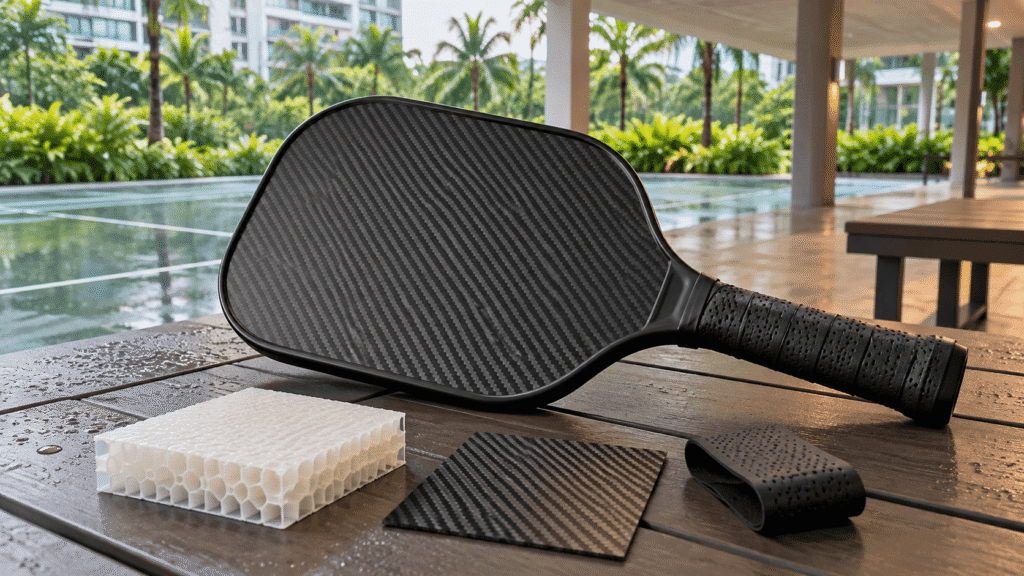
The B2B lesson is to spec the core for the segment you are buying, not to order a single “good” paddle and hope. A club purchasing manager buying 200 paddles for mixed-skill programming wants the middle of the density range — durable, forgiving, fast to reorder. A premium retailer buying for advanced players wants tighter density and a stiffer carbon face. Both should be buying from a factory that can quote core density in numbers — cells per inch, core thickness, face weave count — rather than vague adjectives like “high performance.”
—
5. Distribution and Club Channels: How Volume Actually Moves in Singapore
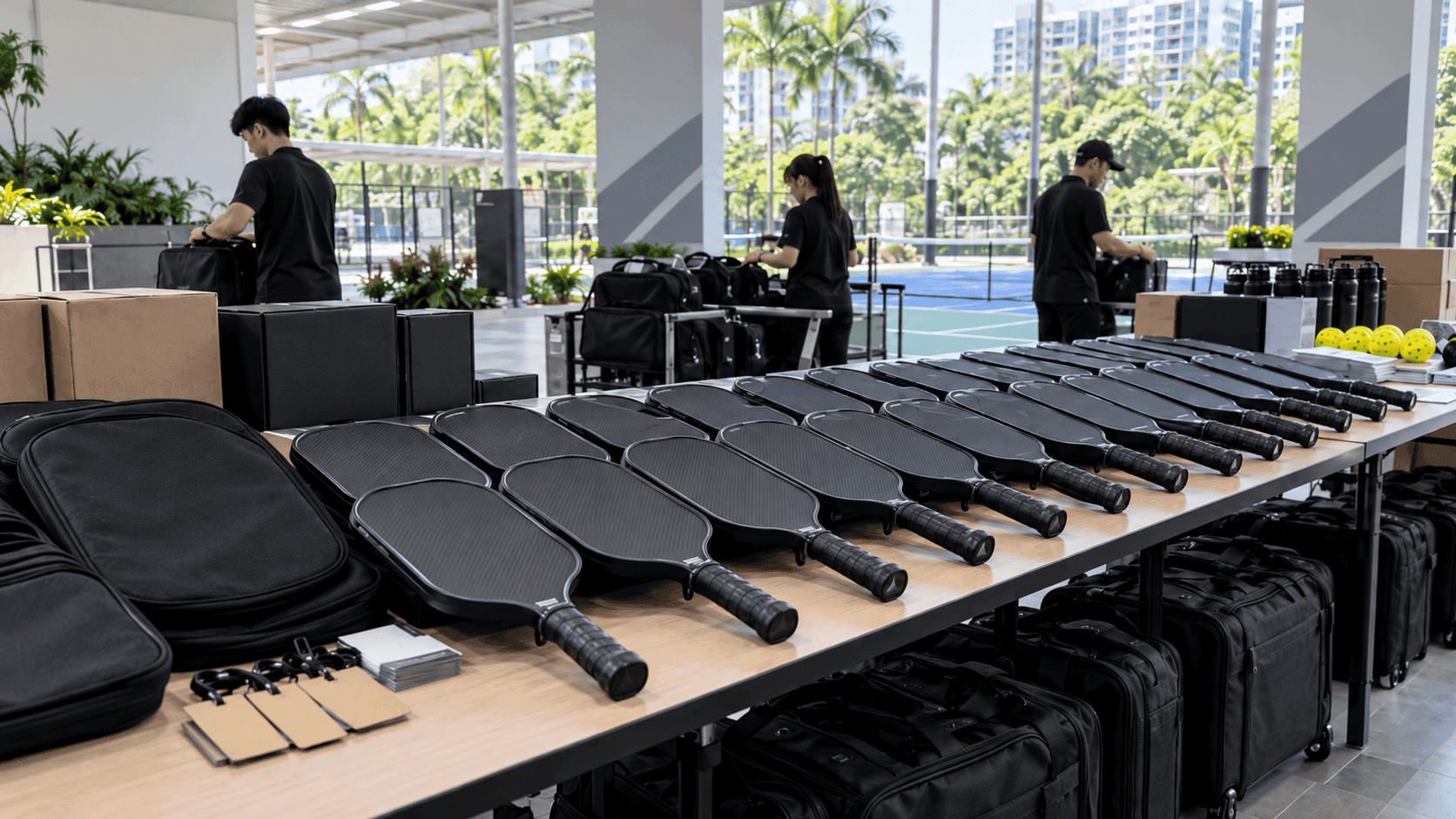
Singapore’s pickleball supply chain is short and concentrated, which is good news for a new entrant. Distribution runs through a handful of channels rather than a fragmented retail landscape, and the fastest route to 200-plus unit orders is the institutional and club segment rather than one-off retail.
The national governing body, Singapore Pickleball (formerly the Singapore Pickleball Association, established 1995), partners with Sport Singapore and the People’s Association to run community-centre interest groups and leagues. ActiveSG runs the court network — facilities at Yishun, Bedok North, Bukit Panjang and elsewhere — and the Ministry of Culture, Community and Youth announced in March 2026 that 50 new multipurpose badminton and pickleball courts would be built over five years, with a goal of placing a facility within a 10-minute walk of most homes by 2030. That infrastructure build-out is the single clearest signal of upcoming bulk-equipment procurement.
| Channel | Who Buys | Typical Order | Entry Angle |
|---|---|---|---|
| ActiveSG / community clubs | Program managers | 100–300 paddles | Bulk pricing, durability spec |
| Private clubs & academies | Coaches, operators | 50–150 paddles | Performance + branding |
| Retail (Decathlon SG, sports chains) | Buyers (HART, Gearbox, JOOLA) | Trial PO → repeat | Approved-line listing |
| Corporate / events | HR, event organizers | 50–400 paddles | Custom branding, fast lead time |
| Local distributors (MJA, Liang Seng, Amosen) | Own B2B accounts | Container-level | Wholesale margin, white-label |
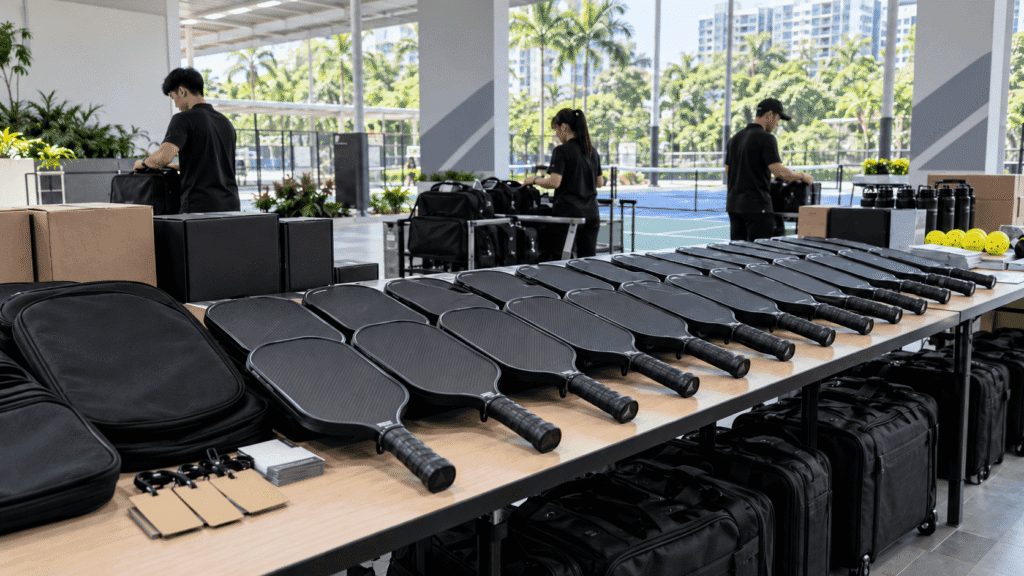
Retail is dominated by Decathlon Singapore, which stocks pickleball equipment from HART, Gearbox, and JOOLA through its stores and marketplace and holds a long-running partnership with Sport Singapore. It is a high-volume but gated channel. The accessible on-ramp for a new overseas factory or brand is the club, academy, and corporate-event segment, where a smaller minimum order, a USAPA-approved spec, and a reliable reorder lead time buy faster traction than competing head-to-head with incumbent retail brands.
—
6. Landed-Cost Math and the Singapore Hub Advantage
Because Singapore is a free port with a flat 9% GST and zero duty, the landed-cost equation is simpler to model than almost any other import market — and Singapore’s role as a regional logistics hub adds a strategic option the market rewards.
Sea freight from a Chinese factory to Singapore runs roughly 5–10 days door-to-door, and air freight clears in a day or two. Compare that to 30–40 days for sea freight to the US East Coast or Europe, and the cash-to-cash cycle a Singapore distributor enjoys is dramatically shorter, which matters when you are financing a first container against a 200-paddle club order.
| Scenario | Approximate Budget | Notes |
|---|---|---|
| 1-SKU test launch (100 paddles) | $3,000–5,000 USD | Includes landed cost + GST |
| 3-SKU club launch (300 paddles) | $9,000–14,000 USD | Carbon fiber, mid-density core |
| Retail-line launch (3 SKU × 300) | $27,000–40,000 USD | Approved models, packaging |
The regional angle is worth pricing in from day one. Singapore’s bonded-warehouse and re-export infrastructure means a distributor can land a container in Singapore, clear it duty-free, and redistribute to Malaysia, Indonesia, or the rest of ASEAN at a lower marginal cost than shipping each market from China separately. A factory that can hold stock in Singapore — or a buyer who can — turns a Singapore import guide into a Southeast Asia distribution strategy.
—
Frequently Asked Questions
Is a pickleball paddle subject to import duty in Singapore?
No. Pickleball paddles fall under HS code 9506 (sports equipment), which carries zero import duty in Singapore. The only border cost is the 9% Goods and Services Tax (GST) on the CIF value. Duty applies only to liquors, tobacco, motor vehicles, and petroleum products.
What GST applies to importing pickleball paddles into Singapore?
The standard GST rate is 9%, calculated on the CIF (Cost, Insurance, Freight) value of the shipment. For bulk B2B orders, GST is collected at the point of import through the TradeNet declaration, so it is a budgeted cash-flow item on the landed invoice.
Do pickleball paddles sold in Singapore need certification?
There is no hard pre-market certification for passive sports equipment, but goods must meet the Consumer Protection (Safety Requirements) Regulations for general safety, and club buyers increasingly expect USAPA / USA Pickleball approval as a de-facto quality benchmark. Material documentation for grips and coatings is requested by institutional and club purchasers.
Ready to Source Your Singapore Paddles?
Talk to our OEM team about carbon fiber paddle manufacturing for the Singapore and Southeast Asia market. From core density specs to USAPA-approved lines and bulk production, we handle it at our ISO-compliant factory.