When a procurement team reaches the carbon fiber step of a new pickleball paddle program, the question that matters most is almost never “which weave feels better.” It is “how do I buy raw carbon fiber sheet without overpaying, getting burned on grade, or locking myself into a supplier that can’t hold spec across a production run.” That is the question this guide answers.
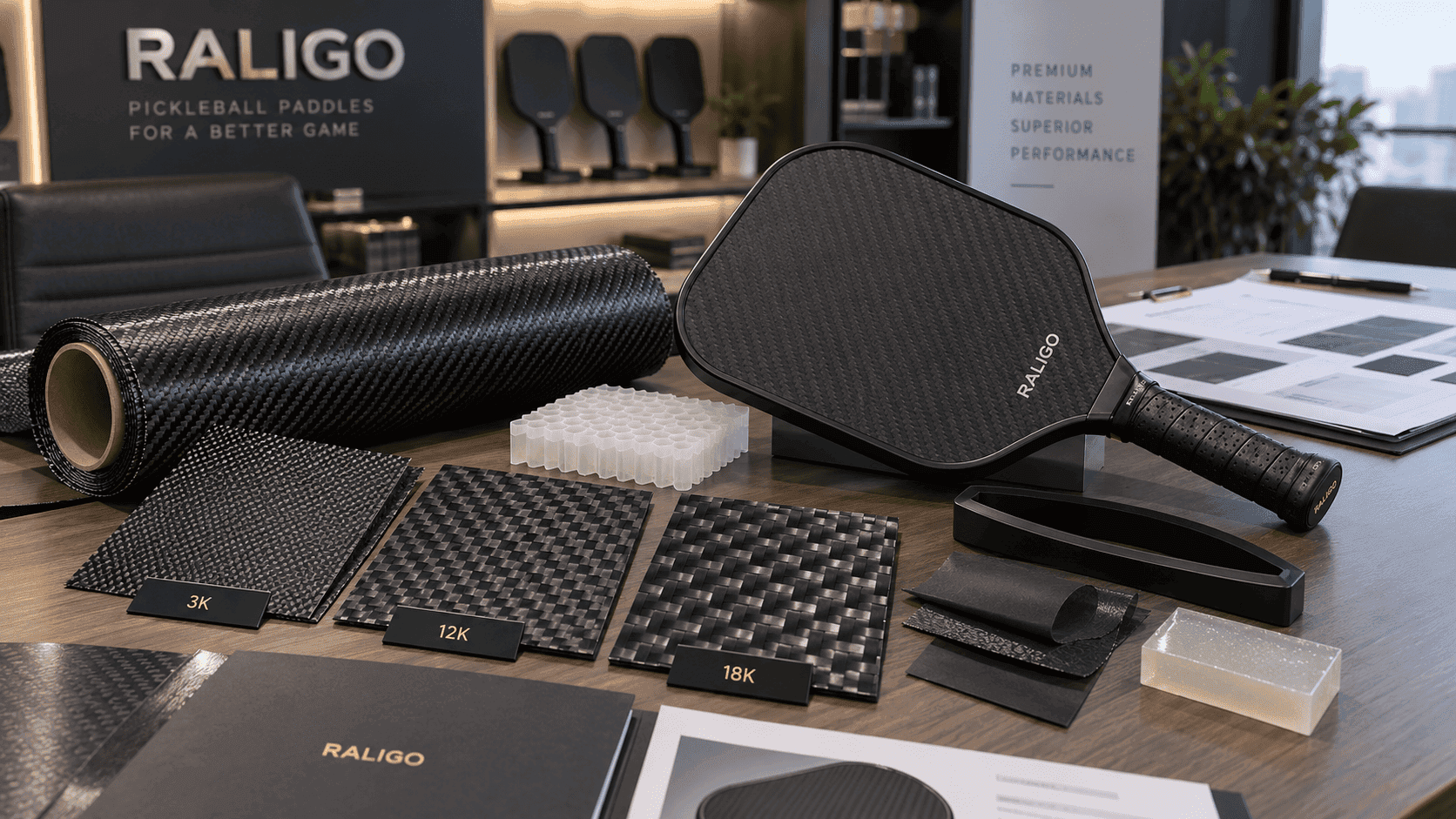
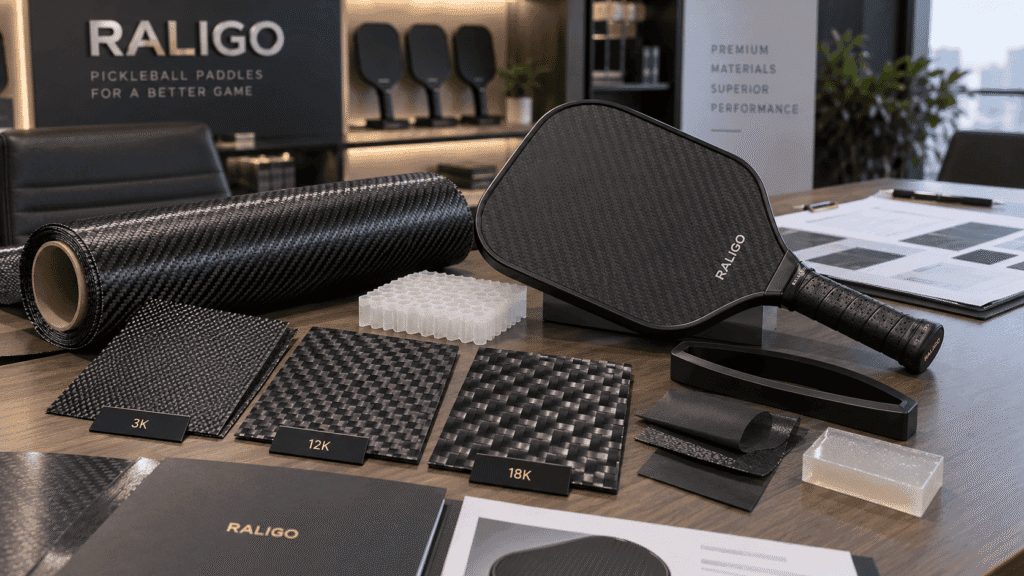
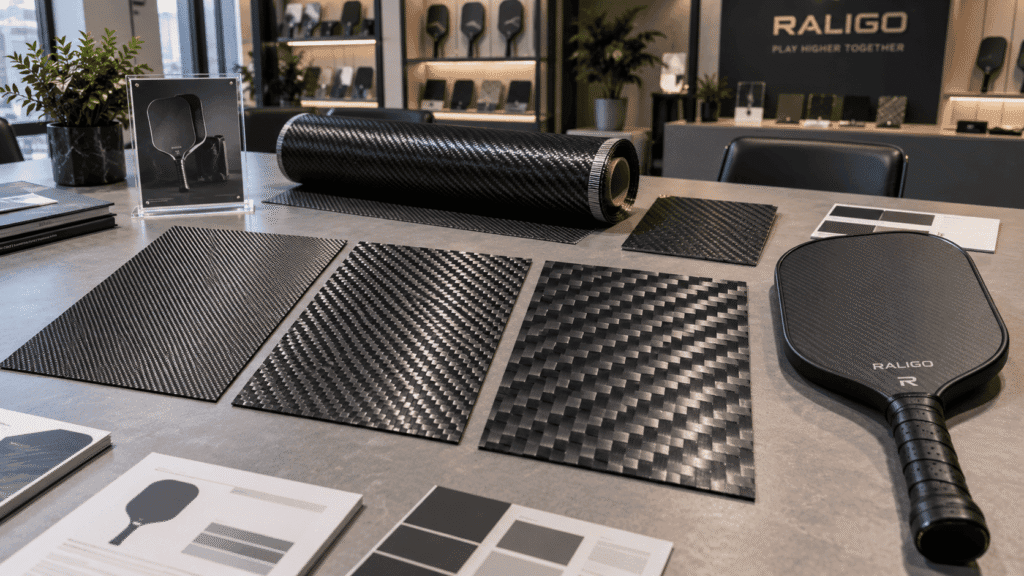
The short version: 3K, 12K, and 18K refer to how many carbon filaments bundle into each tow, and that number drives both the sheet’s price and its role in your paddle. 3K prepreg runs on the finer, more expensive end and reads as control-oriented. 12K is the volume workhorse — the cheapest per square meter and the easiest to source consistently. 18K is coarse, stiff, and increasingly used for textured faces. But the K-rating is only one line on a supplier’s spec sheet. Resin content, fiber modulus, GSM tolerance, and the supplier’s ability to hold a batch certificate matter more for your landed cost and field reliability than the logo on the weave pattern.
What Actually Determines the Cost of a Carbon Fiber Sheet?
Raw carbon fiber sheet is priced on four variables, and OEM buyers over-index on the first one.
- Tow count (K-rating). 12K is the most economical per kilogram at the raw tow stage because it is produced in the highest volume. 3K carries a premium for finer filament drawing, and 18K is occasionally discounted because fewer tows are needed for a given panel width.
- Fiber modulus. Standard-modulus fiber (roughly 230–240 GPa, the Toray T300/T700 class) is the default for paddles. Intermediate-modulus fiber (290+ GPa) costs notably more and rarely buys you anything in a paddle face where core and resin dominate feel.
- Resin content and type. A 40% resin-content prepreg versus a 30% version changes both cost and panel weight. Epoxy prepreg is the standard; out-life and storage requirements (many prepregs need cold-chain freight and a frozen warehouse) add to landed cost in ways buyers rarely budget for.
- GSM tolerance. Tighter areal-weight tolerance (±3% versus ±8%) costs more because the supplier discards more material. If your paddle is weight-certified, the tighter tolerance pays for itself in reduced rework at the layup station.
Frankly, the biggest procurement mistake we see is buyers negotiating price on a sheet spec that never mentions resin content or GSM tolerance — then wondering why batch two feels different from batch one.
Supplier Evaluation: Six Things to Check Before You Place a PO
Sourcing raw carbon fiber sheet is not like buying a commodity resin. You are buying a material that will sit inside a performance product, and the supplier’s consistency is your brand’s reputation. Here is the checklist we run a carbon sheet supplier through.
- Batch certificate (COA) discipline. Every shipment should come with a certificate of analysis listing fiber modulus, resin content, areal weight, and cure cycle. No COA, no PO — a supplier that won’t certify material is a supplier that won’t catch its own drift.
- Precursor source transparency. Ask whether the PAN precursor is from a named source. Toray, Teijin, and Mitsubishi Chemical (Grafil) are the names that give procurement managers confidence; generic PAN can be fine, but you want it declared so you can benchmark it.
- Roll-to-roll consistency. Request a capability study showing GSM and resin-content variance across a full production roll. A supplier that shows you a single sample is not showing you consistency.
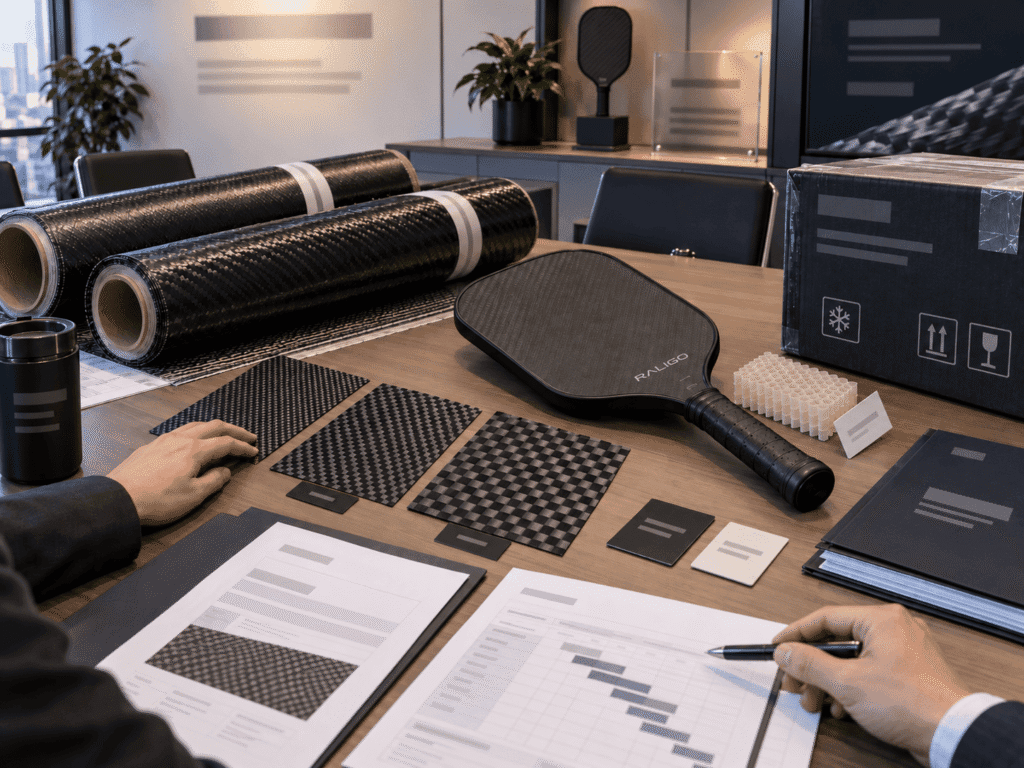
- Storage and cold-chain. Confirm the prepreg’s out-life at room temperature and whether it must be shipped frozen. A supplier that ships ambient when the datasheet says “store below -18°C” is quietly degrading your material.
- Minimum order quantity (MOQ) and lead time. Raw carbon sheet is often sold in roll quantities with 4–8 week lead times. Your paddle production schedule should plan around the sheet MOQ, not the other way around.
- Third-party truth. For a first order, send a cut sample to an independent lab for fiber modulus and resin-content verification. It costs a few hundred dollars and settles whether the COA is honest.
Grade Selection: Standard vs Intermediate Modulus, and Why It Matters for Paddles
Most pickleball paddles should be built on standard-modulus fiber. Here is the reasoning, laid out plainly.
- Standard-modulus (230–240 GPa). The right default. It is what nearly every production paddle face uses, it is widely available, and its elongation before failure gives the face enough toughness to survive edge impacts without delaminating.
- Intermediate-modulus (290–350 GPa). Stiffer per gram, and occasionally marketed as a “premium” upgrade. In a paddle face bonded to a polymer or honeycomb core, the core and resin system — not the fiber modulus — usually dominate the stiffness the player actually feels. You pay a premium for a spec that rarely translates to field performance.
- High-modulus (>350 GPa). Effectively never used in pickleball. This is aerospace and cycling territory, and the brittleness work against a paddle’s durability requirements.
The honest guidance: specify standard-modulus fiber with a well-controlled resin system and tight GSM tolerance. That combination will outperform an intermediate-modulus sheet with sloppy tolerances every time — and cost less.
Cost Structure of a Production-Grade Carbon Sheet Order
Here is a realistic cost breakdown for a mid-volume OEM pickleball program sourcing 12K standard-modulus prepreg. Figures are directional — actual quotes vary with region, precursor source, and order volume.
| Cost Component | Typical Share of Landed Cost | Notes |
|---|---|---|
| Raw carbon tow | 25–35% | PAN precursor and filament drawing |
| Prepreg processing | 20–30% | Resin impregnation, film casting |
| Quality control & COA | 5–10% | Batch testing, certificate generation |
| Cold-chain freight & storage | 10–20% | Frozen shipping, warehouse, out-life tracking |
| Supplier margin & overhead | 20–30% | Varies most widely by source |
What should stand out: freight and storage can rival the raw material itself, and they are the line items buyers most often forget to quote. A supplier quoting “ex-works” (factory gate) price is not quoting your landed cost.
Where Carbon Sheet Sourcing Fits the Paddle Manufacturing Chain
Source the sheet correctly and the downstream steps get simpler. Here is how raw sheet purchasing slots into a production pickleball paddle line.
- Layup. Sheet is cut to face-panel geometry based on tow orientation and the paddle’s target surface. Consistent GSM keeps cut weights repeatable.
- Face-to-core bonding. The sheet bonds to the core under heat and pressure — thermoforming or cold-press lamination. Resin chemistry, not weave alone, determines bond quality here.
- Core density interplay. The face sheet and the core density are specified together. A heavier face allows a lighter-density core while holding total paddle weight and Power in range. We cover core density pairing in a separate engineering guide.
- Surface finishing. Edge trimming, sealing, and any grit or texture treatment happen after cure. The sheet’s resin system must survive these finishing steps without brittleness at the edges.
This is the whole point of treating carbon sheet as a sourced material rather than an aesthetic choice: the sheet you buy constrains the core density and layup you can build around it.
How to Spec Raw Carbon Fiber Sheet for Your Program (Decision Framework)
When a paddle program comes to us, we walk it through this sourcing sequence. Copy it and you will avoid most of the traps.
- Lock the performance target first. Control, power, or spin-biased? That points you to 3K, 12K, or a textured 18K face — but the K-rating is an output, not an input.
- Choose the fiber modulus. Standard-modulus for almost every paddle. Only entertain intermediate-modulus if you have a specific structural reason and the budget to test it.
- Fix resin content and GSM tolerance. These two numbers, more than the K-rating, determine batch-to-batch consistency and landed cost. Specify them explicitly in the PO.
- Qualify the supplier on consistency, not price. A slightly more expensive supplier with COA discipline and cold-chain integrity will cost you less over a full year than a cheap supplier whose batch drift surfaces as field returns.
- Plan around the sheet MOQ and lead time. Raw carbon sheet is not a just-in-time part. Build your production and container schedule backward from the sheet lead time.
FAQ: Carbon Fiber Sheet Sourcing Questions from OEM Buyers
Is 12K carbon fiber sheet cheaper than 3K? Yes. 12K is produced in the highest volume at the tow stage, so it generally carries the lowest per-square-meter price. 3K costs more because finer filament drawing adds processing steps. 18K can be discounted where fewer tows cover a given width, but sheet-level pricing depends on the supplier’s resin and QC as much as the tow count.
How do I verify a carbon sheet supplier isn’t mislabeling grade? Request the certificate of analysis for every batch, ask for the precursor source, and — for a first order — send a cut sample to an independent lab to confirm fiber modulus and resin content against the COA. A supplier that resists any of these is one to avoid.
What GSM should a pickleball paddle face be? Face-sheet prepreg typically lands in the 200–600 GSM range depending on weave and resin content, with 3K on the low end and 18K on the high end. The specific number is set together with core density to hit your total paddle weight and swing-weight target.
Does sourcing raw carbon sheet mean I have to buy a full roll? Usually yes, at MOQ a roll or more. Some suppliers offer cut length or pre-slit panels at a markup. For a first production run, full rolls make sense; for prototyping, negotiate cut-length pricing.
Ready to Get Started?
Talk to our OEM team about sourcing carbon fiber sheet for your pickleball paddle program. From material spec and supplier qualification to core-density pairing and bulk production, we handle it end to end at our ISO-compliant factory.