| Customisation level | What changes | Typical MOQ | Defensibility |
|---|---|---|---|
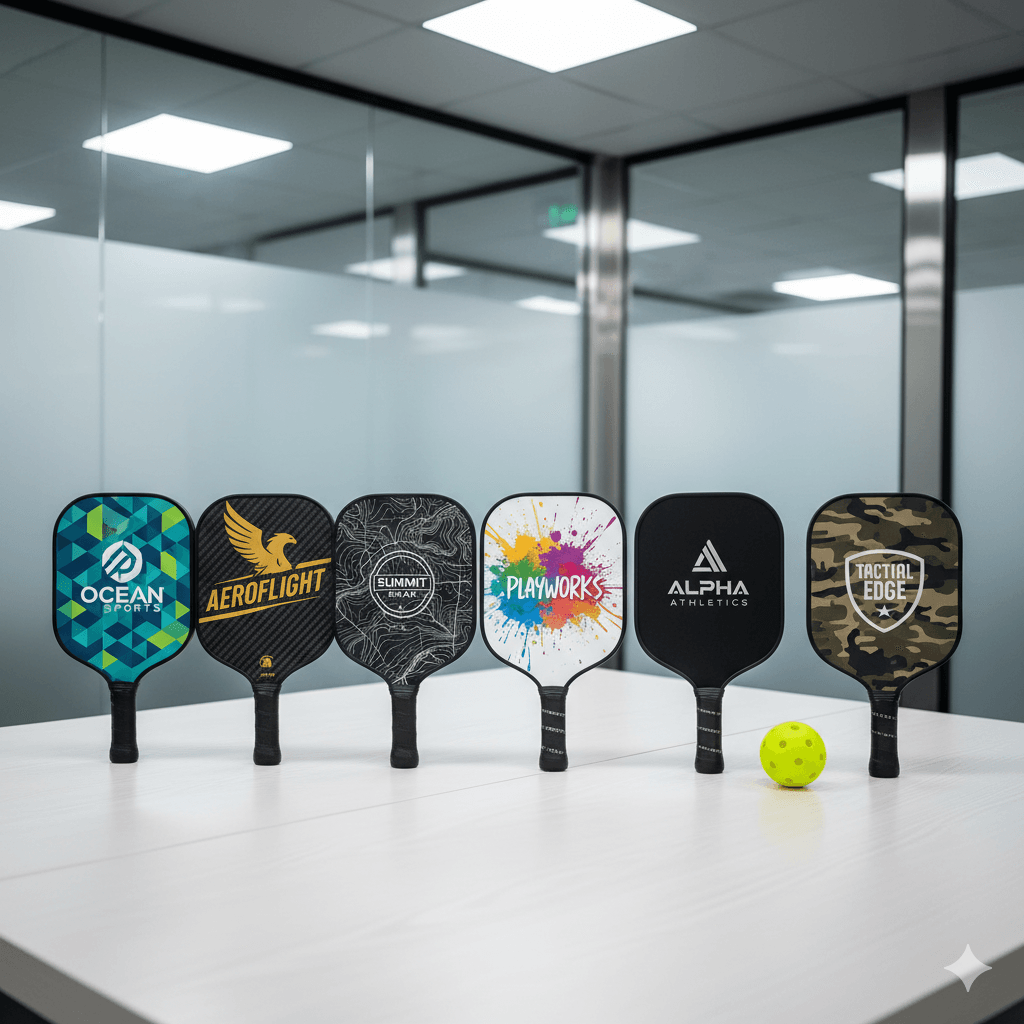
| Logo application | Branding only (pad print, laser, in-mould) | 100–300 | None — competitors can order the same mould |
| Colour and finish | Face graphics, grip colour, surface pattern | 300–500 | Low |
| Spec customisation | Core density/thickness, face material, weight, balance | 300–500 | Medium — performance differs from catalogue |
| Full OEM (new mould) | Shape, dimensions, internal architecture | 500–1,000 | High — tooling is yours |
See our comparison of pad print, laser and in-mould branding for the cost and durability trade-offs at each level.
Ask: "Who owns the mould if I fund it? Can you show me a paddle you built to a customer’s spec rather than your own catalogue?"
Warning sign: Reluctance to discuss mould ownership, or a portfolio of only in-house designs.
3. Quality Systems: Certifications Are the Floor, Not the Ceiling
ISO certificates tell you a paper system exists. They do not tell you whether the last container matched the approved sample. The evidence you want is operational:
- Cross-section cuts from the last three production batches
- Quoted internal QC failure rates at 500 / 1,000 / 3,000 simulated play hours
- An agreed pre-shipment AQL level (1.5–2.5 is typical) with photo or video evidence
- USAPA compliance testing records, plus CE/UKCA and RoHS documentation for EU-bound shipments
- Whether third-party inspection (SGS, Bureau Veritas) is permitted on your account
Our USAPA certification guide covers what the testing actually involves and how to read the documentation a factory provides.
4. MOQ, Lead Time and Capacity Reality
Low MOQ is attractive, but ask what it costs elsewhere. A factory quoting unusually low minimums may be brokering your order to a third party, which removes your control over quality and schedule. Establish whether production is in-house and what monthly capacity they can commit to during peak season.
Ask: "What is your output capacity per month, and what is the longest you have made a customer wait during peak season?" Then ask how far ahead you should place a Q4 order. A factory that cannot state its Chinese New Year cutoff is not planning your programme.
For a full breakdown of the wholesale timeline — samples, bulk production, QC, sea versus air freight — see our wholesale procurement guide.
5. Communication: The Predictor Most Buyers Ignore
Responsiveness during the enquiry stage is your best available proxy for behaviour during a production problem. Note the reply time, whether answers are specific or generic, and whether they volunteer bad news or wait to be asked.
Test them deliberately: ask one technical question that requires checking with their production team. A factory that comes back with a real answer within 24 hours is organised. One that replies instantly with something generic is guessing, and will guess again when your shipment is delayed.
6. Pricing: Evaluate Landed Cost, Not Unit Price
The cheapest quote is frequently the most expensive programme. Compare total landed cost across the full order:
- Unit price at your actual volume tier (not the headline 3,000-piece rate)
- Tooling and mould amortisation, and whether it is refundable at volume
- Sample and pre-production charges
- Freight terms (FOB vs DDP) and who clears customs
- Import duty and tax in your destination market
- Cost of inspection and rework if QC fails at destination
A supplier 8% cheaper on unit price but excluding tooling, inspection and duty is usually the more costly partner by the second order.
Evaluation Scorecard
| Area | What good looks like | Red flag |
|---|---|---|
| Specialisation | Discusses core geometry, density tiers, thermoforming effects | Only talks price |
| OEM depth | Built customer-spec products; clear mould ownership | Only in-house catalogue designs |
| Quality | Retention samples, quoted failure rates, permits 3rd-party inspection | Certificates but no operational evidence |
| MOQ / capacity | In-house production, stated monthly capacity, CNY cutoff known | Ultra-low MOQ, vague capacity |
| Communication | Specific 24-hour technical answers | Instant generic replies |
| Pricing | Full landed-cost breakdown with tiers | Single unit price, no tiers |
FAQ
How do I choose an OEM pickleball paddle manufacturer?
Evaluate six areas in order: genuine specialisation in paddle manufacturing, depth of OEM customisation (and who owns the tooling), operational quality evidence rather than certificates alone, in-house capacity and stated lead times, responsiveness to technical questions, and full landed cost rather than unit price. Request a spec-locked sample and cross-section cuts from recent production batches before committing.
What MOQ should I expect from an OEM pickleball paddle factory?
Logo-only customisation on an existing mould typically starts at 100–300 pieces. Spec customisation — your own core density, thickness or face material — usually begins at 300–500. A fully custom shape requiring a new mould starts at 500–1,000 pieces, because the tooling cost rather than the paddle drives the minimum.
What certifications should a paddle manufacturer hold?
For the US market, USAPA approval is the relevant performance certification. For EU shipments, look for CE/UKCA marking and RoHS compliance. ISO 9001 indicates a documented quality system but is not evidence that production matches your approved sample — always pair it with retention samples and an agreed AQL for pre-shipment inspection.
Should I use a trading company or a direct factory?
Trading companies offer convenience and can be useful for very small or mixed-category orders. Direct factories give you control over specifications, tooling ownership and quality gates, which matters once your volumes justify custom development. If a supplier quotes an unusually low MOQ, confirm whether production is actually in-house before assuming you are dealing with a factory.
How long does it take to develop a custom paddle?
Allow 7–15 days for sample production, 20–45 days for bulk manufacturing, 3–7 days for QC and packing, and 25–40 days by sea freight to the US or EU. A new mould adds tooling fabrication time before sampling begins. Build the Chinese New Year window into any programme that spans Q1 restocking.
Final Thoughts
Choosing a pickleball paddle manufacturer is not a sourcing formality — it is the decision that sets your unit economics, your product’s defensibility, and your reliability in front of customers. Score every candidate on the six areas above, insist on a spec-locked sample and retention cross-sections, and evaluate landed cost rather than the headline unit price.
If you are looking for an OEM partner specialising in T700 carbon fiber pickleball paddles and foam core constructions, with transparent MOQ tiers and documented QC, our factory is built for exactly that.
👉 Contact us for a quotation and sample evaluation.
Why This Decision Is Harder Than It Looks
Choosing an OEM pickleball paddle manufacturer looks like a procurement task. In practice it is a risk decision. The factory you pick determines your unit economics, your product’s defensibility, and whether your first container arrives on schedule or sits in customs while your competitors restock.
Most selection guides list generic criteria — experience, quality, communication — that every sales deck claims to satisfy. This one is different. Below are the six evaluation areas that actually separate a factory capable of supporting a brand at scale from one that can produce a good sample and little else. Each section ends with the specific question to ask, and the answer that should concern you.
1. Specialisation: Do They Actually Build Pickleball Paddles?
Many factories that quote pickleball paddles are general sporting-goods manufacturers who added paddles to their catalogue. The difference shows up in ways buyers feel six months later: whether they understand core crushing, whether they can hold a swing-weight tolerance, whether their edge guard survives a lateral impact test.
Look for demonstrated depth in the specific technical stack: raw carbon fiber prepreg handling, polypropylene honeycomb and EPP/EVA foam core lamination, thermoforming versus cold-press construction, and USAPA compliance testing. A factory that can discuss cell geometry and density tiers in detail is a specialist. One that only discusses price is not.
Ask: "Walk me through how your thermoforming process affects cell wall integrity in the honeycomb core."
Warning sign: A vague or rehearsed answer, or a pivot straight back to price.
2. OEM Capability: Customisation Depth, Not Customisation Claims
Every factory claims to offer OEM. The real question is how deep the customisation goes — and where the tooling cost sits. Print a logo on an existing mould and you have bought branding. Specify your own core density, thickness, face material and edge profile and you have bought a product.
| Customisation level | What changes | Typical MOQ | Defensibility |
|---|---|---|---|
| Logo application | Branding only (pad print, laser, in-mould) | 100–300 | None — competitors can order the same mould |
| Colour and finish | Face graphics, grip colour, surface pattern | 300–500 | Low |
| Spec customisation | Core density/thickness, face material, weight, balance | 300–500 | Medium — performance differs from catalogue |
| Full OEM (new mould) | Shape, dimensions, internal architecture | 500–1,000 | High — tooling is yours |
See our comparison of pad print, laser and in-mould branding for the cost and durability trade-offs at each level.
Ask: "Who owns the mould if I fund it? Can you show me a paddle you built to a customer’s spec rather than your own catalogue?"
Warning sign: Reluctance to discuss mould ownership, or a portfolio of only in-house designs.
3. Quality Systems: Certifications Are the Floor, Not the Ceiling
ISO certificates tell you a paper system exists. They do not tell you whether the last container matched the approved sample. The evidence you want is operational:
- Cross-section cuts from the last three production batches
- Quoted internal QC failure rates at 500 / 1,000 / 3,000 simulated play hours
- An agreed pre-shipment AQL level (1.5–2.5 is typical) with photo or video evidence
- USAPA compliance testing records, plus CE/UKCA and RoHS documentation for EU-bound shipments
- Whether third-party inspection (SGS, Bureau Veritas) is permitted on your account
Our USAPA certification guide covers what the testing actually involves and how to read the documentation a factory provides.
4. MOQ, Lead Time and Capacity Reality
Low MOQ is attractive, but ask what it costs elsewhere. A factory quoting unusually low minimums may be brokering your order to a third party, which removes your control over quality and schedule. Establish whether production is in-house and what monthly capacity they can commit to during peak season.
Ask: "What is your output capacity per month, and what is the longest you have made a customer wait during peak season?" Then ask how far ahead you should place a Q4 order. A factory that cannot state its Chinese New Year cutoff is not planning your programme.
For a full breakdown of the wholesale timeline — samples, bulk production, QC, sea versus air freight — see our wholesale procurement guide.
5. Communication: The Predictor Most Buyers Ignore
Responsiveness during the enquiry stage is your best available proxy for behaviour during a production problem. Note the reply time, whether answers are specific or generic, and whether they volunteer bad news or wait to be asked.
Test them deliberately: ask one technical question that requires checking with their production team. A factory that comes back with a real answer within 24 hours is organised. One that replies instantly with something generic is guessing, and will guess again when your shipment is delayed.
6. Pricing: Evaluate Landed Cost, Not Unit Price
The cheapest quote is frequently the most expensive programme. Compare total landed cost across the full order:
- Unit price at your actual volume tier (not the headline 3,000-piece rate)
- Tooling and mould amortisation, and whether it is refundable at volume
- Sample and pre-production charges
- Freight terms (FOB vs DDP) and who clears customs
- Import duty and tax in your destination market
- Cost of inspection and rework if QC fails at destination
A supplier 8% cheaper on unit price but excluding tooling, inspection and duty is usually the more costly partner by the second order.
Evaluation Scorecard
| Area | What good looks like | Red flag |
|---|---|---|
| Specialisation | Discusses core geometry, density tiers, thermoforming effects | Only talks price |
| OEM depth | Built customer-spec products; clear mould ownership | Only in-house catalogue designs |
| Quality | Retention samples, quoted failure rates, permits 3rd-party inspection | Certificates but no operational evidence |
| MOQ / capacity | In-house production, stated monthly capacity, CNY cutoff known | Ultra-low MOQ, vague capacity |
| Communication | Specific 24-hour technical answers | Instant generic replies |
| Pricing | Full landed-cost breakdown with tiers | Single unit price, no tiers |
FAQ
How do I choose an OEM pickleball paddle manufacturer?
Evaluate six areas in order: genuine specialisation in paddle manufacturing, depth of OEM customisation (and who owns the tooling), operational quality evidence rather than certificates alone, in-house capacity and stated lead times, responsiveness to technical questions, and full landed cost rather than unit price. Request a spec-locked sample and cross-section cuts from recent production batches before committing.
What MOQ should I expect from an OEM pickleball paddle factory?
Logo-only customisation on an existing mould typically starts at 100–300 pieces. Spec customisation — your own core density, thickness or face material — usually begins at 300–500. A fully custom shape requiring a new mould starts at 500–1,000 pieces, because the tooling cost rather than the paddle drives the minimum.
What certifications should a paddle manufacturer hold?
For the US market, USAPA approval is the relevant performance certification. For EU shipments, look for CE/UKCA marking and RoHS compliance. ISO 9001 indicates a documented quality system but is not evidence that production matches your approved sample — always pair it with retention samples and an agreed AQL for pre-shipment inspection.
Should I use a trading company or a direct factory?
Trading companies offer convenience and can be useful for very small or mixed-category orders. Direct factories give you control over specifications, tooling ownership and quality gates, which matters once your volumes justify custom development. If a supplier quotes an unusually low MOQ, confirm whether production is actually in-house before assuming you are dealing with a factory.
How long does it take to develop a custom paddle?
Allow 7–15 days for sample production, 20–45 days for bulk manufacturing, 3–7 days for QC and packing, and 25–40 days by sea freight to the US or EU. A new mould adds tooling fabrication time before sampling begins. Build the Chinese New Year window into any programme that spans Q1 restocking.
Final Thoughts
Choosing a pickleball paddle manufacturer is not a sourcing formality — it is the decision that sets your unit economics, your product’s defensibility, and your reliability in front of customers. Score every candidate on the six areas above, insist on a spec-locked sample and retention cross-sections, and evaluate landed cost rather than the headline unit price.
If you are looking for an OEM partner specialising in T700 carbon fiber pickleball paddles and foam core constructions, with transparent MOQ tiers and documented QC, our factory is built for exactly that.
👉 Contact us for a quotation and sample evaluation.