You’ve got a paddle concept. A shape, a layup schedule, a target price point. What you need now is a factory that can turn that concept into a container-load of finished paddles — without six months of back-and-forth and a 15% defect rate on the first shipment.
This is the end-to-end B2B workflow for custom pickleball paddle manufacturing, written from the factory floor. If you’re a brand owner, a procurement manager, or a product lead evaluating OEM partners, here is exactly what happens between your first CAD file and your first pallet landing at your warehouse.
Phase 1: Design & Spec Development (Week 1–2)
Atomic Answer: Design freeze is the most consequential 2-week window in the entire project. You hand us your paddle dimensions, material preferences, layup schedule, and performance targets; we build a production-grade 3D CAD model, a bill of materials (BOM), and a process routing sheet that every station on the line will follow. Miss a spec here, and you’re paying for it downstream in sampling delays.
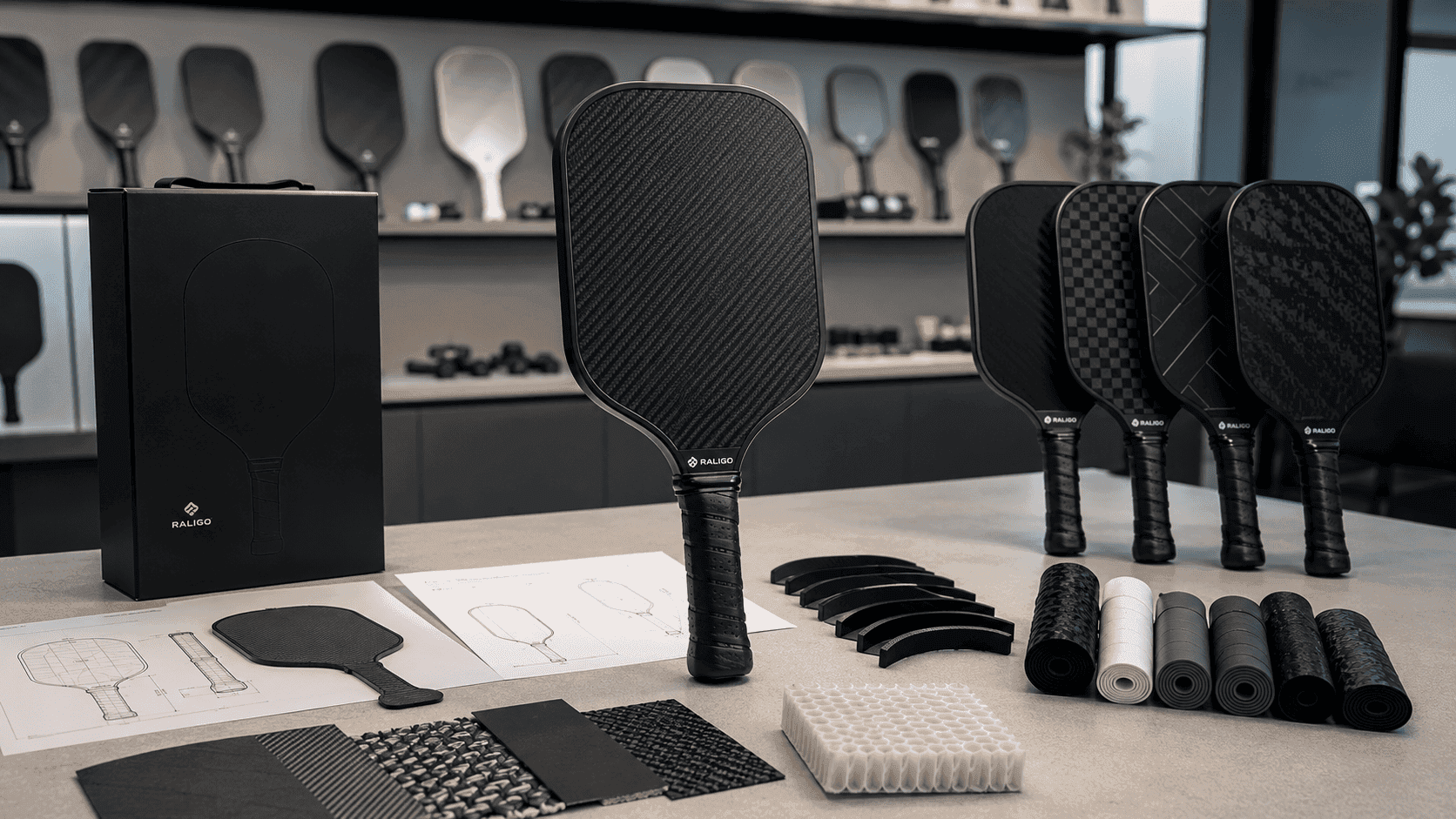
In our facility, spec development starts with five deliverable documents:
- 3D CAD File (STEP/IGES format): Overall length, width, thickness profile, edge radius, handle geometry. We model the exact mold cavity — not just the finished paddle — because draft angles and material shrinkage matter during thermoforming.
- Layup Schedule: How many plies of carbon fiber (typically Toray T700 or T300 in 3K, 12K, or 18K weave), orientation of each ply (0°/90°, ±45°), and resin content per ply. A standard thermoformed paddle uses 2–4 face plies plus edge reinforcement strips.
- Core Specification: Polypropylene honeycomb with specified cell size (6 mm to 10 mm), density (60 kg/m³ to 80 kg/m³), and thickness (14 mm or 16 mm). For Nomex honeycomb cores, we add the phenolic coating spec.
- Performance Targets: Target weight range (±3 g), balance point from handle butt (mm), surface coefficient of friction (COF ≥ 0.4 per ASTM F3506), and deflection tolerance.
- Graphics & Branding Brief: Edge guard color, face sheet print file (CMYK, 300 dpi), grip wrap spec, and packaging artwork.
A common mistake we see from first-time brands: they send a napkin sketch and expect a production sample in two weeks. The BOM and process routing alone take 3–5 engineering hours. If you can provide a completed spec sheet at kickoff, you’ll save 7–10 days on the design phase.
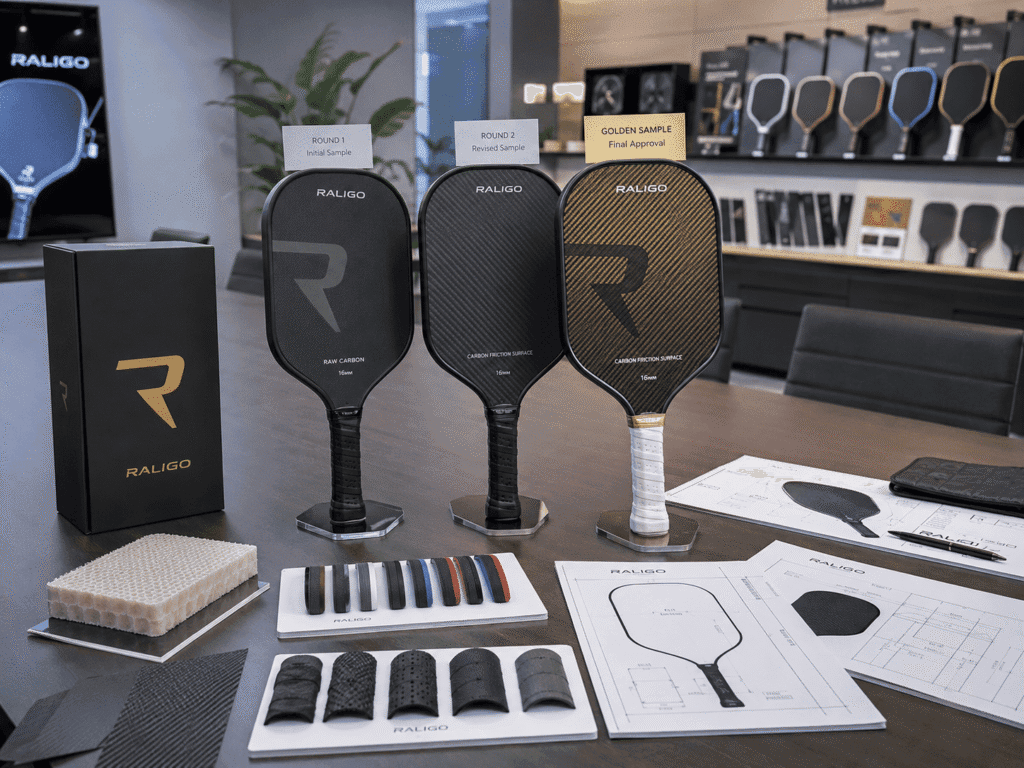
Phase 2: Prototyping & Sampling (Week 3–6)
Atomic Answer: Prototyping is where CAD meets reality. Using your frozen design, we produce the first physical samples — typically 5–10 units — through the same manufacturing method that mass production will use (thermoforming, hot press, or cold press). Each sample iteration tightens the gap between the target spec and what actually comes out of the mold.
2.1 Rapid Tooling
For brands with a unique paddle shape, we machine aluminum molds from the CAD file. A standard thermoforming mold set (upper + lower cavity) takes 10–14 days from tooling steel or 6061 aluminum. Mold cost ranges from $2,000 to $5,000 depending on complexity, amortized across your production run. If your design uses an existing mold profile, tooling is already done — you skip straight to sample layup.
2.2 Sample Production
We produce samples using the exact materials and process that will run in production. This is not a hand-built one-off — it’s a small-batch production run. The operator loads prepreg carbon fiber sheets per the layup schedule, places the PP honeycomb core, closes the mold, and runs the full heat-pressure cycle. Thermoformed samples cure at 150°C under 8–12 MPa for 15–20 minutes.
Each sample gets measured against spec: weight (±3 g), thickness (±0.3 mm), and edge bonding integrity under a 30× loupe. We ship samples to you by air (3–5 days) with a measurement report. You hit with them, you inspect them, you send feedback.
2.3 Iteration Loops
Average projects go through 2–3 sample rounds. First round catches dimensional and weight issues. Second round dials in feel — usually a core density adjustment or a layup tweak. Third round (if needed) is cosmetic: edge guard color, grip texture, print registration. Each iteration adds 7–10 days. Brands that provide detailed feedback with photos and measured data get to sign-off faster than those who send us a text message saying “it feels dead.”
Once all samples meet spec, we produce the pre-production sample (PPS) — a final golden sample that serves as the quality benchmark for the entire production batch. Both parties sign off on the PPS before any bulk production begins.
Phase 3: Testing & Validation (Week 7–8)
Atomic Answer: Before the production line fires up, the golden sample goes through a formal testing battery. Core density, flex performance, surface COF, edge guard impact, and weight distribution are all measured against both your spec and ASTM F3506 baseline requirements. Any deviation triggers a process adjustment before committing to bulk.
Here is what we test and why:
| Test | Method | Pass Criteria | Why It Matters |
|---|---|---|---|
| Core density | Cross-section cut, density meter | ±5% of target (e.g., 75 ± 3.75 kg/m³) | Controls power/feel balance; density drift = inconsistent batch |
| Flex / deflection | 3-point bend, ASTM D790 adapted | Deflection within ±10% of golden sample | Paddle stiffness affects sweet spot size and dwell time |
| Surface COF | Optical profilometer or friction sled | COF ≥ 0.4, ≤ USAPA maximum | Legal spin potential; exceeds limit = tournament disqualification |
| Edge guard impact | Drop-weight impact tester, 5 J | No delamination, no cracking after 3 drops | Edge failure is the #1 field return reason we see |
| Weight distribution | Balance point measurement | ±5 mm from target balance point | Head-heavy vs handle-heavy directly affects swing feel |
| Accelerated fatigue | Cyclic impact (5,000 hits at 15 m/s) | Weight change < 2%, no face delamination | Simulates 3–6 months of play in a lab environment |
For brands targeting USAPA certification, we run a pre-screen against USAPA deflection and surface roughness limits before you submit to an independent third-party lab like Element. Pre-screening catches about 80% of certification failures before the formal submission, which saves you the 4–6 week re-submission cycle.
Phase 4: Production Ramp (Week 9–11)
Atomic Answer: Production ramp is the factory-floor execution phase: mold preparation, prepreg cutting, layup, hot pressing, CNC routing, edge sealing, final QC. Each station on the line follows the process routing sheet locked in during Phase 1. The goal is to transition from 10-sample output to 100–200 units/day without quality drift.
The production line breaks into eight stations:
- Mold Prep (Station 1): Clean mold cavities, apply release agent, preheat to 150°C. Molds run in matched pairs — two cavities per press cycle — for throughput balance.
- Prepreg Cutting (Station 2): Automated cutting table with nesting software. Carbon fiber prepreg rolls (typically Toray T700, 200 gsm) are cut to the exact face sheet shape plus 5 mm trim allowance per the CAD layout.
- Layup (Station 3): Operator builds the sandwich: bottom face sheet → core → top face sheet → edge reinforcement strips. Each ply orientation is verified against the layup schedule. Misaligned plies produce asymmetric flex — the most common cause of a paddle that “feels different” from the golden sample.
- Hot Press (Station 4): Loaded mold enters the heated hydraulic press. Cycle: 150°C, 10 MPa, 18 minutes. Temperature and pressure curves are logged for every cycle. A ±2°C deviation triggers an alert.
- Cooling & Demolding (Station 5): Mold cools to 60°C before opening. Forced-air cooling rack reduces cycle time without causing thermal-shock delamination.
- CNC Routing (Station 6): Trim flash and cut the paddle to final shape. Tolerance: ±0.2 mm on the perimeter. The CNC program comes directly from the CAD model so the finished paddle matches the approved design exactly.
- Edge Sealing (Station 7): Edge guard installation or, for edgeless thermoformed paddles, a protective edge coating. Edge guard bonding is checked for gaps under a 10× loupe — any gap over 0.5 mm = reject.
- Final Assembly (Station 8): Grip wrap application, weight check (±3 g of target), visual inspection under 500-lux lighting, and serial-number labeling.
From experience: the first 48 hours of ramp are the highest-risk window. Operators are adjusting to a new layup sequence, press cycle, and QC rhythm. We run the first 50 units at 80% press speed and inspect 100% of them. Once pass rate hits 95%+, we accelerate to full line speed.
Phase 5: Bulk QC & Shipping (Week 11–12)
Atomic Answer: Bulk QC is not a final gate — it’s a sampling protocol that runs in parallel with production. Following ANSI/ASQ Z1.4 (AQL 2.5, Level II), we pull samples from every production shift for ASTM F3506 batch testing. Only lots that pass the sampling protocol move to packaging and shipping.
5.1 Batch Sampling Protocol
For a 1,000-unit production run at AQL 2.5 Level II, we pull 80 units for inspection. The inspection covers: weight, thickness, balance point, surface COF (on 5 units), edge guard bonding, print quality, and grip wrap tightness. Acceptance: ≤7 defects for the lot to pass. If we hit the rejection threshold, the entire lot gets 100% re-inspection before any units ship.
5.2 Packaging & Logistics
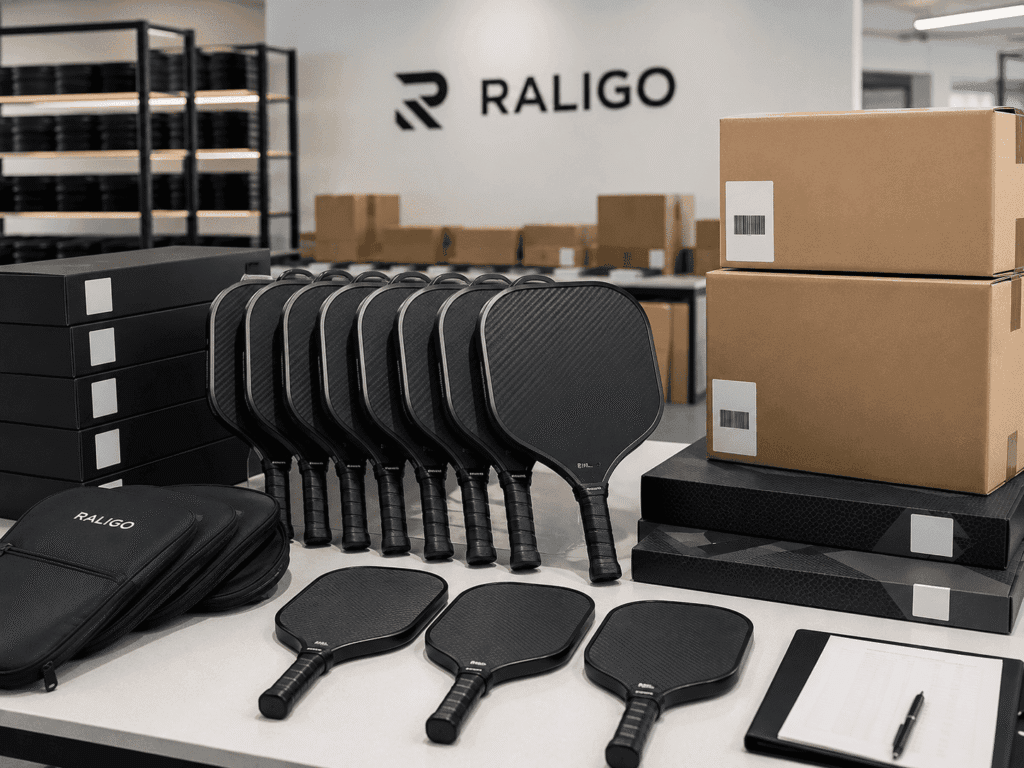
Your packaging spec should be finalized during Phase 1. We need the retail box artwork, any interior foam inserts, hang tag specs, and barcode placement. Paddles are individually poly-bagged, placed in retail boxes, and packed into master cartons (typically 25–50 units per carton).
Shipping options break down by urgency and budget:
| Method | Transit Time | Cost (500 Units, US West Coast) | Best For |
|---|---|---|---|
| Air freight | 3–5 days | $8–$12/unit | Launch inventory, trade show samples |
| Sea freight (LCL) | 18–25 days | $2–$4/unit | Small replenishment orders (< 200 units) |
| Sea freight (FCL, 20 ft) | 18–25 days | $1.50–$2.50/unit | Full production runs (1,000+ units) |
| Rail + truck (to EU) | 18–22 days | $3–$5/unit | European distribution hubs |
Timeline & Cost Summary
Here is the end-to-end timeline for a standard custom paddle project, assuming an existing mold profile (no new tooling) and thermoformed construction:
| Phase | Duration | Key Deliverable | Estimated Cost |
|---|---|---|---|
| Design & Spec | 2 weeks | CAD, BOM, process routing | $500–$1,500 (engineering hours) |
| Sampling (2–3 rounds) | 3–4 weeks | Golden sample + PPS sign-off | $800–$2,000 (materials + labor + air shipping) |
| Testing & Validation | 1–2 weeks | Test report, USAPA pre-screen | $300–$800 (lab time + equipment) |
| Production Ramp | 2–3 weeks | First 200 units at 95%+ pass rate | Rolled into unit cost |
| Bulk QC & Shipping | 1 week (QC) + transit | Batch test report, B/L | $500–$1,000 (inspection + packaging prep) |
| Total (from kickoff to ship) | 8–11 weeks + transit | — | $2,100–$5,300 pre-unit costs |
If your project requires new mold tooling (proprietary shape), add $2,000–$5,000 and 2–4 weeks to the timeline. The tooling cost is amortized across your production run, so at 1,000 units it adds only $2–$5 per paddle.
Per-unit FOB pricing for a standard thermoformed paddle with T700 carbon face and PP honeycomb core typically runs $10–$18 depending on volume, layup complexity, and finishing requirements. Cold-press paddles with fiberglass faces start around $6–$9 FOB.
Frequently Asked Questions
How long does it take to manufacture a custom pickleball paddle from design to shipping?
A standard project moves from design freeze to first bulk shipment in 8–11 weeks, broken into design (2 weeks), sampling (3–4 weeks), testing (1–2 weeks), and production ramp (2–3 weeks). Add 2–4 weeks if you need new mold tooling. Established designs on repeat orders ship in 3–4 weeks from PO confirmation.
What is the minimum order quantity for custom pickleball paddles?
Full-custom paddles with proprietary molds: 300–500 units. Semi-custom (your graphics on existing mold): 100 units. Thermoformed paddles: 100 units minimum. Cold-press paddles: typically 300 units due to line setup economics. We can run 50-unit validation batches for market testing before committing to full MOQ.
What testing standards apply to pickleball paddle production?
Every batch in our facility undergoes ASTM F3506 testing for dimensional compliance, surface COF, and deflection. Core density is verified via cross-section sampling at 2% of each batch. For USAPA certification, we run a pre-screen against USAPA deflection and roughness limits before you submit to a third-party lab.
What is the difference between thermoforming, hot press, and cold press manufacturing?
Thermoforming fuses prepreg carbon fiber and core into a unibody structure under heat (150°C) and pressure (10 MPa) — strongest bond, largest sweet spot, highest per-unit cost. Hot pressing bonds pre-made face sheets to the core with heat and pressure — durable, mid-range cost. Cold pressing uses structural adhesive at room temperature — softest feel, lowest per-unit cost. Your choice depends on your target price point and performance profile.
How do I choose between T700 and T300 carbon fiber for my paddle?
T700 offers roughly 40% higher tensile strength than T300 (4,900 MPa vs 3,530 MPa), which translates to a stiffer face with better energy return. For power-oriented paddles, T700 is the standard. T300 is slightly more compliant and costs about 15–20% less — good for control-oriented designs or entry-level price points. Both are available in 3K, 12K, and 18K weaves, with finer weaves (12K, 18K) providing larger sweet spots at similar stiffness levels.
Ready to Bring Your Paddle Design to Life?
Our engineering team at Raligo Sport handles the full pipeline — from CAD and material selection to production ramp and batch QC. We run thermoformed, hot-press, and cold-press lines with Toray carbon fiber and PP/Nomex honeycomb cores, and we ship to brands across North America, Europe, and Australia.