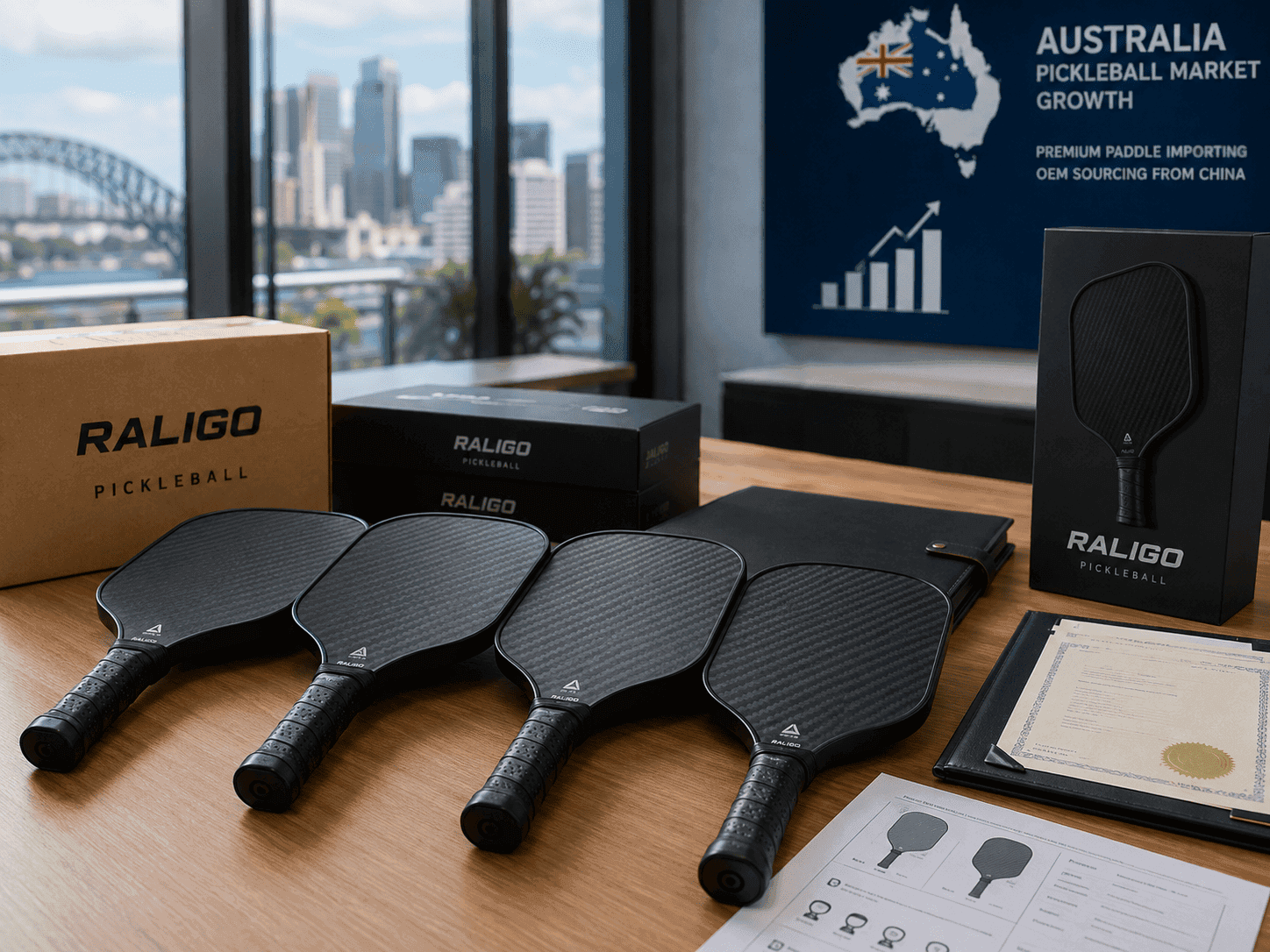
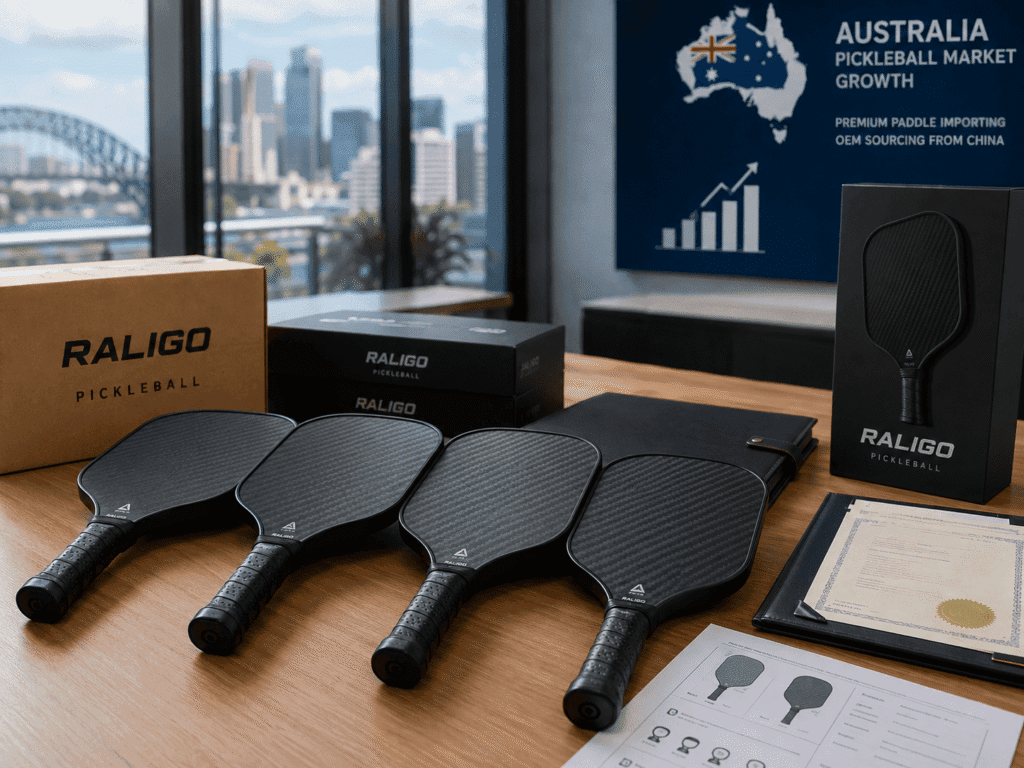
The Australian pickleball market is moving fast. Pickleball Australia registered over 27,000 members by mid-2026 across 410+ affiliated clubs — a 50% year-over-year membership jump. The Australian Sports Commission pegs total participation at 155,000+ players. Paddles were the leading equipment category in the Australian market in 2025. And yet, the premium segment remains underserved: most serious players still import directly for advanced paddle tech.
For Australian distributors, retailers, and brand founders, the question isn’t whether to source paddles — it’s how to navigate the compliance maze, land quality product at the right price, and avoid getting burned by suppliers who don’t understand Australian requirements. This guide covers what you actually need: AS/NZS standards (or lack thereof), ChAFTA duty optimization, landed cost breakdowns, and how Chinese OEM factories compare to what local Australian brands offer.
Australia’s Paddle Market at a Glance — The Numbers Driving Demand
Pickleball Australia has grown from roughly 16,000 members in early 2024 to 27,974 registered players by June 2026. That’s not a blip — it’s a structural shift. Over 410 clubs and venues are now affiliated nationally, and the Australian Sports Commission’s count of 155,000+ total participants suggests a large casual-to-organized conversion pipeline sitting untapped.
The equipment gap is real. Paddles are the number-one product category by revenue, but most premium paddles sold in Australia are imported — either through distributors bringing in US brands at retail markup, or direct-to-consumer imports from Chinese factories. Australian-designed brands like Six Zero, HUSTL, and Spinex exist and are growing, but their production runs almost exclusively through Chinese OEM partners. This isn’t an anomaly; it’s the global supply chain reality for composite pickleball paddles.
| Market Indicator | Value (2025–2026) | Source |
|---|---|---|
| Registered PA Members | 27,974 (Jun 2026) | Pickleball Australia |
| Total Australian Players | 155,000+ | Australian Sports Commission |
| YoY Membership Growth | ~50% | PA Annual Report |
| Top Equipment Category | Paddles | Market Analysis |
| Global Paddle Market Size | USD 250M (2025) | Industry Reports |
| APAC Growth Rate (2024) | Fastest region globally | Fortune Business Insights |
Takeaway for importers: Australia’s paddle market is growing faster than local supply chains can respond. The winners over the next 3-5 years will be the importers who lock in quality OEM relationships now — while freight costs are manageable and factory capacity isn’t maxed out.
Do Pickleball Paddles Need AS/NZS Certification? The Short Answer
No dedicated AS/NZS standard exists for pickleball paddles. Unlike protective eyewear (AS/NZS 4066:1992) or permanent court fixtures, paddles fall under general consumer product safety provisions of the Australian Consumer Law (ACL), enforced by the ACCC. This means your paddles must be “fit for purpose” and “of acceptable quality” — but there’s no specific certification gate you need to pass at the border.
The standard that does matter for competitive play is USAP (USA Pickleball) certification. Pickleball Australia and the PPA Tour Australia have formally adopted USAP/UPA-A approved paddle lists for all sanctioned events. If a paddle isn’t on the USAP approved list, it can’t be used in any tournament under PA jurisdiction. They also partner with Pickle Pro Labs for on-site paddle testing at major Australian events.
| Standard / Requirement | Applies to Pickleball Paddles? | Who Enforces It |
|---|---|---|
| AS/NZS 4066:1992 (Eye Protection) | No — eyewear only | Standards Australia |
| Australian Consumer Law (ACL) | Yes — general product safety | ACCC |
| USAP Paddle Certification | Yes — tournament play | Pickleball Australia / PPA Tour |
| Labeling Standard (Trade Descriptions) | Yes — country of origin, English labels | ABF / ACCC |
| Biosecurity (used equipment) | Yes — if previously used outdoors | Dept of Agriculture |
What this means for sourcing: Don’t waste money chasing AS/NZS certification that doesn’t exist. Put your compliance budget into USAP testing (USD 500–800 per model, 4-6 week turnaround) and make sure your Chinese OEM factory understands the surface roughness and deflection tolerances USAP checks against. We’ve seen importers lose entire container loads because their factory’s “standard paddle” couldn’t pass the coefficient-of-friction test — by the time they found out, the stock was already in a Melbourne warehouse.
ChAFTA and the Zero-Duty Opportunity Most Importers Miss
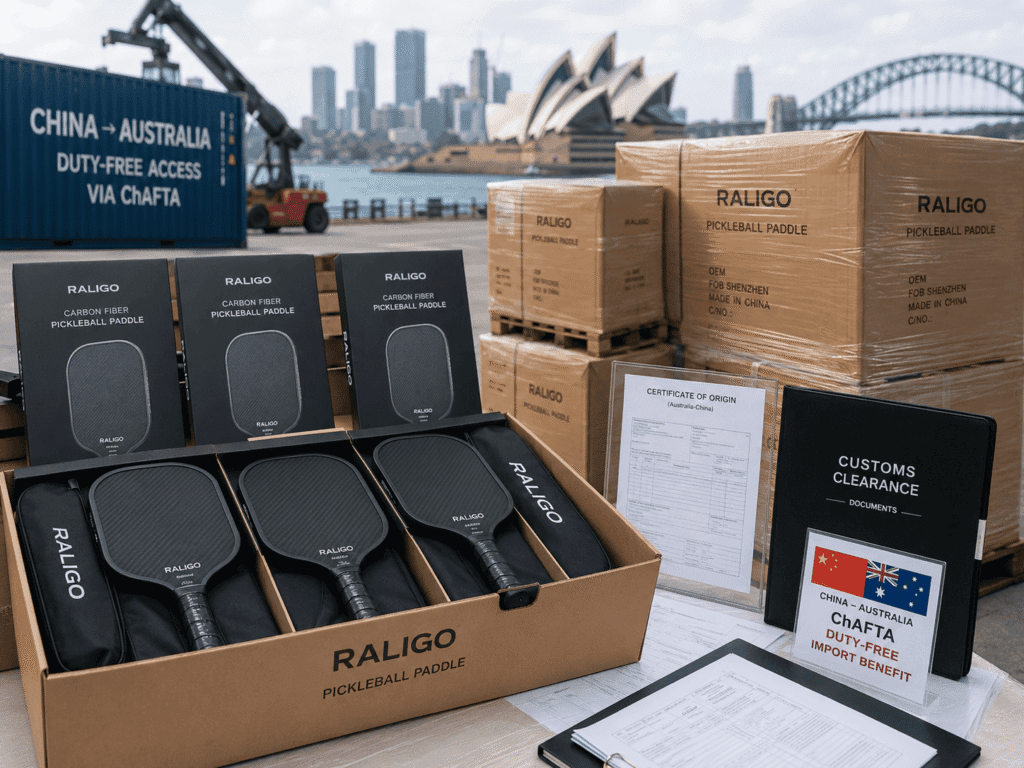
Under the China-Australia Free Trade Agreement (ChAFTA), pickleball paddles manufactured in China qualify for zero import duty. The standard MFN rate is 4.9%, so on a AUD 50,000 container order, that’s AUD 2,450 saved before you even touch GST. But here’s the catch: you need a valid Certificate of Origin (CoO) issued by the China Council for the Promotion of International Trade (CCPIT) or equivalent, stamped and dated, for every shipment.
| Cost Component | Without ChAFTA | With ChAFTA (Properly Documented) |
|---|---|---|
| FOB Paddle Cost (1,000 units) | USD 18,000 | USD 18,000 |
| Sea Freight (Shenzhen → Sydney, 40′ HQ) | USD 2,800 | USD 2,800 |
| Insurance (1% CIF) | USD 208 | USD 208 |
| Import Duty | USD 1,029 (4.9%) | USD 0 |
| GST (10% of VoTI) | USD 2,204 | USD 2,101 |
| Customs Broker Fee | USD 350 | USD 350 |
| Total Landed Cost (AUD equiv.) | AUD ~35,100 | AUD ~33,600 |
| Per-Unit Landed Cost | AUD ~35.10 | AUD ~33.60 |
The HS code for carbon fiber pickleball paddles typically falls under 9506.59.00 (tennis, badminton, and similar rackets) or 9506.99.00 (other sports equipment). Confirm with your broker before the first shipment — misclassification at the border is a fast track to detention fees and ABF audits. I’ve seen HS code disputes hold up cargo for 2-3 weeks, which for a small importer is a cash-flow disaster.
GST note: Shipments valued over AUD 1,000 attract GST collected by the ABF at clearance. You can claim import GST as an input tax credit on your BAS if you’re GST-registered — effectively making it cash-flow neutral for established businesses.
Australian Brands vs. Chinese OEM: The Real Cost-Quality Equation
Most “Australian” pickleball paddles are designed in Australia and manufactured in China. That’s the industry model — Six Zero, HUSTL, and Little Court Co. all run through Chinese OEM partners. The distinction that matters for an importer isn’t country of origin, it’s who controls the spec.
| Factor | Buying from AU Brand (Wholesale) | Direct Chinese OEM (Your Spec) |
|---|---|---|
| Per-Unit Wholesale Cost | AUD 60–120 | USD 15–35 (FOB) |
| MOQ | No MOQ (case pack) | 50–300 units per model |
| Customization | None — off-shelf | Full: face, core, grip, edge guard, logo |
| USAP Cert (per model) | Already done | USD 500–800 / 4-6 weeks |
| Lead Time | 2–14 days (local stock) | 30–50 days production + 18–25 days sea freight |
| Quality Control | Brand’s QC | You own QC (third-party inspection recommended) |
| Warranty / Returns | Brand handles | You handle (factory typically covers manufacturing defects) |
| Margin Potential | 30–50% retail markup | 200–500% landed-to-retail spread |
Frankly, if you’re moving fewer than 500 paddles a year, buying wholesale from an Australian brand is the safe play. You get pre-certified product, local warranty support, and zero customs headaches. The margin is thinner, but so is your risk.
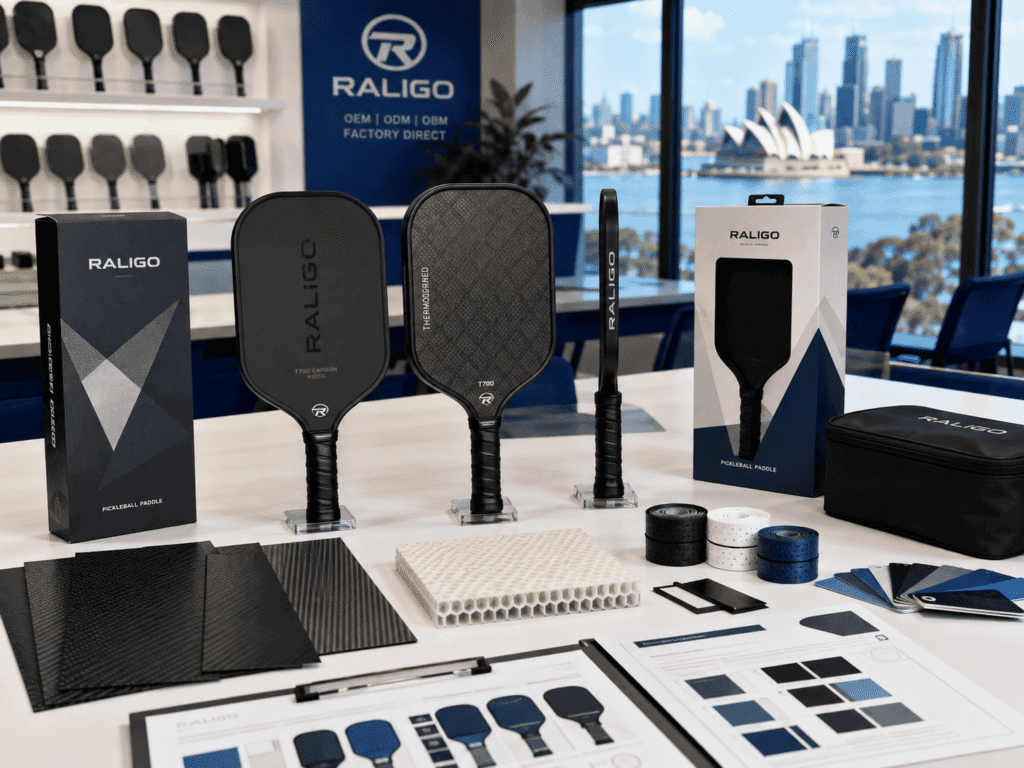
Once you cross the 500–1,000 unit threshold annually, direct OEM sourcing starts making serious financial sense. At Raligo Sport, our standard OEM paddle FOB is USD 18–28 per unit for thermoformed carbon fiber with Toray T700 face sheets and polypropylene honeycomb core — the same construction you’d pay AUD 120+ for at retail. Even adding freight, duty (if any), USAP cert, and third-party QC inspection, you’re landing paddles at AUD 30–45 and selling at AUD 99–149. That’s not a margin — that’s a business model.
B2B Procurement Decision Matrix — Choose Your Sourcing Path
Which route fits your business? Answer two questions: annual volume and time-to-market tolerance.
| Your Profile | Annual Volume | Time Sensitivity | Recommended Path | Why |
|---|---|---|---|---|
| New entrant testing the market | < 200 units | Immediate | AU brand wholesale | No MOQ, no cert delays |
| Growing club / academy | 200–500 units | 2–4 weeks | AU brand wholesale + logo co-brand | Volume discount, still fast |
| Private label startup | 500–2,000 units | 8–12 weeks | Chinese OEM (Raligo Sport tier) | Full custom, 300%+ margin |
| Established retailer / distributor | 2,000+ units | Ongoing | Chinese OEM + annual contract | Price lock, MOQ flexibility, priority production |
| Tournament / event organizer | 500–1,000 units (seasonal) | Fixed deadline | OEM + air freight buffer | 10-day air freight if sea freight misses deadline |
Sourcing From China — What Australian Importers Get Wrong
After handling OEM paddle production for buyers across 15+ countries, here are the five mistakes I see Australian importers make on their first run:
1. Skipping third-party QC inspection
Factory self-inspection reports are worth exactly what you pay for them: nothing. A proper third-party QC run — SGS, Bureau Veritas, or Intertek — costs USD 300–500 per container and checks surface grit consistency (COF measurement), edge guard adhesion, core delamination, and weight tolerance. At Raligo Sport we encourage buyers to bring their own inspector; a factory that pushes back on this is hiding something.
2. Assuming all carbon fiber is the same
Toray T700, T300, and generic “3K carbon” are not interchangeable. T700 has roughly 40% higher tensile strength than T300. Generic 3K weaves from non-Japanese suppliers can vary ±15% in modulus batch to batch. If your factory doesn’t specify the raw material source on the production sheet, assume it’s generic — and price accordingly.
3. Missing the labeling requirements
Australian law requires all imported sporting goods to carry a trade description label in English stating country of manufacture, material composition, and care instructions. We’ve had shipments flagged by ABF because the paddle face had a “Made in China” sticker but the retail box didn’t. Sounds trivial. Costs you 3-5 business days in customs detention each time.
4. Ordering samples but not stress-testing them
A sample that looks good out of the box tells you nothing. Put it through 20+ hours of play, hit it against court surfaces, expose it to Australian summer heat (40°C+ in a car boot). Thermoformed edges that survive one session often delaminate after a month of real use. If the sample still holds up after your club’s A-grade players have abused it for two weeks — then you can talk production quantities.
5. Not planning for the GST cash-flow gap
You pay GST at clearance, then claim it back on your next BAS. If your BAS cycle is quarterly and you land a container in January, you’re floating that GST until April. On a AUD 50,000 shipment, that’s AUD 5,000+ in working capital locked up. Build it into your cash-flow forecast — or time your shipments to land right after your BAS lodgement date.
USAP Certification — The Gatekeeper for Australian Tournament Play
If your paddles are going anywhere near a sanctioned tournament in Australia, they need to be on the USAP approved paddle list. Pickleball Australia uses USAP standards for all competitive play, and they test paddles on-site at major events through their Pickle Pro Labs partnership. You can’t show up with uncertified inventory and expect it to move through clubs and competitive players.
The certification path for OEM paddles:
- Factory produces pre-production samples to USAP spec (surface roughness ≤ 30 Ra μm, deflection under specified load limits)
- Submit 2–4 samples per model to USAP (or an authorized test lab)
- Destructive testing: surface COF, deflection, weight, dimensions, edge guard integrity
- Approval → paddle added to USAP approved list → valid for sanctioned play
- Recertify every 2 years, or whenever the paddle design changes materially
Cost: USD 500–800 per model. Timeline: 4-6 weeks from submission to approval. Worth every cent if you’re targeting the club and competitive segment — where paddles retail at AUD 150–250 and players replace them every 4-8 months.
Logistics Playbook — Shenzhen to Sydney Without the Drama
Most Chinese paddle factories cluster around Shenzhen, Dongguan, and Xiamen. Sea freight from Shenzhen (Yantian port) to Sydney (Port Botany) takes 18–25 days. Melbourne adds 2-3 days. Brisbane and Perth add 3-5 and 7-10 days respectively.
| Shipping Mode | Transit Time | Cost (40′ HQ, ~6,000 paddles) | Best For |
|---|---|---|---|
| Sea Freight (FCL) | 18–25 days | USD 2,500–3,500 | Full container loads |
| Sea Freight (LCL) | 22–30 days | USD 150–250/m³ | Small batch (50–300 paddles) |
| Air Freight | 5–8 days | USD 4–6/kg | Urgent restock, samples, tournament deadlines |
| Express (DHL/FedEx) | 3–5 days | USD 8–12/kg | Samples only (<20 units) |
Procurement teams often overlook this: sea freight rates swing 50-100% seasonally. Q3 (Jul-Sep) is peak — factories are full, freight is expensive. If you can place orders in Q4 for Q1 delivery, you’ll save 15-30% on logistics alone. Chinese New Year (Jan/Feb) shuts down production for 2-3 weeks; plan around it or pay rush fees.
OEM Compliance Checklist — Before You Sign the PO
Print this. Tape it to your wall. Run through every item before wiring the deposit.
| # | Check Item | Why It Matters | Status |
|---|---|---|---|
| 1 | USAP certification submitted or planned for this model? | Required for tournament play in Australia | ☐ |
| 2 | Certificate of Origin from CCPIT included in shipping docs? | Required for ChAFTA zero-duty claim | ☐ |
| 3 | HS Code confirmed with Australian customs broker? | Misclassification = detention + penalties | ☐ |
| 4 | English-language trade description labels on product AND packaging? | ACL mandatory requirement | ☐ |
| 5 | Third-party QC inspection booked (SGS/BV/Intertek)? | Catch defects before container leaves China | ☐ |
| 6 | Surface roughness spec confirmed (≤ 30 Ra μm for USAP)? | Most common USAP failure point | ☐ |
| 7 | Raw material source documented (Toray T700 vs T300 vs generic)? | Determines performance claims and retail positioning | ☐ |
| 8 | Production sample stress-tested (20+ hours play, heat exposure)? | Reveals delamination and durability issues | ☐ |
| 9 | GST cash-flow gap planned for (timing vs BAS cycle)? | Avoids working capital crunch | ☐ |
| 10 | Spare edge guards and grip tape in the order? | Warranty claims resolution — cheap insurance | ☐ |
| 11 | Factory audit completed (ISO 9001 or equivalent)? | Baseline quality management system | ☐ |
| 12 | Production timeline accounts for Chinese New Year shutdown? | 2-3 week production stop in Jan/Feb | ☐ |
Frequently Asked Questions
Do I need a license to import pickleball paddles into Australia?
No general import license is required for sporting goods including pickleball paddles. You may need an Australian Business Number (ABN) and GST registration if importing commercially. Specific permits aren’t needed for carbon fiber or composite paddles — they don’t fall under any restricted goods category.
What’s the minimum order quantity from Chinese OEM factories?
Most established factories require 50–300 units per model as MOQ. Premium manufacturers (Raligo Sport included) can go as low as 30 units for initial samples and trials. MOQ flexibility usually correlates with factory quality — the best factories are willing to do smaller trial runs because they’re confident they’ll win your repeat business.
How long does the entire process take, from order to delivery in Australia?
Realistic timeline: 4-6 weeks for USAP certification (run this in parallel with production), 30-50 days for manufacturing, 18-25 days sea freight, 3-5 days customs clearance and last-mile delivery. Total: 12-16 weeks from PO signing to stock in hand. Air freight can cut the shipping to 5-8 days, but at 5-8x the cost per unit.
Can I sell Chinese OEM paddles under my own brand in Australia?
Yes — that’s the private label model. You own the brand, the factory manufactures to your spec with your logo and packaging. The brand is registered in Australia, the product carries your warranty terms, and you control pricing and distribution. Most Australian paddle “brands” operate this way. The key is having a factory that treats your IP seriously and doesn’t sell your custom mold to the next buyer who walks in.
What quality issues should I watch for in carbon fiber paddles?
The big three: edge guard delamination (thermoformed edges separating, especially after heat exposure), surface grit degradation (COF dropping below playable levels within 4-6 weeks), and core crushing (honeycomb collapse from impact, usually indicating poor polypropylene density or inconsistent cell sizing). A factory that does profilometry QC on every batch catches these before they leave the loading dock.
Start Your OEM Project
Talk to our OEM team about your pickleball paddle manufacturing needs. From spec development and USAP certification prep to bulk production and Australia-compliant packaging, we handle it all at our ISO-compliant factory.