Pickleball Paddle Weight & Balance Distribution Engineering for OEM Buyers
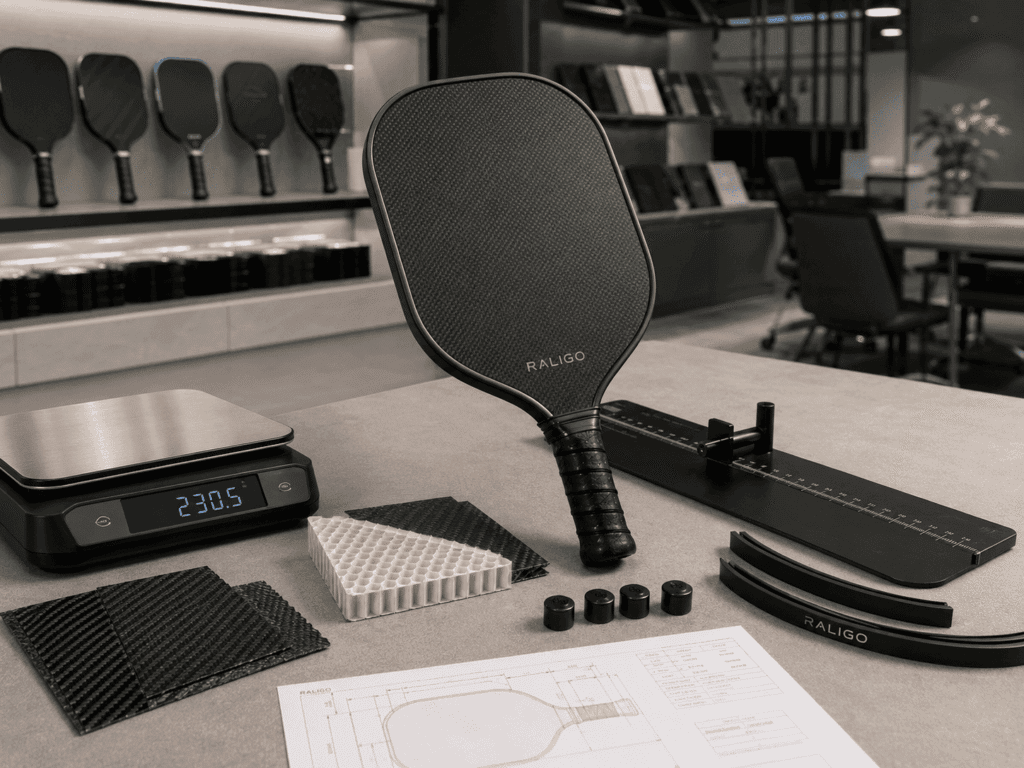
Weight is the first number buyers ask about. Balance is what actually determines how a pickleball paddle plays. An OEM buyer who only specifies total weight is leaving half the engineering specification blank — and that blank space gets filled by whatever the factory defaults to. At Raligo, we’ve seen paddles with identical total weights play like entirely different products because the mass was distributed differently across the face, throat, and handle.
This article breaks down the weight and balance engineering decisions that matter when ordering custom pickleball paddles. It is written for procurement managers, product developers, and brand owners who need to translate on-court feel into factory specifications.
1. Total Weight vs. Weight Distribution: Why the Number on the Scale Misleads
A pickleball paddle’s total static weight tells you one thing: what the scale says when the paddle sits on it. But a paddle in play is never static. Swing weight — the resistance a paddle offers when you rotate it around your wrist — is what players actually feel. Two paddles weighing 8.0 oz can have swing weights differing by 15–20% if one carries more mass in the head and the other in the handle.
In OEM paddle manufacturing, total weight is controlled by core density selection, face layer count, and edge guard mass. But swing weight is controlled by mass distribution along the longitudinal axis. The factory can manipulate this through core density grading, handle weighting, and strategic placement of carbon fiber reinforcement patches. When you submit a spec sheet that only says “7.8–8.2 oz,” the factory will pick a mid-range core density and call it done. If you want a specific balance profile — head-heavy for power drives, head-light for quick hands at the net — you need to specify it explicitly.
| Specification | What It Measures | Factory Control Method |
|---|---|---|
| Static Weight | Total mass on a scale (oz/g) | Core density, face layers, edge guard mass |
| Swing Weight | Rotational inertia (kg·cm²) | Mass distribution along length |
| Balance Point | Distance from butt cap (mm) | Handle weighting, head reinforcement |
| Twist Weight | Resistance to off-center twisting (kg·cm²) | Face width distribution, edge guard stiffness |
Frankly, most factory catalogs show a weight range and maybe a balance point description like “balanced” or “head-heavy.” That’s not enough. A proper OEM specification should include static weight range, target balance point in millimeters from the butt cap, and either measured swing weight or at minimum a qualitative balance profile.
2. Balance Point Engineering: The 230–250 mm Window
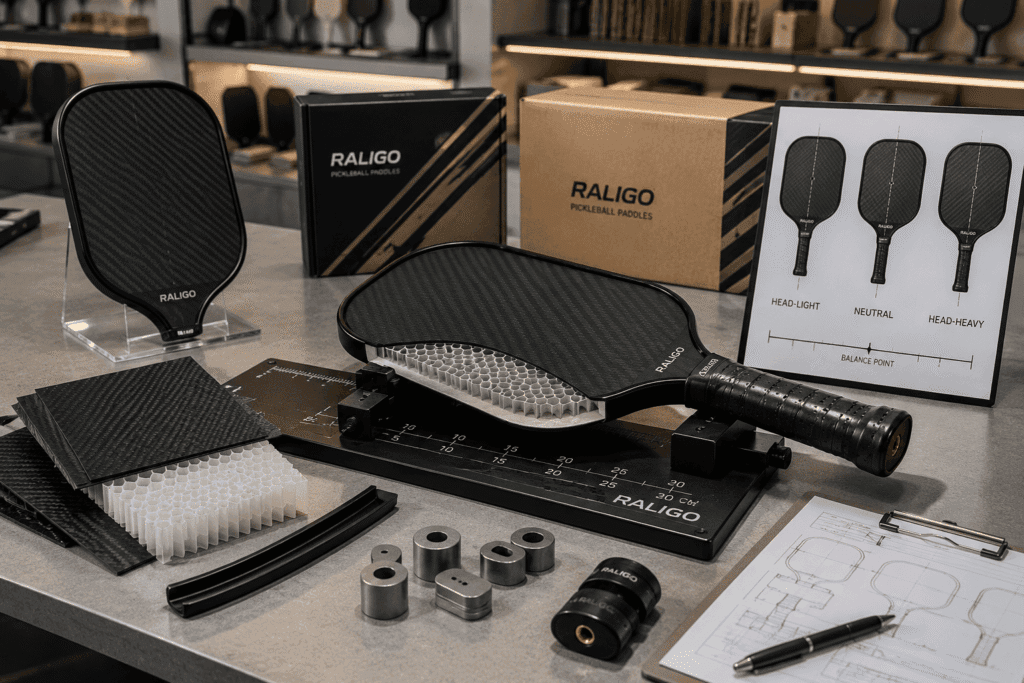
The balance point of a pickleball paddle — measured from the bottom of the handle toward the head — is the single most informative number that almost nobody asks for. In tennis and table tennis racket engineering, balance point specification is standard. In pickleball OEM, it is still surprisingly rare.
For a standard 16-inch pickleball paddle, a neutral balance point sits at approximately 240 mm from the butt cap (roughly the midpoint of the paddle). A reading below 235 mm indicates more mass in the handle — typically achieved by adding weighted inserts inside the handle core or using denser handle materials. A reading above 250 mm signals head-heavy configuration, often achieved through thicker edge guards at the head, additional face reinforcement layers, or lower-density core material in the throat region.
At Raligo’s manufacturing floor, we achieve specific balance targets through a combination of:
- Handle weighting: Cylindrical or rectangular tungsten-polymer inserts placed inside the honeycomb core at the grip end. Weight can be tuned from 5–20g without changing external dimensions.
- Core density gradients: Using variable-density polypropylene honeycomb — denser in the handle zone, progressively lighter toward the head — to shift the center of mass backward.
- Edge guard profiling: Thicker edge trim at the head adds 3–7g of mass at the farthest point from the hand, dramatically increasing swing weight per gram added.
- Face layer asymmetry: Adding an extra carbon fiber ply only to the upper third of the paddle face concentrates mass where it increases swing weight the most.
OEM buyers should specify a target balance point with a tolerance band — for example, “240 ± 5 mm.” Without this, even a premium carbon fiber paddle with perfect materials can end up with a balance profile that doesn’t match the intended player segment.
3. Core Density Gradients and Their Effect on Paddle Performance
Not all polypropylene honeycomb cores are created equal. Core density — measured in kg/m³ — directly controls the paddle’s weight, stiffness, and energy return characteristics. A standard 8mm-thick core with 60 kg/m³ density produces one feel. The same core with 80 kg/m³ produces a noticeably firmer, heavier paddle.
Core density isn’t just a single number. Advanced OEM manufacturing now uses density-graded cores where different zones of the honeycomb have different densities. This lets you tune paddle performance in ways that uniform-density cores cannot:
- High-density center (70–85 kg/m³) with lower-density edges creates a stable sweet spot for clean drives while keeping the paddle maneuverable. This is ideal for power-oriented paddles targeting intermediate-to-advanced players.
- Uniform high density (80–90 kg/m³) throughout the full face produces maximum stiffness and pop. Carbon fiber face sheets on a dense core deliver a crisp, responsive feel that tournament players prefer — but the paddle weight ceiling becomes a constraint.
- Gradient from handle (dense) to head (lighter) shifts the balance point rearward without adding handle inserts. This gives a head-light feel while maintaining total weight in the desired range.
Procurement teams often overlook core density specification entirely. They approve a sample based on feel, not knowing that the factory used a specific core batch. When production switches to a different batch with slightly different density, the paddle feels different — and the brand gets inconsistent reviews. Specify the core density grade (e.g., “PP honeycomb, 75 ± 5 kg/m³, density-graded: high center, low edges”). It forces the factory to control a variable that otherwise drifts.
| Core Configuration | Typical Density Range | Weight Impact (approx.) | Best for |
|---|---|---|---|
| Soft uniform core | 55–65 kg/m³ | Lightweight (7.3–7.7 oz) | Beginner/control paddles |
| Medium uniform core | 65–75 kg/m³ | Mid-weight (7.7–8.1 oz) | All-court recreational |
| Firm uniform core | 75–90 kg/m³ | Mid-heavy (8.0–8.4 oz) | Power/advanced play |
| Density-graded (center-firm) | Center: 80, Edge: 60 kg/m³ | Mid-weight (7.6–8.0 oz) | Sweet-spot optimized |
| Density-graded (handle-dense) | Handle: 85, Head: 65 kg/m³ | Mid-weight (7.6–8.0 oz) | Head-light maneuverable |
4. Carbon Fiber Face Layup and Its Weight Contribution
Carbon fiber paddle faces contribute 30–40% of the total paddle weight, depending on ply count and resin content. A typical thermoformed carbon fiber paddle uses 2–4 plies of 3K or 12K carbon fiber weave on each side, with each ply adding roughly 8–12g per side after resin infusion.
The weight contribution from carbon fiber isn’t just about how many plies you use. Resin content — the ratio of epoxy to carbon fiber — matters enormously. A wet layup with 45% resin content adds dead weight without stiffness. A properly controlled prepreg or thermoforming process with 30–35% resin content maximizes the stiffness-to-weight ratio of the carbon fiber structure.
Toray T700 carbon fiber — the industry standard for premium pickleball paddle faces — has a tensile modulus of 230 GPa with a density of 1.80 g/cm³. Compare that to T300 (230 GPa, 1.76 g/cm³) or lower-grade generic carbon fiber (typically 200–210 GPa), and you can see why material grade matters: at the same thickness, you get better stiffness at approximately the same weight.
For OEM specification, the key carbon fiber parameters that affect weight and balance are:
- Ply count and orientation: 0°/90° vs. ±45° layup affects weight distribution and torsional stiffness differently. A ±45° orientation adds twist-weight resistance without significantly changing swing weight.
- Face sheet coverage: Whether the carbon fiber extends fully into the throat and handle area or stops at the hitting surface boundary. Full coverage adds roughly 5–8g total but creates a more uniform flex profile.
- Surface texture integration: If the texture (peel ply, spray-on grit, or molded texture) is applied post-lamination, it adds 1–3g total. If it’s molded into the carbon fiber during thermoforming, the weight increment is zero — a consideration for weight-critical designs.
A paddle manufactured with 3K Toray T700 at 35% resin content, 2 plies per side, full face coverage, will land approximately 4–6g heavier than the same paddle with edge-only coverage. That 4–6g doesn’t sound like much, but when you’re targeting a specific total weight ceiling of 8.0 oz, every gram matters.
5. Edge Guard Systems: The Overlooked Balance Lever
The edge guard — that thermoplastic or rubber strip running around the paddle perimeter — looks like a protective afterthought. In engineering terms, it’s one of the most powerful levers for tuning paddle weight and balance because it sits at the farthest possible distance from the grip axis.
A full-perimeter edge guard typically adds 12–18g to total paddle weight, concentrated almost entirely at the outer edges. Of that, the head section — the top 4–5 inches — accounts for roughly 40% of the guard mass. That means 5–7g of material sitting at the most swing-weight-sensitive position on the paddle.
Manufacturing options for edge guard weight management:
- Partial edge guards: The bottom half (throat and handle zone) can use a thinner guard profile or omit it entirely. This removes 3–5g from low-leverage positions without sacrificing head protection.
- Material substitution: Standard PVC edge guards weigh more than TPU alternatives at the same thickness. TPU offers better impact absorption with roughly 10–15% lower density.
- Integrated edge molding: Some thermoforming processes mold the edge protection directly into the face structure during pressing. This eliminates the need for a separate guard strip entirely, saving 8–12g.
- Edgeless designs: Carbon fiber paddles with molded-in edge reinforcement can go fully edgeless, removing 12–18g. But this requires high manufacturing precision — delamination risk increases without the protective rim.
I’ve overseen production runs where switching from a full PVC guard to a partial TPU guard shifted the balance point by 8–10 mm toward the handle — a difference easily noticeable on court. OEM buyers who want a specific balance profile should treat the edge guard as a tunable variable, not a fixed component.
6. Handle Construction and Its Role in Balance Tuning
The handle is the counterweight. Every gram added to the grip end shifts the balance point toward the player’s hand and reduces swing weight. Standard pickleball paddle handles consist of a core extension (typically the same honeycomb as the face, sometimes foam-filled), overwrapped with a synthetic grip and potentially an overgrip.
Weight tuning through the handle:
- Handle core material: Switching from honeycomb to EVA foam adds 5–8g to the handle. EVA also dampens vibration better, which some players prefer for comfort.
- Weighted butt caps: A small stainless steel or tungsten insert in the butt cap adds 8–15g at the farthest possible point from the head. This is the most efficient way to shift balance rearward — every gram here moves the balance point approximately 1.5–2.0 mm.
- Grip choice: A thick cushioned grip (typically 18–22g) versus a thin performance grip (12–15g) changes both total weight and balance. The difference of 6–7g at the handle translates to roughly 3–4 mm of balance point shift.
For OEM buyers, the smartest approach is to specify the grip as part of the balance engineering spec. Don’t just pick a grip color — pick a grip weight class. Light (12–15g), medium (16–19g), or heavy (20–24g). Combined with a butt cap weight option (0g, 5g, 10g, 15g insert), this gives you a handle weight matrix that can adjust total paddle balance without touching the hitting surface.
7. Manufacturing Tolerance: Why QC Testing of Weight and Balance Matters
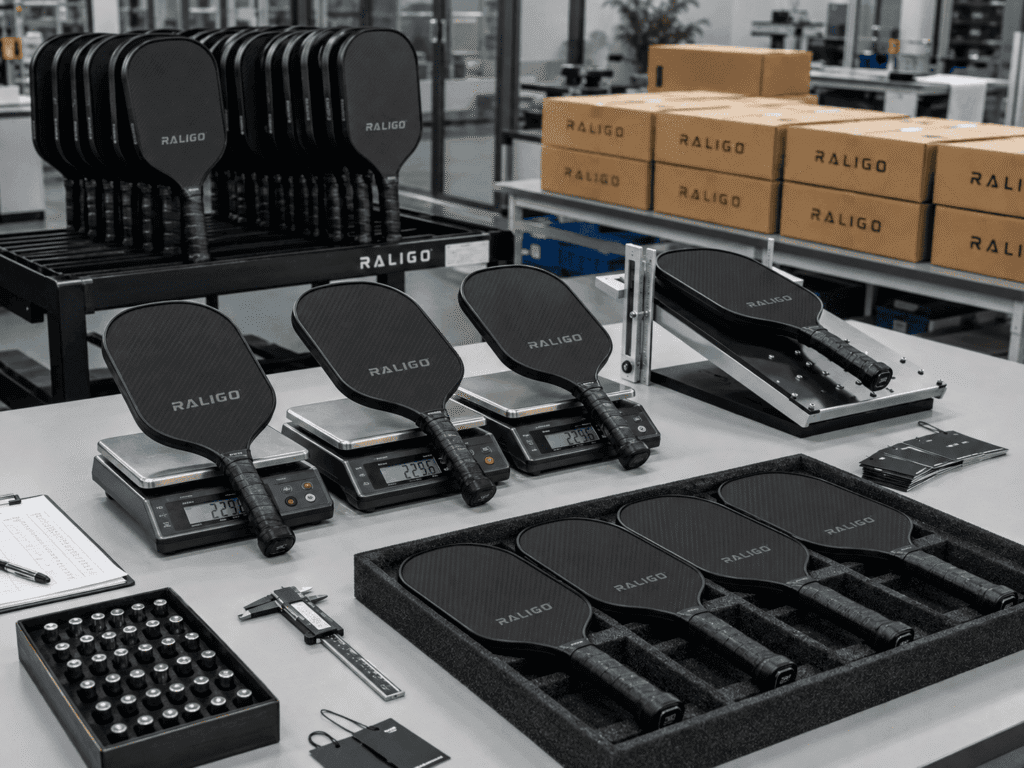
In the real factory environment, weights drift. A polypropylene honeycomb sheet that’s supposed to come in at 75 kg/m³ might arrive from the supplier at 72 or 78. Carbon fiber prepreg resin content varies batch to batch. Edge guard extrusion dies wear over time, producing slightly thicker or thinner cross-sections. None of these variations alone is dramatic, but cumulatively they push a paddle’s weight and balance outside the specified tolerance band.
For a typical 8.0 oz target paddle at ±3% tolerance, that’s a ±0.25 oz range — already a noticeable difference on court. Without active QC that checks both total weight and balance point on every production batch, you’ll get paddles within weight spec but with balance wandering.
Minimum QC checks every OEM buyer should demand:
- Per-batch sampling: Measure static weight and balance point on at least 5% of units per production batch (minimum 10 paddles for small runs).
- Weight tolerance: ±3g (±0.1 oz) for premium paddles, ±5g (±0.18 oz) for mid-range.
- Balance point tolerance: ±5 mm from the specified target.
- Swing weight verification: At minimum, a manual swing weight measurement on 1–2 samples per batch using a calibrated swing weight scale. If the factory doesn’t have one, ask them to build a simple pendulum rig — it costs under $50 in materials and takes 30 minutes to calibrate.
At Raligo, we run weight and balance QC on every production batch and tag each paddle individually for brands that require batch traceability. The cost is negligible relative to the cost of inconsistent reviews and returns from customers who notice their replacement paddle feels different from the original.
8. Specifying Your Paddle Weight and Balance: A Practical OEM Template
Below is a specification template that captures the variables discussed in this article. Every field that you leave as “factory default” is a variable you’re not controlling. The more complete the specification, the more consistent your production runs.
| Parameter | Your Specification | Tolerance |
|---|---|---|
| Target Static Weight | oz / g | ±3g (premium) or ±5g (standard) |
| Target Balance Point | ___ mm from butt cap | ±5 mm |
| Qualitative Balance | Head-light / Neutral / Head-heavy | — |
| Core Material | PP Honeycomb / Nomex / EVA Foam | — |
| Core Density | ___ kg/m³ (uniform or graded) | ±5 kg/m³ |
| Density Profile | Uniform / Center-firm / Handle-dense | — |
| Face Material | Carbon Fiber (specify grade: T700/T300/etc.) | — |
| Carbon Fiber Plies | ___ per side | — |
| Resin Content Target | ___ % | ±3% |
| Edge Guard Type | Full / Partial / Edgeless | — |
| Edge Guard Material | PVC / TPU / Integrated-mold | — |
| Handle Core | Honeycomb / EVA Foam | — |
| Butt Cap Weight | 0g / 5g / 10g / 15g insert | — |
| Grip Weight Class | Light / Medium / Heavy | — |
Procurement teams often ask for a target weight, a core material, and a face material, and stop there. The remaining parameters default to whatever the factory’s standard recipe uses — and that recipe can change between production runs. If you’re ordering 500 paddles for your brand, the difference between a thoughtfully specified balance profile and a factory-default one is roughly 15 minutes of extra paperwork. That’s a good trade.
Frequently Asked Questions
Q: What’s more important for paddle performance — total weight or balance point?
Balance point typically matters more than total weight for how a paddle actually plays. A 7.8 oz head-heavy paddle can feel slower through the air than an 8.2 oz head-light paddle because swing weight — not static weight — determines maneuverability. For OEM ordering, specify both, but if you can only control one precisely, prioritize the balance point target.
Q: How do I convert the on-court feel my testers describe into a factory specification?
Map feel descriptions to engineering parameters: “too sluggish” usually means swing weight is too high, so either reduce head mass (thinner edge guard, fewer face plies) or add handle counterweight. “Too whippy” often means the balance point is too far forward with insufficient mass in the head — increase core density in the upper face zone. “Plow-through” feel requires higher total mass plus a neutral or slightly head-heavy balance. Quantitative measurement beats qualitative description, so invest in a simple balance board and swing weight rig.
Q: Can the factory produce the same weight and balance consistently across multiple production runs?
Yes, if you’ve specified the parameters clearly and the factory has a QC process in place. The problem is not manufacturing capability — it’s whether the factory knows what you want. Most OEM factories in pickleball manufacturing can hold ±3g weight tolerance and ±5 mm balance point tolerance on production runs of 500+ units, provided the specification is detailed and the QC gate is agreed upon upfront.
Q: How does core density affect paddle durability alongside weight?
Higher-density cores (80+ kg/m³) resist cell-wall collapse better than lower-density cores under repeated impact. A soft 55 kg/m³ core will lose its rebound characteristics after 3–6 months of heavy play as cell walls fatigue. A firm 80 kg/m³ core maintains its mechanical properties significantly longer. This is a manufacturing trade-off: lighter paddles feel friendlier out of the box but degrade faster. B2B brands targeting the serious player market should err toward higher core density at the expense of a slight weight increase.
Q: Is there an ideal weight range that sells best in the current market?
The 7.8–8.2 oz range dominates the mid-to-premium pickleball paddle market in North America. Paddles below 7.5 oz are perceived as beginner/recreational. Paddles above 8.5 oz are niche — power players who don’t mind the weight penalty. For a mass-market OEM order, the 7.9–8.1 oz sweet spot with a neutral-to-slightly-head-heavy balance is the safest commercial bet. But the long-tail opportunity lies in carving out a specific weight-balance identity rather than defaulting to the center of the bell curve.
Conclusion
Weight and balance distribution isn’t a footnote in the OEM specification — it’s the engineering backbone of paddle performance. A well-executed carbon fiber face on a poorly balanced core produces a paddle that looks premium but doesn’t deliver. The factory can build what you specify; the question is whether your specification captures what your players actually want.
If you’re ordering custom pickleball paddles, bring a completed weight and balance specification template to your first factory conversation. It signals that you understand manufacturing — and it gives the factory parameters they can actually engineer against instead of guessing what “good feel” means.
Ready to Get Started?
Talk to our OEM team about your pickleball paddle manufacturing needs. From spec development to bulk production, we handle it all at our ISO-compliant factory.