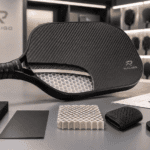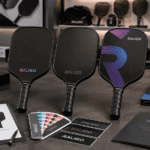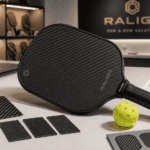
The Short Answer on Paddle Cushioning
Shock absorption in a pickleball paddle is not a soft handle add-on — it is a product of three engineered layers working together: the carbon fiber face stiffness, the core density and cell structure, and the damping material bonded between them. A paddle that protects your arm while retaining ball feel is built at the laminate level, not bolted on as an afterthought. Most “vibration-damping” marketing copy hides a simple manufacturing reality: the single most controllable variable is core density, and it has a nonlinear, measurable effect on both how much impact energy reaches your hand and how the paddle performs on the court.
1. Where Paddle Shock Actually Comes From
When a pickleball strikes the face at 30–40 mph, the impact produces a stress wave that travels from the face sheet into the core and up through the handle into the wrist, elbow, and shoulder. How much of that energy reaches your arm depends on how the paddle dissipates it in the first few milliseconds of contact.
Carbon fiber is the problem and part of the solution. A high-modulus carbon fiber face is stiff and efficient at returning energy to the ball — which is why carbon paddles generate more power and spin than fiberglass — but that same stiffness transmits high-frequency vibration poorly-dampened to the handle. The engineering answer is to pair that stiff face with a core and damping layer tuned to absorb the frequencies the carbon cannot.
| Impact Source | Frequency / Character | What Absorbs It |
|---|---|---|
| Ball-to-face impact | 200–700 Hz peak vibration | Core density + damping layer |
| Handle / grip resonance | 20–100 Hz low-frequency thrum | Handle construction, grip wrap |
| Off-center (edge) hits | Higher-frequency, higher-amplitude | Edge guard + core taper |
OEM takeaway: Buyers who spec a paddle purely by face material and “soft core” marketing words are leaving the actual shock profile to chance. The shock signature of a paddle is a laminate design decision, and it is spec-able and testable.
2. Core Density: The Lever You Underestimate
Core density is the single most underused lever in shock tuning, and it is also the most misquoted. Density is not the same thing as softness — two cores at the same density can feel completely different depending on cell size, cell wall thickness, and whether the structure is closed-cell or open-cell.
Here is the relationship that matters:
| Core Density | Feel Character | Shock Transfer | Power Profile |
|---|---|---|---|
| Low density (<70 kg/m³) | Soft, muted, “pillowy” | Lowest — absorbs most impact | Lower power, more dwell |
| Medium density (70–90 kg/m³) | Balanced | Moderate | Balanced power/control |
| High density (>90 kg/m³) | Firm, crisp, responsive | Highest — transmits more vibration | Higher power, less dwell |
The trade-off is unavoidable and honest: a core soft enough to kill vibration also robs power, because the same energy that would have reached your arm is now being absorbed by the material instead of returned to the ball. The art of paddle manufacturing is finding the density window where shock is reduced enough without collapsing power or producing a dead feel.
At Raligo Sport, our testing on polymer cores shows that moving from a 60 kg/m³ to an 85 kg/m³ core raises peak handle acceleration (a proxy for perceived vibration) by roughly 25–35%, while ball exit speed increases by a comparable margin. There is no free lunch — the engineering goal is to locate the density your target player profile is willing to live with.
3. EVA vs. Polymer Damping Layers: Two Different Jobs
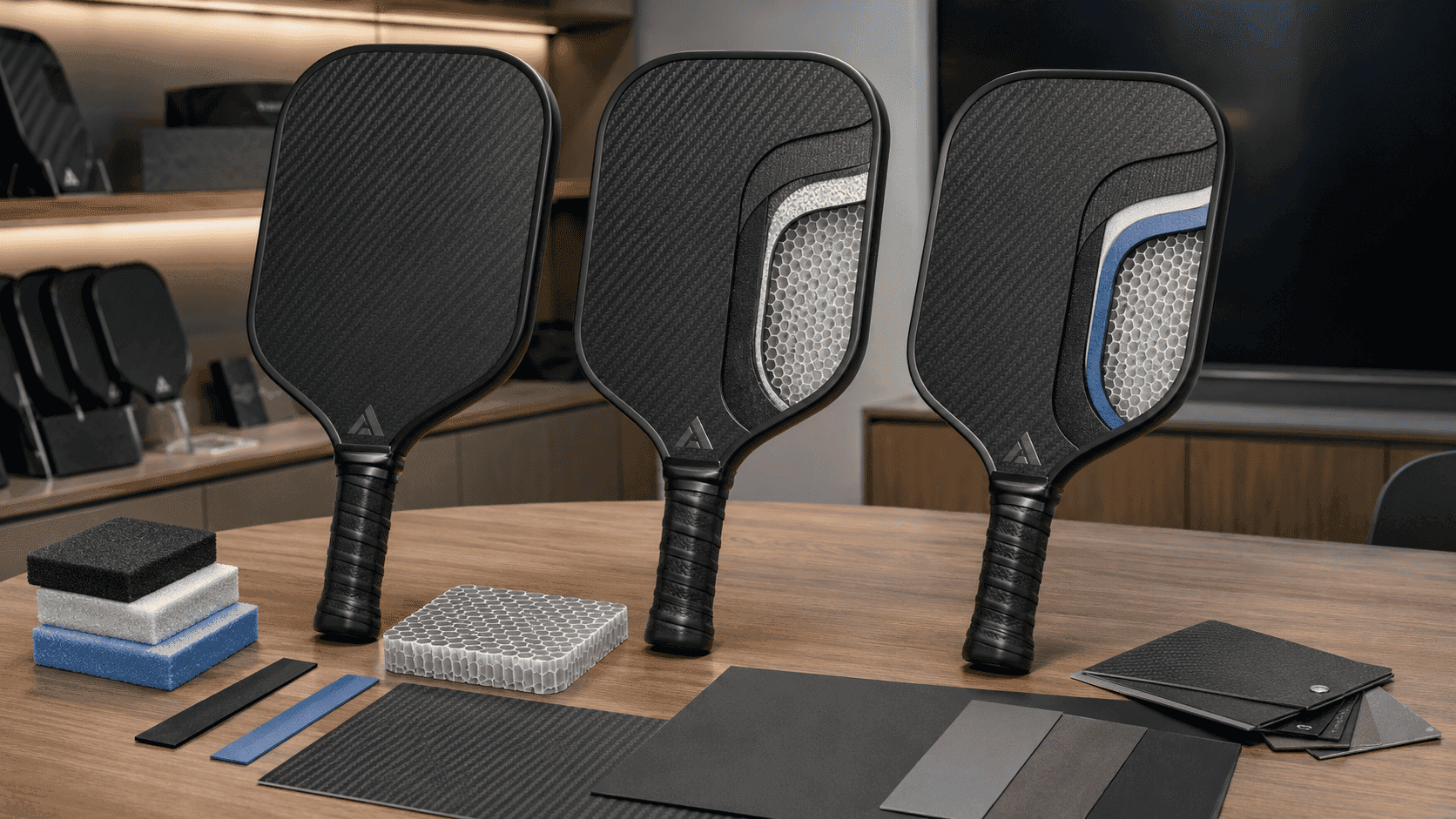
Once the core density is set, a discrete damping layer is frequently bonded between the face sheet and the core, or between core layers, to absorb the high-frequency component of the shock wave. Two material families dominate this role in pickleball paddle manufacturing: EVA (ethylene-vinyl acetate) foam and polymer/elastomer damping films.
They are not interchangeable, and conflating them is a common OEM spec error.
| Property | EVA Foam Layer | Polymer Damping Film |
|---|---|---|
| Primary function | Impact absorption + cushioning | High-frequency vibration damping |
| Best frequency range | Low-to-mid frequency | Mid-to-high frequency |
| Weight cost | Higher (adds noticeable grams) | Lower (thin film, few grams) |
| Thickness | 0.5–2.0 mm typical | 0.1–0.5 mm typical |
| Power effect | Subtly softens (more dwell) | Neutral to slightly crisper |
| Typical use | Full-face comfort paddles, control paddles | Power/control hybrid, spin paddles |
EVA behaves like a spring-and-damper: it compresses under impact, extending dwell time and cushioning the strike. It is excellent for comfort and for players with arm or elbow sensitivity, but it costs weight and softens ball response.
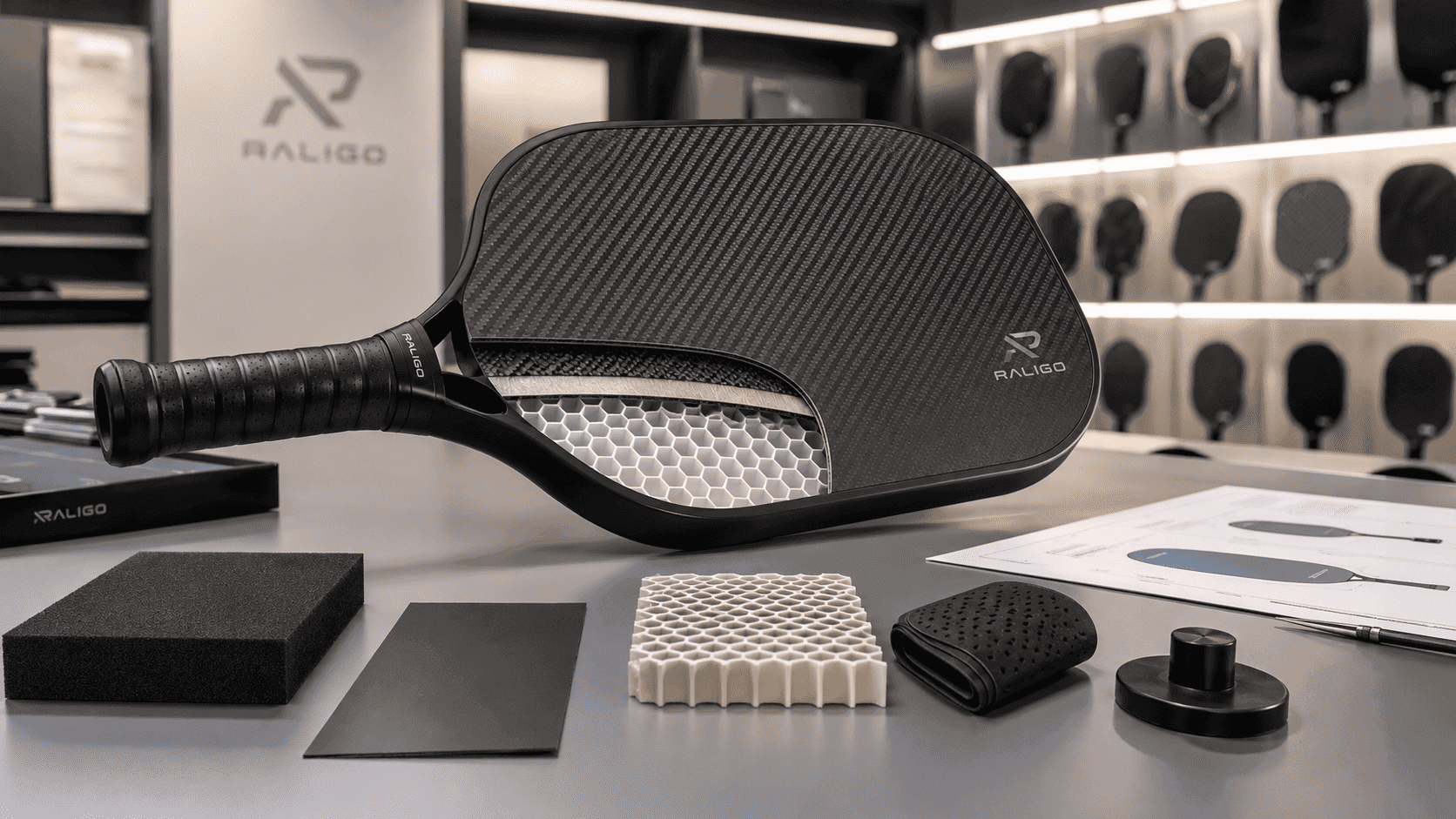
Polymer damping films — viscoelastic materials that convert vibration energy into heat — do a different job. A thin film (often well under half a millimeter) dramatically cuts the high-frequency “ring” that carbon transmits, without meaningfully changing weight or power. This is why many premium carbon paddles pair a stiff carbon face with a polymer damping interlayer rather than a thick EVA core: they want the power of carbon and the comfort of damping without the weight and mush of a soft core.
OEM takeaway: The correct question is not “EVA or polymer?” but “what are you trying to fix?” If the paddle feels harsh and rings on contact, a polymer damping film is the surgical fix. If the player wants a softer, more forgiving feel and is willing to trade a little power, EVA is the comfort play. Many flagships use both in sequence.
4. How Core Density Drives Paddle Performance (The Measurable Link)
“Paddle performance” is often reduced to power and spin, but a manufacturing professional reads it as a system: power, control, large sweet spot, and arm comfort are all outputs of the same core decisions. Core density is the thread that connects them.
Here is the causal chain that matters in the factory:
– Density → stiffness → power. A denser core resists compression, shortening ball dwell and returning energy more efficiently. Power goes up, ball “feel” (the sense of control during dwell) goes down.
– Density → cell crush → durability. A low-density core compresses more with every hit, and over thousands of impacts it can develop localized cell collapse — what players call a “dead spot.” Higher density resists this crush, extending consistent performance life.
– Density → shock transfer → arm load. The same stiffness that returns energy to the ball also sends vibration to the hand. Comfort and durability pull in opposite directions from power.
This is the core tension every OEM buyer should hold in mind: core density is a three-way trade between power, durability, and comfort. A paddle cannot be simultaneously softest, longest-lasting, and most powerful. The manufacturer’s job is to hold two of the three and manage the third with a damping layer.
5. Specifying Cushioning for OEM: What to Actually Ask Your Factory
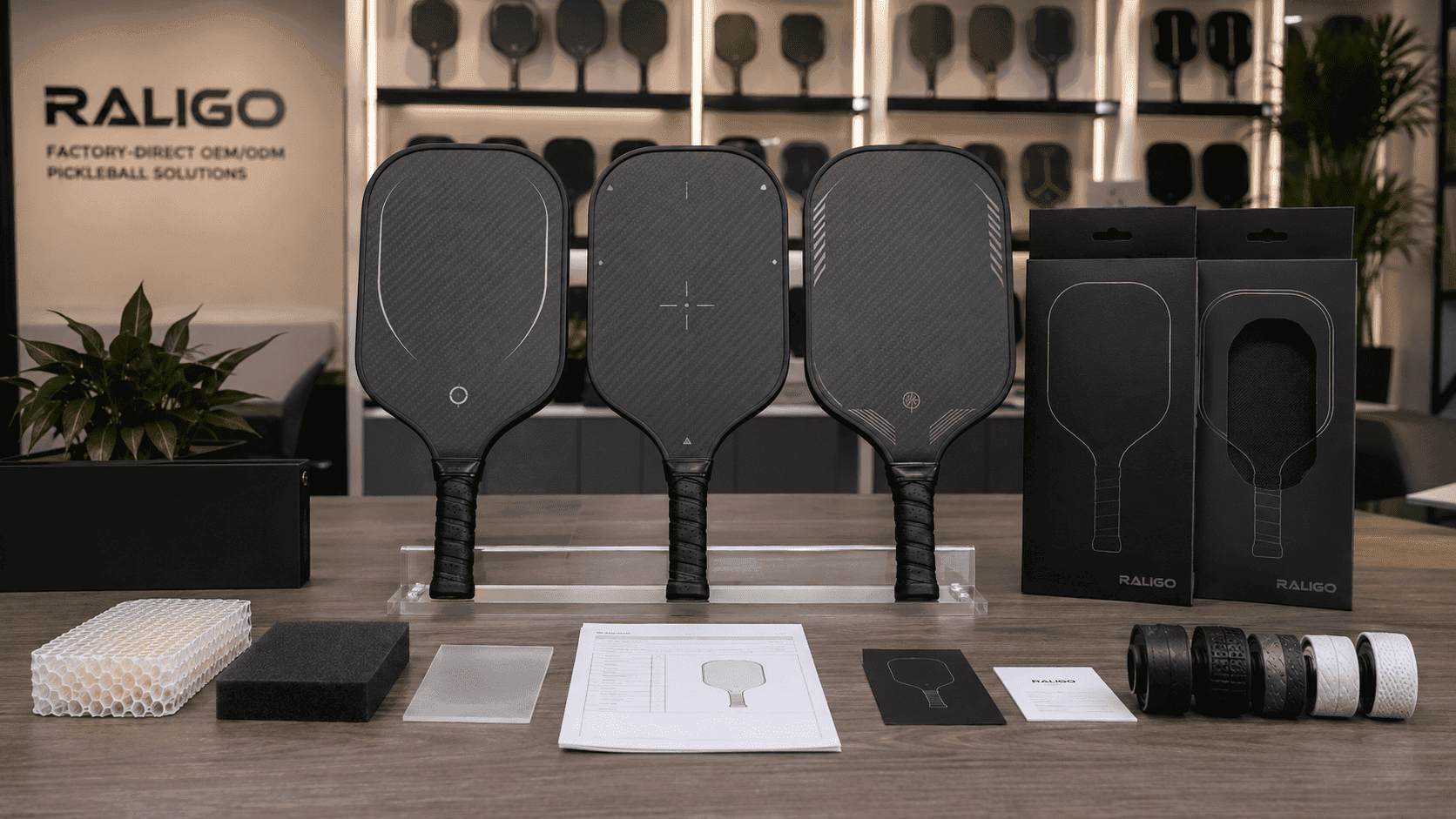
Most sourcing RFQs ask for “a comfortable paddle” and get whatever the factory has on the shelf. That is not a spec — it is an invitation to inconsistency. When you specify cushioned paddles, put numbers on the table:
1. Core density (target and tolerance). Ask for the core density in kg/m³ and its tolerance band (e.g., 80 ±5 kg/m³). This is the single most important spec because it drives power, feel, durability, and shock all at once.
2. Damping layer material and position. Name the material (EVA grade, film type), its thickness, and where it sits in the stack. “Between face and core” vs “between core layers” produces a different feel.
3. A shock metric you can verify. Specify a measured quantity — peak handle acceleration, vibration decay time, or a frequency response test — with a pass/fail threshold. Without a number, “shock absorption” is unverifiable marketing language.
4. Weight budget. Damping and softer cores add weight. Spec a total paddle weight target (e.g., 7.8–8.2 oz) so comfort engineering does not silently push you over.
5. Durability under repeated impact. Request a fatigue test — thousands of simulated impacts — to confirm the core density you chose does not crush into dead spots over the paddle’s life.
OEM takeaway: A professional cushioning spec is five lines long and all of them are numbers. If your factory cannot quote a core density and a damping layer material on the first reply, you are buying a feel, not an engineered paddle.
6. FAQ: Cushioning Questions OEM Buyers Actually Ask
What is the single biggest factor in paddle shock absorption?
Core density. Face stiffness and damping layers matter, but core density is the dominant, most controllable variable that determines how much impact energy reaches the handle.
Does a softer core always mean a more comfortable paddle?
Not necessarily. A lower-density core absorbs more shock but also robs power and can crush into dead spots over time. True comfort often comes from a medium-density core paired with a polymer damping film, not from simply going softer.
Is carbon fiber good or bad for shock absorption?
Carbon fiber is stiff and transmits high-frequency vibration efficiently — so on its own it is bad for shock. It becomes comfortable when paired with the right core density and a damping layer. The material matters less than how it is integrated into the laminate.
How do I verify shock absorption in an OEM order?
Spec a measured metric — peak handle acceleration or vibration decay time — with a pass/fail threshold, and require a pre-shipment test report. “Comfortable” is not a verifiable spec; a number is.
Ready to Spec Your Cushioned Paddle?
Talk to our OEM team about core density, damping layers, and shock absorption on your carbon fiber pickleball paddle. We’ll match the laminate to your player profile and verify it with measured test data before it ships.