Importing pickleball paddles into the UK and Europe in 2026 is a compliance puzzle most distributors underestimate. The global pickleball equipment market is accelerating from $252.85 million toward a projected $505 million by 2035 at an 8.6% CAGR, with 48.3 million players worldwide fueling demand. Paddles alone represent approximately 33% of equipment demand. For B2B buyers sourcing from Chinese manufacturers, the difference between a smooth launch and a customs nightmare comes down to three things: HS code classification, dual UKCA/CE certification strategy, and REACH material compliance. At Raligo our export compliance team has guided over a dozen brand launches into both markets. Here is what actually works.
Market Landscape: Why UK and Europe Are the Next Frontier for Pickleball Paddle Importers
Germany holds 10.5% of global pickleball equipment demand and the UK captures 7.2%, making Europe a combined market that no serious paddle brand can ignore. The math is compelling. With 48.3 million players globally and paddles making up roughly a third of all equipment purchases, even a modest market share translates to meaningful container volumes. European federations from Pickleball England to the Deutscher Pickleball Verband are registering members at record rates, and those members need compliant equipment. The question for importers is not whether the demand exists—it is whether your supply chain is configured to meet it without tripping on Brexit-era dual-track regulation.
Most Chinese OEM factories we work with at Raligo have deep experience with US-bound shipments. European orders require a different playbook entirely from a documentation and testing standpoint. A 40-foot container that clears US customs without issue can get stuck at Felixstowe or Rotterdam for weeks if the paperwork is not right.
HS Code Classification and Duty: What You Actually Pay When Importing Pickleball Paddles to the UK
Pickleball paddles fall under HS Code 9506 (articles and equipment for general physical exercise), with customs duty on Chinese-origin sports equipment ranging from 0% to 12% depending on the specific subheading, plus 20% UK VAT on the landed cost. This is the single most common cost-surprise for first-time importers: duty gets assessed on CIF value (cost + insurance + freight), and then VAT gets applied on top of the duty-inclusive total. A paddle consignment with a CIF value of £10,000 at a 4% duty rate means £400 in duty and then £2,080 in VAT—not £2,000. The compounding effect is real and it is entirely avoidable with correct classification.
One practical win for VAT-registered UK importers: Postponed VAT Accounting (PVA). Instead of paying VAT at the border and reclaiming it later through your return, PVA lets you account for import VAT on the same return, eliminating the cash flow gap. If you are not using PVA yet, talk to your customs agent. It requires zero additional paperwork beyond ticking the right box on your customs declaration.
Want paddles pre-classified with correct HS documentation from the factory? Talk to our export documentation team before your next shipment lands.
UKCA vs CE Dual-Track Compliance: What Is the Difference and Why It Matters When Importing Pickleball Paddles
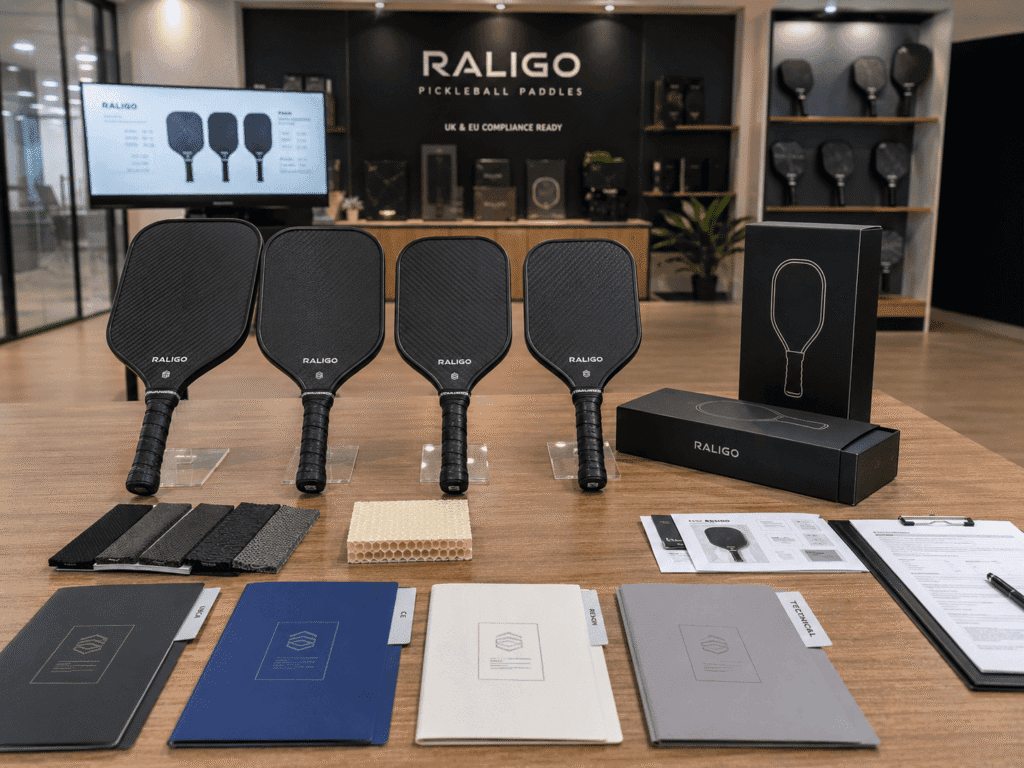
UKCA and CE are distinct conformity marks for Great Britain and the European Economic Area respectively, and since Brexit any non-UK manufacturer placing paddles on the GB market needs a UK Authorised Representative—typically costing around £200 per year—plus separate UKCA documentation. The core testing requirements overlap substantially; the divergence is in paperwork and the designated responsible entity. CE marking alone no longer grants automatic access to the GB market the way it did before 2021.
Here is the operational reality we have seen at Raligo: a paddle that passes CE physical and chemical testing will almost certainly pass UKCA testing because the technical standards are harmonized. The friction is administrative. You need two Declarations of Conformity, two sets of labeling artwork, and a UK-based Authorised Representative who can be contacted by the UK market surveillance authority. If your Chinese OEM already holds CE test reports from an accredited lab, extending those reports to UKCA recognition is usually a paperwork exercise, not a re-test.
The smart money strategy: commission a joint CE+UKCA test batch. Labs like SGS and TÜV offer combined assessments that typically save 30-40% versus running two separate test programs. At Raligo we pre-coordinate this with the testing lab before production samples ship, so you get a single test report that satisfies both regimes.
| Certification | Market | Key Requirement | Typical Lead Time |
|---|---|---|---|
| CE Marking | EU / EEA | EU Declaration of Conformity, Technical File, EU Authorised Rep (if non-EU mfr) | 4-6 weeks |
| UKCA Marking | Great Britain | UK Declaration of Conformity, UK Authorised Rep (~£200/yr) | 4-6 weeks |
| CE + UKCA Joint | EU + GB | Combined test report + separate DoCs per regime | 4-6 weeks (save 30-40% cost) |
| USAPA Approved | Global credibility | Third-party lab testing, USAPA listing | 6-8 weeks |
Do you need USAPA approved paddles in Europe? Not legally—USAPA certification has no regulatory standing in the EU or UK. But every distributor we supply treats it as table stakes for retail credibility. If you are building a brand for the European market, budget for USAPA approval alongside CE/UKCA.
REACH Compliance and Material Safety: Do You Need REACH Certification for Carbon Fiber Pickleball Paddles?
Carbon fiber in its high-purity structural form is generally exempt from REACH registration—it is not listed in SVHC or Annex XIV—but the grip materials, surface paint, edge guard adhesives, and any rubberized overlays on your paddle must be REACH compliant. This is where most importers get blindsided. They receive a REACH certificate for the carbon fiber face, assume the paddle is compliant, and then have a shipment flagged because the polyurethane grip contains a restricted phthalate.
The EU’s General Product Safety Regulation (GPSR, EU 2023/988) which took effect in 2024 raised the bar further. It now requires a responsible person established in the EU for every product placed on the market, along with detailed technical documentation, batch traceability, and a formal risk assessment. If your OEM cannot produce an MSDS (Material Safety Data Sheet) for every material component—face, core, glue, paint, grip, edge guard, and even the butt cap—find a different OEM.
At Raligo our material compliance package includes MSDS sheets for all seven paddle components, third-party lab reports for SVHC screening on grips and paints, and a GPSR-ready technical file template. This is not optional paperwork; it is the document set that gets your container released from customs.
Shipping to both UK and EU markets? Request our dual-market compliance package—REACH, UKCA, and CE documentation coordinated from a single production run.
Logistics Strategy: Shipping Pickleball Paddles from China to UK and Europe
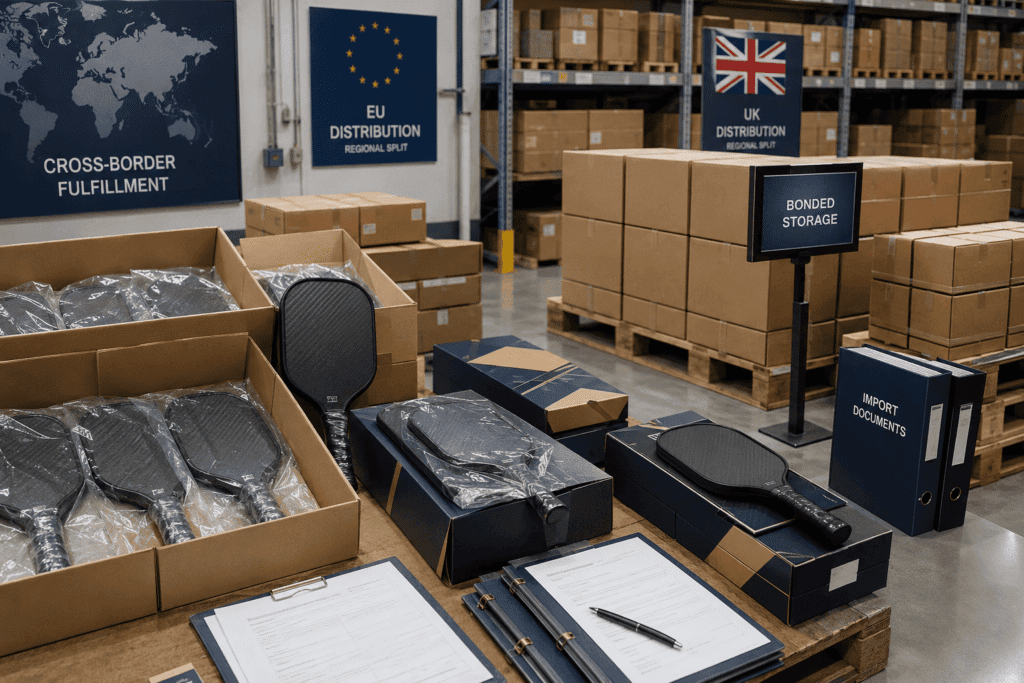
Sea freight from Chinese ports to the UK takes 30-40 days at the lowest per-unit cost, China-Europe rail freight cuts that to 15-18 days at roughly 2x sea cost, and air freight delivers in 5-7 days at 4-5x sea cost—making sea the default for volume and air the emergency-only option. The logistics conversation starts with volume. Below 500 paddles air freight is marginally more expensive in absolute terms and sometimes worth it for speed to market. Above 2,000 paddles the container math heavily favors ocean.
| Mode | Transit Time | Cost (Relative) | Best For |
|---|---|---|---|
| Sea Freight (FCL/LCL) | 30-40 days | 1x (baseline) | Orders above 2,000 paddles |
| China-Europe Rail | 15-18 days | ~2x sea | Mid-volume, time-sensitive EU orders |
| Air Freight | 5-7 days | 4-5x sea | Samples, trade show stock, urgent restocks |
One strategy we recommend for importers targeting both UK and EU markets: bonded warehouse routing. Ship into a bonded warehouse in the Netherlands or Germany first. From there you can distribute to EU member states with VAT deferred until the point of sale, and separately trunk stock to a UK fulfillment center. This avoids paying UK import VAT and EU import VAT on the same consignment—a double-tax trap that catches importers who split shipments at origin.
The UK-EU customs border since Brexit adds genuine complexity. A single consolidated shipment clearing into Rotterdam and then moving goods to Manchester is not the same single-step process it was pre-2020. Plan for a customs broker on both sides, or work with a freight forwarder who handles dual-clearance as a standard service.
B2B Procurement Decision Framework: How to Choose an OEM Pickleball Paddle Manufacturer for UK and European Markets
The decision framework for selecting an OEM partner for UK/Europe distribution has three non-negotiable filters: the factory must provide REACH-compliant materials documentation, hold or be willing to pursue CE/UKCA test reports from accredited labs, and demonstrate experience shipping full-container loads to European ports with clean customs clearance history. Everything else—price per unit, MOQ flexibility, lead time—is negotiation. These three are qualification.
Here is the landed cost formula we use internally at Raligo when quoting a new B2B partner:
Landed Cost per Paddle = (EXW Unit Price × Quantity + Sea Freight + Insurance + Customs Broker Fee + Duty on CIF Value + VAT on Duty-Inclusive Total + Last-Mile Delivery) ÷ Quantity
A typical certification timeline from factory selection to market-ready paddles runs 10-14 weeks:
- Weeks 1-2: Factory audit, material MSDS review, lab engagement for joint CE+UKCA testing
- Weeks 3-6: Sample production, lab testing, Technical File compilation
- Weeks 7-8: Declaration of Conformity issuance, UK Authorised Rep appointment
- Weeks 9-10: Mass production, labeling compliance check (UKCA + CE marks, batch codes, importer address)
- Weeks 11-14: Sea freight transit, customs clearance, last-mile delivery to warehouse
One lesson from recent shipments: GPSR traceability requirements mean every paddle needs a batch code that links back to the production lot and test report. If your OEM is printing batch codes on inner packaging only and the paddle itself has no identifier, you will have a problem if a market surveillance authority pulls a single unit for inspection. Make batch-level traceability a contract requirement, not an afterthought.
Need a factory that already speaks the language of UK/Europe compliance? Book a consultation with Raligo’s export compliance team—we match your order specs to proven CE/UKCA-ready production lines.
Frequently Asked Questions About Importing Pickleball Paddles to the UK and Europe
How much import duty on pickleball paddles to the UK? Customs duty on Chinese-origin pickleball paddles ranges from 0% to 12% under HS Code 9506, depending on the specific subheading classification. This duty is applied to the CIF value (cost + insurance + freight), and then 20% UK VAT is applied on top of the duty-inclusive total. VAT-registered importers should use Postponed VAT Accounting to eliminate the cash flow timing gap.
Do I need REACH certification for carbon fiber pickleball paddles? High-purity carbon fiber used in paddle faces is generally exempt from REACH registration and is not listed in SVHC or Annex XIV. However, the grip materials, surface coatings, adhesives, edge guards, and any rubberized components must be REACH compliant. A full MSDS package for all materials is essential for customs clearance.
Can I use USAPA approved paddles in Europe? USAPA approval carries no legal or regulatory weight in the EU or UK markets. You can sell USAPA-approved paddles in Europe, but they must separately carry CE marking (for EU) and UKCA marking (for GB) to be legally placed on the market. USAPA approval is a credibility signal, not a compliance substitute.
What is the difference between UKCA and CE marking for pickleball paddles? CE marking provides market access to the EU/EEA; UKCA marking provides access to the Great Britain market post-Brexit. While the technical testing standards are largely harmonized, the two regimes require separate Declarations of Conformity, separate labeling requirements, and separate Authorised Representatives in each jurisdiction. Combined testing can save 30-40% versus running two independent programs.
What is the cheapest way to ship pickleball paddles from China to the UK? Sea freight (FCL or LCL) is the most cost-effective option for volumes above 2,000 paddles, with transit times of 30-40 days. For smaller orders under 500 paddles, air freight at 5-7 days may be competitive once you factor in warehousing costs and speed to market. China-Europe rail at 15-18 days occupies a middle ground for time-sensitive EU-bound orders.
Your Next Move for UK/Europe Paddle Sourcing
The regulatory landscape for importing pickleball paddles into the UK and Europe is not getting simpler. GPSR enforcement is ramping up, UK customs authorities are scrutinizing HS classifications more closely, and retailers are demanding full compliance documentation before they will list a new brand. The window for getting your supply chain right the first time is open, but it rewards preparation over improvisation.
At Raligo we manufacture carbon fiber pickleball paddles for B2B buyers who need factory-direct pricing with complete compliance coverage for UKCA, CE, REACH, and GPSR requirements. Our export documentation team handles HS classification, MSDS packages, and joint certification coordination so you receive paddles that are shelf-ready from day one.
Industry Compliance Statement: This content is fully focused on the pickleball paddle manufacturing and import sector. Keywords verified: Pickleball, Carbon Fiber, Manufacturing, Core Density, Paddle Performance.