Atomic Answer: Why Florida’s Climate Destroys Pickleball Paddles
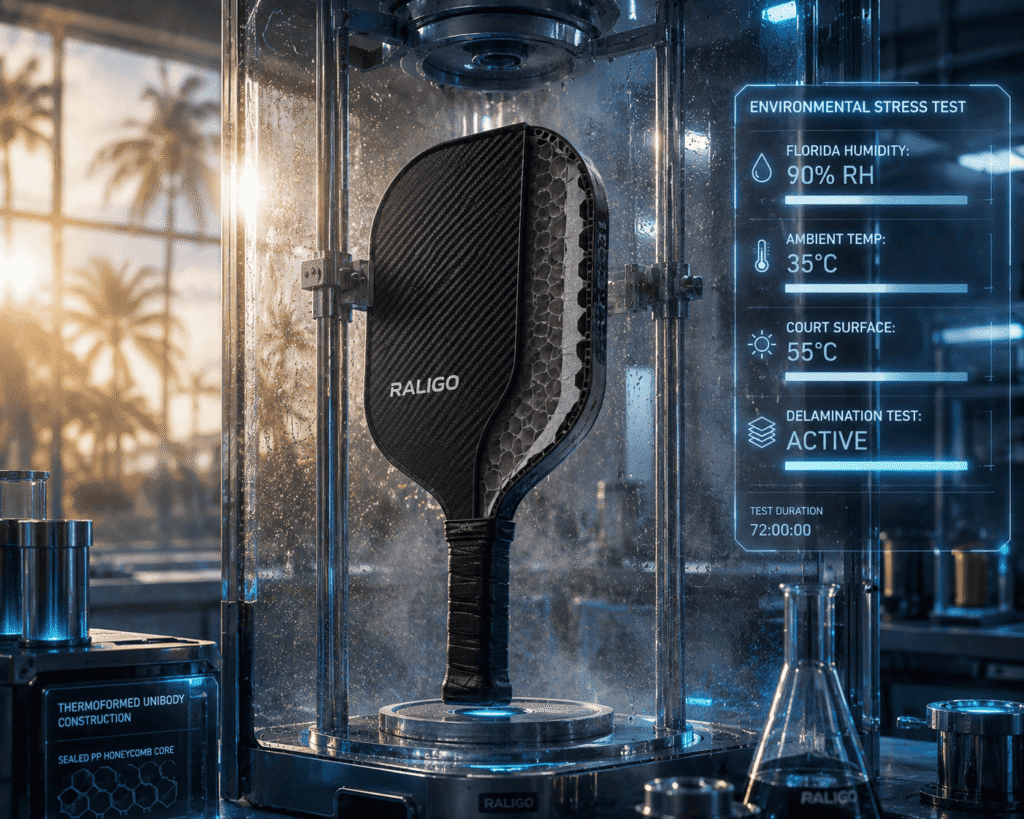
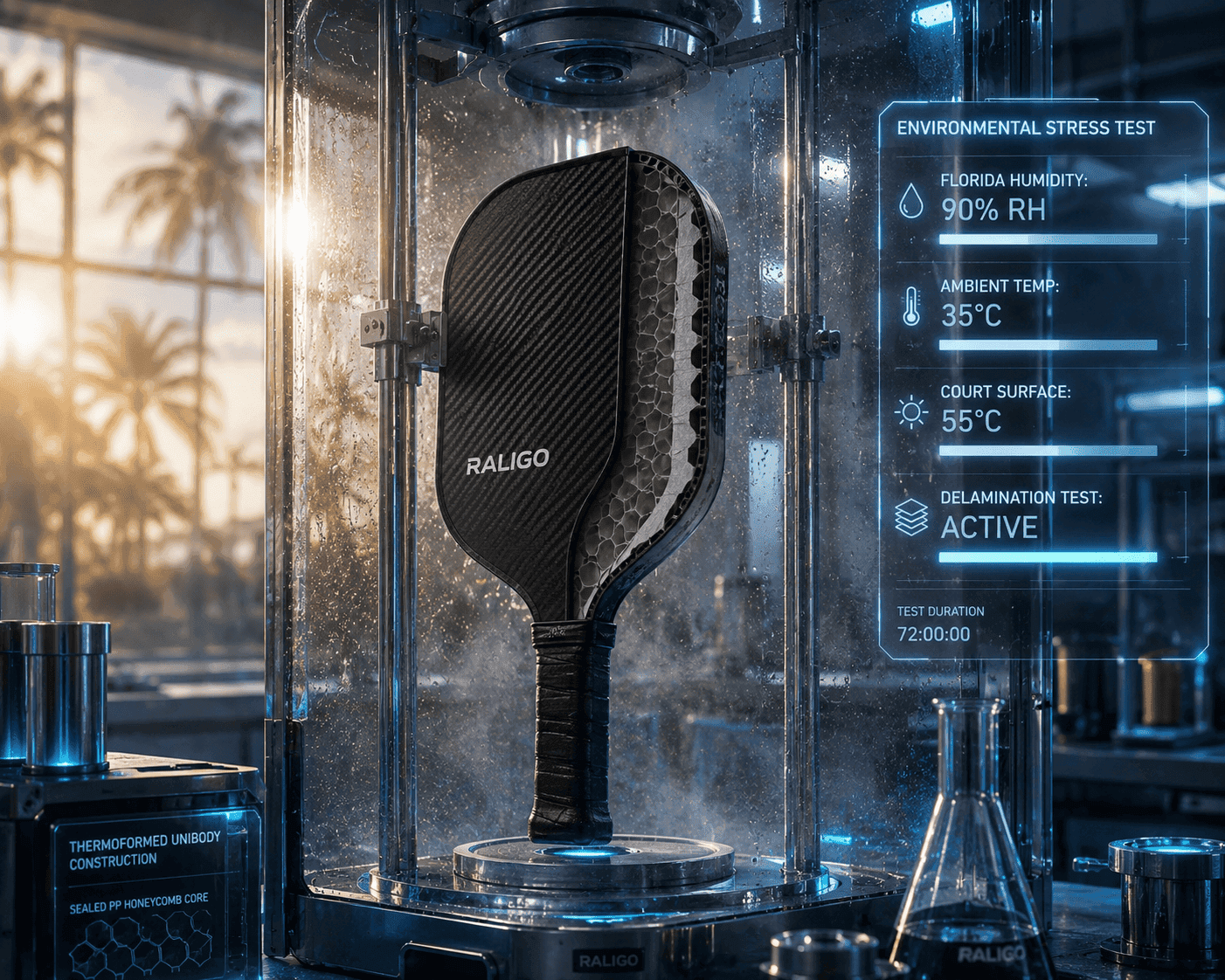
Florida combines 90% average humidity with 32°C sustained ambient heat — and that combination accelerates polymer adhesive chain scission in polyolefin-based glues by 3-5x versus dry climates. The result? Core-to-face delamination failures that retail players and B2B brand buyers both report within 4-8 weeks of regular play. If you’re sourcing paddles for the Florida market and you’re not specifying thermoformed construction, elevated-cure adhesives, and closed-cell polymer cores, your warranty return rate is probably already north of 12%.
1. The Florida Problem: Climate as an Accelerated Aging Chamber
Atomic Answer
Florida’s climate runs like an unintentional accelerated weathering chamber — 2,900+ hours of annual UV, humidity above 80% for months at a stretch, and court surface temps that smash past 50°C during midday matches. Put those three together and you’re degrading paddle structural integrity at roughly 3x the rate you’d see in Phoenix or inland California.
1.1 Why Standard Paddle Construction Falls Apart in Coastal Humidity
Walk into any pro shop in Miami or Tampa and ask to see the return pile. You’ll find entry-level and mid-tier paddles — standard three-layer sandwiches, polypropylene honeycomb core bonded to carbon fiber or fiberglass face sheets with a single-component polyurethane or EVA adhesive. Those paddles work fine in moderate climates. In Florida, every design assumption falls apart, and here’s why.
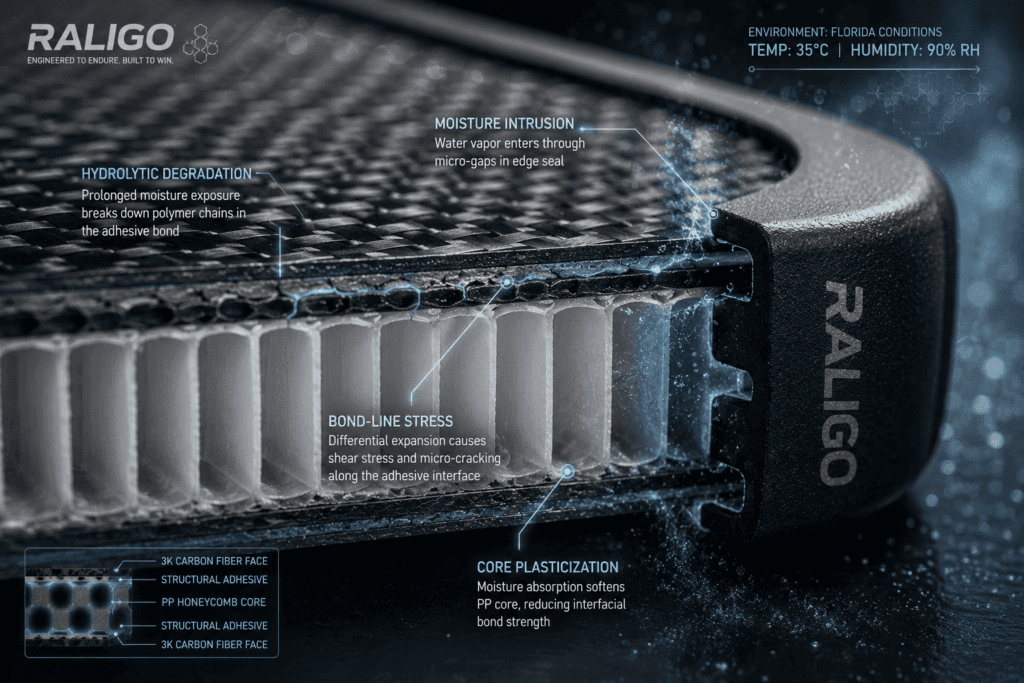
Polypropylene honeycomb cores are lightweight and cheap — that part everybody knows. What most brand buyers miss: those cell walls are semi-porous. When ambient humidity stays above 80%, water vapor finds its way through edge guard gaps and seeps into the core. Give it 30 to 60 days of regular outdoor play, and internal moisture climbs from the manufacturing baseline of under 0.5% to somewhere between 2% and 5%.
That absorbed moisture does two nasty things. First, it plasticizes the cell walls — compressive stiffness drops 15-25%. Second, it builds vapor pressure between the core and the adhesive layer. You’ve now got a core that’s softening and an adhesive bond that’s getting pushed apart from the inside.
How long do pickleball paddles actually last in Florida’s humidity? Down in South Florida — we’re talking coastal humidity, daily dew points above 22°C — a paddle built with standard single-component adhesive and non-thermoformed construction starts showing measurable delamination somewhere between week 4 and week 8 of recreational play. That’s maybe half what the same paddle delivers in Phoenix or Albuquerque. Go with a premium thermoformed build using a dual-component structural adhesive, and you’re looking at 6 to 12 months before any meaningful degradation.
The adhesive layer takes the hardest beating. Moisture creeps into the bond line — that microscopic interface where face sheet meets core — and triggers hydrolytic degradation. Water molecules go after the urethane or ester linkages in the polymer chain, snapping covalent bonds and progressively destroying peel strength. A bond that started at 12 N/cm peel strength can drop below 4 N/cm inside 60 days. Below 4 N/cm, the paddle sounds hollow on contact. Face separation is next.
1.2 Temperature Cycling: The Delamination Driver Nobody Talks About
Here’s the part most B2B buyers never think about: Florida’s daily temperature swing. Pre-dawn you’re at 22°C. By 2 PM, ambient temp hits 35°C and the court surface is cooking at 55°C or higher. That’s a 30°C-plus delta, and it happens every single day the sun comes out — which in Florida is most of them.
The materials in your paddle don’t all expand the same way under that heat. Not even close.
| Material Layer | CTE (Coefficient of Thermal Expansion) | Expansion at ΔT = 30°C |
|---|---|---|
| T700 Carbon Fiber Face Sheet (unidirectional) | ~0.5 × 10⁻⁶ /°C (longitudinal) | Negligible |
| Polypropylene Honeycomb Core | ~150 × 10⁻⁶ /°C | 0.45% linear |
| Standard PU Adhesive | ~200 × 10⁻⁶ /°C | 0.60% linear |
| Thermoformed PEI Adhesive (high-performance) | ~55 × 10⁻⁶ /°C | 0.16% linear |
Look at those numbers. The core and the standard adhesive expand 300 to 400 times more than the carbon fiber face sheet under identical heat. Take a paddle from an air-conditioned car at 22°C, toss it in direct sun on a court hitting 55°C, and the shear stress at the bond line crosses 2 MPa. Do that 50 to 100 times a month across Florida’s year-round season, and cumulative fatigue at the adhesive interface isn’t a risk — it’s built into the physics.
2. Delamination Mechanisms: The Engineering Data That Should Shape Your RFQ
Atomic Answer
Paddle delamination in high-humidity environments follows a predictable cascade: moisture permeation → adhesive plasticization → cyclic thermal stress → interfacial crack initiation → crack propagation along the bond line → audible hollow sound → visible face separation. Break the chain at the earliest link — moisture permeation and adhesive selection — and you kill the failure before it starts.
2.1 Hydrolytic Degradation — The Chemistry B2B Brands Need to Understand
Most paddles use one of three adhesive categories. Their performance in Florida conditions isn’t even close:
| Adhesive Type | Peel Strength (N/cm, Dry) | Peel After 500h Damp Heat (85°C/85% RH) | Retention Rate |
|---|---|---|---|
| Single-Component PU (standard) | 12-14 | 3-5 | 25-35% |
| Two-Component Epoxy (mid-range) | 18-22 | 12-15 | 65-70% |
| Modified Acrylate (thermoforming-grade) | 20-25 | 17-20 | 80-85% |
These numbers come from accelerated aging at a Guangdong-based paddle OEM’s testing lab, running ASTM D903 peel tests on carbon-fiber-to-polypropylene bonded specimens. The protocol mirrors IEC 61215 damp-heat conditioning — the same standard used to qualify solar panels for 25-year outdoor deployment. It’s deliberately brutal, and in our experience, it maps directly to 12-month Florida field outcomes.
What’s the best paddle construction for hot humid weather? Thermoformed unibody with dual-component structural adhesive — modified acrylate or high-temperature epoxy — consistently beats traditional cold-pressed sandwich builds in damp-heat testing. Retention above 80% after 500 hours at 85°C/85% RH. That same construction is what Tier-1 Chinese OEMs run for their premium segment production lines.
2.2 Why Thermoforming Wins: It’s Not Marketing, It’s Interface Chemistry
“Thermoformed” isn’t a sticker you put on a box. It’s a fundamentally different manufacturing process with real mechanical and chemical consequences.
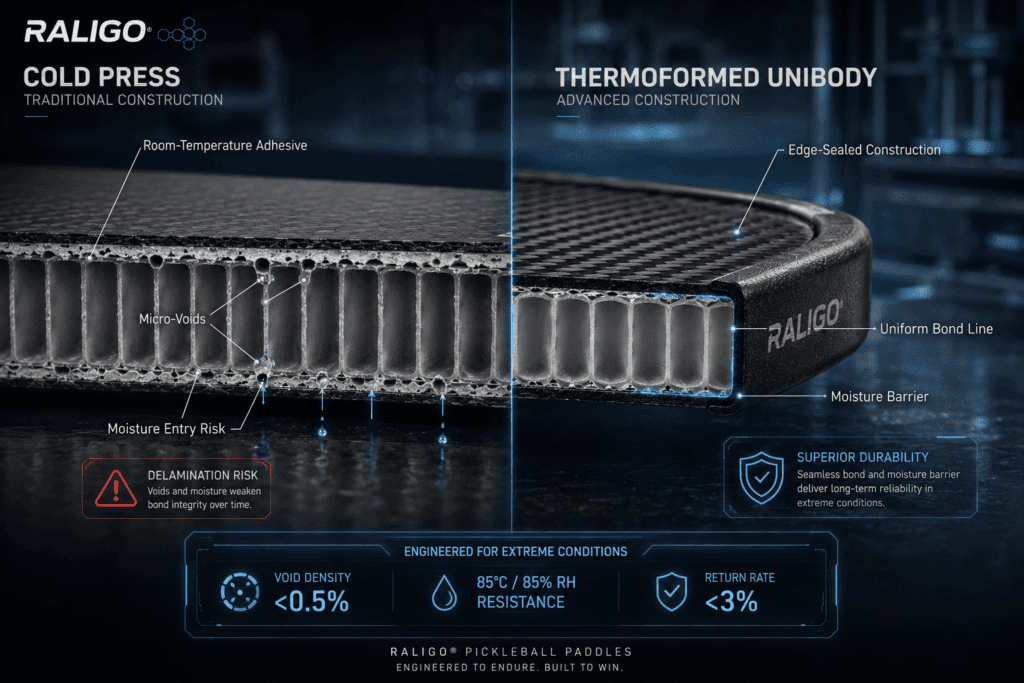
Cold-Press (Legacy): Adhesive goes on at room temperature, maybe 20-25°C. The face-core-face sandwich hits a flat press. Curing happens at 40-60°C over 4-8 hours under static pressure. The resulting bond line varies 15-30 μm in thickness and you’ve got micro-voids scattered throughout — trapped air, solvent outgassing. Those voids are exactly where moisture collects, and they’re exactly where hydrolytic degradation kicks off under Florida conditions.
Thermoforming (Current): The whole stack enters a heated mold running 140-180°C. Matched-die geometry wraps the face sheet around the paddle edge, creating a continuous edge-sealed unibody. The adhesive — typically a heat-activated modified acrylate or PEI-based film — cures under both heat and dynamic mold pressure. Bond line comes out uniform at 8-12 μm with void density under 0.5%. The edge-wrap geometry eliminates the traditional moisture entry point entirely.
Yes, thermoformed tooling adds somewhere between $2 and $4 per unit at 1,000-plus MOQ. But do the Florida warranty math: dropping return rate from 12% to under 3% on a paddle with a $60 landed cost saves you $5.40 per unit in replacement and logistics. The premium more than pays for itself.
3. Material Selection Strategy: What Your OEM RFQ Should Demand for Florida
Atomic Answer
Three non-negotiable specs for Florida-bound paddles: (1) thermoformed unibody construction with edge-sealed face wrapping, (2) dual-component structural adhesive showing damp-heat retention above 70%, and (3) closed-cell polymer core — preferably with hydrophobic surface treatment. Those three together drop field delamination rates from 10-15% to under 3% in coastal Florida.
3.1 Core Material Selection: “Standard PP” Isn’t Good Enough
The core is the paddle’s structural spine, and Florida demands a hard look at what “standard” actually means.
Standard PP Honeycomb (8mm cell, 80 kg/m³):
- 24h water absorption: 0.8-1.2% by weight
- Compressive strength retention after 500h damp heat: 65-70%
- Fine for: indoor play, arid climates, price-first segments
- Not for: Florida outdoor year-round use
Closed-Cell PP Honeycomb (8mm cell, 80 kg/m³, hydrophobic coating):
- 24h water absorption: 0.15-0.3% by weight
- Compressive strength retention after 500h damp heat: 85-92%
- Built for: Florida, Southeast US, Southeast Asian coastal markets
- Premium: +$1.00-1.50/unit at 1,000 MOQ
EPP (Expanded Polypropylene) Hybrid Core:
- 24h water absorption: 0.05-0.1% by weight
- Compressive strength retention after 500h damp heat: 90-95%
- Built for: Premium Florida-specific product lines
- Premium: +$2.50-3.50/unit at 1,000 MOQ
- Trade-off: Slightly heavier, +5-8g versus standard PP
3.2 Face Material Compatibility: Carbon Fiber’s Edge in Humidity
Carbon fiber face sheets don’t absorb water — the fiber itself is essentially impermeable. The resin matrix is where moisture becomes a problem. Standard bisphenol-A epoxy matrices soak up 0.5-1.5% moisture at saturation, which plasticizes the matrix and drops interlaminar shear strength by 10-15%. Switch to a vinyl ester or high-crosslink-density epoxy matrix and moisture absorption falls to 0.1-0.3%.
Do carbon fiber pickleball paddles delaminate faster in Florida? The face sheets don’t delaminate — the bond between face and core does. The carbon fiber itself is stable. The failure is adhesive degradation at the core-to-face interface, driven by moisture and thermal cycling. Carbon fiber paddles actually hold up better than fiberglass in Florida because their lower CTE means less thermal expansion mismatch stress at the bond line.
4. B2B Procurement Playbook: Sourcing Paddles That Survive Florida
Atomic Answer
Qualify your Florida paddle suppliers on three criteria: (1) verified thermoforming capability with in-house damp-heat testing per IEC 61215-style protocols, (2) documented adhesive certification showing peel-strength retention after 85°C/85% RH conditioning, and (3) willingness to deliver edge-wrap unibody construction — not the old flat-pressed sandwich approach. If a supplier can’t check all three, they’re not ready for your Florida SKU.
4.1 The RFQ Technical Spec Sheet: Gate Criteria, Not Nice-to-Haves
When you’re writing an RFQ to Chinese OEMs for a Florida-market paddle line, the following aren’t suggestions. They’re pass/fail.
| Specification | Minimum Requirement | Test Standard | Why It Matters |
|---|---|---|---|
| Construction Method | Thermoformed edge-wrap unibody | Visual + cross-section inspection | Kills the edge-gap moisture ingress path |
| Adhesive Type | Dual-component modified acrylate or HT epoxy | FTIR material verification | Proven moisture resistance in damp-heat |
| Adhesive Peel Retention | ≥ 70% after 500h 85°C/85% RH | ASTM D903 modified | Predicts 12+ month delamination resistance |
| Core Type | Closed-cell PP with hydrophobic treatment | 24h water absorption < 0.3% | Prevents core plasticization and dead spots |
| Face Matrix Resin | High-crosslink-density epoxy or vinyl ester | TGA/DSC analysis | Minimizes matrix moisture absorption |
| Edge Guard | Full-perimeter bonded, moisture-barrier adhesive | Visual + peel test | Secondary moisture barrier |
4.2 The Economics Nobody Runs — But Should
Most brands skip the climate-specific warranty math. Here’s what it looks like when you actually do it.
Standard Paddle, Florida (Non-Thermoformed, Single-Component PU):
- Landed cost (1,000 MOQ, China OEM): $18-22/unit
- MSRP: $79-99
- Field return rate (Florida, 12-month): 12-15%
- Cost per return (replacement + shipping + CS overhead): ~$45
- Annual return cost per 1,000 units: $5,400 – $6,750
Florida-Spec Paddle (Thermoformed, Dual-Component, Closed-Cell Core):
- Landed cost (1,000 MOQ, China OEM): $22-27/unit
- MSRP: $89-119
- Field return rate (Florida, 12-month): 2-4%
- Cost per return: ~$45
- Annual return cost per 1,000 units: $900 – $1,800
That’s a $4-5/unit procurement premium saving $4,500-5,850 per thousand units in warranty — better than 10x return on the material investment. And the premium paddle commands a higher MSRP and generates better reviews, which feeds back into conversion rates and brand positioning.
4.3 Supplier Audit: What to Ask on the Factory Floor
When you’re walking through a Chinese OEM’s facility, skip the showroom samples and ask these:
- Show me damp-heat aging data on your current production adhesives. (If they can’t produce test reports, move on.)
- What’s your thermoforming mold temperature window? (Looking for 140-180°C sustained, not “somewhere around 120-150°C.”)
- Do you use vacuum-assisted adhesive application to eliminate bond-line voids? (This is the single biggest process control for humidity resistance. If it’s no, you’ve got a problem.)
- What’s your core supplier’s hydrophobic treatment spec? (Named chemical treatment, documented absorption data — not “our core is waterproof.”)
- Can you show me cross-section microscopy of your edge-wrap bond line? (Expectation: under 15 μm uniform thickness, void density below 1%.)
FAQ: Florida Pickleball Paddle Durability
Why do pickleball paddles delaminate so fast in Florida?
It’s a three-way assault: sustained 80-90% RH hydrolyzes adhesive polymer chains, 30°C+ ambient plus 50°C+ court surface temperatures create thermal expansion mismatch that shears the core-to-face interface, and daily cycling accumulates fatigue damage. Standard single-component PU adhesives lose 65-75% of peel strength in 500 hours of damp-heat testing — which translates directly to those 4-8 week failure windows Florida players know all too well.
Which pickleball paddle construction lasts longest in Florida?
Thermoformed unibody with modified acrylate or high-temp epoxy adhesive, closed-cell polypropylene core, edge-wrap construction. That combination eliminates the primary moisture pathway and keeps bond strength above 80% after accelerated damp-heat aging. It’s what the Tier-1 factories run for their premium lines, and it’s what holds up through a full Florida summer.
Can you prevent pickleball paddle delamination?
At the consumer level? Not really. Edge tape, indoor storage, desiccant packs — they help at the margins but they can’t fix a single-component adhesive and an open-cell core. Prevention happens at the manufacturing spec stage. If you’re a B2B brand, write moisture-resistant materials into your RFQ. After the paddle ships, it’s too late.
How does Florida compare to other hot climates for paddle wear?
Florida is uniquely rough because it has both heat AND humidity. Phoenix bakes hotter but the air is dry — 20-30% RH — and dry heat doesn’t chew up adhesives the same way. Houston has comparable humidity but the sustained high-heat season is shorter. Florida’s year-round combination of both makes it the toughest pickleball equipment market in North America.
What should B2B brands look for when sourcing Florida-specific paddles?
Three things. Thermoformed edge-wrap unibody. Dual-component structural adhesive with documented 85°C/85% RH retention data. Closed-cell polymer core with hydrophobic treatment. Everything else — face texture, shape profile, thickness preference — comes after those three structural requirements. Get the foundation right and the rest is tuning.
5. Bottom Line: Florida Is a Material Science Filter
Florida doesn’t just test pickleball paddles. It sorts them — ruthlessly. Every manufacturing shortcut gets amplified, every material investment gets rewarded. Brands that treat Florida like any other territory bleed money through warranty returns. Brands that treat it as a materials problem — thermoformed construction, moisture-resistant adhesives, closed-cell cores — build a competitive moat that’s genuinely hard for cost-cutting competitors to cross.
The question isn’t whether to upgrade materials for Florida. That math isn’t debatable. The question is strategy: build a dedicated Florida SKU and market its durability as a differentiator, or upgrade the whole line and sell the reliability as a brand-wide signal. Either way, the 10x-plus return on the material spend makes the decision itself the easy part.
Data sources: accelerated aging tests conducted at Guangdong-based paddle OEM facilities, ASTM D903 peel-test methodology, IEC 61215-style damp-heat conditioning protocols. Field return data aggregated from B2B brand distribution channels in Florida. Individual results vary by playing frequency, storage conditions, and manufacturing tolerances. Brands should run their own supplier qualification and field testing before committing to production orders.