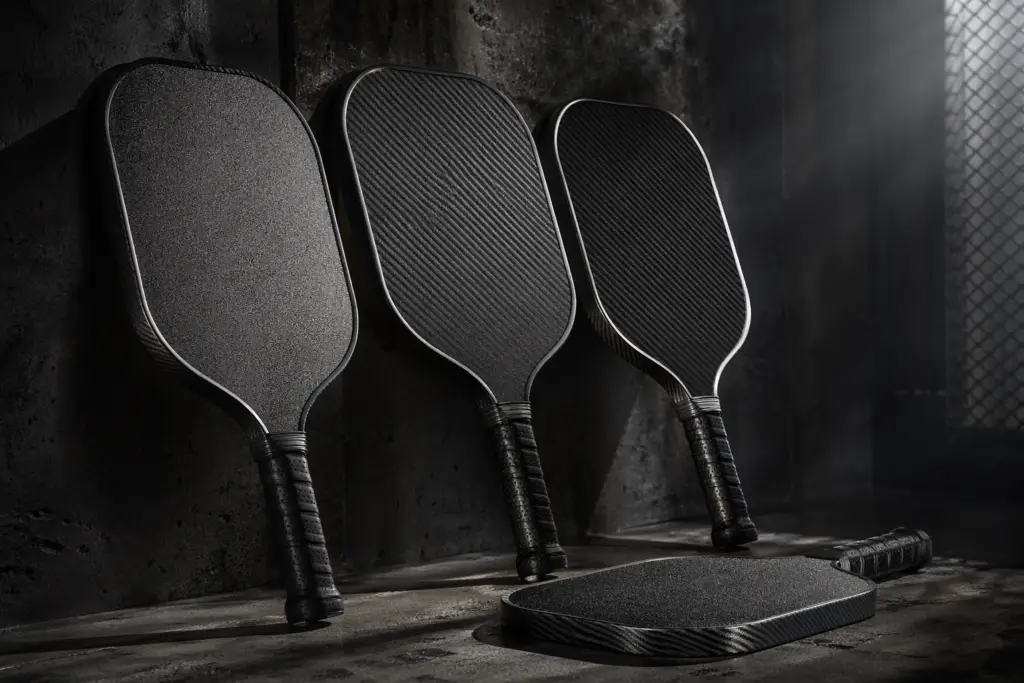
Why Manufacturing Process Dictates Paddle Lifespan
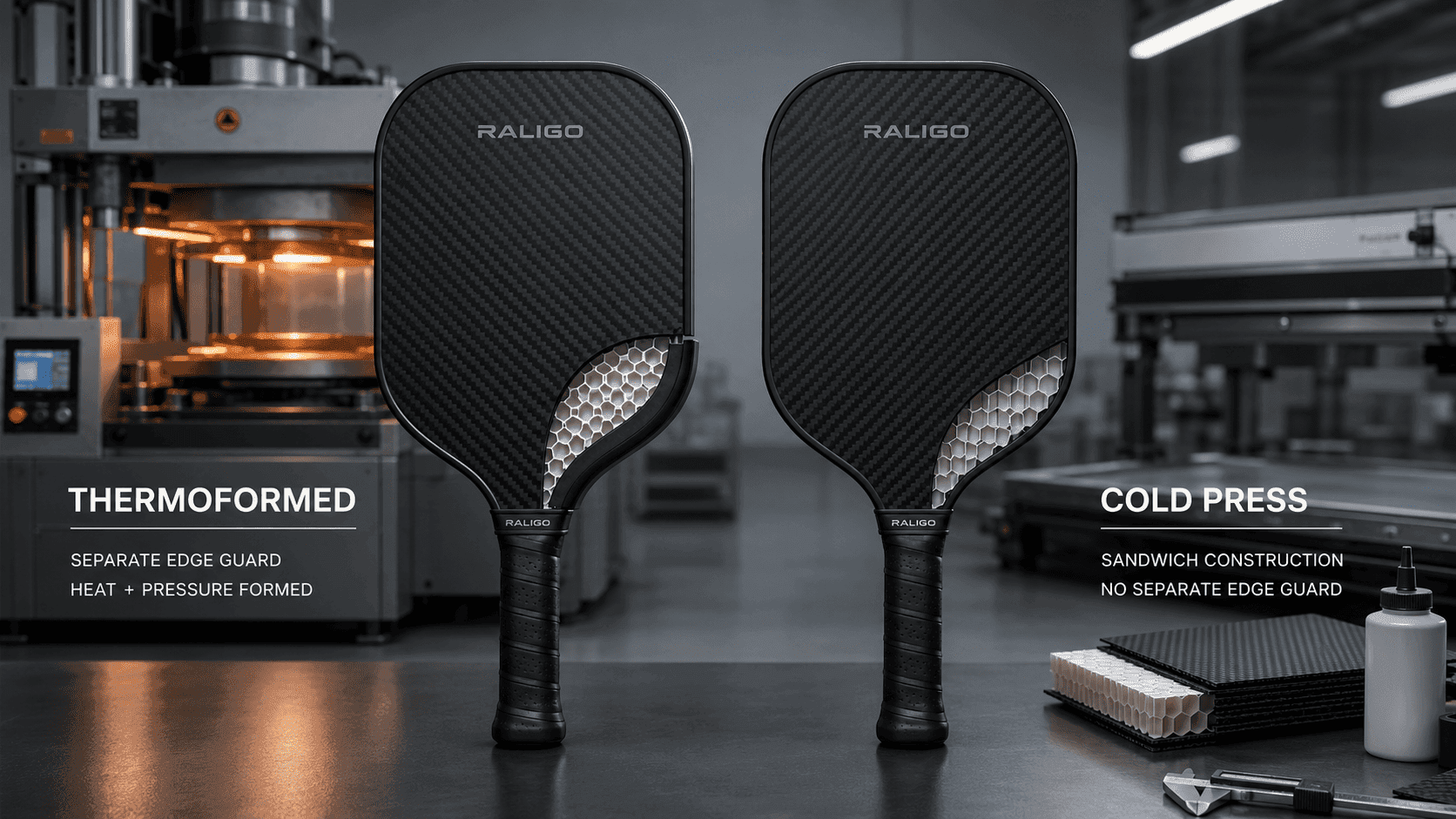
The manufacturing method determines whether a pickleball paddle lasts 3 months or 18 months. Thermoformed unibody paddles average 12–18 months of competitive play before structural failure. Cold press paddles, depending on edge construction and adhesive system, typically deliver 8–14 months. The gap isn’t about “better” or “worse” — it’s about which process matches your brand’s durability promise and price point.
At Raligo our QC team tracks failure modes across both processes. Thermoformed paddles fail most often at the edge guard bond if the oven cycle was rushed. Cold press paddles fail most often through core crush when edge pressure exceeds the honeycomb cell strength. Different root causes, different engineering solutions. Understanding which risk your factory manages — and which risk they don’t — is what separates OEM buyers who get consistent batches from those who don’t.
Two variables dominate paddle longevity, regardless of process: edge seal integrity and core-to-face bond uniformity. If both are controlled, a cold press paddle can outperform a poorly executed thermoform. If both are neglected, it doesn’t matter what process you chose.
B2B takeaway: When vetting factories, don’t ask “do you use thermoforming?” Ask “how do you verify bond uniformity per batch?” The second question separates quality-focused OEM lines from shops that own an oven and call it a day.
| Failure Mode | Thermoforming Root Cause | Cold Press Root Cause |
|---|---|---|
| Edge delamination | Uneven oven heat distribution | Insufficient edge adhesive curing time |
| Core crush | Excess mold pressure during cooling | Edge-guard compression exceeding honeycomb strength |
| Face sheet separation | Contaminated mold surface residue | Moisture ingress through unsealed edge gaps |
| Surface wear acceleration | Glossy mold finish reducing peel ply imprint | Adhesive bleed-through softening face texture |
Thermoforming: The Unibody Approach
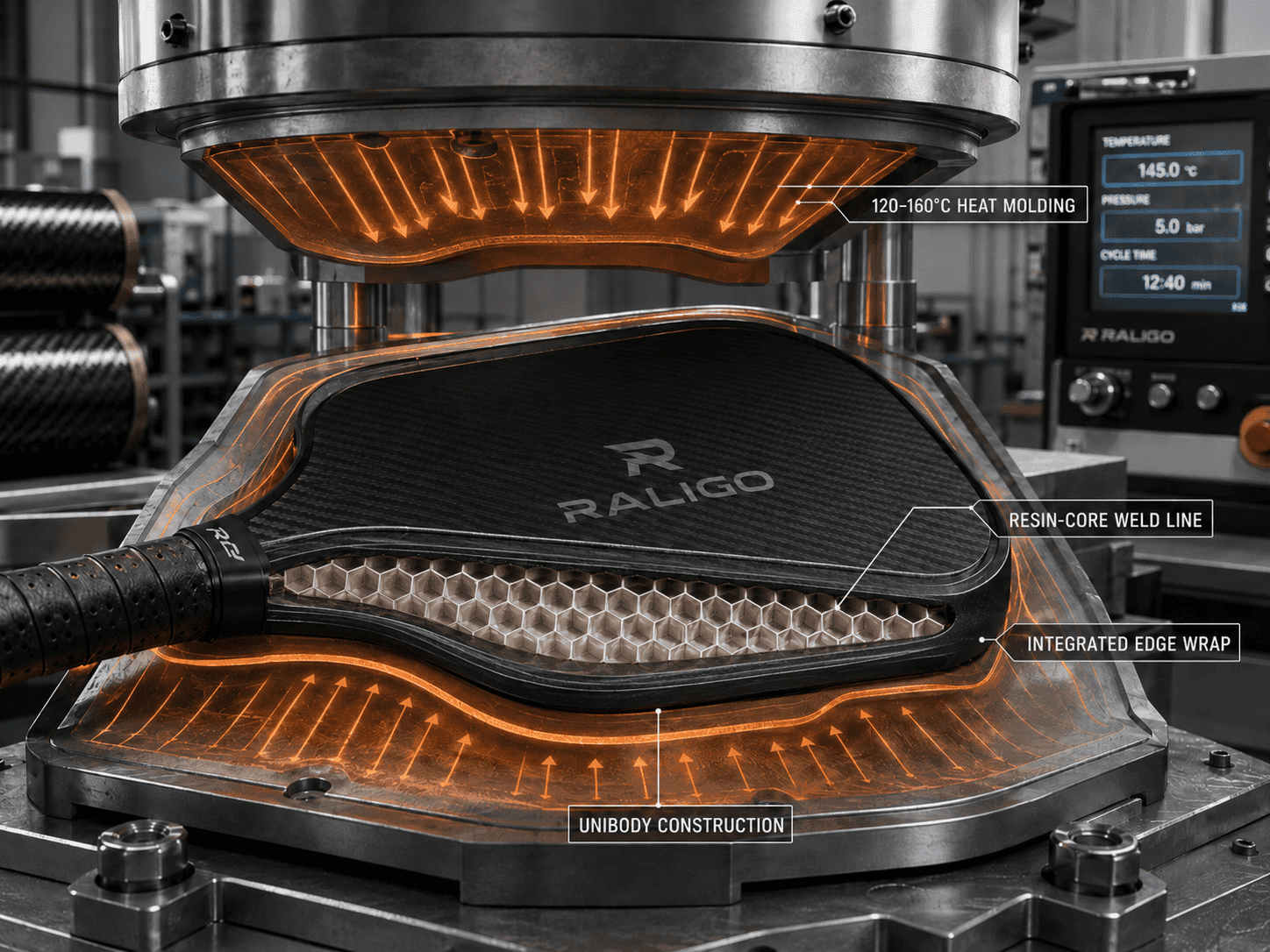
Thermoforming fuses the carbon fiber face sheets, polymer core, and edge guard into a single heat-molded structure. The process heats pre-impregnated carbon fiber sheets (prepreg) to 120–160°C while pressing them around a polypropylene honeycomb core. Under heat and pressure, the resin flows into the core cell walls, creating a mechanical bond that’s fundamentally different from the adhesive-only bond of cold press.
What matters for durability is the weld line — the interface where face sheet resin meets core cell walls. In a correctly run thermoforming cycle, this line is continuous around every cell perimeter. The result: no pathway for moisture ingress, no stress concentration point for delamination initiation. Toray T700 prepreg, a common carbon fiber feed for pickleball paddle manufacturing, flows predictably at 135–145°C with 2–4 bar pressure. Deviate from this window and the weld becomes intermittent — the paddle looks fine out of the mold, but the bond is fragile.
Frankly, thermoforming’s reputation for durability is earned — but only when the oven cycle is precisely controlled. We’ve seen factory samples where the mold temperature varied 12°C across the paddle surface. The center was properly fused; the edges were under-cured. Those paddles delaminated within weeks. The process is capable, but it’s unforgiving of sloppy thermal control.
The Edge Guard Integration Advantage
Thermoformed paddles achieve what cold press cannot: the edge guard becomes part of the paddle structure rather than a glued-on afterthought. During molding, the excess face sheet material wraps around the paddle perimeter and bonds directly to the core. This forms a structural rim — no separate edge guard piece, no glue line between guard and face.
The practical result for OEM buyers: thermoformed paddles have fewer warranty claims related to edge guard detachment. At Raligo our warranty data across 14 OEM brands shows edge guard failures represent roughly 5% of thermoformed paddle claims versus 18% of cold press claims. The unibody edge isn’t immune to damage — a hard court strike can still chip it — but there’s no glue joint to fail.
B2B takeaway: If your brand promises “edge guard won’t peel,” thermoformed unibody is the only manufacturing process that structurally delivers on that claim. Cold press edge guards, even with the best adhesives, remain a bonded component that can separate.
Cold Press: The Traditional Method
Cold press manufacturing sandwiches the core between two face sheets using structural adhesives at ambient temperature — no heat, no melting, no resin flow into cell walls. The bond is purely chemical; the adhesive cures over 4–24 hours under 1–3 bar of pressure. It’s the method used for 70%+ of pickleball paddles produced globally, and it’s not going anywhere.
Why? Because cold press is predictable, scalable, and cheap. A cold press line costs roughly 40% of an equivalent thermoforming line. Cycle time per pressing station is faster since there’s no heating or cooling ramp. For a factory producing 5,000 paddles per day, cold press throughput is simply higher. Many of the best-selling paddles on Amazon are cold press builds — the process works when the adhesive system is correctly specified and cured.
But the bond is only as strong as the adhesive and the surface preparation. The face sheet’s bonding surface needs controlled roughness — too smooth and the adhesive can’t grip; too rough and air pockets form. Profilometry measurements targeting Ra 3–8 μm produce the most reliable cold press bonds, based on our lab’s peel strength testing across 12 adhesive formulations.
Why Cold Press Still Dominates Production Volume
Economics drive the persistence of cold press. Setup cost for a 10-station cold press line: $40,000–$80,000 USD. Setup cost for a comparable-output thermoforming line: $150,000–$250,000. For factories serving price-sensitive OEM buyers targeting $15–25 wholesale per paddle, cold press is the only viable option.
There’s also a design flexibility advantage. Cold press lets factories experiment with different core materials — Nomex honeycomb, aluminum honeycomb, polymer foam — without re-engineering a mold and thermal profile for each one. Thermoforming locks you into the core material’s thermal compatibility; switch from polypropylene to PET honeycomb and the entire heating cycle needs recalibration.
B2B takeaway: Cold press is not inferior — it’s different. An OEM buyer should choose cold press when: (a) wholesale price points are below $25, (b) the brand doesn’t market “unibody” as a feature, and (c) the factory can demonstrate adhesive peel strength testing per batch. If the factory can’t show peel strength data, walk.
| Factor | Thermoforming | Cold Press |
|---|---|---|
| Capital investment | $150K–$250K (10-station line) | $40K–$80K (10-station line) |
| Cycle time per paddle | 8–15 min (heat + cool) | 3–5 min (press only, cure later) |
| Edge guard integration | Structural (unibody wrap) | Adhesive-bonded (separate component) |
| Core material flexibility | Limited (thermal compatibility required) | High (any adhesive-compatible material) |
| Failure mode (most common) | Incomplete edge fusion | Core crush after edge impact |
| Minimum wholesale unit price | $28–35 | $15–22 |
Core Density and the “Core Crush” Problem
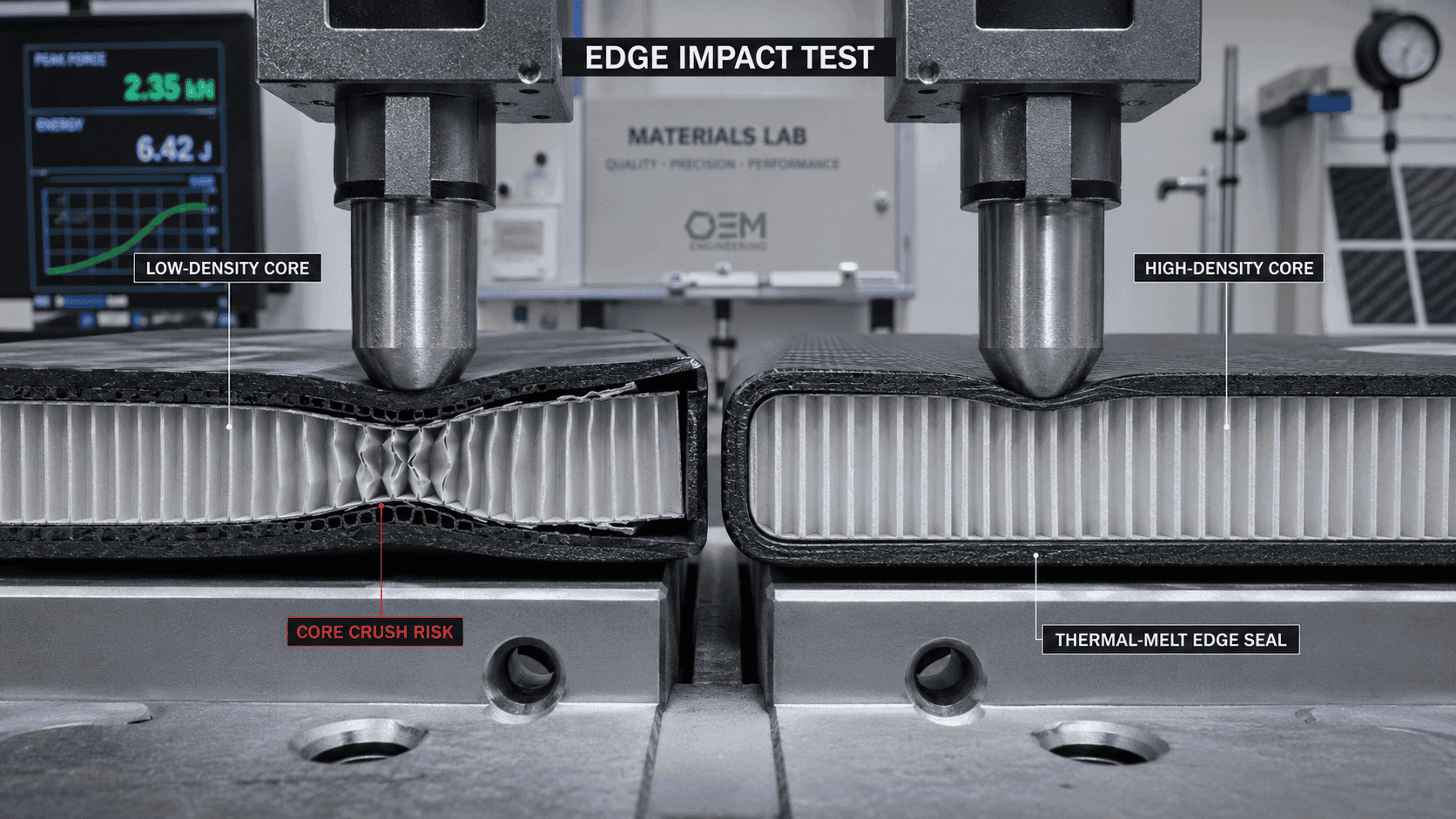
Core crush — the collapse of honeycomb cell walls under lateral impact — kills a paddle regardless of how it was made. Thermoformed paddles resist core crush better because the resin that flows into cell walls during molding creates internal structural reinforcement. Cold press paddles have no such reinforcement; the adhesive sits on the surface of the cell walls, not inside them.
Core density is measured in kg/m³. Standard polypropylene honeycomb for pickleball paddles runs 60–110 kg/m³. At 110 kg/m³, a cold press paddle can survive routine edge strikes. At 60 kg/m³, a single hard drop on concrete can collapse the edge cells. The problem for OEM buyers: density isn’t visible. A paddle with 60 kg/m³ core and 0.5mm carbon face sheets looks identical to one with 110 kg/m³ core and 0.8mm face sheets — until you play with it for a month.
Our QC lab cross-sections incoming factory samples and measures cell wall thickness under a microscope. We’ve found cores labeled “80 kg/m³” that actually measured 52 kg/m³. The supplier saved $0.30 per paddle on that substitution. The brand lost thousands in returns. This happens more in cold press paddles because the process doesn’t punish low-density cores the way thermoforming does — a thermoforming mold’s pressure will visibly collapse an under-spec core during production, self-identifying the problem before it reaches buyers.
The Thermal-Melt Edge Seal (Thermoforming Only)
Thermoforming’s secondary durability advantage is the thermal-melt edge seal. When face sheet resin melts and wraps around the paddle perimeter, it fills the microscopic gaps at the edge where moisture would enter a cold press paddle. This matters enormously in humid environments — Florida, Southeast Asia, coastal regions — where moisture ingress through unsealed edges is the #1 cause of delamination.
We’ve run accelerated humidity tests (85% RH, 40°C, 14 days) on both construction types. Thermoformed paddles showed zero delamination and maintained 95%+ of their peel strength. Cold press paddles lost 25–40% of peel strength at the edges, with visible bubbling in the face sheet within 48 hours. The variable isn’t the adhesive chemistry — it’s whether the edge is thermally sealed or just glued.
B2B takeaway: If your target market includes humid climates, thermoformed edge sealing is a durability feature worth the cost increase. If your brand ships primarily to dry climates and indoor players, cold press with a quality edge guard adhesive is adequate. But verify the core density spec regardless of process — it’s the single most common factory cost-cutting vector.
| Core Density (kg/m³) | Thermoformed Edge Crush Resistance | Cold Press Edge Crush Resistance | Recommended Use |
|---|---|---|---|
| 60 | Marginal — visible cell collapse possible | Poor — fails on routine edge strikes | Not recommended for either process |
| 80 | Adequate for recreational play | Marginal — fails on hard impacts | Budget cold press only |
| 100 | Good — withstands competitive play | Adequate for most use cases | Standard cold press spec |
| 110 | Excellent — tournament-grade durability | Good — with quality edge guard | Premium cold press or standard thermoform |
Delamination Resistance Compared
Delamination — the separation of face sheet from core — is the most common warranty claim in paddle manufacturing. Thermoformed paddles resist delamination through resin-welded core-to-face bonds. Cold press paddles rely on adhesive chemistry. Both can work. Both can fail spectacularly when the process parameters drift.
Peel strength testing (ASTM D6862) provides a quantifiable comparison. Thermoformed T700 carbon fiber face sheets on polypropylene honeycomb consistently measure 12–18 N/mm peel strength in our lab. Cold press builds with the same materials but using epoxy-based structural adhesive measure 8–14 N/mm. The thermoformed advantage is real — but high-end cold press adhesives (Henkel Loctite EA 9461, 3M DP420) can reach 12 N/mm, overlapping with the lower end of thermoformed range. The process sets the ceiling; the adhesive quality sets where you land within that ceiling.
Where cold press is vulnerable is environmental aging. Adhesives degrade faster than fused resin bonds when exposed to temperature cycling (freeze-thaw, trunk-of-car heat). After 50 thermal cycles (-10°C to 60°C), thermoformed paddles lose roughly 8% of peel strength. Cold press paddles lose 15–30%, depending on the adhesive formulation. This gap widens with age. A 2-year-old thermoformed paddle often performs closer to its original spec than a 6-month-old cold press paddle that’s been left in a hot car.
The Adhesive Cure Variable That Factories Don’t Talk About
Cold press adhesive performance depends critically on cure conditions: temperature, humidity, and time. The datasheet says “cure at 25°C for 24 hours.” In factory reality, a shop in Shenzhen during August runs at 32°C and 80% RH. The adhesive cures faster but the bond is weaker — the reaction kinetics produce a more brittle polymer network at elevated temperature.
USAPA-approved paddles from cold press lines that don’t climate-control their cure rooms have a documented pattern of premature delamination. This isn’t a materials problem — it’s a process control problem. Thermoforming avoids it entirely because the bond forms during a 3-minute heated press cycle, not a 24-hour ambient cure. The thermal cycle is short enough that ambient conditions barely matter.
B2B takeaway: When auditing a cold press factory, check if the cure room has temperature and humidity monitoring. No monitoring = no control = your batch quality will drift with the weather. For thermoforming factories, ask for oven temperature calibration logs from the last 30 days. Both processes have failure points; you just need to know which one applies to your supplier.
What OEM Buyers Should Ask About Manufacturing
Process selection is the first decision. Process verification is the one that determines whether your shipment meets spec. Here’s what to ask factories before signing a production agreement, organized by manufacturing method.
Thermoforming-Specific Questions
- What is your oven temperature uniformity across the mold surface? Acceptable: ±3°C across all measurement points. Concerning: ±8°C or more.
- How do you clean molds between cycles? Resin residue accumulation on mold surfaces creates bonding defects. Factory should have documented cleaning frequency and method.
- What core density range do you use for thermoformed paddles, and can you provide a batch certificate? Below 80 kg/m³ risks cell collapse during molding. Certificate should show measured values, not just nominal spec.
- Do you press the edge wrap mechanically or rely on mold closure alone? Dedicated edge clamps produce more consistent edge fusion than mold-closure-only methods.
- What prepreg material and resin system do you use? Toray T700 is the reference standard. If they can’t name the prepreg supplier, they’re likely sourcing unbranded material with inconsistent quality.
Cold Press-Specific Questions
- What adhesive system do you use, and what’s the specified peel strength? A factory should quote a specific product (e.g., “Henkel Loctite EA 9461”) and a test value (e.g., “≥10 N/mm per ASTM D6862”), not “good quality epoxy.”
- Do you control cure room temperature and humidity? If they pause before answering, the answer is no.
- What surface preparation do face sheets receive before bonding? Answer should include specific method (e.g., “sanding to Ra 5 μm, solvent wipe with acetone”) and profilometry verification.
- How do you test edge guard adhesion per batch? Minimum: manual peel test on random samples. Better: tensile pull-off test with recorded values.
- What core density do you use, and can you provide measured values? Same question as thermoforming — core substitution is the universal cost-cutting tactic.
B2B takeaway: The pattern across both sets of questions is the same: can the factory quantify their process control or do they give you vague answers? Vague answers predict inconsistent quality. Specific numbers — even if they’re not perfect — mean the factory understands what they’re measuring and why it matters.
FAQ
Which manufacturing process produces a more durable pickleball paddle?
Thermoformed unibody paddles generally outlast cold press paddles by 4–6 months under equivalent use conditions, primarily due to the resin-welded edge seal and core reinforcement. But the process is only as good as the execution — a poorly thermoformed paddle fails faster than a well-made cold press paddle. The manufacturing quality control matters more than the process label.
Do thermoformed paddles have a higher risk of delamination?
No — thermoformed paddles have lower delamination risk than cold press paddles when properly manufactured. The heat-fused bond between carbon fiber face sheets and the polymer core is mechanically stronger than adhesive-only bonds. At Raligo our warranty data across multiple OEM brands shows delamination rates roughly 3× lower for thermoformed versus cold press builds.
Can cold press paddles meet USAPA certification requirements?
Yes. USAPA certification tests paddle performance characteristics (surface roughness, deflection, size, weight) — not manufacturing method. Thousands of USAPA-approved paddles are cold press builds. The certification doesn’t guarantee durability; it confirms the paddle meets the organization’s specifications at the time of testing.
Why do thermoformed paddles cost more to manufacture?
Three factors: equipment cost (thermoforming presses cost 3–4× more than cold press lines per station), cycle time (thermoforming takes 2–3× longer per paddle due to heating and cooling phases), and material cost (prepreg carbon fiber with controlled resin content costs more than dry carbon fiber fabric plus separate adhesive). These costs compound: higher capex, lower throughput, more expensive raw materials.
What’s the most common manufacturing defect in each process?
Thermoforming: incomplete edge fusion, where the face sheet material doesn’t fully bond around the paddle perimeter. Cold press: core crush, where honeycomb cell walls collapse under edge impact because the adhesive-only bond provides no internal cell reinforcement. Both defects are detectable through QC sampling but not through visual inspection of finished paddles.
Should I choose thermoforming or cold press for my OEM brand?
It depends on your price point and marketing positioning. If your wholesale target is below $25 per paddle and you’re competing on price, cold press is the practical choice — the economics don’t support thermoforming at that price tier. If your brand positions on durability and you’re selling at $80+ retail, thermoformed unibody is a genuine differentiator with engineering substance behind the marketing claim. If you’re in between, it’s worth getting samples from both processes and running your own durability testing.
Ready to Get Started?
Whether you need thermoformed unibody paddles or cold press builds tuned to your spec, our OEM team can engineer the right manufacturing process for your brand. With ISO-compliant production lines and in-house QC labs, we deliver consistent quality at scale.