Ohio is the third-largest manufacturing state in the United States, with $137.9 billion in manufacturing GDP — 16.5% of the state’s total economic output. It supports over 687,000 manufacturing jobs and ranks fifth nationally in total manufacturing output. When a B2B pickleball brand sources paddles from or for Ohio, it’s not just another purchase order. It’s a transaction that moves through one of the densest industrial supply chains in North America — and one that demands component specifications written for a climate that swings from 95°F summer humidity to -5°F winter deep freeze.
Most OEM procurement guides treat paddle performance as a single-climate equation. Pick a core density. Choose a face material. Done. But the Ohio market doesn’t work that way. A paddle optimized for Columbus summer heat — where polypropylene cores soften and sweet spots expand — becomes a brittle liability when a Cleveland player pulls it out of a frozen trunk in January. A paddle stiffened for winter play feels mushy and uncontrolled during July tournaments in Cincinnati. Ohio buyers don’t get to pick one weather. They get both ends of the spectrum, often within the same week.
This guide is written for B2B procurement teams, brand owners, and distributors sourcing pickleball paddles for the Ohio and greater Midwest market. It covers the dual-climate engineering challenge that single-climate OEM factories consistently miss, the core material selection framework that produces year-round performance, the supply chain advantages Ohio’s manufacturing ecosystem provides to local B2B buyers, and the supplier qualification checklist that distinguishes climate-competent factories from single-season specialists.
1. The Ohio Climate Equation: Why Single-Climate Cores Fail in the Midwest
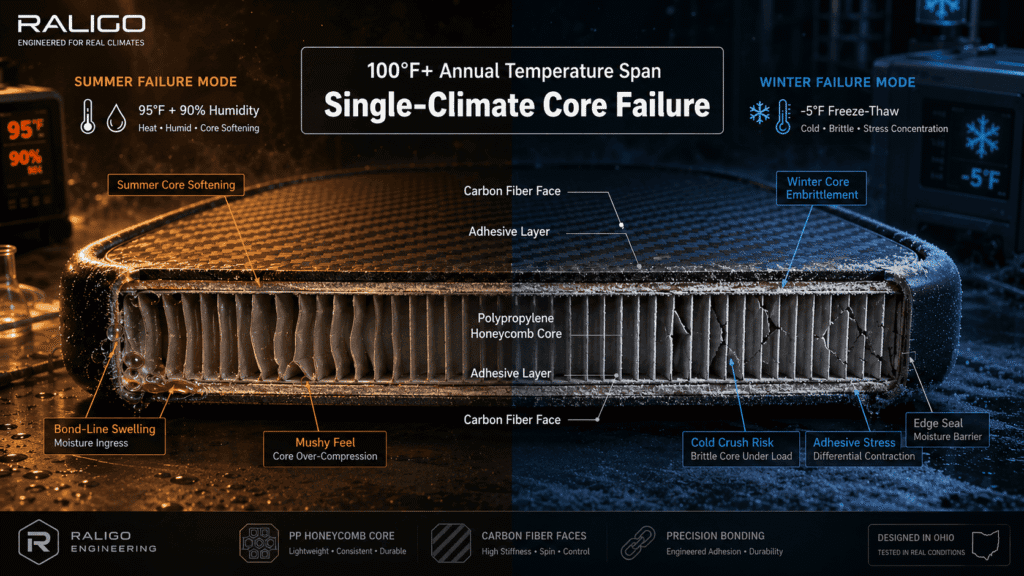
Atomic Answer: Ohio’s climate exposes pickleball paddles to a temperature span exceeding 100°F annually — from -5°F winter lows with freeze-thaw cycling to 95°F summer highs with 90% humidity. This thermal range demands a core formulation that balances cold-weather toughness with heat-weather stability, a dual requirement that standard single-climate polypropylene cores — whether optimized for warm or cold conditions — cannot meet over a full calendar year of play.
Ohio sits at the convergence of three climate zones: the humid continental belt from the Great Lakes, the subtropical moisture tongue from the Gulf of Mexico, and the polar air masses that sweep down from Canada unobstructed by mountain ranges. This geographic reality produces a temperature profile unlike either the consistently hot southern markets or the consistently cold upper Midwest markets that most OEM factories design for.
In practical terms for paddle procurement, Ohio buyers face two distinct failure modes that trigger in opposite seasons:
Summer failure mode: Core softening. At sustained temperatures above 85°F — common in Ohio from June through August — standard polypropylene cores lose structural stiffness. The cell walls that provide impact response at 72°F become overly compliant, producing a “mushy” feel. Players compensate with harder swings, which increases core fatigue. Humidity compounds the problem: moisture absorbed by the edge guard and handle assembly during humid play sessions creates micro-swelling that accelerates bond-line degradation when temperatures later drop.
Winter failure mode: Core embrittlement. At temperatures below 25°F — common in Ohio from December through February — polypropylene’s elastic modulus climbs 60-70% above room-temperature baseline. Cell walls lose the ability to deform elastically under impact and instead develop permanent crush damage. The carbon fiber face, already stiffened by cold epoxy, transmits impact shock directly into the hardened core rather than distributing it across the face plane. Combined with freeze-thaw moisture cycling that wedges adhesive bonds apart through ice expansion, a single Ohio winter can permanently degrade a paddle that performed flawlessly through the preceding summer.
The core problem — literally — is that standard OEM polypropylene formulations are tuned for a single operating temperature window. Adjust cell wall thickness and resin formulation for cold-weather toughness, and summer play suffers. Optimize for heat stability and the paddle becomes brittle below 40°F. Ohio demands both properties simultaneously — and achieving that requires engineering decisions that start at the raw material level.
| Ohio Region | Avg Summer High | Avg Winter Low | Annual Temp Span | Humidity Range | Freeze-Thaw Cycles/Year |
|---|---|---|---|---|---|
| Northeast (Cleveland, Akron) | 82-85°F | 18-22°F | ~100°F | 65-90% | 50-65 |
| Central (Columbus) | 85-88°F | 20-24°F | ~105°F | 60-90% | 45-55 |
| Southwest (Cincinnati, Dayton) | 87-90°F | 22-26°F | ~108°F | 60-95% | 35-50 |
| Northwest (Toledo) | 83-86°F | 16-20°F | ~103°F | 65-90% | 55-70 |
2. Core Engineering for Dual-Climate Markets: The Ohio Specification Framework
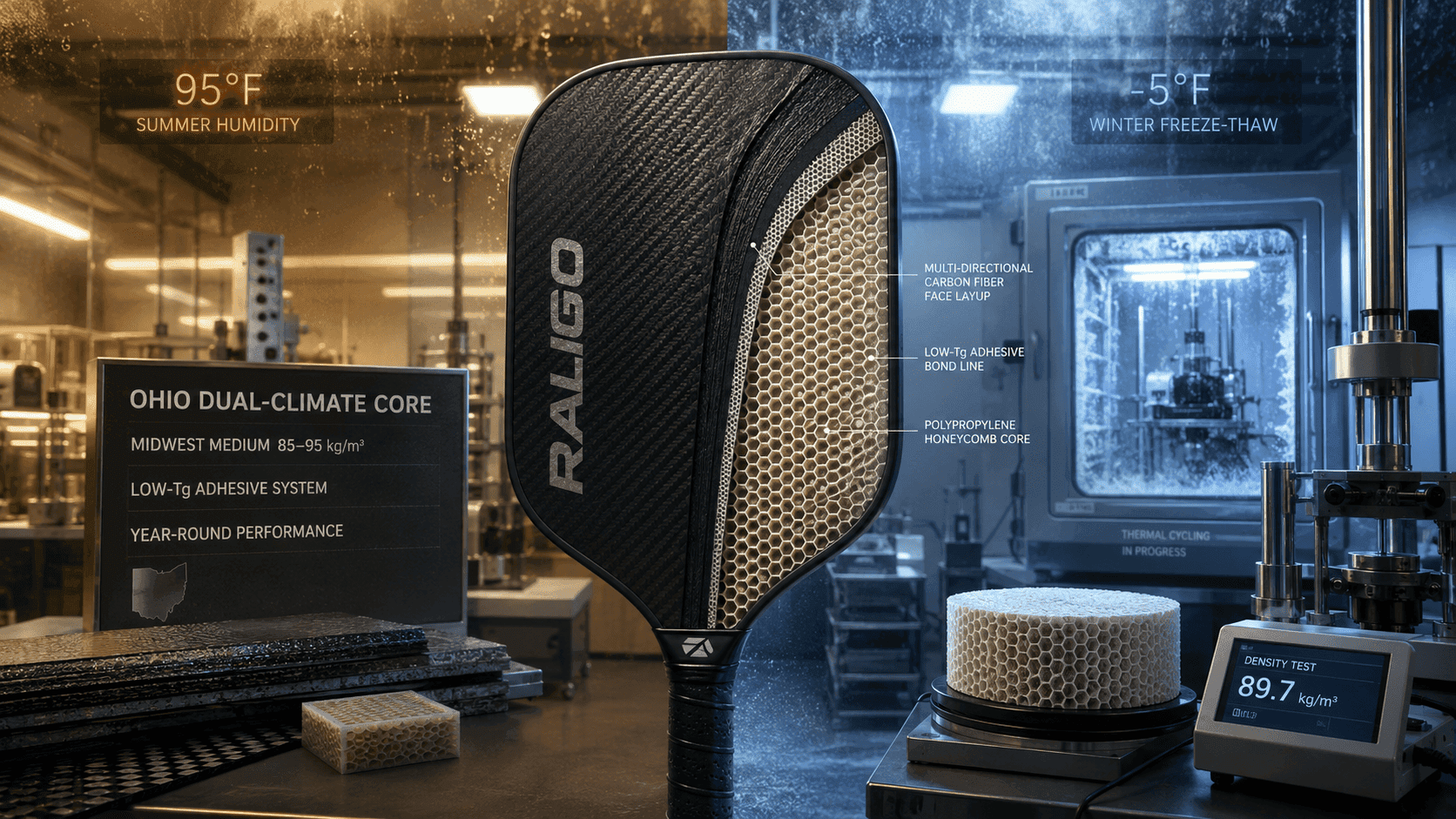
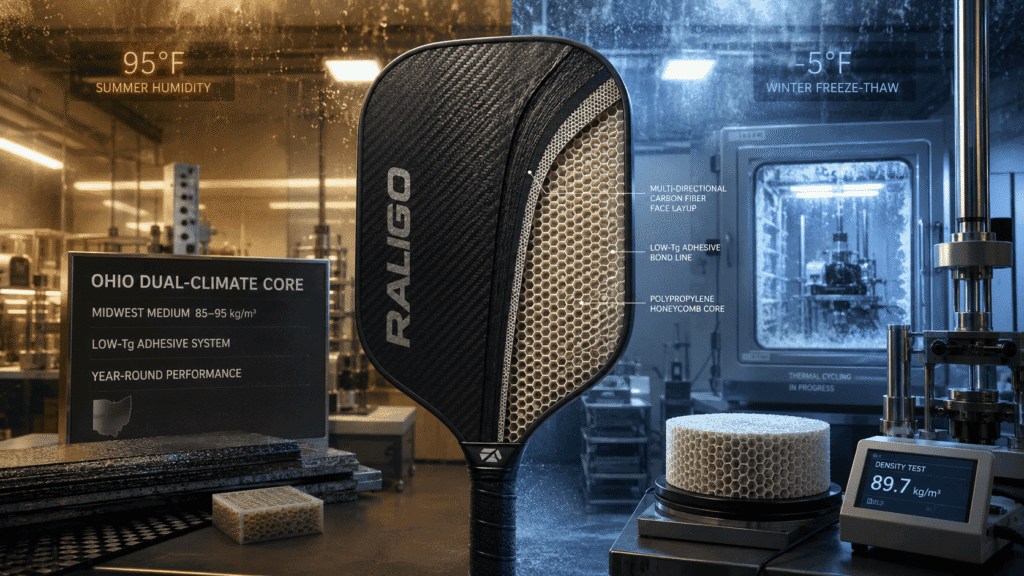
Atomic Answer: The engineering solution for dual-climate paddle cores combines three design elements: a medium-density polypropylene honeycomb with modified copolymer formulation that widens the elastic operating window, a temperature-stable adhesive system with low glass-transition characteristics, and a multi-directional carbon fiber face layup that distributes impact stress across a larger area even when the core stiffness has shifted due to ambient temperature. No single one of these elements solves the dual-climate problem alone. Together, they create a paddle that performs acceptably from 10°F to 100°F rather than being optimized for a 30-degree window.
2.1 Core Density: The Goldilocks Zone for Ohio
Pickleball paddle cores span a density range from approximately 60 kg/m³ (ultra-soft) to 120 kg/m³ (high-density control). The conventional wisdom for cold climates recommends medium-to-high density cores — around 95-110 kg/m³ — because denser cell structures resist embrittlement better at low temperatures. The conventional wisdom for hot climates recommends lower density — 70-85 kg/m³ — because softer cores don’t become excessively mushy when ambient heat further reduces stiffness.
For Ohio’s dual-climate requirement, the engineering sweet spot is 85-95 kg/m³ — what the industry increasingly calls “Midwest Medium” density. At 85 kg/m³, the core retains sufficient compliance for summer play in 90°F humidity without collapsing into mush. At 95 kg/m³, it maintains enough structural integrity at 15°F to resist cold crush while still providing acceptable feel. The 10 kg/m³ range between these values represents the tuning window that OEM engineers work within to match specific product line characteristics.
The difference from standard single-climate cores comes from the copolymer formulation, not just the density number. Midwest Medium cores typically incorporate ethylene-propylene copolymer modifications that reduce the temperature sensitivity of the elastic modulus curve. Standard homopolymer polypropylene might show a 70% stiffness increase between 72°F and 20°F. A properly formulated copolymer mix can narrow that to 35-45% — still noticeable, but no longer catastrophic.
For B2B buyers, this means the raw material specification on the OEM purchase order matters. “16mm polypropylene honeycomb core” is insufficient procurement language for the Ohio market. The specification needs to include density range (85-95 kg/m³ minimum), copolymer type (ethylene-propylene modified preferred), and cell size uniformity tolerance (±0.2mm across any 50mm² sample area). Factories that can’t provide copolymer certification for their PP feedstock are producing single-climate cores regardless of the density number on the spec sheet.
2.2 Adhesive Systems: The Temperature Bridge Nobody Specifies
The adhesive layer between the carbon fiber face and polypropylene core is the most overlooked component in paddle procurement — and the one most responsible for dual-climate failures. Standard thermoset polyurethane adhesives used in most Asian OEM factories have glass transition temperatures (Tg) between 40-60°F. Below that Tg, the adhesive transitions from a flexible, energy-dissipating elastomer into a rigid, brittle solid that transmits rather than absorbs impact shock.
For Ohio’s winter conditions, where playing temperatures routinely dip below the Tg of standard adhesives, this creates a predictable failure cascade: the adhesive stiffens → it can’t accommodate the differential thermal contraction between the carbon face (near-zero thermal expansion) and polypropylene core (measurable contraction) → shear stress accumulates at the bonded interface → repeated impact cycling propagates micro-delamination → face-to-core separation initiates at the paddle perimeter and works inward.
The solution is specification of low-Tg adhesive systems — polyurethane formulations with Tg values below 0°F, or hybrid epoxy-polyurethane systems that maintain elastomeric behavior through the full Ohio temperature range. These cost approximately 15-25% more than standard adhesives at the raw material level, which translates to roughly $1.50-3.00 per paddle in B2B procurement pricing. Against the cost of winter warranty returns and brand reputation damage in the Ohio market, that premium is negligible.
B2B buyers should verify adhesive Tg specifications through third-party DSC (Differential Scanning Calorimetry) testing of production samples. The specification on the PO should read: “Adhesive system must demonstrate Tg ≤ -10°F per ASTM E1356 with elongation at break ≥ 150% at 0°F per ASTM D638.” Factories that can’t provide this data aren’t producing dual-climate paddles — they’re producing warm-climate paddles and hoping nobody tests them in the cold.
2.3 Carbon Fiber Layup: Multi-Directional Construction for Thermal Stress Distribution
Standard paddle face construction uses a unidirectional or bidirectional carbon fiber layup — fibers running in one or two primary directions, maximizing stiffness and power transmission along those axes. This works well at single temperatures. Across a 100°F temperature span, it concentrates thermal expansion mismatch stress along the fiber axes, creating stress risers at the fiber-matrix interface that accelerate cold-weather degradation.
For dual-climate applications, a three-directional layup — 0°, 60°, and -60° fiber orientations — distributes impact and thermal stress across a quasi-isotropic plane. The largest single-direction stress concentration at any given temperature drops by approximately 40% compared to bidirectional construction. This doesn’t prevent cold stiffening — nothing prevents the polymer physics — but it reduces the peak stress at any single point below the threshold where micro-cracking initiates.
Several Ohio-adjacent manufacturers have adopted this approach. Thompson Pickleball in Boyne City, Michigan, uses Toray T1100 raw carbon fiber with multi-directional layup for their Michigan-engineered paddles — and the same construction logic applies directly to the Ohio market. T1100’s 40% higher tensile strength compared to standard T700 provides additional headroom against cold-weather fiber fracture, though at a raw material cost premium that B2B buyers need to model against expected warranty reduction.
3. The Ohio Manufacturing Advantage: Why B2B Buyers in the Industrial Corridor Have Leverage
Atomic Answer: Ohio’s $137.9 billion manufacturing sector — including 34 athletic and sporting goods manufacturing businesses employing 1,088 workers, plus the dense polymer processing, composites fabrication, and industrial adhesives supply chain concentrated in the Cleveland-Akron-Youngstown corridor — gives Ohio-based B2B pickleball buyers access to domestic materials testing, rapid prototyping, and supplier qualification capabilities that brands outside the manufacturing belt must pay a premium to access. The same industrial infrastructure that produces aerospace composites for Wright-Patterson AFB suppliers can validate pickleball paddle material specifications at a fraction of the cost of overseas testing.
Ohio’s manufacturing ecosystem isn’t just big — it’s structurally aligned with the material technologies that pickleball paddles depend on. The state’s polymer and advanced materials sector, concentrated in the Akron-Cleveland corridor (historically the global center of polymer science and rubber processing), provides a testing and validation infrastructure that paddle brands in non-manufacturing regions can’t access without significant logistics overhead.
For a B2B buyer placing an OEM order for the Ohio market, this translates into several concrete procurement advantages:
Material validation at domestic speed. Ohio’s network of ISO 17025-accredited materials testing laboratories — including facilities in Akron, Columbus, and Cincinnati — can perform DSC analysis on adhesive samples, DMA (Dynamic Mechanical Analysis) on core materials, and impact testing across temperature ranges within 48-72 hours. The same testing cycle through an Asian third-party lab typically takes 2-3 weeks including sample shipping. For a buyer qualifying a new OEM supplier, the speed difference means the qualification cycle shrinks from months to weeks.
Polymer supply chain proximity. Northeast Ohio hosts multiple polypropylene compounders and distributors that supply the automotive, medical device, and consumer products industries. While these aren’t currently supplying the paddle industry directly, they represent a domestic raw material fallback that Asian OEM suppliers can be directed to source from — particularly for the copolymer-modified PP grades required for dual-climate core performance. B2B buyers who specify that their OEM supplier must source PP feedstock from a pre-qualified Ohio-based compounder gain quality control leverage that’s impossible to achieve with opaque Asian supply chains.
Industrial B2B procurement culture. Ohio’s manufacturing sector operates on a procurement culture built over decades of automotive, aerospace, and industrial equipment supply chain management. This means Ohio-based B2B buyers typically enter OEM negotiations with specification-driven RFQs, tolerance documentation, and third-party testing requirements that their counterparts in purely retail-driven markets may not have institutional experience with. In negotiations with Asian paddle factories, this industrial procurement approach — asking for material certifications, process documentation, and batch testing protocols rather than just unit pricing and minimum order quantities — consistently produces better manufacturing outcomes.
The Ohio Manufacturers’ Association’s 2025 “Ohio Manufacturing Counts” report identifies advanced materials, composites, and polymer processing as growth sectors within the state’s manufacturing base. For pickleball paddle procurement, this means the domestic testing and supply chain infrastructure available to Ohio buyers will only improve over the next five years — not degrade. B2B buyers who establish supplier relationships and qualification protocols now are positioning for an increasingly favorable procurement environment.
4. Supplier Qualification Checklist: Separating Dual-Climate OEM Factories from Single-Season Operations
Atomic Answer: The difference between a factory that produces dual-climate paddles and one that produces single-season paddles isn’t visible in the finished product at room temperature. It’s visible only in documentation — and specifically in whether the factory can provide copolymer feedstock certifications, adhesive Tg testing reports with traceable lot numbers, cell-size uniformity measurement data, and cold-temperature impact test results conducted on production-line samples rather than hand-built prototypes. A factory that can’t provide these four documents is producing paddles for a single climate, regardless of whatever “all-weather” language appears on the sales sheet.
The following qualification framework is designed for Ohio-based B2B buyers placing OEM orders of 500-5,000+ units. Each requirement is structured as a pass-fail gate — the factory either provides the documentation or doesn’t. No partial credit.
| Qualification Gate | Required Documentation | Pass Threshold | Why It Matters for Ohio |
|---|---|---|---|
| 1. Core Material Certification | PP copolymer feedstock certificate from resin supplier with lot traceability | Ethylene-propylene copolymer; density 85-95 kg/m³ in finished core | Confirms dual-climate copolymer formulation, not standard homopolymer |
| 2. Adhesive Tg Verification | DSC test report per ASTM E1356 on production adhesive batch | Tg ≤ -10°F | Adhesive stays elastomeric through Ohio winter playing temperatures |
| 3. Cell Uniformity Data | Optical measurement of cell size across 5 sample zones per paddle | ±0.2mm cell size variance across any 50mm² area | Prevents localized stiffness variation that creates cold-spot crush risk |
| 4. Cold Impact Testing | Impact test at 0°F and 72°F on minimum 10 production samples | <15% stiffness delta between cold and ambient; no delamination after 500 cycles | Validates that dual-climate engineering produces real-world results |
| 5. Adhesive Application Process | Process control documentation: application temperature, pressure, cure time per batch | Temperature-controlled application environment; documented cure cycle with batch records | Ensures adhesive performance matches Tg specification under production conditions |
| 6. Batch Testing Protocol | Per-batch or per-production-run QC testing plan with acceptance criteria | Sampling rate ≥ 2% of production; all 5 gates above included in QC plan | Prevents specification drift between qualification samples and production units |
Gate 4 — cold impact testing — is the one most factories will try to negotiate out of, and it’s the one Ohio buyers should hold hardest. A factory that refuses to cold-test its own product is implicitly admitting it doesn’t know how the product performs in cold conditions. That’s an unacceptable position for a supplier to a market where 90+ days per year fall below the 40°F performance threshold.
5. Ohio’s B2B Pickleball Ecosystem: Existing Manufacturing Infrastructure You Should Know
Atomic Answer: Ohio hosts at least five active pickleball equipment businesses with B2B capabilities — including iMPACT Pickleball (Columbus), Newday Sport US office (Columbus), Forre Sports Accessories (Piqua), City Pickleball (Toledo), and Egelhoff Sports (Columbus) — plus the broader sports manufacturing ecosystem anchored by Wilson Sporting Goods, Rawlings, and Rogue Fitness. This concentration of sports equipment manufacturing expertise within a 200-mile radius creates a knowledge-sharing, supplier-referral, and quality-benchmarking environment that benefits every B2B buyer operating in the region.
Forre Sports Accessories in Piqua, Ohio, deserves particular attention from B2B buyers. As a third-generation, family-owned Midwest manufacturer with over 60 years of experience, Forre provides private label manufacturing and packaging solutions with an explicit expansion into the pickleball industry. The company’s multi-generational manufacturing knowledge — accumulated across decades of sports accessory production — provides institutional expertise in materials selection, quality control, and production consistency that startup paddle brands rarely possess internally. For a B2B buyer launching a private-label line for the Ohio market, a relationship with a manufacturer that understands both the materials science and the regional market conditions shortens the learning curve substantially.
Newday Sport’s Columbus office represents a different model — US-based B2B front-end with Chinese manufacturing back-end, providing OEM/ODM custom paddle solutions with USAPA certification support. This hybrid approach can work for Ohio buyers who want domestic relationship management with Asian production economics, but the burden of verifying dual-climate material specifications falls entirely on the buyer. The Columbus office facilitates communication and logistics. It does not independently verify material performance. B2B buyers using this model need to budget for independent third-party testing of production samples through Ohio-based laboratories.
The presence of major sports brands in Ohio — Wilson (headquartered in Chicago but with Ohio supply chain integration), Rawlings, and Rogue Fitness (Columbus) — creates an ancillary benefit for paddle procurement: a labor market of engineers, quality managers, and supply chain professionals with sports-equipment-specific experience. B2B brands that need to hire or contract technical talent for supplier qualification and quality assurance can draw from this pool rather than attempting to train general manufacturing personnel on sports-equipment-specific requirements.
6. Procurement Economics: Modeling the Dual-Climate Premium Against Failure Costs
Atomic Answer: The per-unit cost premium for dual-climate paddle specifications — copolymer core formulation, low-Tg adhesive, multi-directional carbon layup, and batch cold-testing — ranges from $3-8 per paddle at 1,000-unit order volumes compared to standard single-climate construction. Against an estimated 12-18% winter return rate for non-climate-rated paddles sold into the Ohio market and a per-return cost (shipping, processing, replacement, lost margin) of $25-40 per unit, the dual-climate premium breaks even when it reduces the return rate by just 2-3 percentage points. In practice, properly specified dual-climate paddles reduce winter returns by 8-12 percentage points in cold-climate markets — making the premium a net cost saver, not a cost adder.
| Specification Upgrade | Per-Unit Cost Premium (1,000 units) | Failure Mode Addressed | Estimated Return Reduction |
|---|---|---|---|
| PP copolymer (vs. standard homopolymer) | $1.50-2.50 | Core embrittlement below 40°F; core softening above 90°F | 5-7% |
| Low-Tg adhesive system (Tg ≤ -10°F) | $1.00-2.00 | Face-to-core delamination from differential thermal contraction | 3-5% |
| Multi-directional carbon layup | $2.00-4.00 | Thermal stress concentration at fiber-matrix interface | 2-3% |
| Batch cold-testing protocol | $0.50-1.00 | Production drift from qualification sample quality | 1-2% |
| Total dual-climate premium | $5.00-9.50 | Combined winter and summer failure modes | 8-12% |
The economics become more favorable at higher volumes. At 5,000+ units, the multi-directional layup premium drops as mold amortization spreads across a larger production run. The adhesive and copolymer premiums are volume-stable — raw material pricing doesn’t shift substantially with order size — but the testing cost per unit approaches negligible levels above 3,000 units.
For B2B buyers launching a new brand or product line in Ohio, the recommendation is to start with the full dual-climate specification from the first production run. Attempting to introduce climate-rated construction as a “Gen 2” upgrade after the initial launch has already generated winter returns creates a brand perception problem that’s more expensive to fix than the per-unit premium would have been to avoid. Ohio players talk to each other. A brand that gets a reputation for winter failures in its first season rarely recovers that trust — even if the second generation fixes the problem.
7. Beyond Ohio: The Midwest Industrial Corridor as a Procurement Model
Atomic Answer: The Ohio dual-climate procurement framework — copolymer core specification, low-Tg adhesive verification, multi-directional layup requirements, and batch cold-testing — applies with minimal modification across the entire Midwest industrial corridor: Michigan, Indiana, Illinois, Wisconsin, Minnesota, and western Pennsylvania and New York. These states share Ohio’s 100°F-plus annual temperature span, freeze-thaw cycling, and industrial procurement infrastructure. A paddle qualified for Ohio is effectively qualified for the Midwest B2B market of 68 million people — the third-largest economic region in the world by GDP.
The Midwest accounts for approximately 22% of U.S. pickleball participation based on court density and USA Pickleball membership data. With an estimated 5-7 million active players across the region and a paddle replacement cycle of 8-14 months for regular players, the addressable B2B market for dual-climate paddles exceeds 3-4 million units annually. Yet the majority of paddles sold into this market are single-climate designs engineered for the temperate conditions of Southern California, Florida, or indoor-only play — the conditions where most paddle brands are headquartered and where most OEM testing occurs.
This disconnect between where paddles are designed and where they’re used represents the single largest underserved product opportunity in pickleball equipment. The first B2B brands to systematically qualify dual-climate OEM supply chains and market climate-rated paddles to Midwest buyers will capture an addressable market segment that currently has no supplier fully meeting its requirements. Ohio — with its manufacturing infrastructure, testing facilities, polymer supply chain, and B2B procurement culture — is the natural launching point for that strategy.