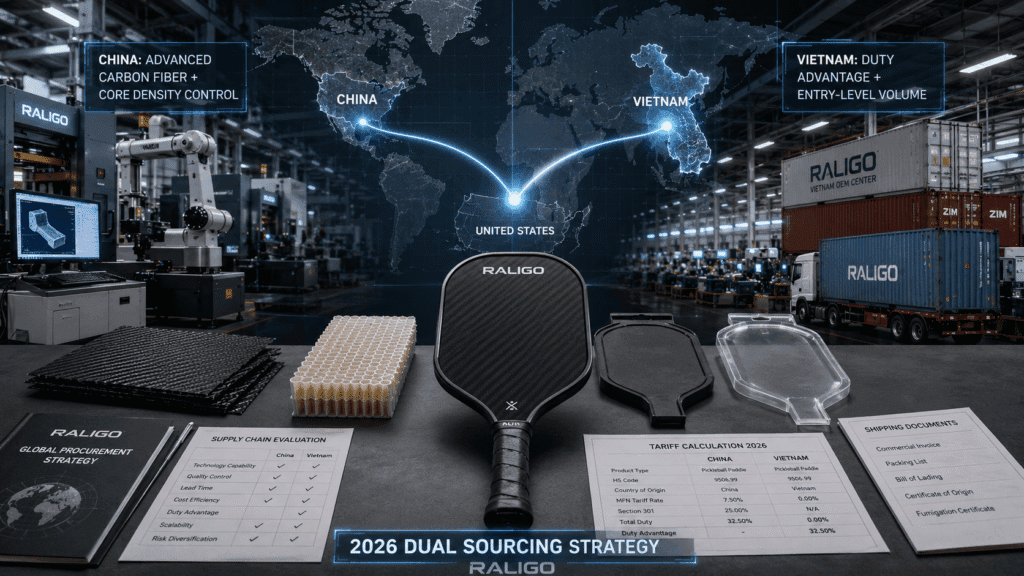
If you’re sourcing pickleball paddles in mid-2026, you already know the old playbook is dead. A China-first approach that worked eighteen months ago now carries a landed-cost penalty that erases margins before your first container clears customs. The question has moved from Should I diversify? to How do I split my production between China and Vietnam without destroying my unit economics?
This guide gives you a procurement-focused comparison — cost structures, tariff realities, quality tiers, factory maturity curves, and the dual-sourcing model that brands are deploying right now. No industry fluff. Just what you need to brief your CFO and lock your Q3–Q4 production slots.
Where Each Country Wins: The 30-Second Executive Summary
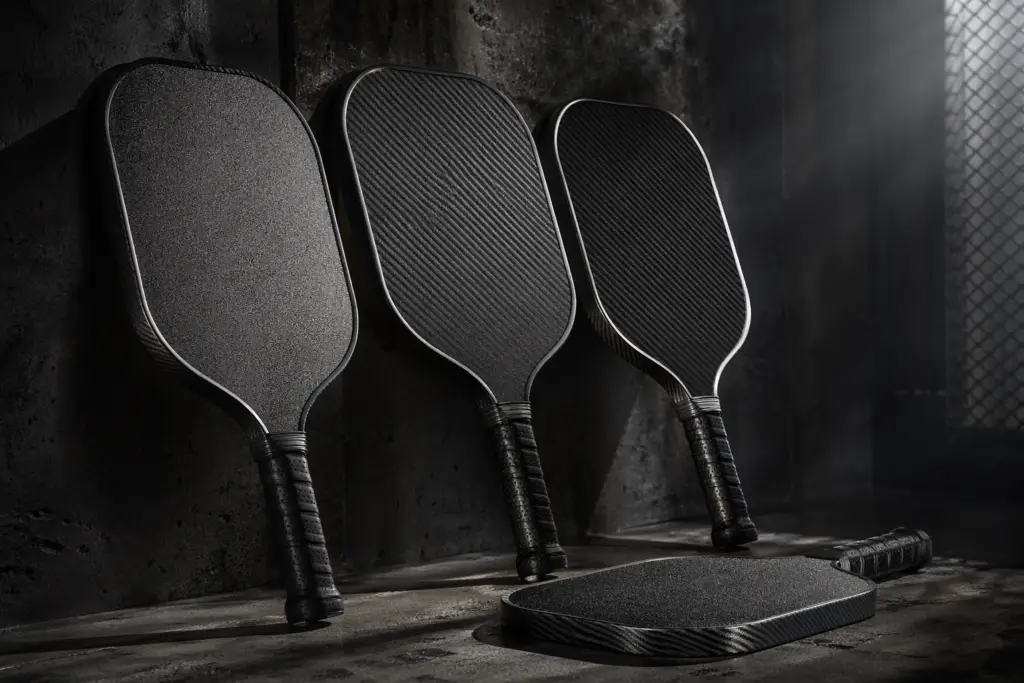
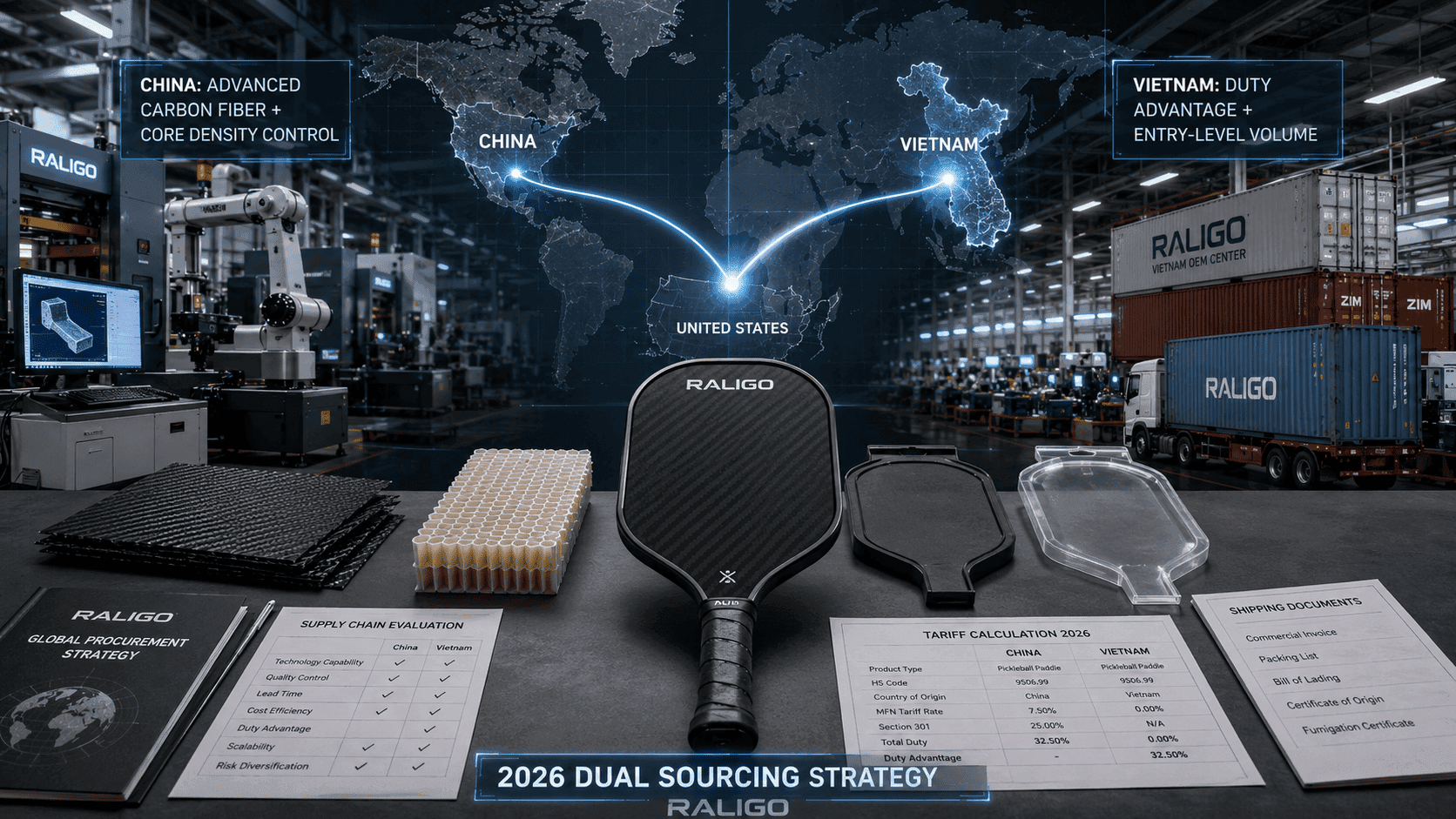
China wins on technical depth. If your paddle requires thermoformed unibody construction, multi-layer T700/T800 carbon layup, or precision CNC-machined polymer cores, Chinese factories remain the global benchmark. No other country has a supplier ecosystem where carbon fiber prepreg, Nomex honeycomb cores, and edge-guard extrusion are all produced within a 200 km radius. That vertical density translates to faster iteration cycles and lower per-unit material costs.
Vietnam wins on tariff arbitrage. As of June 2026, Chinese-origin sports equipment faces a cumulative tariff burden that has fundamentally altered landed-cost math. Vietnam, under the October 2025 US-Vietnam Framework Agreement, operates at a 20% reciprocal rate — still a tariff, but dramatically lower than the combined Section 301 + reciprocal rates applied to Chinese goods. For a mid-tier paddle with an FOB price of $12, the tariff differential alone can swing $6–$10 per unit.
The takeaway isn’t “pick one.” It’s “run both.” But you need to know which production categories go where.
Cost Structure: Line-by-Line Breakdown for 500-Unit Runs
Factory-gate pricing only tells half the story. Procurement teams that compare FOB quotes without modeling landed cost are the ones who get burned. Here’s a realistic cost comparison for a mid-spec USAPA-compliant paddle — T700 carbon face, polypropylene honeycomb core, thermoformed construction, 500-unit order.
| Cost Line | China Factory | Vietnam Factory | Delta (Per Unit) |
|---|---|---|---|
| FOB Unit Price (500 MOQ) | $10–$14 | $13–$18 | +$3–$4 VN |
| Tooling / Mold Amortization | $1.50–$2.50/unit | $2.00–$3.00/unit | +$0.50 VN |
| Ocean Freight (to US West Coast) | $2.50–$3.50/unit | $2.00–$3.00/unit | ~$0.50 CN |
| US Import Duty (cumulative, mid-2026) | $5.00–$14.00/unit | $2.60–$3.60/unit | +$2.40–$10.40 CN |
| QC / Third-Party Inspection | $2.00–$3.00/unit | $3.00–$4.00/unit | +$1.00 VN |
| Total Landed Cost (Est.) | $21.00–$37.00 | $22.60–$31.60 | Range overlap |
The critical insight: China’s FOB advantage gets partially or fully consumed by tariffs. At the low end of the tariff spectrum (if your product classification qualifies for exclusions), China still edges ahead. At the high end — where most pickleball paddles sit in mid-2026 — Vietnam’s landed cost is $5–$6 cheaper per unit. That’s $2,500–$3,000 saved on a 500-unit run.
Tariff Reality Check: What Procurement Teams Need to Know (June 2026)
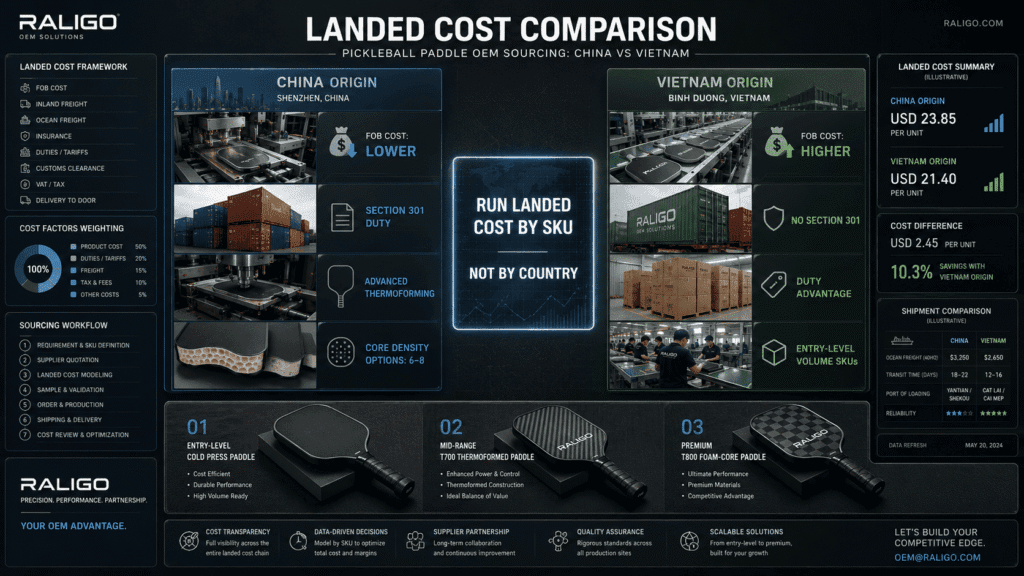
Trade policy is moving fast. Here’s where things stand as of this writing, and why static cost models from 2024 are dangerously outdated.
China: The Layered Tariff Stack
Chinese-origin pickleball paddles entering the US face at least two layers of duty. The baseline Section 301 rate on sports equipment from the original four-year review has evolved into a more complex structure. The USTR’s Section 301 four-year review introduced product-specific exclusions for certain composite goods starting January 1, 2026 — but pickleball paddles, classified under broader sporting goods HTS codes, have inconsistent exclusion coverage depending on exact material composition and construction method.
The second layer — the April 2025 reciprocal tariff announcement and subsequent adjustments — created a fluid environment where importers need to check HTS code classification on a shipment-by-shipment basis. Customs ruling NY N347450 (April 2025) classified a pickleball set from China, confirming the product falls under the general sports equipment HTS heading, but the exact duty rate depends on the specific subheading and any active exclusions at the time of entry.
Procurement action item: Before committing to a Chinese production run, request your factory’s export HTS code and run it through your customs broker against current USTR exclusion lists. A one-digit HTS code difference can swing your duty rate by 10+ percentage points.
Vietnam: The 20% Framework
The October 2025 US-Vietnam Framework for Reciprocal Trade established a 20% tariff on Vietnamese goods entering the US, effective through at least December 2026. While this is not duty-free — and procurement teams should stop treating Vietnam as a zero-tariff panacea — it represents a stable, predictable rate that is significantly lower than the cumulative charge on Chinese imports.
Vietnam’s participation in CPTPP and RCEP also provides alternative export pathways that, while not directly impacting US-bound shipments, strengthen the country’s overall trade resilience and raw-material access — factors that matter when you’re building a multi-year sourcing strategy.
Quality Tiers: Where Chinese and Vietnamese Factories Actually Deliver
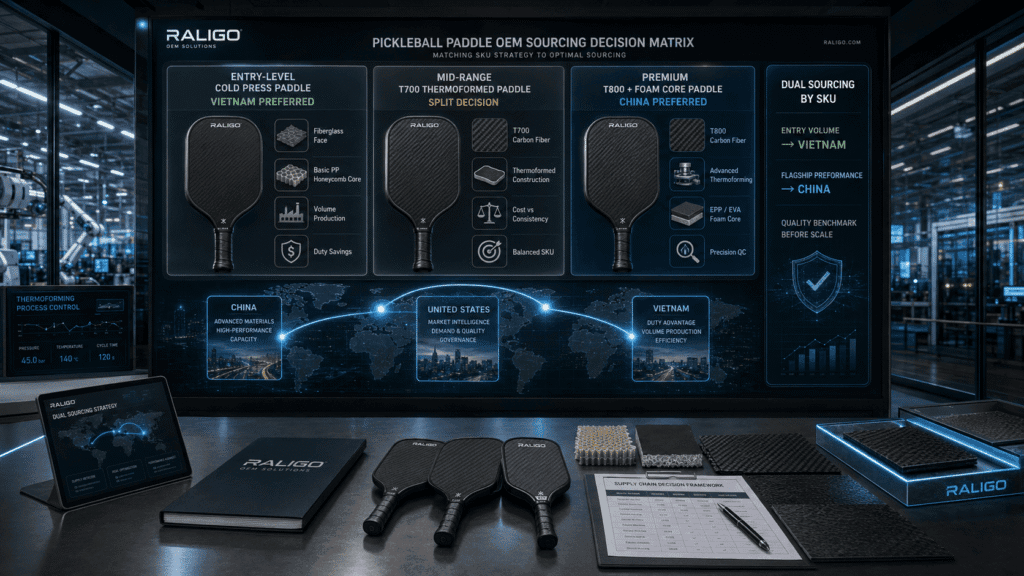
Not all production is interchangeable. A factory’s capability profile determines what it can build consistently, not what it can build once for a trade-show sample. Here’s how the two countries map against quality tiers, based on factory audits and production data from the Raligo Sport supply chain.
| Quality Tier | China Capability | Vietnam Capability | Recommendation |
|---|---|---|---|
| Premium ($80+ retail) T700/T800 thermoformed, textured surface, edge-foam injection | Mature. 20+ factories with verified USAPA-certified thermoforming lines. Toray-grade prepreg available domestically. | Emerging. 3–5 factories. Most still import carbon fiber prepreg from China, Japan, or Korea. R&D depth limited. | China for now. Vietnam in 18–24 months as JV factories mature. |
| Mid-Range ($40–$79 retail) T700 or 3K carbon face, PP honeycomb core, standard edge guard | Very mature. Highly competitive pricing. Large factory pool ensures backup capacity. | Growing fast. 8–12 factories active. QC consistency improving quarterly. Strongest value proposition in this tier. | Split 60/40 China/Vietnam based on tariff exposure per SKU. |
| Entry-Level ($20–$39 retail) Fiberglass or 1K/3K carbon, basic core, minimal finishing | Mature but margin erosion from tariffs makes this tier hard to justify from China alone. | Strong. Labor cost advantage compounds at high volumes. Most Vietnamese factories entered the market targeting this tier first. | Vietnam primary. China as overflow capacity during peak season. |
| Promotional / Bulk (< $20 retail) Basic composite or wood, high-volume runs | Not cost-competitive post-tariff unless exclusions apply. | Ideal. Low labor cost, improving throughput, acceptable QC variance for non-performance SKUs. | Vietnam. Also evaluate Pakistan for ultra-budget tier. |
Factory Maturity: The Capability Gap Nobody Talks About
Cost comparisons are easy. Capability comparisons are harder — and where procurement mistakes get expensive.
China’s factory base has depth. In Dongguan, Shenzhen, and Xiamen, you’ll find factories that have been making composite sporting goods for 15–25 years. They didn’t start with pickleball — they came from tennis, badminton, table tennis, and carbon-fiber bicycle manufacturing. That cross-pollination matters: a factory that has produced 500,000 badminton rackets understands layup consistency and weight distribution at a level that a 3-year-old pickleball-only factory simply doesn’t.
Chinese factories also offer vertical integration that Vietnam hasn’t replicated yet. When a Chinese factory says they control the supply chain, they often mean it literally — same industrial park produces the carbon prepreg, molds the foam core, extrudes the edge guard, and prints the face graphics. Vietnam’s factories, by contrast, are more assembly-oriented. Carbon fiber prepreg is imported (primarily from China, Japan’s Toray, or Korea’s Hyosung), cores are often sourced from separate suppliers, and graphics may require a third-party print shop.
Vietnam’s factory base is younger but moving fast. The investment pace is the story. In 2023, perhaps 5 Vietnamese factories were producing USAPA-eligible paddles. By mid-2026, that number has at least tripled — and the newcomers aren’t starting from zero. Many are joint ventures with established Chinese paddle manufacturers (AMA Sport’s Vietnam facility, Pickle Global’s Hung Yen plant with VND 17 billion initial investment) that transplant process knowledge directly. The result is a factory ecosystem that compresses a decade of learning into 2–3 years.
The capability gap is closing, but it hasn’t closed. For a procurement director, the practical question is: does my factory have a track record of delivering identical QC results across three consecutive production runs? In China, the answer is usually yes. In Vietnam, you’ll want to see batch-level QC data before trusting that yes.
Material Supply Chains: Why Carbon Fiber Access Defines the Map
Carbon fiber isn’t a commodity — it’s a strategic material with concentrated global production. Understanding where each country’s factories source their prepreg tells you a lot about cost stability and supply risk.
- China: Domestic carbon fiber production has scaled dramatically. Chinese mills now produce T700-equivalent and T800-grade fiber at prices 30–40% below imported Toray equivalents. Factories in Fujian and Guangdong have direct relationships with domestic prepreg suppliers, meaning carbon cloth moves from mill to layup room within the same week. That proximity eliminates one of the biggest supply-chain headaches: prepreg shelf-life management.
- Vietnam: Nearly all carbon fiber prepreg is imported — predominantly from China, with some Japanese Toray and Korean Hyosung for premium lines. Import lead times add 2–4 weeks to the production pipeline. More importantly, Vietnamese factories pay a premium on imported prepreg (duties, logistics, intermediary markups) that partially offsets their labor-cost advantage. The factories investing in cold-chain storage and in-house prepreg cutting are the ones worth shortlisting.
- Core Materials (Nomex, PP Honeycomb): Both countries access the same global suppliers for honeycomb cores. The cost difference here is marginal. What matters more is the factory’s core-density QC protocol — something independent of geography.
For premium paddles where carbon fiber grade is a brand differentiator, China’s domestic prepreg supply is a structural advantage that Vietnam won’t close for at least 3–5 years. For mid-range and entry-level paddles where 3K carbon or fiberglass is the spec, the material supply question is less decisive.
Lead Times, MOQs, and Production Flexibility
Procurement isn’t just about unit price — it’s about cash-flow management, inventory turns, and the ability to respond to demand signals without sitting on dead stock.
| Production Parameter | China | Vietnam |
|---|---|---|
| Standard Lead Time (500 units) | 5–7 weeks | 6–9 weeks |
| Minimum Order Quantity (OEM) | 50–100 units | 100–300 units |
| Design-to-Sample Cycle | 2–3 weeks | 3–5 weeks |
| Rush Order Premium | 15–25% surcharge | 20–30% surcharge |
| Production Cycles per Year (typical) | 4–6 | 3–4 |
| Peak Season Capacity Risk | Moderate (large pool, can shift lines) | Higher (fewer factories, faster saturation) |
China’s lower MOQ is particularly valuable for brands testing new designs or entering new market segments. Being able to order 50 units of a new shape, test market response, and iterate without committing to a full container is a strategic advantage that Vietnam’s factory ecosystem hasn’t yet matched at scale.
However, Vietnam’s MOQ disadvantage is narrowing. As more factories come online and competition for orders intensifies, we’re seeing Vietnamese manufacturers drop minimums from 500 to 100–200 units — still above China’s floor, but moving in the right direction for smaller brands.
The Dual-Sourcing Playbook: How Leading Brands Are Structuring Production
Here’s the model that’s emerging across the industry — not a theory, but what procurement teams at established paddle brands are executing right now.
Core Strategy: Split by Product Tier, Not by Volume
The naive approach — “send 50% to China, 50% to Vietnam” — creates problems. Different factories have different strengths. A better framework:
- Premium SKUs → China. Thermoformed unibody paddles with textured carbon surfaces rely on process knowledge that’s still concentrated in Chinese factories. The per-unit tariff hit on a $70+ wholesale paddle is proportionally smaller than on a $15 entry-level unit, so the quality-risk-to-tariff-cost ratio favors keeping premium production in China.
- Mid-Range Volume SKUs → Split. This is where the tariff arbitrage matters most. Run your bestselling mid-tier SKUs in both countries, weighted toward Vietnam for tariff savings but maintaining a China line as capacity backup and quality benchmark. Many brands target a 60/40 Vietnam/China split for this tier.
- Entry-Level and Promotional → Vietnam. These SKUs have the thinnest margins, making the tariff differential decisive. Vietnam’s factory base is now competent enough at this tier that the quality-risk premium is negligible.
- R&D and Rapid Prototyping → China. When you need 10 units of a new design in 3 weeks, Chinese factories can do it. Vietnamese factories — not yet, not reliably. Keep your innovation pipeline in China; shift production to Vietnam once designs are stable.
The JV Option: Chinese Expertise, Vietnamese Tariff Treatment
A growing number of Chinese paddle manufacturers are establishing joint ventures or wholly-owned subsidiaries in Vietnam. These operations combine Chinese process engineering and QC methodology with Vietnamese labor, logistics, and — crucially — Vietnamese rules of origin for tariff purposes.
The JV model isn’t a silver bullet. Rules-of-origin requirements mean the factory must demonstrate substantial transformation in Vietnam — simply assembling Chinese-made components won’t qualify for Vietnamese origin. But factories that are investing in in-house prepreg cutting, core molding, and thermoforming within Vietnam are building legitimate Vietnamese-origin products that qualify for the 20% rate rather than China’s cumulative tariff burden.
When evaluating a Vietnam-based factory, ask: Where does your carbon fiber come from? Do you do your own core molding or import cores? What percentage of value-add happens in this facility versus being imported? The answers tell you whether you’re getting genuine tariff savings or just a relabeling exercise that won’t survive a customs audit.
QC and Compliance: What to Demand from Either Country
Geography doesn’t guarantee quality — process does. Here’s what procurement teams should require regardless of which country they’re sourcing from.
- USAPA batch certification. Not “the factory is USAPA-approved” — that’s table stakes. Demand the actual test certificate for your production batch, showing weight, dimensions, surface roughness within tolerance, and deflection data.
- Weight tolerance: ±0.3 oz. A paddle spec’d at 8.0 oz that ships at 8.5 oz changes the playing characteristics meaningfully. Write tolerance into the contract.
- Destructive testing on samples. Core delamination, edge-guard adhesion, and face-sheet bonding should be tested to failure on 5–10 units from every production run. If the factory can’t or won’t do this, find another factory.
- In-process inspection at 25%, 50%, and 100% completion. Catching a layup defect at 25% saves you from discovering it when the container arrives in Long Beach.
- Third-party audit if volume exceeds 1,000 units/year. Budget $3,000–$5,000 per audit. It’s cheaper than a recall or a chargeback from a retail partner.
One underappreciated difference: Chinese factories are more accustomed to third-party inspection services (SGS, Bureau Veritas, Intertek) and have processes in place to accommodate them. Vietnamese factories are still building that muscle. When booking an inspection in Vietnam, budget extra time for coordination and be explicit about what you need to see.
Regional Risk and Supply Chain Resilience
Beyond tariffs and costs, the dual-sourcing conversation is fundamentally about supply-chain resilience. Events of the past three years — COVID-era logistics disruptions, Red Sea shipping diversions, port congestion on both US coasts — have demonstrated that single-country sourcing is a single point of failure.
China and Vietnam offer complementary risk profiles:
- China: Mature logistics infrastructure. Major ports (Shanghai, Ningbo, Shenzhen) with frequent sailings to US West and East coasts. But concentrated exposure to China-specific trade policy shifts.
- Vietnam: Improving port infrastructure (Ho Chi Minh City, Hai Phong). Closer geographic proximity to Southeast Asian raw-material sources. But susceptible to regional disruptions (typhoon season in Q3–Q4 affects Vietnamese ports more than Chinese ones) and has less excess logistics capacity during peak season.
The two countries together provide geographic and political diversification. If one origin faces a disruption — whether that’s a port strike, a new tariff announcement, or a regional supply-chain bottleneck — the other can absorb some of the volume. That optionality isn’t free, but for brands above 5,000 units/year, it’s insurance worth buying.
FAQ: Quick Answers for Procurement Teams
Is Vietnam really cheaper than China for pickleball paddles in 2026?
It depends on the tariff classification of your specific product. At the FOB level, China is still 20–30% cheaper per unit. But when you add cumulative US import duties — which can reach prohibitive levels on Chinese-origin goods — Vietnam’s total landed cost is frequently $3–$7 lower per unit for mid-range paddles. Run the math with your customs broker using your actual HTS code. Don’t rely on general estimates.
Can Vietnamese factories match Chinese quality on thermoformed carbon paddles?
Not yet, not consistently. The top 2–3 Vietnamese factories — most of them joint ventures with Chinese manufacturers — can produce thermoformed paddles that pass USAPA certification. But batch-to-batch consistency, particularly on surface texture and weight distribution, still lags behind established Chinese factories. If your brand competes in the premium tier ($100+ retail), keep thermoformed production in China for now. If you’re in the $40–$79 mid-range, Vietnamese factories are viable with proper QC oversight.
What’s the minimum order quantity for OEM paddles in Vietnam vs China?
China: 50–100 units for most OEM/ODM factories. Vietnam: 100–300 units, though some factories are dropping to 100 as competition intensifies. For brands testing new designs, China’s lower MOQ is a meaningful advantage. For established brands ordering 500+ units per SKU, the MOQ difference is irrelevant.
How do I verify a Vietnamese factory actually qualifies for the 20% tariff rate?
Request the factory’s Certificate of Origin (Form B issued by the Vietnam Chamber of Commerce and Industry). Verify that the factory performs “substantial transformation” in Vietnam — meaning carbon fiber cutting, core molding, layup, thermoforming, and finishing all occur in-country. If the factory imports pre-assembled paddle bodies from China and only does edge-guard attachment and packaging, you may not qualify for Vietnamese origin. Your customs broker can review the documentation before you commit.
Should I completely move production out of China?
Almost certainly not. China’s manufacturing ecosystem for composite sporting goods is unmatched in depth, speed, and technical capability. The right strategy for most brands is a tiered dual-sourcing model: premium and R&D in China, volume production split between China and Vietnam based on tariff exposure per SKU. Complete divestment from China sacrifices supply-chain resilience and technical depth for uncertain long-term tariff savings.
Your 4-Week Dual-Sourcing Action Plan
If you’re reading this as a procurement decision-maker, here’s what to do in the next month:
- Week 1 — Classify your SKUs. Map every paddle in your current and planned lineup to a quality tier (premium, mid-range, entry-level, promotional). For each SKU, calculate the estimated landed cost from both China and Vietnam using your actual HTS codes and current tariff rates.
- Week 2 — Audit your current China factory. If you’re already manufacturing in China, request updated QC documentation, tariff classification data, and their perspective on whether they have or plan a Vietnam JV. Many Chinese factories now have both-country options they’ll offer proactively if asked.
- Week 3 — Shortlist and contact Vietnamese factories. Start with 3–5 factories. Request USAPA certification, production samples from their last three runs (not hand-picked trade-show samples), and a detailed bill of materials showing origin of carbon fiber and core materials.
- Week 4 — Place a parallel test order. Pick one mid-range SKU. Order 200 units from your existing China supplier and 200 units from your top Vietnam candidate. Compare not just unit cost but the full experience: communication quality, sample turnaround time, packaging quality, and documentation completeness.
The brands that will win in 2026–2027 aren’t the ones that picked the cheapest factory. They’re the ones that built a sourcing architecture flexible enough to absorb whatever the trade policy environment throws at it next.
Raligo Sport is a USAPA-certified pickleball paddle OEM/ODM manufacturer with production facilities in China and Vietnam. We help brands and distributors build quality paddle lines with transparent pricing, batch-level QC documentation, and dual-country production optionality. Contact our procurement engineering team at raligosport.com/contact for a product-tier-specific landed-cost analysis.