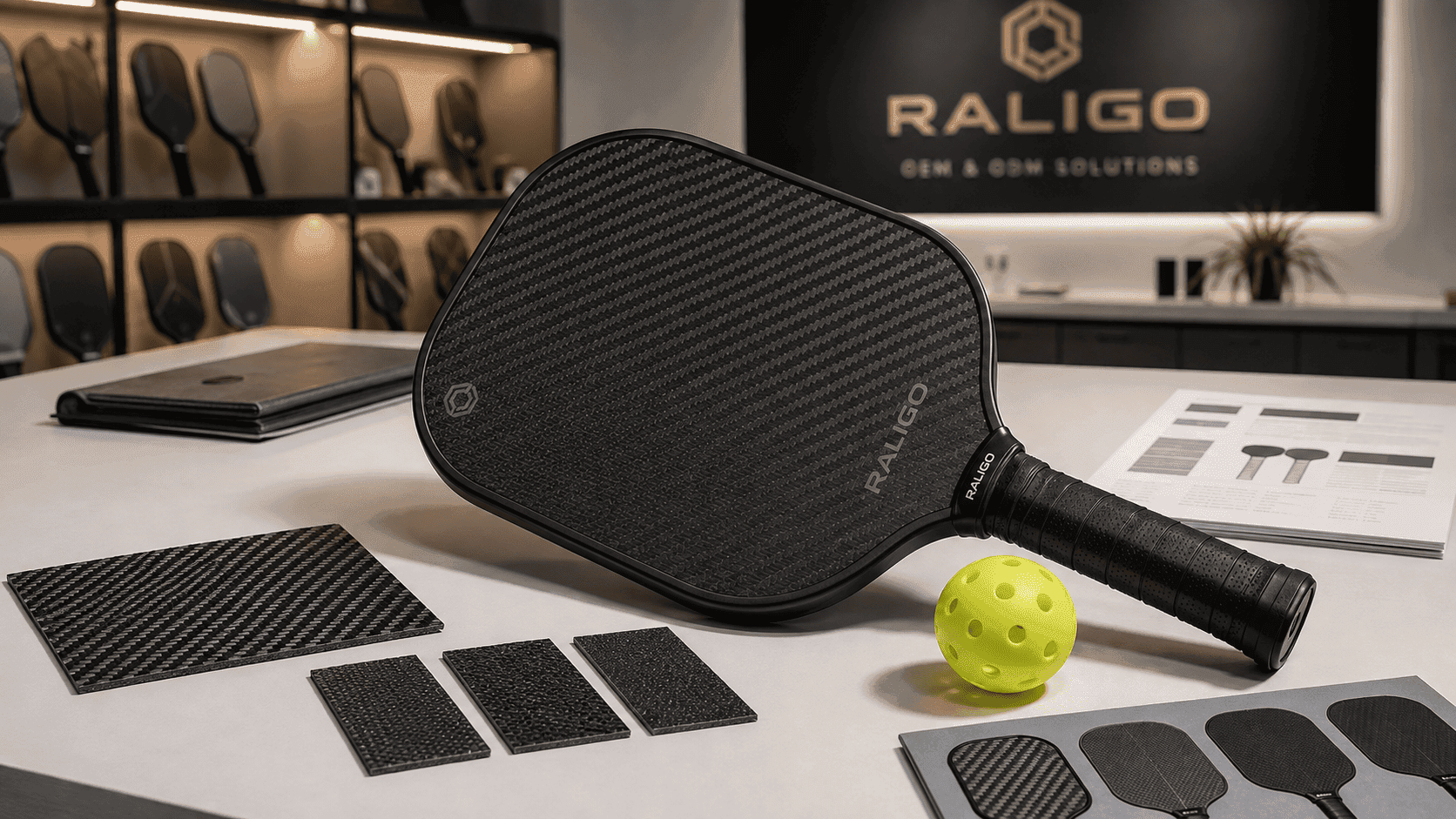
Paddle Surface Texture and Spin: The Manufacturing Reality
It’s easy to think spin comes from raw texture aggressiveness. In factory reality, the equation is far more constrained. The USAPA Equipment Evaluation Standard sets a static friction limit of 0.1875 and a surface roughness ceiling of Rt ≤ 40 µm / Rz ≤ 30 µm. These aren’t arbitrary — they define the engineering corridor every OEM mold shop and prepreg cutter operates within. You can’t just blast a paddle face with coarse grit and call it a “spin paddle.” The question every procurement team should ask is: how much usable spin can you engineer while staying inside the compliance window?
1. Why Surface Texture Determines Spin Capability
At the contact point, a pickleball deforms against the paddle face for roughly 4-6 milliseconds. During that dwell time, surface asperities — microscopic peaks and valleys on the paddle face — mechanically grip the ball’s polymer shell. This grip generates tangential force that converts linear impact energy into rotational acceleration. No surface texture, no grip; no grip, no spin.
The key metric is static coefficient of friction (µs). Pickleball Science has modeled that a µs above approximately 0.110 is sufficient to generate rotational speeds exceeding 1,200 RPM on a well-struck top-spin drive. Below that threshold, the ball slides across the face with minimal rotational transfer regardless of swing mechanics.
What matters for manufacturing isn’t just “roughness” — it’s the type of roughness. Profilometer traces distinguish between peak-dominated surfaces (sharp spikes that wear quickly) and valley-dominated surfaces (deep reservoirs that retain texture under abrasion). The latter consistently outperforms the former in durability testing. A surface with Ra = 2.5 µm dominated by rounded valleys will outlast a surface with Ra = 3.5 µm dominated by sharp peaks by a factor of roughly 1.8× in simulated play tests, because the load-bearing area is spread across more material volume.
OEM takeaway: Don’t spec a roughness number without specifying the morphology. Two paddles can share identical Ra figures and deliver radically different spin durability. Ask your mold shop for profilometer traces, not just RMS averages.
2. USAPA Surface Roughness Limits: Rt, Rz, and the Compliance Ceiling
USA Pickleball’s equipment certification manual imposes two surface roughness thresholds: Rt (total roughness, peak-to-valley) ≤ 40 µm and Rz (mean peak-to-valley over five sampling lengths) ≤ 30 µm. The static coefficient of friction ceiling — measured with a calibrated sled test — sits at 0.1875.
These numbers are generous enough that any properly engineered textured surface passes comfortably, but tight enough to eliminate crude sanding or uncontrolled abrasive coatings. In practice, most commercial paddles sit in the range of Ra 1.5–3.5 µm, with sprayed-grit paddles occasionally breaching the upper bound if QC isn’t rigorous.
The compliance risk isn’t at the fresh-out-of-mold stage. It’s at the 2,000-stroke mark. Some spray-grit coatings initially test at Rz ≈ 28 µm — safely below the 30 µm limit — but after 500–1,000 ball impacts, the grit particles fracture and the effective surface roughness increases as sharp edges emerge from the coating matrix. A surface that was compliant when the paddle left the factory can become non-compliant after a few tournament sessions. USAPA random batch testing catches this occasionally; OEM buyers should design for worst-case-ragged measurements, not best-case-fresh ones.
Critical distinction: USAPA does not regulate spin output directly. It regulates surface characteristics that enable spin. A paddle can generate 2,000+ RPM and be fully compliant — provided the texture stays within the roughness and friction corridors.
3. Peel Ply vs. Spray Coating vs. Etched Surface: The Three Manufacturing Approaches
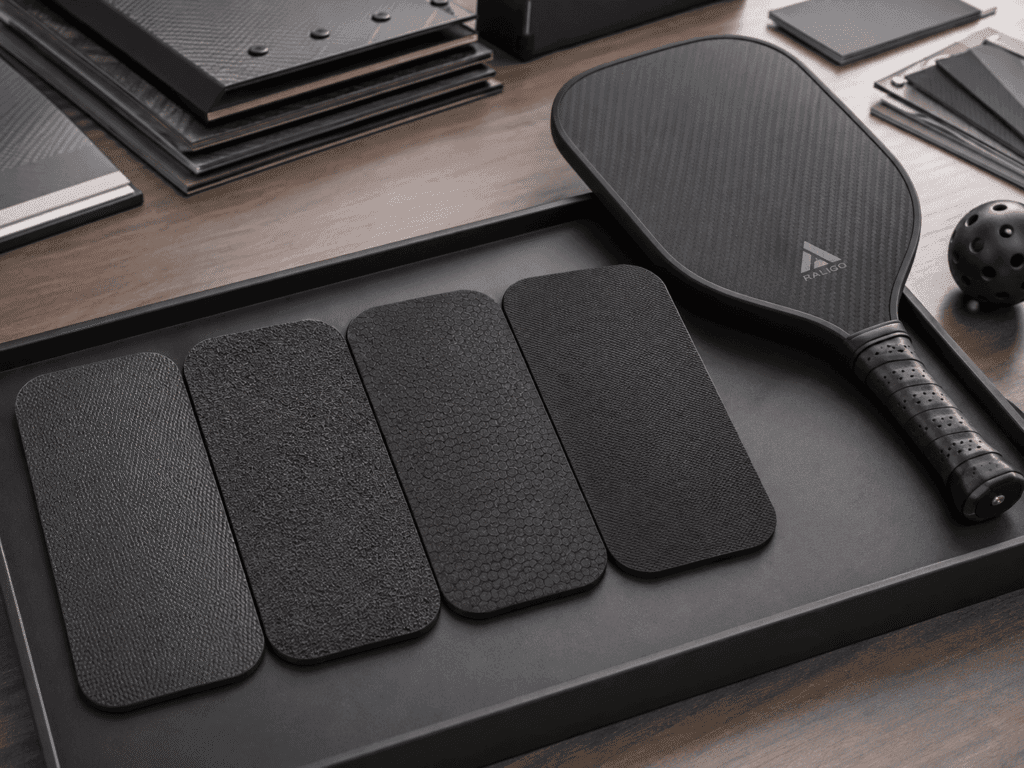
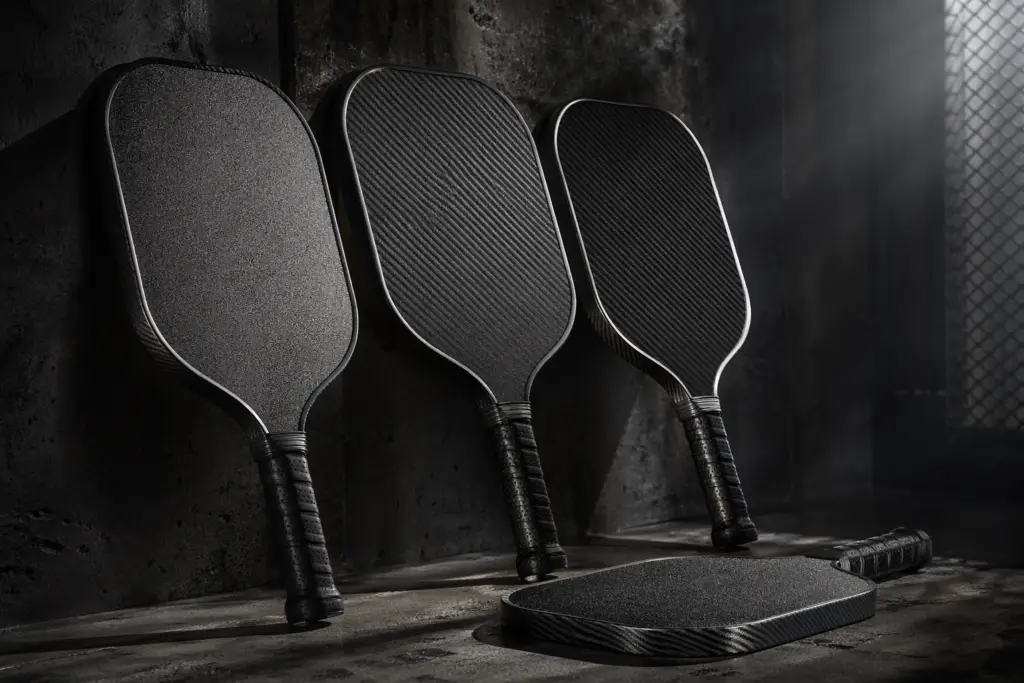
| Texture Technology | How It’s Created | Typical Ra (µm) | Static COF (µs) | Spin Durability (50h equiv.) | Manufacturing Complexity |
|---|---|---|---|---|---|
| Peel Ply (Standard) | Nylon/dacron fabric pressed into prepreg, peeled post-cure | 1.8–3.2 | 0.12–0.16 | ~75% retention | Low — one extra layup step |
| Spray Grit Coating | Silica/carbide particles suspended in clear-coat, spray-applied post-molding | 3.0–8.0 | 0.14–0.19 | <60% retention | Low — post-processing only |
| Laser-Etched Surface | CNC laser raster-scan ablates pattern into cured face | 1.5–6.0 | 0.11–0.17 | High (depth-controllable) | Medium — requires laser station |
| Hybrid Nano-Texture | Micro-particle embedding in epoxy matrix during cure cycle | 2.0–4.5 | 0.13–0.18 | ~90% retention | Medium-High — material formulation R&D |
| Mold Micro-Texture | Pattern CNC’d into mold cavity, transferred during thermocompression | 0.8–5.0 | 0.10–0.15 | Very High — integral to face sheet | Very High — mold tooling CAPEX |
Peel Ply: The Industry Baseline
Peel ply is the most widespread surface texturing method in carbon fiber pickleball paddle manufacturing. A sacrificial nylon or polyester fabric layer is laid over the outermost prepreg ply during the layup. Under heat and pressure in the molding press, the fabric’s weave pattern imprints into the epoxy matrix. After cure, the peel ply is stripped away, leaving a negative of the weave pattern — a textured surface defined by the fabric’s thread count and denier.
The primary advantage is integration: the texture is the paddle face itself, not a coating on top. It can’t delaminate because there’s nothing to delaminate. The weakness is uniformity. Fabric weave quality, prepreg resin flow during cure, and peel angle all affect the final surface. Two paddles from the same mold can differ measurably if peel ply tension wasn’t controlled.
At Raligo, our QC team has observed Ra variations of up to 0.8 µm within a single production batch when peel ply isn’t mechanically tensioned. Adding a tensioning frame to the layup station reduced intra-batch variation to under 0.2 µm.
Spray Grit: High Spin, Low Longevity
Spray-applied grit coatings deliver the highest initial friction — often µs = 0.17–0.19 fresh out of the box — by embedding hard particles (silica, silicon carbide, or ceramic microspheres) in a clear-coat binder. For a player, the first 20 hours feel incredible. The problem is what happens after hour 30.
Joying Pickleball’s 50-hour accelerated wear testing — using 500× microscopy — found spray grit surfaces lose more than 40% of their spin capability within the equivalent of two months of regular play. The failure mode is particle dislodgement: the clear-coat binder fractures under repeated ball impact, releasing grit particles. The remaining surface becomes polished smooth in the high-contact zone (center of paddle face). This creates a performance gradient — high spin on edges, low spin in the sweet spot — which is exactly where you don’t want it.
For OEM brands, spray grit creates a warranty liability. A player buying a “$220 spin paddle” that becomes a smooth-faced paddle within 60 days will file a return. The B2B math is simple: higher initial spin = higher customer satisfaction at unboxing = higher return rate at month 3.
Etched and Nano-Texture: The Durable Alternative
Laser etching and hybrid nano-texture represent the manufacturing frontier for spin durability. Laser etching uses a CNC-controlled laser raster to ablate the cured carbon fiber face, creating a precisely defined surface pattern. Because the pattern is engraved into the material rather than coated onto it, there’s no delamination failure mode. Depth is programmable; USAPA compliance can be baked into the CAD file.
Hybrid nano-texturing embeds sub-micron particles (typically SiO₂ or Al₂O₃) into the epoxy matrix during resin formulation, before prepreg production. The particles become integrally bonded — they’re part of the polymer network, not sitting on top of it. The 50-hour wear retention rate of ~90% makes this the leader for brands that market “permanent spin” or “durable grit” as differentiating features. The trade-off is minimum order quantity: custom nano-texture formulations typically require 500+ unit commitments from the raw material supplier.
4. Dwell Time, Core Stiffness, and the Hidden Spin Variable
Surface texture doesn’t work in isolation. The paddle’s core stiffness — governed by core material (polymer honeycomb vs. Nomex vs. foam), core density, and face sheet modulus — determines how long the ball stays in contact with the textured surface.
A paddle face with a higher effective stiffness produces shorter dwell time because the face deflects less under impact. Shorter dwell time means the surface texture has less time to grab the ball and convert force into rotation. This is why two paddles with identical surface texture can produce measurably different spin rates: one has a softer core that absorbs more impact energy and extends contact duration.
The engineering trade-off is power versus spin. A stiffer paddle face (e.g., T800 carbon fiber, 294 GPa modulus, vs. T700 at 230 GPa) returns more energy to the ball for higher exit velocity. But that 28% higher modulus also reduces dwell time, clipping the spin ceiling. Manufacturers address this through hybrid layups — high-modulus outer plies for structural rigidity, lower-modulus intermediate plies to modulate face deflection, and a carefully selected core density to tune the overall system response.
For procurement: If your brand’s value proposition is “maximum spin,” don’t just specify surface roughness. Specify core density, foam type, and face sheet layup. The surface is only one variable in a three-component system.
5. Quality Control: Profilometer Testing and Factory-Side Compliance
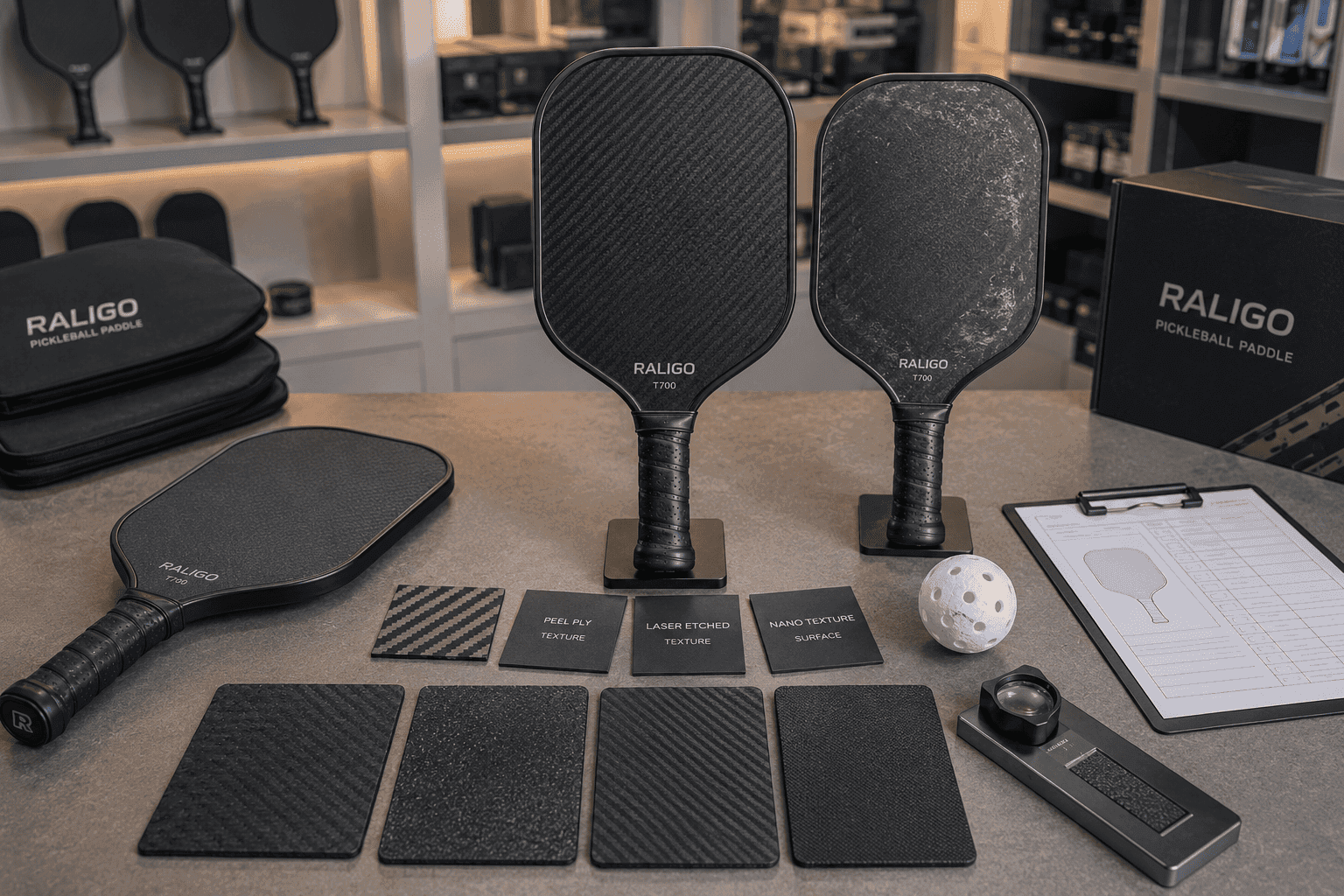
Profilometry — specifically contact stylus profilometry per ISO 4287 or non-contact optical methods — is the standard QC tool for surface texture verification in paddle manufacturing. At minimum, QC should measure Ra (arithmetic mean roughness), Rz (mean peak-to-valley), and Rt (total roughness) on three locations per paddle face: center (impact zone), upper third, and lower third.
The center zone is the most critical. This is where the ball strikes most frequently and where texture wear concentrates. A common QC failure mode in OEM factories is testing only a single point on the paddle face — typically a low-wear edge — and passing batches that would fail if the impact zone were tested. Our internal protocol at Raligo requires center-zone measurements on every paddle in the AQL 2.5 sampling plan.
Beyond profilometry, actual spin output testing closes the loop. Using a robotic swing arm with controlled head speed and angle, a standardized ball is struck and high-speed cameras capture RPM. This validates that the measured surface texture actually translates to on-court performance — closing the gap between profilometer numbers and player experience.
For OEM buyers: Ask your factory to provide profilometer traces (not just summary numbers) from the paddle center zone. If they can’t produce these, assume their surface texture QC is cosmetic-only.
6. The Evolution: From Peel Ply to Engineered Texture
Pickleball paddle surface engineering has progressed through three eras:
– Era 1 (2015–2019): Peel ply as default. Manufacturers used whatever fabric was available in the composite shop. Texture was a byproduct of the molding process, not a designed feature. Spin performance was incidental.
– Era 2 (2020–2023): Spray grit emerges as a “spin upgrade.” Brands differentiate on texture aggressiveness. USAPA begins enforcing roughness limits more rigorously. The market sees the first wave of “spin paddles” — and the first wave of durability complaints.
– Era 3 (2024–present): Engineered texture — laser etching, mold micro-texturing, hybrid nano-particle embedding — becomes the competitive differentiator. The goal shifts from “how rough can we make it” to “how long can we maintain target roughness under wear.” Durability replaces peak spin as the engineering priority.
This trajectory mirrors what happened in automotive tire compounds and golf club face milling: the market eventually discovers that peak performance at hour zero is a marketing metric, while consistent performance at hour 500 is a customer loyalty metric.
Frequently Asked Questions
Does a higher friction coefficient always mean more spin?
Not exactly. Static COF above ~0.110 is sufficient for maximum spin transfer given the dwell time and ball mass of a pickleball. Going from µs = 0.12 to µs = 0.18 may look better on a spec sheet but adds negligible RPM gains while increasing wear rate and compliance risk. The diminishing returns kick in hard above 0.14.
How does USAPA test surface roughness?
USAPA uses a calibrated surface roughness tester (historically the Starrett SR100 or equivalent contact profilometer) to measure Rt and Rz on submitted paddles. They also conduct dynamic COF testing using a sled apparatus that meets ASTM D1894-equivalent standards. Testing is done on fresh samples; random batch testing may occur post-certification to verify production consistency.
Can a paddle produce too much spin for USAPA approval?
USAPA doesn’t cap spin output — it caps the surface characteristics that enable spin. A paddle that measures Rt = 41 µm would be non-compliant regardless of how much spin it actually generates. Conversely, a paddle that generates exceptionally high spin through optimized dwell time (core tuning) while staying within roughness limits is fully compliant. This is the engineering sweet spot.
What should OEM brands specify for durable spin texture?
At minimum, specify three things: (1) the texture technology (peel ply / laser etch / nano-texture), (2) target Ra with tolerance band (e.g., Ra 2.5 ± 0.3 µm), and (3) after-wear testing protocol (minimum 2,000 ball impacts, center-zone re-measurement required). The third item is what separates serious OEM programs from commodity sourcing — most factories won’t volunteer wear-testing data unless it’s in the spec.
Ready to Engineer Your Paddle’s Spin Performance?
At Raligo Sport, we manufacture paddles with laser-etched, peel-ply, and hybrid nano-texture surfaces — all engineered to stay inside USAPA limits while maximizing spin durability. From profilometer QC to wear-test validation, every batch ships with data, not promises.