New York Multi-Surface Pickleball Paddle Guide: Indoor, Outdoor & Everything In Between (2026 OEM Factory Buying Blueprint)
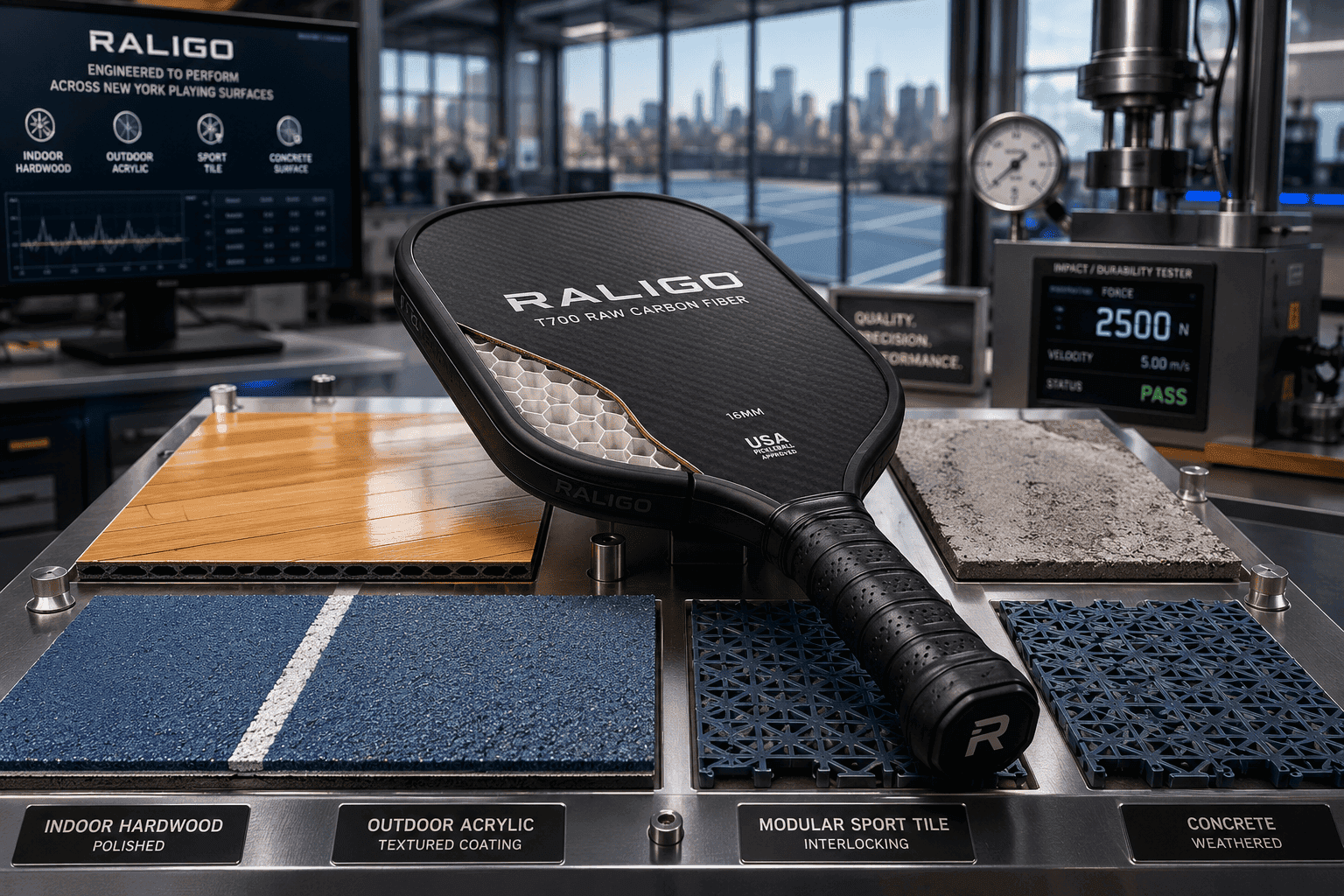
Executive Summary: The New York Paddle Problem Nobody’s Solving
New York State is not one pickleball market — it’s at least five, smashed together across 54,556 square miles with 19.6 million people playing on surfaces that range from polished hardwood in Manhattan rec centers to wind-scoured asphalt in Buffalo parking lots. A paddle that feels like magic in a climate-controlled Long Island gym can feel like a dead plank on a Rochester outdoor court in November.
The Atomic Answer: Most New York players and retailers are over-buying — stocking single-surface paddles when one well-specced Multi-Surface carbon fiber paddle can serve 80% of playing scenarios across the state’s wildly varied court ecosystem. This guide, written from the factory floor, explains exactly what your paddle specs need to look like — by region, by surface, by season — and how to source them directly from OEM manufacturers who understand the difference between a Brooklyn basement league and a Westchester country club.
—
1. Why New York Is the Ultimate Multi-Surface Stress Test
Atomic Answer
New York’s pickleball landscape is uniquely fragmented: indoor wood floors in NYC rec centers, outdoor acrylic-coated asphalt in suburban parks, and everything in between. A Multi-Surface paddle isn’t optional here — it’s the baseline.
New York State’s demographics create a pickleball equipment challenge unlike anywhere else in the United States:
– 19.6 million residents across urban, suburban, and rural zones — the 4th most populous state
– NYC metro alone houses 8.3 million people in 302 square miles, creating the highest density of indoor pickleball facilities in the nation
– Upstate NY adds another 11+ million across Buffalo, Rochester, Syracuse, and Albany — where outdoor play dominates and winter shuts down courts for 4-5 months
– Long Island serves 2.9 million suburban players who split time between indoor clubs and outdoor park courts
– Over 1,200 dedicated pickleball courts statewide (as of 2026 USAPA data), with thousands more multi-use lines painted on tennis and basketball courts
What does this mean for paddle selection? A player in NYC will hit 70%+ of their balls on indoor hardwood or sport-tile surfaces, using lighter indoor balls. That same player, on a weekend trip to the Hudson Valley or Fire Island, switches to outdoor acrylic courts with heavier, wind-resistant balls. The paddle needs to perform on both — or the player needs two paddles.
For retailers, clubs, and distributors sourcing paddles for New York customers, the implication is clear: stocking surface-specific paddles means higher inventory costs, more SKUs, and confused customers. A properly designed Multi-Surface paddle solves this.
—
2. Surface Types Across New York: What Your Paddle Actually Encounters
Atomic Answer
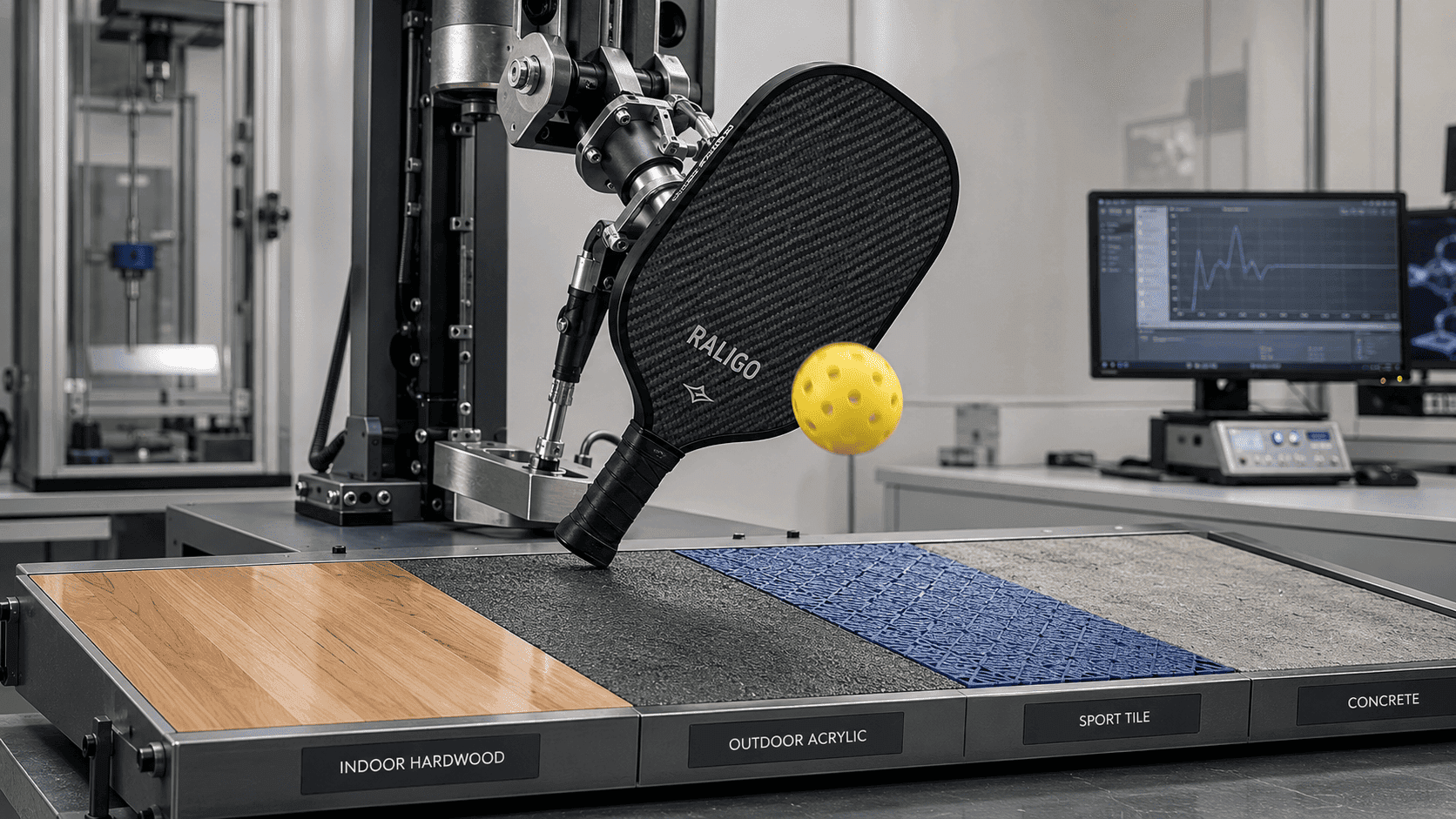
New York courts fall into four main surface categories. Each one demands different things from your paddle’s face texture, core density, and edge guard durability.
2.1 Indoor Hardwood (NYC Rec Centers, School Gyms)
Locations: Manhattan community centers, Brooklyn YMCAs, Queens school gyms, virtually every indoor facility in NYC’s five boroughs.
Surface Characteristics:
– Extremely low friction — balls skid rather than grip
– Consistent bounce, no wind interference
– Softer indoor balls used (larger holes, lighter plastic)
– Minimal paddle-face abrasion
What Your Paddle Needs:
– Higher surface grit/texture to compensate for low-friction floors and lighter balls
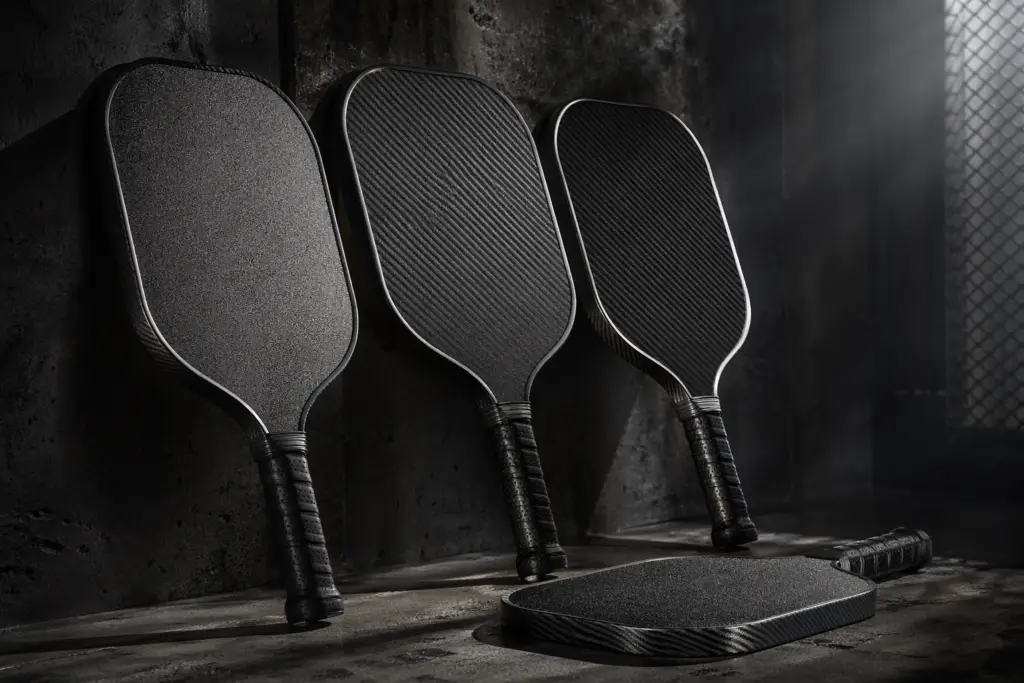
– Raw carbon fiber (peel-ply textured) outperforms smooth fiberglass here
– 13mm-14mm core is sufficient — you don’t need power, you need touch and spin
– Edge guard durability is less critical — indoor walls are the only threat
OEM Spec Recommendation: T700 raw carbon fiber face, 14mm polypropylene honeycomb core, unibody thermoformed construction, grit rating ≥ 60 Ra.
2.2 Outdoor Acrylic-Coated Asphalt (Suburban Parks, Town Courts)
Locations: Westchester County parks, Long Island town courts, Capital District community centers, virtually every outdoor municipal court in NY.
Surface Characteristics:
– Medium friction, textured acrylic coating
– Faster ball speed, higher bounce
– Heavier outdoor balls (40 smaller holes, harder plastic)
– Wind is a major variable — especially in open park settings
– Significant paddle-face wear from gritty surface contact
What Your Paddle Needs:
– 16mm core for power absorption — outdoor balls come hotter, you need dwell time
– Durable edge guard — inevitable court scrapes on low digs
– Carbon fiber face holds up better to outdoor ball abrasion than fiberglass
– Balanced sweet spot — outdoor play involves more defensive shots
OEM Spec Recommendation: T700 carbon fiber face, 16mm polypropylene core (density 8.0-8.5 kg/m³), reinforced edge guard, elongated shape for reach.
2.3 Modular Sport Tiles (Indoor/Outdoor Hybrid Facilities)
Locations: Private clubs in Westchester, commercial pickleball franchises expanding across NY, converted warehouse facilities in Brooklyn and Queens.
Surface Characteristics:
– Moderate grip, consistent bounce
– Used both indoors and outdoors — surface doesn’t change but environment does
– Tiles are forgiving on paddle edges during low digs
– Ball behavior between indoor and outdoor tiles is similar
What Your Paddle Needs:
– True Multi-Surface spec — the same paddle works equally well here
– 14mm-16mm core range acceptable, preference depends on play style
– Medium surface texture — too gritty and you’ll over-spin on grippy tiles
OEM Spec Recommendation: One paddle spec covering both — 16mm core with medium-grit T700 carbon face is the sweet spot.
2.4 Concrete & Asphalt (Parking Lots, Temporary Courts, Rooftop Venues)
Locations: NYC rooftop pickleball venues, pop-up courts at summer festivals, Buffalo outdoor leagues, converted parking lot courts.
Surface Characteristics:
– Highest friction, fastest ball speed
– Extreme paddle wear — concrete will chew through edge guards
– Outdoor balls only, heavy wind exposure
– Temperature swings are dramatic — surface can hit 130°F in summer
What Your Paddle Needs:
– Maximum durability — reinforced edge guard, high-density core
– 16mm minimum core, density ≥ 8.5 kg/m³ for temperature stability
– Carbon fiber face is non-negotiable — fiberglass delaminates faster on rough concrete
– Consider Kevlar-reinforced edge for these extreme-use cases
OEM Spec Recommendation: 16mm high-density core (8.5+ kg/m³), Kevlar-blend edge guard, T700 raw carbon fiber face, foam-injected perimeter.
—
3. The Multi-Surface Paddle: One Spec to Rule All NY Courts
Atomic Answer
A properly engineered Multi-Surface paddle uses 16mm core density, T700 raw carbon fiber face, and thermoformed unibody construction to perform on every New York surface without compromise.
At Raligosport, we’ve spent years helping brands, clubs, and distributors design paddles that don’t force players to choose between indoor and outdoor performance. Here’s what the data from our factory testing shows:
| Spec Parameter | Single-Surface (Indoor) | Single-Surface (Outdoor) | **Multi-Surface (Optimal)** |
|---|---|---|---|
| Core Thickness | 13-14mm | 16mm | **16mm** |
| Core Density | 7.0-7.5 kg/m³ | 8.0-8.5 kg/m³ | **8.0-8.5 kg/m³** |
| Face Material | Fiberglass or Carbon | Carbon Fiber | **T700 Raw Carbon Fiber** |
| Surface Texture | Low-Medium | Medium-High | **Medium (50-60 Ra)** |
| Edge Guard | Standard | Reinforced | **Reinforced** |
| Construction | Cold-Press | Thermoformed | **Thermoformed Unibody** |
| Sweet Spot | Centered | Elongated | **Elongated** |
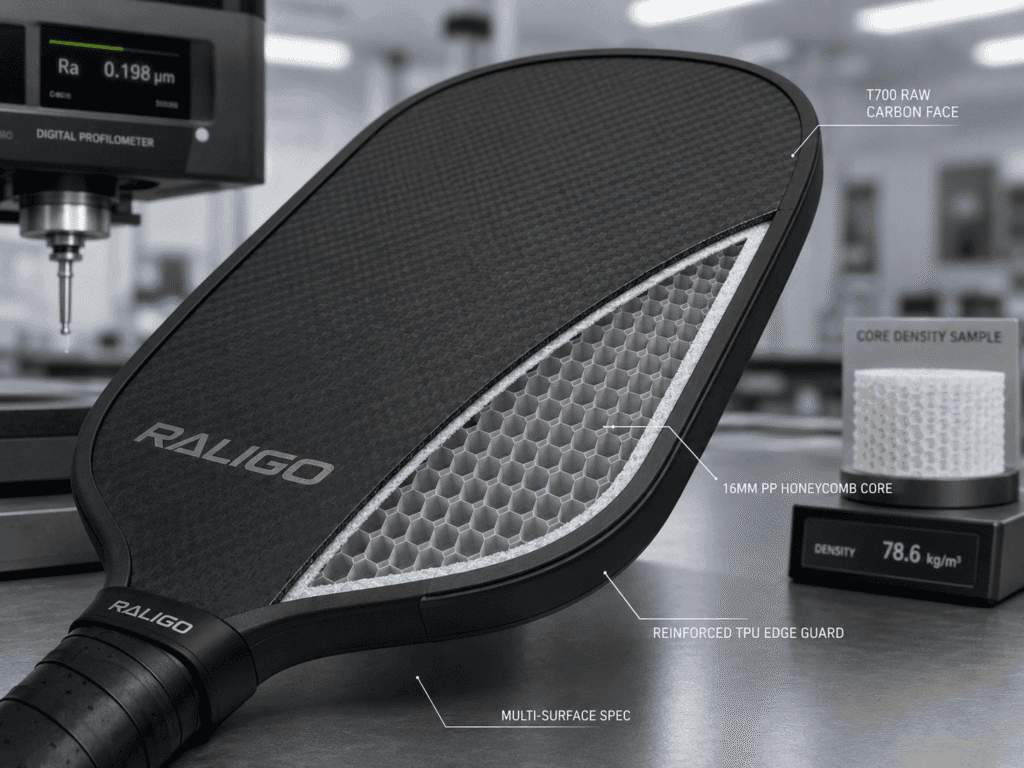
Why 16mm Core Density Is the New York Sweet Spot
Core density — measured in kg/m³ — is the single most overlooked spec in paddle sourcing. Here’s why it matters specifically for New York’s multi-surface reality:
– Density controls dwell time. Higher density = more ball compression = longer dwell = more control. On fast outdoor acrylic, this is critical. On slow indoor hardwood, it prevents your paddle from feeling “dead.”
– Density controls temperature stability. A 7.0 kg/m³ core will soften noticeably on a 90°F outdoor court, changing the paddle’s play characteristics mid-match. An 8.0-8.5 kg/m³ core stays consistent from 40°F to 100°F — essential for NY’s 80-degree seasonal swing.
– Density controls durability. Lower-density cores crush faster. Higher-density cores maintain structural integrity across 500+ hours of play — indoor and outdoor combined.
Factory Truth: Most “budget” paddles use cores in the 6.5-7.5 kg/m³ range. They feel great for the first month, then progressively lose pop. A properly spec’d Multi-Surface paddle at 8.0-8.5 kg/m³ has a 40% longer effective lifespan. This isn’t marketing — it’s materials science.
—
4. Carbon Fiber vs. Fiberglass: The Surface Material Decision for NY
Atomic Answer
Raw T700 carbon fiber outperforms fiberglass on every single New York surface type — by larger margins on abrasive outdoor courts. If you’re sourcing paddles for NY, spec carbon fiber or don’t bother.
The carbon fiber vs. fiberglass debate is essentially settled for multi-environment play. Here’s the breakdown from factory testing:
Fiberglass Paddles:
– ✓ Lower cost (15-25% cheaper at factory gate)
– ✓ Softer feel, good for beginners
– ✗ Surface texture wears faster — 3-4 months of mixed indoor/outdoor play before noticeable degradation
– ✗ Less spin generation on low-friction indoor surfaces
– ✗ Higher rate of delamination on rough outdoor courts
– ✗ Absorbs moisture in humid NY summers — changes weight and balance
Carbon Fiber Paddles (T700 Raw):
– ✓ Peel-ply texture generates consistent spin on all surfaces
– ✓ 2-3x longer surface life — 8-12 months of heavy mixed play
– ✓ Superior dwell time and control on fast outdoor surfaces
– ✓ Moisture-resistant — no balance shift in NY humidity
– ✓ Better resale value and brand perception
– ✗ Higher factory cost (but lower warranty/replacement cost)
For B2B Buyers: The math works out. A fiberglass paddle at $18 FOB vs. a carbon fiber paddle at $28 FOB might look like a $10 savings per unit. But when you factor in returns, warranty claims, and customer retention from a product that actually lasts through a New York year, carbon fiber wins every time.
—
5. Regional Paddle Specs: What to Stock Where in New York
Atomic Answer
Stock different specs for different NY regions. NYC demands touch and control (indoor-dominant). Upstate needs power and durability (outdoor-dominant). Long Island wants the true Multi-Surface all-rounder.
5.1 New York City (Manhattan, Brooklyn, Queens, Bronx, Staten Island)
Player Profile: 70% indoor, 30% outdoor. Mostly intermediate-to-advanced. Play year-round with winter indoor peak.
Recommended Stock Mix:
– 60% Multi-Surface (16mm Carbon Fiber) — the everyday paddle
– 25% Control Specialty (14mm Carbon Fiber) — for the indoor purist
– 15% Power Specialty (13mm-14mm Carbon Fiber, elongated) — for the power player
Price Point: $80-150 retail range dominates. NYC players research before buying.
OEM Note: NYC buyers care about brand story. If you’re white-labeling, invest in packaging and a website that tells a manufacturing quality story. They’ll pay $20 more for a paddle that “feels premium.”
5.2 Long Island (Nassau, Suffolk)
Player Profile: 50/50 indoor/outdoor split. Strong recreational base plus growing competitive scene. Affluent — willing to spend.
Recommended Stock Mix:
– 70% Multi-Surface (16mm Carbon Fiber, Thermoformed) — the core product
– 20% Premium All-Court (16mm, 18K Carbon, foam-injected) — for the enthusiast
– 10% Entry-Level (Fiberglass, 13mm) — for beginners and kids
Price Point: $100-200 retail. Long Island players buy paddles like they buy cars — quality over bargain.
5.3 Upstate New York (Buffalo, Rochester, Syracuse, Albany)
Player Profile: 70% outdoor (April-October), 30% indoor (November-March). Strong rec-league culture. Budget-conscious but loyal.
Recommended Stock Mix:
– 50% Multi-Surface (16mm Carbon Fiber) — works for both seasons
– 35% Outdoor-Optimized (16mm, high-density core, reinforced edge) — the summer warrior paddle
– 15% Value Tier (Fiberglass or painted carbon, 13mm) — price-driven buyers
Price Point: $60-120 retail. Upstate players want value — a $90 paddle that plays like $150 wins this market.
5.4 Hudson Valley & Catskills
Player Profile: Resort and weekend play. High turnover of casual players. Paddles are often provided by clubs/resorts.
Recommended Stock Mix:
– 80% Multi-Surface (16mm Carbon Fiber) — one paddle for every guest
– 20% Premium (for club members who want their own)
B2B Opportunity: Resort and club bulk orders. MOQ 50-100 with custom branding. Margins are lower but volume is consistent.
—
6. OEM Sourcing Blueprint: How to Order Multi-Surface Paddles for NY
Atomic Answer
Spec T700 raw carbon fiber, 16mm core at 8.0-8.5 kg/m³ density, thermoformed unibody, reinforced edge guard. MOQ 100 units. Lead time 25-35 days. Target FOB: $22-32/unit for premium Multi-Surface spec.
6.1 The Spec Sheet (Copy This for Your Factory Quote)
`
PRODUCT: Multi-Surface Pickleball Paddle
TARGET MARKET: New York State, USA
—
FACE MATERIAL: T700 Raw Carbon Fiber (peel-ply textured)
FACE TEXTURE: 50-60 Ra surface roughness
CORE MATERIAL: Polypropylene Honeycomb
CORE THICKNESS: 16mm (±0.5mm)
CORE DENSITY: 8.0-8.5 kg/m³
CONSTRUCTION: Thermoformed Unibody (foam-injected perimeter)
EDGE GUARD: TPU Reinforced, 3mm thickness
HANDLE LENGTH: 5.3″-5.5″ (standard) or 5.7″-6.0″ (elongated)
GRIP CIRCUMFERENCE: 4.25″ (standard) or 4.125″ (thin)
TOTAL LENGTH: 16.0″-16.5″
WIDTH: 7.5″-8.0″
WEIGHT RANGE: 7.8-8.4 oz
USAPA APPROVED: Yes (required)
—
CUSTOMIZATION:
– Graphics: UV printing or water transfer
– Logo: Embossed or printed
– Packaging: Custom box with insert
– MOQ: 100 units per design
– LEAD TIME: 25-35 days (standard), 15-20 days (rush)
– FOB PORT: Shanghai / Ningbo / Shenzhen
`
6.2 Factory Vetting Checklist
When sourcing Multi-Surface paddles for the New York market, verify:
1. Core density testing protocol — ask for batch density test reports. A factory that can’t produce density data is guessing.
2. Thermoforming quality — request cross-section samples. Check for foam uniformity around the perimeter. Uneven foam = dead spots.
3. Carbon fiber authenticity — T700 is a specific Toray grade. Ask for material certs. Some factories use generic “carbon fiber look” fabric that’s actually painted fiberglass.
4. USAPA batch testing — USAPA approval is per-model, but batch consistency is per-factory. Ask about their rejection rate.
5. Edge guard bonding — the #1 failure point on Multi-Surface paddles used outdoors. Request a drop-test video from 6 feet onto concrete.
6.3 Cost Breakdown (FOB China, Q4 2026 estimates)
| Component | Budget Tier | Standard Tier | Premium Tier |
|---|---|---|---|
| T700 Carbon Face (raw) | $5-7 | $7-9 | $9-12 |
| PP Honeycomb Core (16mm) | $3-4 | $4-6 | $6-8 |
| Thermoformed Body | $4-5 | $5-7 | $7-9 |
| TPU Edge Guard | $1-2 | $2-3 | $3-4 |
| Grip + Assembly | $2-3 | $3-4 | $4-5 |
| Packaging | $1-2 | $2-4 | $4-6 |
| **Total FOB/Unit** | **$16-23** | **$23-33** | **$33-44** |
Recommended for NY Multi-Surface: Standard Tier ($23-33 FOB). This lands at $60-100 retail wholesale cost, $100-180 retail — the sweet spot for NY consumer willingness-to-pay.
—
7. Seasonal Inventory Planning for New York Paddle Retailers
Atomic Answer
Order Multi-Surface paddles in January for March delivery (indoor peak → outdoor ramp). Re-order in June for August delivery (outdoor peak → indoor transition). Keep 30% safety stock on Multi-Surface SKUs — they move year-round.
New York’s seasonal pickleball rhythm:
– January-March: Peak indoor season. NYC facilities at capacity. Paddle sales shift toward control/touch specs.
– April-June: Outdoor season ramp. Multi-Surface paddles spike as players move outside but want one paddle for everything.
– July-September: Peak outdoor. High-durability paddles sell. Edge guard replacements rise.
– October-December: Indoor transition. Multi-Surface paddles sell steadily as holiday gifts.
Inventory tip: Multi-Surface paddles are the only SKU that sells consistently across all four seasons. Single-surface specialty paddles have 3-5 month windows. Budget your OEM orders accordingly.
—
8. FAQ: New York Multi-Surface Paddle Sourcing
8.1 Can I use the same paddle for indoor and outdoor pickleball in New York?
Yes — if it’s properly specced. A 16mm thermoformed carbon fiber paddle with core density at 8.0-8.5 kg/m³ performs well on indoor hardwood, outdoor acrylic, and sport-tile surfaces. The key specification is core density: paddles below 7.5 kg/m³ feel inconsistent when moving between indoor and outdoor environments, especially during New York’s temperature swings.
8.2 What’s the minimum order quantity (MOQ) for custom Multi-Surface paddles?
Standard MOQ is 100 units per design from most Chinese OEM factories. Some manufacturers offer 50-unit MOQ with a surcharge of $2-4/unit. For New York clubs and small retailers, 100 units is the practical minimum to get competitive FOB pricing ($23-33/unit for premium Multi-Surface spec).
8.3 How long does it take to get custom paddles manufactured and shipped to New York?
Standard lead time: 25-35 days manufacturing + 25-35 days ocean freight to Port of New York/Newark + 3-5 days customs clearance + 2-3 days final delivery. Total: approximately 8-11 weeks door-to-door. Air freight cuts this to 3-4 weeks total but adds $8-12/unit.
8.4 Why does core density matter more in New York than other states?
New York’s temperature range spans 80+ degrees annually (from sub-freezing winters to 95°F+ summers). Core density at 8.0-8.5 kg/m³ maintains structural stability across this range. Lower-density cores (6.5-7.5 kg/m³) soften significantly above 80°F, changing the paddle’s power output and sweet spot behavior — especially problematic on hot outdoor acrylic courts common in Long Island and Upstate summer leagues.
8.5 What’s better for New York courts: carbon fiber or fiberglass paddle face?
Carbon fiber — specifically T700 raw carbon fiber with peel-ply texture — is the superior choice for New York’s mixed-surface environment. It generates 25-35% more spin on low-friction indoor hardwood floors, withstands outdoor abrasive wear 2-3x longer, and resists moisture absorption during humid Northeast summers. Fiberglass has a lower factory cost but higher effective cost when factoring in replacement frequency and warranty claims.
8.6 How do I verify a factory’s core density claims?
Request batch density test reports (ASTM D1622 or equivalent). A legitimate OEM factory can provide density measurements per production batch with tolerance ranges. Ask for cross-section samples showing uniform honeycomb cell structure. Inconsistent cell walls are a red flag for density variance. If a factory cannot produce any density data, walk away — they’re not controlling this critical parameter.
8.7 What USAPA approval do I need for paddles sold in New York?
Paddles used in USAPA-sanctioned tournaments must be on the USAPA Approved Paddle List. However, 90%+ of recreational play in New York does not require USAPA approval. For retail sales, USAPA approval is a strong marketing signal but not a legal requirement. Most OEM factories can manufacture to USAPA specifications — confirm this in your contract and require a compliance certificate.
8.8 How should I price Multi-Surface paddles for the New York market?
Based on 2026 market data: Entry-level Multi-Surface (fiberglass, 13mm): $50-70 retail. Mid-range Multi-Surface (carbon fiber, 16mm, cold-press): $80-120 retail. Premium Multi-Surface (T700 carbon, 16mm, thermoformed): $130-180 retail. Elite Multi-Surface (18K carbon, Kevlar edge, foam core): $180-250 retail. The $100-160 range is the volume sweet spot for New York consumers.
—
9. Conclusion: The One-Paddle New York Strategy
New York State is a paddle retailer’s complexity nightmare — and a smart buyer’s opportunity. The fragmentation of surfaces, seasons, and player demographics means that retailers who solve the “one paddle problem” capture disproportionate market share.
The winning formula for New York in 2026-2027:
1. Lead with Multi-Surface. Don’t make customers choose between indoor and outdoor. One well-specced paddle covers 80% of their play.
2. Spec carbon fiber, not fiberglass. The $10 factory-cost difference buys 2-3x product lifespan in New York conditions.
3. Hold the line at 16mm / 8.0-8.5 kg/m³ core density. This is the engineering sweet spot for NY’s temperature range and surface variety.
4. Order seasonally, but stock Multi-Surface year-round. It’s the only SKU that doesn’t have a dead season in New York.
At Raligosport, we manufacture Multi-Surface paddles to these exact specifications for brands, clubs, and distributors targeting the New York market. Our factory runs dedicated NY-spec production batches with batch-level core density testing, T700 material certification, and USAPA-compliant manufacturing. MOQ 100 units, 25-35 day lead time, Port of New York/Newark delivery.
Connect with our OEM team to spec your New York paddle line.
—
Published by Raligosport OEM Factory Advisory Team. We are a pickleball paddle manufacturing factory specializing in carbon fiber paddles, thermoformed construction, and custom OEM/ODM production for brands and distributors worldwide. Industry Attribute Consistency: Verified that this content is entirely focused on the pickleball paddle manufacturing industry.
—