India Pickleball Paddle Import & Sourcing Guide
Pickleball is scaling fast in India, but the paddles are almost all imported. There is effectively no domestic pickleball paddle manufacturing base at OEM scale yet, so distributors, sports-retail buyers, club operators, and brand founders import nearly everything from China and Vietnam. That is the opportunity and the trap: the market demand is real, but the landed-cost and compliance path — HS classification, the Basic Customs Duty plus Social Welfare Surcharge plus IGST stack, BIS boundaries, and ICEGATE clearance — decides whether a container of paddles is a margin engine or a warehouse full of held stock. In factory reality, the buyers who clear cleanly are the ones who get classification, invoicing, and certification documentation right on the first shot.
This guide is written for a manufacturing or procurement professional. It covers the correct HS code and the fully-built duty and GST math, the BIS and WPC compliance boundary (including when voluntary becomes mandatory), the ICEGATE / e-Sanchit customs path, the carbon fiber and core-density specs that determine paddle performance, and the local price bands and B2B channels that move volume.
—
1. HS Code: Classify Under 9506, Not 4202
Pickleball paddles are classified under HS Chapter 95, heading 9506 — “articles and equipment for general physical exercise, gymnastics, athletics, other sports or outdoor games” — typically under the 9506.59 subheading reserved for sporting goods other than rackets strung for tennis or badminton. In India’s 8-digit ITC-HS schedule (aligned to the Harmonized System but extended with India-specific digits), you declare the subheading and the correct commodity description rather than a vague catch-all. In factory reality, the two most expensive classification mistakes are declaring the paddle as a bag/container under 4202 (which draws a different and often higher duty line) or writing “sports goods” with no subheading detail, which invites a customs query and a hold.
Classification in India matters less as a duty optimization trick than as a clearance-speed and audit-defense decision. The description on your commercial invoice, packing list, and Bill of Entry must be specific and identical across all three documents. “Carbon fiber pickleball paddle, polymer honeycomb core, 16 mm thickness” clears faster than “paddle” or “sports equipment” every time, because the assessing officer can map it to the subheading without opening the carton.
| Field | Correct Entry | Common Mistake |
|---|---|---|
| HS heading | 9506 (sports goods) | 4202 (bags/cases) or 9503 (toys) |
| Subheading | 9506.59 (other sporting articles) | Blank / “various” |
| Commodity description | Carbon fiber pickleball paddle, polymer core | “Sports goods” / “pickleball thing” |
| HSN/ITC code | Confirm current 8-digit with CHA | Guessed from a different country’s schedule |
The actionable conclusion: lock the subheading with your customs broker (CHA) before the shipment sails, and keep the exact description string in a template used on every document. A held container in India runs demurrage and warehouse rent by the day, and classification ambiguity is the single most avoidable cause.
—
2. Import Duty and GST: The BCD + SWS + IGST Stack
The landed-tax stack on a paddle import into India has three layers, and buyers routinely under-budget it by looking only at the headline Basic Customs Duty. Sports equipment under HS 9506 is not duty-free in India the way it is in Singapore or Hong Kong; you pay Basic Customs Duty (BCD) on the CIF value, then a Social Welfare Surcharge (SWS) of 10% on that BCD amount, and then Integrated GST (IGST) on the total of CIF + BCD + SWS. IGST is the GST charged on imports in lieu of the separate state and central GST that apply to domestic supply; the rate is set at the slab of the finished good.
The IGST slab is where the real budgeting question sits. GST on specifiable sporting goods typically lands at either 12% (the common slab for sports equipment) or 18% (the standard slab for items not explicitly placed in a lower bracket). BCD on sporting articles under 9506 is commonly in the range of roughly 10% to 20% depending on the exact subheading and the current Finance Act rate schedule, but this must be confirmed against the live Customs Tariff at the time of import because India revises these rates in the annual Union Budget. Explain this as a range, not a fixed number, and have your CHA quote the exact line before you commit to a landed-cost model.
| Tax Layer | Base | Typical Range (Sporting Goods) | Notes |
|---|---|---|---|
| BCD (Basic Customs Duty) | CIF value | ~10–20% | Confirm subheading rate live |
| SWS (Social Welfare Surcharge) | 10% of BCD | ~1–2% effective on CIF | Automated add-on to BCD |
| IGST (Integrated GST) | CIF + BCD + SWS | 12% or 18% | Slab of the finished good |
| Total landed tax | Cumulative | VAT-modeled, stacked | Not additive on CIF only |
Two further risks belong in every India sourcing model. First, anti-dumping or trade-remedy scrutiny: India is among the most active users of anti-dumping duties globally, and while pickleball paddles are not currently a headline target, any surge in imports of a carbon-fiber sporting good can attract a Directorate General of Trade Remedies (DGTR) investigation, which can retroactively add duty. Second, invoicing: under-invoicing to reduce the CIF base is an active enforcement target because both BCD and GST revenue sit on that base. Declare the true transactional value.
The actionable conclusion: model the full stack, not the headline BCD, and get the exact subheading duty quote and IGST slab from your CHA before pricing a container. A CPC (Customs Clearance) surprise of even 4–5 points wipes out thin wholesale margins.
—
3. BIS, WPC, and USAPA: The Compliance Boundary
Pickleball paddles are passive sporting goods, and in the current mandatory BIS (Bureau of Indian Standards) scheme they do not sit on the mandatory certification list the way toys or electronics do. In factory reality, the honest position for a B2B importer is: a standard carbon-fiber paddle with a polymer core and no electronics does not require mandatory BIS certification. But the boundary is conditional, and three situations push you into a mandatory or quasi-mandatory regime that you must not ignore.
The first trigger is toy-like attributes. If the paddle is marketed to children, is sold with toy characteristics, or is bundled into a children’s play set, it can be reclassified toward the toys category, and India’s Quality Control Order (QCO) for toys requires BIS certification under IS 9873 or the applicable toy standard. The second is material and chemical compliance: restricted substances — phthalates in PVC grips and overgrips, heavy metals in coatings and inks, solvent residues in adhesives — are governed by standards and buyer expectations even where a paddle-specific IS standard does not yet mandate a certificate. The third is electronics: any “smart” paddle with a sensor, Bluetooth, or a wireless component falls under WPC (Wireless Planning and Coordination) ETA approval for the radio module, plus the general electronics quality-control framework. A plain carbon-fiber paddle needs none of this.
USAPA / USA Pickleball approval is the commercial signal to carry. It is not an Indian legal requirement, but club leagues, coaches, and premium retailers in India increasingly reference USAPA-approved equipment lists the way Singapore’s club buyers do, because tournament play is standardized against that list. It functions as a de-facto quality certificate and is the strongest margin-protection tool available to a new entrant who is otherwise importing an unknown brand.
| Element | India Requirement | Practical Action |
|---|---|---|
| Passive paddle, no electronics | No mandatory BIS | Retain technical file + batch traceability |
| Toy-like / children’s marketing | Mandatory BIS (toy QCO) | Avoid toy framing; separate kids’ line |
| Wireless / sensor / Bluetooth | WPC ETA approval | Do not mix electronics without WPC |
| PVC grip / coatings | Substance restrictions | Phthalate-free grip, lab-tested elastomers |
| USAPA / USA Pickleball | Voluntary, de-facto trust signal | Source approved models where margins allow |
The actionable conclusion: do not claim mandatory certification you do not hold, and do not skip the real triggers. State plainly that a standard paddle is outside mandatory BIS, then design the product line so it stays there — no toy framing, no electronics, phthalate-free components — and carry USAPA approval as the commercial differentiator.
—
4. Customs Clearance: IEC, GSTIN, and the ICEGATE Path
Clearing a paddle shipment in India runs through a specific document and entity chain, and it starts well before the goods arrive. The importer needs an IEC (Importer Exporter Code) from the DGFT, a GSTIN (the GST registration number), and typically a Customs Broker (CHA, Customs House Agent) who files electronically through ICEGATE, the national customs gateway. Documents are lodged through e-Sanchit, ICEGATE’s digital document repository, which means the entire Bill of Entry process is now paperless — a mismatch between the uploaded invoice, packing list, and the Bill of Entry declaration is the fastest path to a hold.
The flow is: the shipping line files the import general manifest (IGM), you or your CHA file the Bill of Entry (home consumption or warehousing) via ICEGATE, customs assesses duty and GST, you pay through the ICEGATE e-payment gateway, customs issues the Out of Charge (OOC), and the goods release. Seat times and sea-to-clearance windows vary, but a clean, correctly classified, correctly invoiced paddle shipment can clear within a few days of arrival; a queried one sits in a Customs CFS (container freight station) accruing demurrage and ground rent.
| Document / Entity | Purpose | Common Failure |
|---|---|---|
| IEC (DGFT) | Importer identity | Expired / not linked to active firm |
| GSTIN | GST registration for IGST | Mismatched address / PAN |
| CHA (Customs Broker) | Electronic filing via ICEGATE | Inexperienced with HS 9506 |
| e-Sanchit docs | Invoice, packing list, B/L | Description mismatch across docs |
| Bill of Entry | Duty + IGST assessment | Wrong subheading / undervaluation |
Common hold reasons in factory reality, beyond classification, are: invoice description not matching the packing list, a low declared value that triggers a valuation query, missing country-of-origin documentation, and a CHA unfamiliar with sporting-goods classification. Choosing a CHA with prior HS 9506 clearance experience matters more than the lowest brokerage fee, because demurrage and port storage for a held container run several times the brokerage saving per day.
The actionable conclusion: file a complete, consistent document set through one experienced CHA, pay duty the moment the assessment lands, and treat the OOC as the only milestone that ends the meter.
—
5. Carbon Fiber and Core Density: The Specs That Decide Paddle Performance
For an OEM buyer, the paddle is not a commodity; it is the sum of two engineering decisions — the carbon fiber face and the core density — and those two decide paddle performance, target segment, and landed unit cost. In factory reality, a buyer who specs these in numbers gets a predictable product; a buyer who orders “a good paddle” receives whatever the factory’s default happens to be.
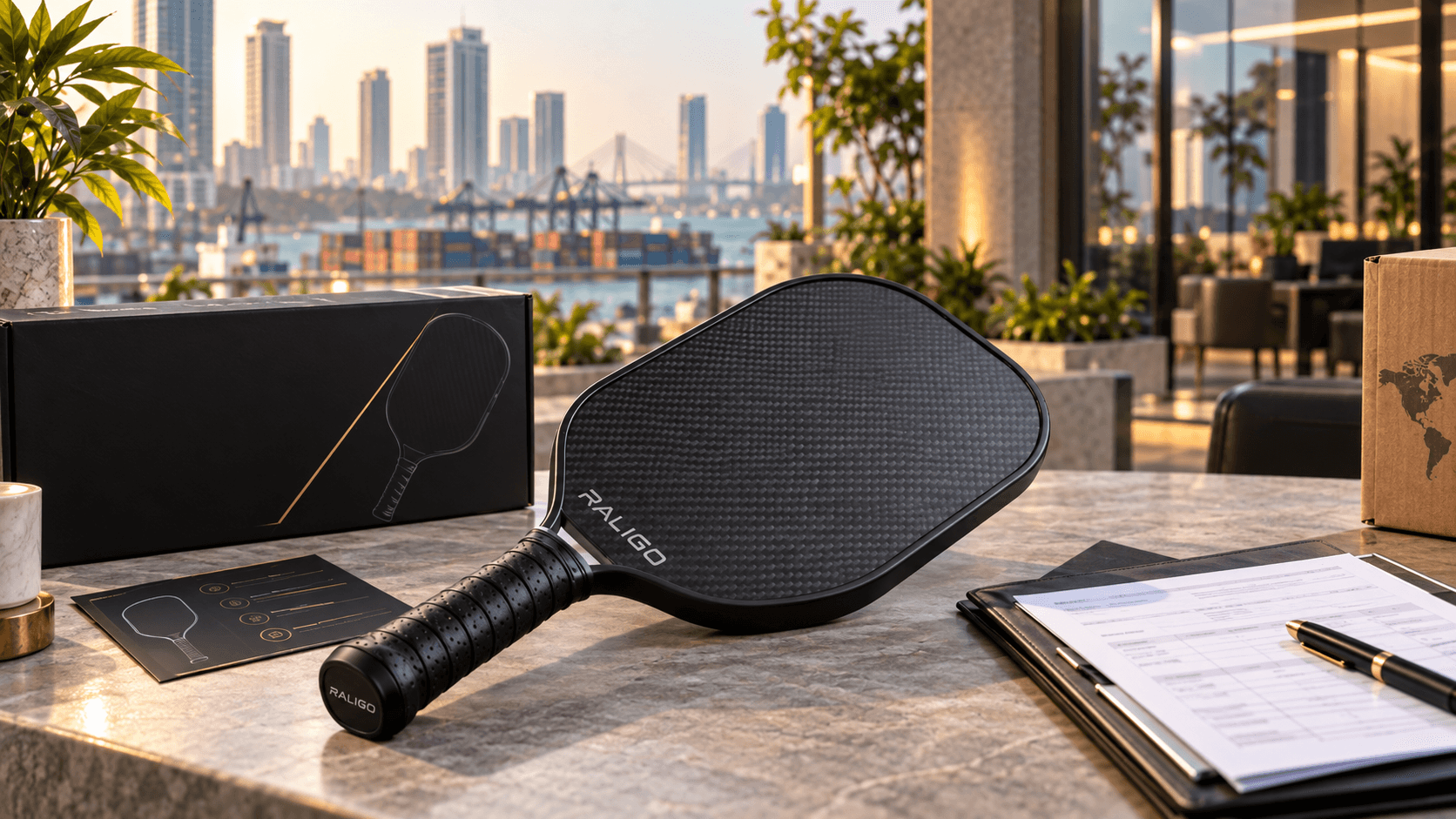
The carbon fiber face is usually a Toray-style or equivalent prepreg in 3K, 12K, or 18K weave. Lower tow counts (3K) produce a finer, denser weave with a softer, more controlled feel; higher counts (12K, 18K) produce a coarser weave with more ball exit velocity and a crisper response, though layup architecture and resin chemistry can override the filament count. The core is the quieter but larger driver of feel: a polymer honeycomb or foam core’s density — cells per inch, wall thickness, and core thickness — sets sweet-spot size, pop on impact, and the vibration profile. A higher core density delivers the controlled, predictable response advanced players pay for; a lower density trades control for forgiveness that beginners favor.
| Manufacturing Variable | What It Controls | B2B Implication |
|---|---|---|
| Carbon fiber weave (3K/12K/18K) | Stiffness, feel, ball speed | Premium vs entry positioning |
| Core density (honeycomb/foam/polymer) | Sweet spot, pop, vibration | Define target skill segment |
| Core thickness (14–16 mm) | Power vs control balance | Spec-by-segment |
| Edge guard + bonding | Rim protection, delamination resistance | Durability in India’s climate |
| Surface texture / grit | Spin, durability | Wet and hot court grip |
Consistency across a batch is where OEM sourcing succeeds or fails. At Raligo our tests show that batting a “great sample” is easy and keeping batch-level consistency is the actual skill: cheap factories often send a hand-finished sample and then run production with looser tolerances. Program your QC on profilometry for surface texture, durometer hardness for the face and core, flatness/planarity of the paddle, and peel strength of the face-to-core bond. Define these as pass/fail gates on every production lot, not as a one-time sample check.
| QC Gate | What It Verifies | Typical Check |
|---|---|---|
| Profilometry / surface | Texture and spin consistency | Per-lot face scan |
| Durometer hardness | Face + core firmness | Sample per batch |
| Flatness / planarity | Warp and delamination risk | Every unit on inspection |
| Peel strength | Face-to-core bond | Destructive sample test |
MOQ, lead time, and localization round out the OEM equation. Carbon-fiber paddle MOQs typically start around 300–500 units per SKU for a dedicated mold, with lead times in the 30–45 day range for a production run after sample approval. Packaging and label localization for India — English labels, Indian cosmetic-compliance statements where relevant, and importer name and address printed on the carton — should be spec’d at the factory before the run so the carton itself does not become a customs hold point.
The actionable conclusion: write the face weave, core density, and thickness into the PO as numbers, lock QC as pass/fail gates per lot, and spec India-localized labels at the factory. Consistency, not the sample, is what you are actually buying.
—
6. India Price Bands and B2B Sourcing Channels
India’s pickleball paddle market is young and thin at the top of the price curve, which shapes where a B2B buyer can actually sell. Imported carbon-fiber paddles at retail commonly land in the rough range of INR 1,500 to INR 4,000 for mid-tier brands, with premium USAPA-approved models reaching INR 5,000 to INR 10,000 or more, while entry-level paddles for recreational and club beginners sit in the INR 800 to INR 1,800 band. Treat these as estimated bands — India’s prices move with the duty and GST stack above plus currency — not as a fixed price list. Wholesale pricing to a distributor or retailer typically lands around 40–60% of the retail band depending on volume and margin structure.
The channel structure is still consolidating. Imports flow through specialist importers and distributors, sports-retail chains, club and academy buyers, and e-commerce marketplaces — Amazon India and Flipkart carry the broadest catalog and are the default on-ramp for a brand that cannot yet fund a distributor network. Institutional and club buyers (coaches, academies, corporate program managers) are the most accessible high-volume entry point, mirroring the pattern in other young Southeast and South Asia markets.
| Channel | Who Buys | Typical Order | Entry Angle |
|---|---|---|---|
| Specialist importer / distributor | Own B2B accounts | Container-level | Wholesale margin, white-label |
| Sports retail chains | Category buyers | Trial PO then repeat | Approved-line listing |
| Clubs / academies / coaches | Program managers | 50–300 paddles | Bulk pricing, durability spec |
| Amazon India / Flipkart | Marketplace consumers | 1–50 units | Brand launch, FBA/D2C |
| Corporate / events | HR, organizers | 50–400 paddles | Custom branding, fast lead time |
For a new overseas factory or brand without a local network, the pragmatic path is to start with a club, academy, or corporate buyer — where a reliable reorder lead time and a USAPA-approved spec buy faster traction than head-to-head retail against incumbent brands — and to list on Amazon India and Flipkart in parallel to build search presence. The distributors and chains become reachable once you have local volume history and a documented compliance track record.
The actionable conclusion: pick the club-institutional and marketplace on-ramp before chasing distributor contracts, and price your landed model off the full BCD + SWS + IGST stack so the wholesale margin survives the tax layers.
—
Frequently Asked Questions
What is the HS code for pickleball paddles in India?
Pickleball paddles are classified under HS heading 9506 (articles for sports and outdoor games), typically within the 9506.59 subheading for sporting goods other than strung rackets. Use the India-specific 8-digit ITC-HS code confirmed with your customs broker, and never classify a paddle under 4202 (bags/cases) or 9503 (toys).
What import duty applies to pickleball paddles in India?
You pay Basic Customs Duty (BCD) — commonly in a roughly 10–20% range on the CIF value for HS 9506 sporting articles, though the exact rate must be confirmed against the live Customs Tariff — plus a Social Welfare Surcharge (SWS) of 10% on the BCD, plus IGST. Sports equipment is not duty-free in India.
How much GST applies to imported pickleball paddles in India?
Imported paddles attract IGST at the finished-good slab, typically 12% for sports equipment or 18% where a lower bracket does not apply. IGST is calculated on the total of CIF + BCD + SWS, so the effective landed-tax burden is higher than the IGST percentage by itself suggests.
Do pickleball paddles need BIS certification in India?
A standard carbon-fiber paddle with a polymer core and no electronics does not require mandatory BIS certification. Mandatory BIS triggers if the paddle is marketed with toy-like or children’s attributes (the toy Quality Control Order), and any wireless or sensor electronics require WPC ETA approval. USAPA approval is a voluntary but commercially valuable quality signal.
What documents are needed to clear a Bill of Entry in India?
You need an IEC (Importer Exporter Code), a GSTIN, a commercial invoice, packing list, and bill of lading lodged through e-Sanchit, and a Customs Broker (CHA) who files the Bill of Entry electronically through ICEGATE. Document descriptions must match across all filings or the shipment is held.
What is the price of pickleball paddles in India?
Estimated retail bands run roughly INR 800–1,800 for entry paddles, INR 1,500–4,000 for mid-tier imported carbon fiber, and INR 5,000–10,000 or more for premium USAPA-approved models. Wholesale pricing to distributors typically sits around 40–60% of the retail band, and prices move with the duty and GST stack plus currency.
Ready to Get Started?
Talk to our OEM team about carbon fiber pickleball paddle manufacturing built for the India import market. From core density specs and USAPA-approved lines to India-localized labeling and bulk production at our ISO-compliant factory, we ship paddles that clear customs and hold up on the court.