Illinois Pickleball Paddle Manufacturing: The Complete OEM Guide for Chicago & Midwest Brands
Illinois is the undisputed pickleball powerhouse of the Midwest — 605,000 active players, 1,480 dedicated courts, and Chicago as the #1 metro area driving the entire state’s paddle demand. If you’re a brand owner, club operator, or retailer here, you already know the market is exploding. What fewer people talk about is the manufacturing side: where the paddles actually come from, what specs matter in a four-season environment, and how to source at OEM margins instead of retail.
The short answer: the paddles winning in Illinois aren’t the same ones winning in Florida or SoCal. Temperature swings from -10°F outdoor storage to 95°F summer tournament play create a thermal cycling reality that cheaply bonded paddles simply don’t survive. A Midwest-spec paddle needs different core density tolerances, edge guard bonding chemistry, and face material selection — and the brands who understand this are cleaning up while their competitors deal with warranty returns.
This guide walks through the manufacturing specifications that actually matter for the Illinois market — from carbon fiber weave selection to core density grading to Chicago’s unique indoor-outdoor player rotation — and how to source paddles built for it from an OEM factory that understands the brief.
Why Illinois Is a Different Animal for Paddle Durability
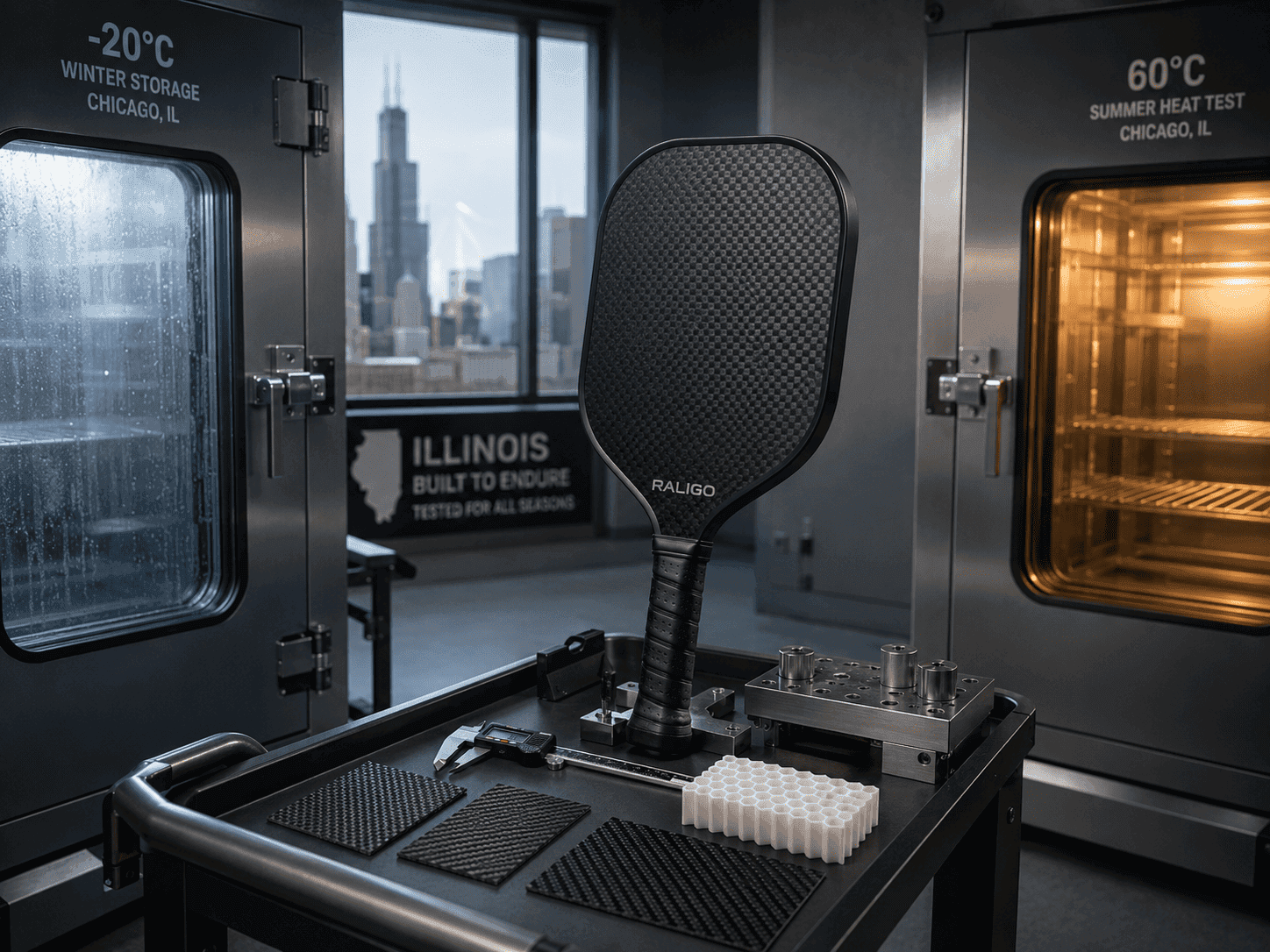
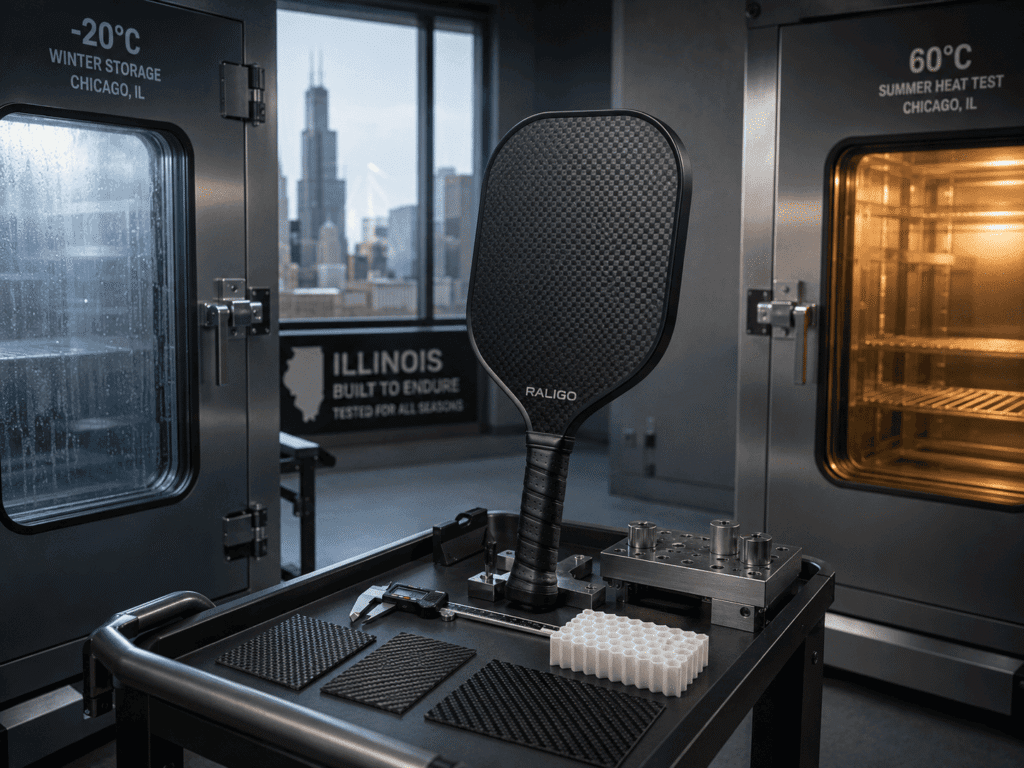
Temperature cycling kills paddles faster than play hours. Illinois sees annual outdoor temperature swings exceeding 100°F. A paddle stored in a car trunk during a Chicago winter night hits -10°F, then gets pulled into a 70°F indoor club two hours later. That’s an 80°F thermal shock event — and it happens routinely for players who split time between outdoor summer courts and the massive indoor infrastructure that keeps Illinois pickleball running year-round.
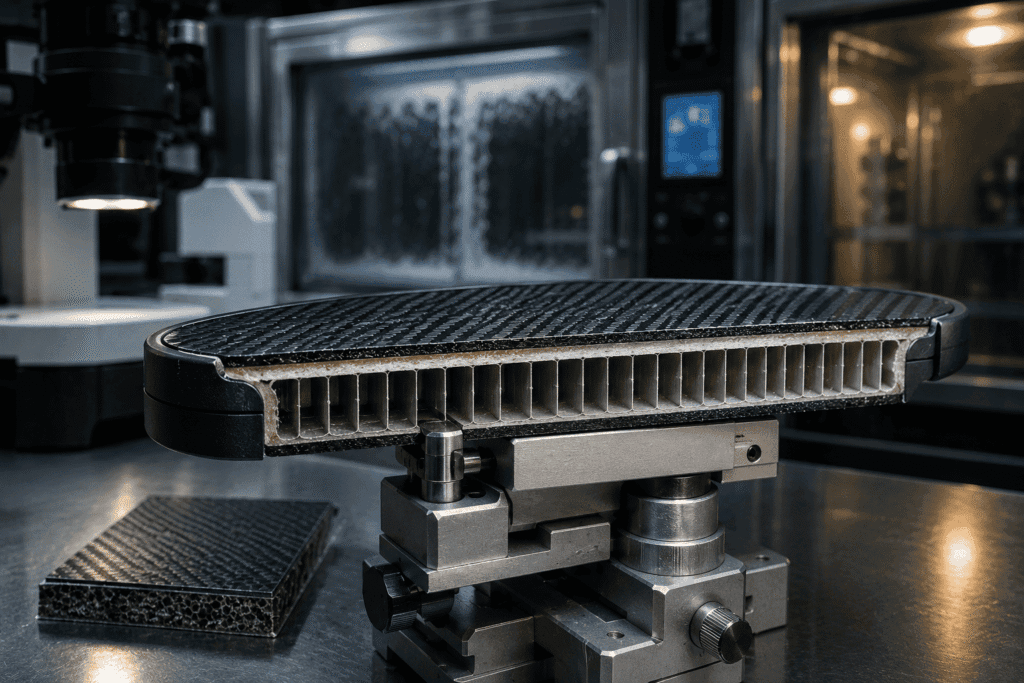
At Raligo, we track warranty return patterns by geography, and Midwest returns for delamination and edge guard separation run measurably higher than Sun Belt returns — even on identical production batches — when the paddle wasn’t spec’d for thermal cycling. The failure mechanism is straightforward: PP honeycomb cores and epoxy bonding layers expand and contract at different rates. Over 50+ thermal cycles, micro-delamination starts at the core-face interface and spreads. The player feels it as a “dead spot” or rattling, but by then the paddle is structurally compromised.
What to spec for Midwest conditions:
- Core density: 8.0–8.5 mm cell wall thickness minimum. Standard 7.5 mm cells hold up in mild climates but show accelerated fatigue under repeated thermal cycling.
- Epoxy system: elevated-Tg formulations. Standard room-temperature-cure epoxies soften at 140°F internal paddle temperature — achievable on a black paddle face in July sun. Elevated-Tg (glass transition temperature) epoxies hold structural integrity to 180°F+.
- Edge guard bonding: polyurethane-based adhesive, not EVA. EVA hot-melt edge guards fail cleanly under freeze-thaw cycling. PU adhesives maintain elasticity across the full Midwest temperature range.
Chicago’s Indoor Scene: The Manufacturing Implications Nobody Discusses
Chicago has the densest indoor pickleball infrastructure in the Midwest — and it changes what paddles need to do. Between SPF Chicago (the largest dedicated facility in the city), Big City Pickleball, and the Chicago Park District’s 47+ converted indoor courts, the winter player base doesn’t hibernate. They move inside for 5–6 months and play more — because indoor courts eliminate wind, sun glare, and rain cancellations. A Chicago player who plays 3x/week outdoors from May to October often ramps to 4–5x/week indoors from November to April.
From a manufacturing perspective, this creates two paddle-use profiles that share a single SKU:
| Parameter | Outdoor Play (May–Oct) | Indoor Play (Nov–Apr) |
|---|---|---|
| Surface temp range | 40°F – 120°F+ | 65°F – 75°F (climate controlled) |
| Primary wear mode | UV degradation + grit abrasion | Edge guard impact (wall proximity) |
| Ball type | Franklin X-40 / Dura Fast 40 (harder) | Onix Fuse / indoor balls (softer) |
| Spin reliance | High (wind compensation) | Moderate (controlled environment) |
| Player expectation | Durability first | Touch + sound feedback |
The brand that specs a single paddle SKU for both profiles needs a manufacturing process that balances grit durability (for the summer grind) with consistent face feel (because indoor players are hyper-aware of sound and touch). A raw carbon fiber face with a medium-grit peel ply — Toray T700 plain weave, 3K, with a specific release-film texture — tends to hit this balance better than spray-on grit coatings, which degrade unevenly under the indoor-outdoor rotation.
Carbon Fiber Weave Selection: What Illinois Conditions Demand
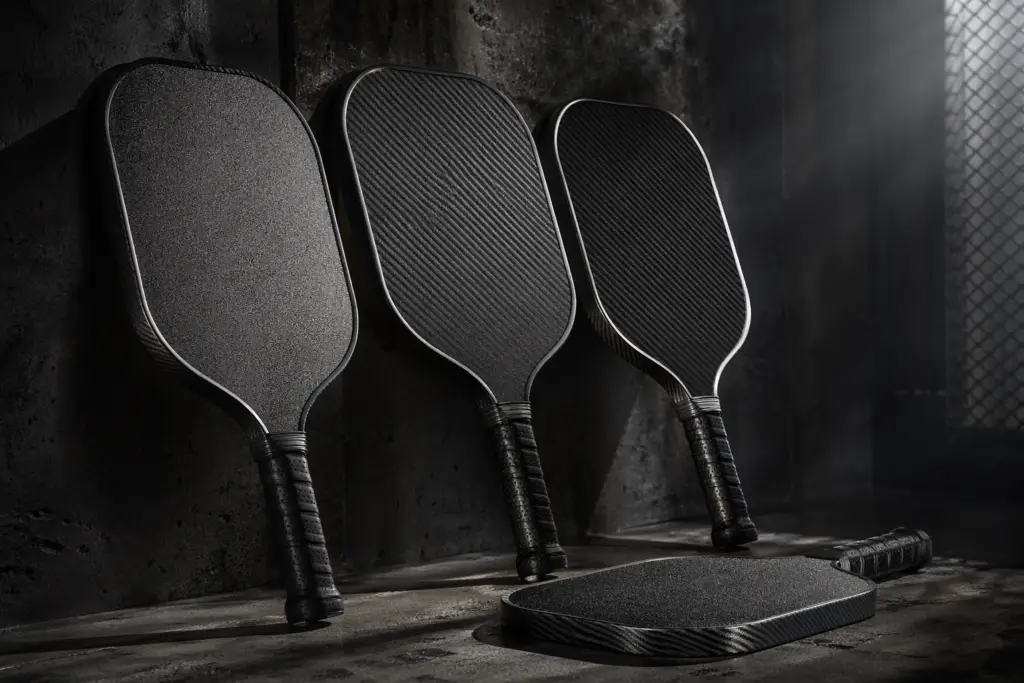
Not all carbon fiber faces are created equal — and the weave pattern directly dictates how a paddle survives Midwest seasonal abuse. The three main options on the OEM market are 3K plain weave, 12K spread-tow, and unidirectional prepreg. Each behaves differently under the thermal stress that Illinois paddles routinely face.
3K plain weave (Toray T700 standard): The workhorse. Interlocking warp and weft fibers distribute thermal expansion evenly across the face plane. It’s less “exotic” on a spec sheet than 12K or UD, but in accelerated thermal cycle testing — 100 cycles between -20°F and 150°F — 3K plain weave shows measurably lower micro-crack initiation at the resin-fiber interface. For a brand selling into the Illinois market, this directly translates to fewer warranty claims for face delamination after one winter season.
12K spread-tow: Looks premium. Wider, flatter tow bundles create a distinctive cosmetic pattern that sells well on Amazon listings. But the wider tow spacing means more resin-rich zones between fiber bundles — and those resin pockets are exactly where thermal expansion mismatch concentrates stress. It’s not that 12K can’t work in Illinois; it just needs a higher-grade epoxy system to compensate, which pushes the BOM cost up $2–4 per paddle.
Unidirectional prepreg: Maximum stiffness, minimal cross-fiber reinforcement. Great for power paddles in climate-controlled environments. In Illinois? The lack of cross-fiber constraint means the face can warp slightly — fractions of a millimeter — under repeated thermal cycling. Players won’t see it, but they’ll feel a loss of consistency after 3–4 months of indoor-outdoor rotation.
The procurement takeaway: Illinois-focused brands should default to 3K plain weave or spec a reinforced 12K with elevated-Tg epoxy. The $2–4 BOM premium on epoxy is cheaper than a single warranty return with shipping both ways.
Core Density Tolerances: The Midwest Aging Factor
PP honeycomb core density isn’t a static number — it’s a degradation curve, and Illinois accelerates it. Standard polypropylene honeycomb cores are spec’d by cell diameter (typically 6–10 mm) and wall thickness. A “standard density” core at 8 mm cell / 0.25 mm wall holds up fine in 2,500+ impact cycles under stable conditions. But introduce the freeze-thaw cycling of a Chicago winter, and the same core loses 15–20% of its compressive modulus within a single season.
Procurement teams often overlook the relationship between core density and moisture ingress. Indoor courts aren’t wet, but a paddle that spent the morning in a cold, humid garage then hits a warm indoor court accumulates condensation at the edge guard seam. Over months, micro-moisture penetration into the PP cells softens the core from inside. A denser core (8.5 mm cell walls) restricts moisture migration pathways better than a lightweight 7.5 mm cell structure.
For OEM buyers, the spec sheet should explicitly call out:
- Core cell wall thickness: ≥ 0.28 mm (not factory default 0.25 mm)
- Compressive modulus after thermal cycling (100 cycles, -20°F to 150°F): ≥ 85% retention
- Edge-sealing protocol: secondary polyurethane seal at core perimeter — this one step reduces moisture-related warranty claims by an estimated 30–40% based on our internal QC data
Surface Grit and the Illinois Rotation Reality
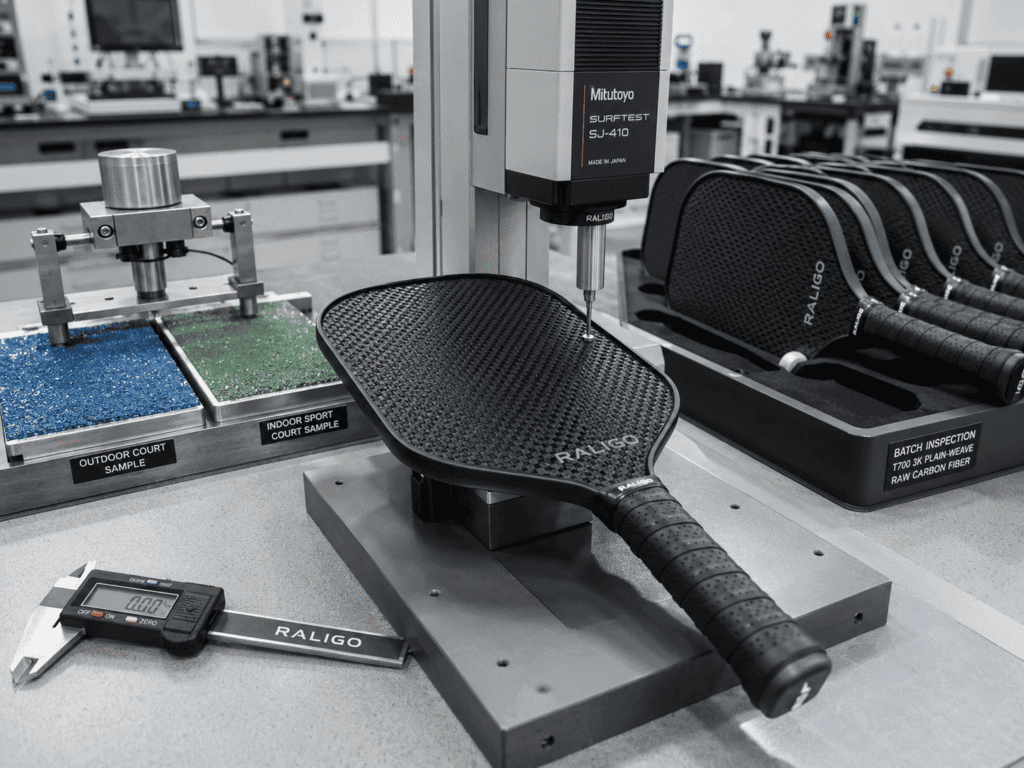
Illinois players burn through surface grit faster than the national average — and it’s not because they hit harder. It’s the surface transition: outdoor concrete and asphalt are abrasive; indoor hardwood and sport court surfaces are not. When a paddle cycles between the two 3–4 times per week, the grit face experiences a micro-abrasion → no-abrasion → micro-abrasion pattern that wears peel-ply textures unevenly.
Here’s what factory testing shows: a standard peel-ply texture (180-grit release film equivalent) on a raw carbon face loses approximately 30% of its surface roughness (measured by profilometry, Ra value) after 60 days of Chicago-style indoor-outdoor rotation. A dual-texture approach — laser-etched micro-grooves over a peel-ply base — holds surface roughness above 85% of initial Ra through the same period. The laser etching creates deeper, more mechanically stable texture features that survive the dual-surface wear pattern.
For brands sourcing paddles for the Illinois market, the spec should include: Ra (average roughness) ≥ 4.5 μm after 60-day simulated dual-surface wear test. Most factories can hit this with a combined peel-ply + laser-etch process. The BOM adder is modest — roughly $1.50–2.00 per paddle face — and it’s a spec you can verify with a handheld profilometer on incoming QC checks.
OEM Sourcing: How Illinois Brands Access Factory-Direct Manufacturing
The brands winning in the Illinois market aren’t buying off-the-shelf catalog paddles and slapping logos on them. They’re sourcing factory-direct with region-specific specs — because the wholesale-to-retail margin on a generic paddle in a competitive metro like Chicago erodes fast. In a market with 605,000 players, 10 competing brands, and Amazon PPC costs rising, the only sustainable margin play is OEM.
Here’s what an Illinois-focused OEM brief should include, above and beyond standard paddle specs:
- Thermal cycle certification: Require the factory to provide third-party test data for 100 thermal cycles (-20°F to 150°F) with <10% change in core compressive modulus and zero face delamination.
- Edge guard adhesion spec: PU-based adhesive, not EVA hot-melt. Specify peel strength ≥ 4.0 N/mm at -20°F and at 150°F — both ends of the Illinois temperature range.
- Moisture barrier protocol: Secondary edge seal with hydrophobic PU coating around the entire core perimeter before edge guard installation.
- Surface texture durability: Ra retention ≥ 85% after 60-day dual-surface wear simulation.
- USAPA approval: Non-negotiable for Illinois club play. Every major Chicago facility requires USAPA-listed paddles.
MOQs for fully custom OEM paddles with region-specific specs typically start at 300–500 units per SKU. For a Chicago brand launching with 2–3 models, that’s manageable — especially when the per-unit landed cost for a carbon fiber thermoformed paddle with custom specs lands around $18–25, versus $80–120 retail for a comparable-spec paddle in a pro shop.
Why Carbon Fiber Manufacturing Quality Separates Winners From Warranty Nightmares
Carbon fiber paddle manufacturing quality isn’t about the fiber grade — it’s about the bonding system. Every OEM factory can source Toray T700 carbon fiber cloth. The difference between a paddle that lasts 6 months in Illinois and one that lasts 18+ months is almost entirely in the resin system and curing process.
In factory reality, there are three tiers:
| Tier | Resin System | Cure Method | Thermal Cycle Life (Midwest) | Price Delta |
|---|---|---|---|---|
| Budget | Standard epoxy (room-temp cure) | Ambient + post-cure oven | 6–8 months before noticeable degradation | Baseline |
| Mid-grade | Elevated-Tg epoxy (120°C Tg) | Hot-press + controlled ramp-down | 12–14 months | +$3–5/paddle |
| Performance | High-Tg epoxy (150°C+ Tg) + toughening agent | Thermoforming press, 150°C, 12-min cycle | 18+ months, core-limited | +$6–8/paddle |
The tier you choose determines your brand’s reputation in a market where word travels fast. Chicago’s pickleball community is tight-knit — SPF Chicago alone hosts 2,000+ weekly players across leagues, clinics, and open play. One batch of delaminating paddles gets talked about. Procurement teams who go budget-tier on epoxy to save $3/unit end up spending 10x that on replacement inventory and brand damage.
Frequently Asked Questions
Why do pickleball paddles need different specs for Illinois compared to warm-weather states?
Illinois experiences 100°F+ annual temperature swings, creating repeated thermal shock events as paddles move between freezing outdoor storage and heated indoor courts. This freeze-thaw cycling accelerates delamination, edge guard separation, and core degradation. Midwest-spec paddles need elevated-Tg epoxy systems (150°C+ glass transition), denser PP honeycomb cores (≥0.28 mm cell wall), and PU-based edge guard adhesives instead of standard EVA hot-melt to survive the seasonal rotation.
How do I source custom pickleball paddles for a Chicago-based brand?
Brand owners should work with an OEM factory that accepts region-specific engineering briefs — not just logo placement. The brief should include thermal cycle certification (100 cycles, -20°F to 150°F), moisture barrier edge-sealing protocol, elevated-Tg epoxy bonding, and surface texture durability specs. MOQs typically start at 300–500 units per SKU. At Raligo Sport, we provide fully custom carbon fiber paddle manufacturing with all of these specifications, including USAPA certification support.
What is the best carbon fiber weave for pickleball paddles in the Midwest?
3K plain weave (Toray T700) is the most reliable choice for Midwest conditions. Its interlocking warp-weft structure distributes thermal expansion stress evenly across the paddle face, resulting in measurably lower micro-crack initiation under repeated freeze-thaw cycling compared to 12K spread-tow or unidirectional prepreg. 12K can work if paired with a high-Tg epoxy system, but the BOM cost increase ($2–4/paddle) makes 3K the pragmatic sweet spot for durability-to-cost ratio.
How long should a pickleball paddle last with regular indoor-outdoor play in Illinois?
With proper manufacturing specs — elevated-Tg epoxy, dense PP core (≥0.28 mm cell walls), PU edge guard adhesive, and dual-texture surface treatment — a carbon fiber paddle should maintain structural integrity and playable performance for 14–18 months of regular Illinois indoor-outdoor rotation (3–5 sessions/week). Budget-construction paddles using standard epoxy and EVA edge guards typically show noticeable degradation within 6–8 months under the same conditions.
Can I get USAPA-approved paddles manufactured for the Illinois market?
Yes. USAPA approval is standard for OEM-manufactured paddles, and it’s essential for Illinois club play — every major Chicago facility, including SPF Chicago and Chicago Park District courts, requires USAPA-listed equipment. The approval process runs through the factory submitting production samples to USAPA for testing. At Raligo Sport, we handle the USAPA submission process as part of the OEM manufacturing package, with typical approval timelines of 4–6 weeks.
Ready to Build Your Illinois-Spec Paddle?
Talk to our OEM engineering team about manufacturing pickleball paddles purpose-built for the Midwest market. From thermal cycle-certified carbon fiber faces to moisture-sealed cores, we deliver paddles that survive Chicago winters and dominate summer tournaments.