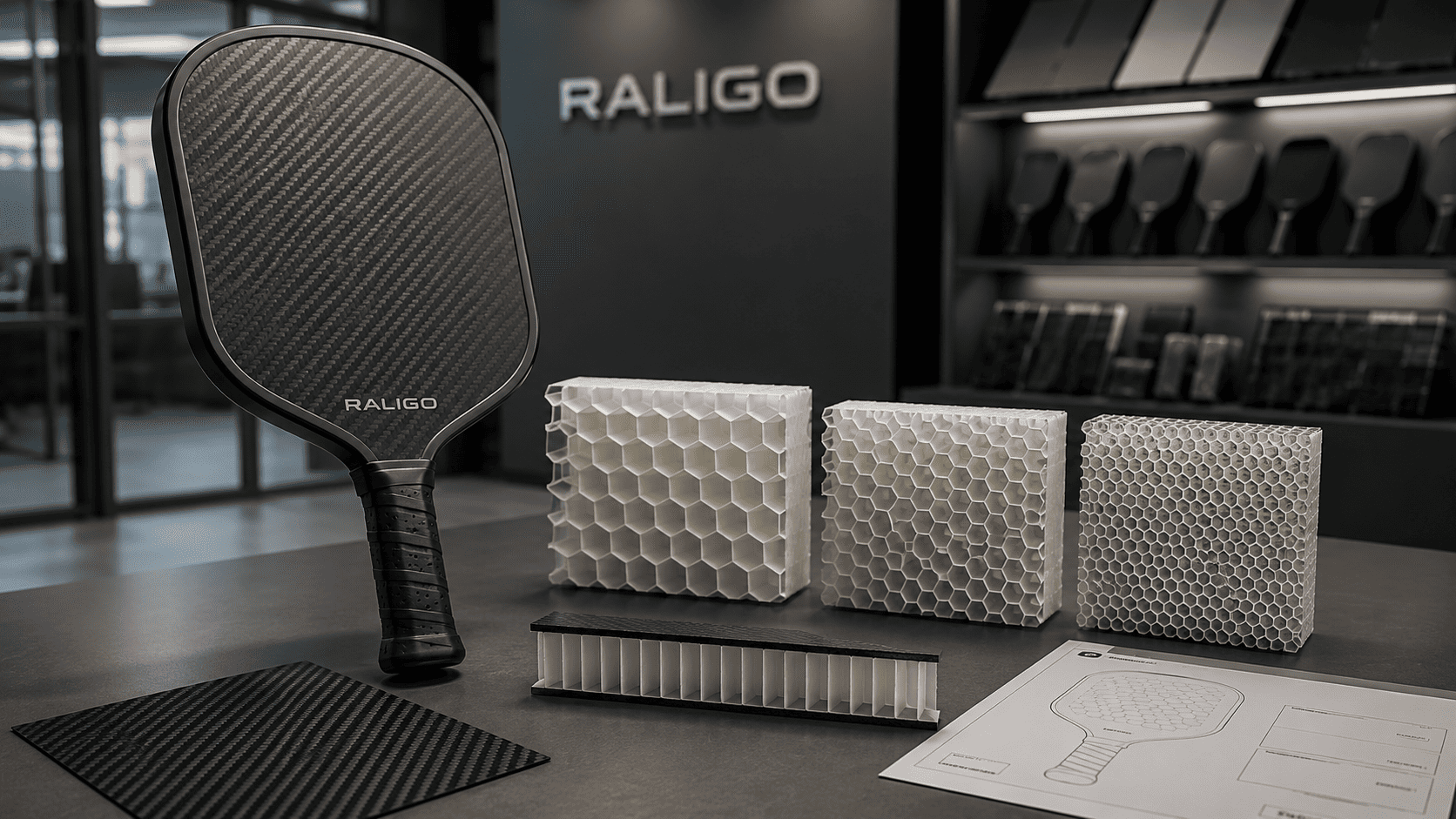
Introduction: The Grid Behind the Carbon Face
Most procurement conversations about carbon fiber pickleball paddles start and end at the face — weave, ply count, resin system. In factory reality, the face is only half the story. The core underneath, a thermoformed polypropylene (PP) honeycomb, dictates weight, feel, power ceiling, and failure mode before the carbon face ever enters the equation.
This article breaks down the two variables that matter most inside that honeycomb: cell size (the across-flats diameter of each hexagon) and cell wall thickness (the polymer thickness forming each wall). Together these two numbers set the core density of the paddle — and core density is what your players actually feel on contact.
If you spec a paddle line, the decisions here are more consequential than anything you’ll print on the face sheet.
—
What Is the Relationship Between Honeycomb Cell Geometry and Core Density?
Atomic Answer: Core density in a honeycomb paddle is a geometric product, not a raw material property. Smaller cell size packs more cell walls per unit area, and thicker cell walls add polymer mass — either change raises density (kg/m³) and stiffness. A typical PP honeycomb runs 6–10 mm cells at 60 μm wall thickness, producing a 60–90 kg/m³ core; shift to 8 mm cells at 40 μm walls and you drop toward 55–70 kg/m³. Geometry is the dial; the polymer is just the substrate.
Polypropylene is the material, but the honeycomb’s open-cell structure means the majority of the core’s volume is air. The actual polymer fraction — and therefore the density — is determined by how much wall material the die extrudes per running meter and how many cells that material forms.
Two parameters dominate:
– Cell size (a): The distance across the flats of a single hexagon. Typical production range is 6 mm to 12 mm.
– Cell wall thickness (t): The nominal thickness of the PP web between adjacent cells. Typical range is 30 μm to 90 μm.
The core density scales roughly with the ratio t/a. Halve the cell size and you approximately double the wall length per unit area; double the wall thickness and you double the polymer mass at constant cell count. This is why two “8mm cores” can feel completely different: one supplier runs 40 μm walls, another 65 μm.
OEM Takeaway: Never spec a core by cell size alone. Always pair it with a wall thickness callout and a target density in kg/m³, or your first production batch will not match the sample you signed off on.
—
Cell Size, Wall Thickness, and Core Density: A Reference Table
The table below maps common production combinations to their approximate core density and resulting paddle feel. These are factory working ranges, not theoretical maxima.
| Cell Size (mm) | Wall Thickness (μm) | Approx. Core Density | Feel Profile | Best Fit |
|---|---|---|---|---|
| 10 | 40 | 45–55 kg/m³ | Ultra-soft, muted | Control paddles, recreational |
| 8 | 50 | 55–70 kg/m³ | Balanced, forgiving | All-around enthusiast |
| 8 | 70 | 70–85 kg/m³ | Firm, poppy | Power hybrids, thermoformed |
| 6 | 60 | 75–90 kg/m³ | Stiff, fast rebound | Tournament power paddles |
| 6 | 80 | 90–110 kg/m³ | Very stiff, harsh | Niche power, thin cores |
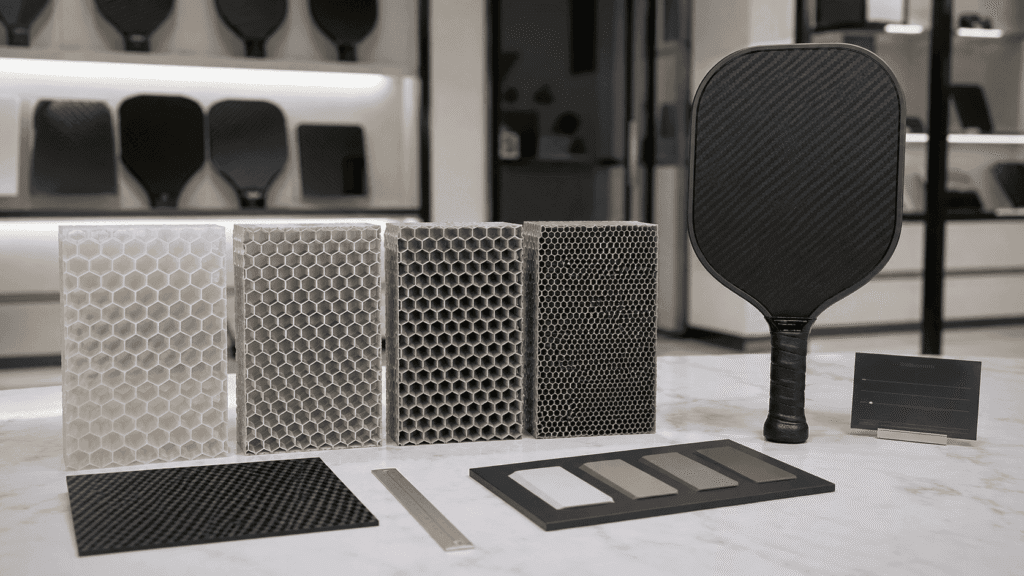
Note the non-linearity: an 8 mm cell at 70 μm walls outperforms a 6 mm cell at 60 μm walls in stiffness-per-gram, which is why thermoformed paddles — which lock the core under compression — tend toward the mid-cell, thicker-wall end of the range rather than shrinking cells indefinitely.
—How Does Cell Size Affect Paddle Performance Beyond Density?
Atomic Answer: Cell size tunes feel and sound independently of total mass. Larger cells (8–12 mm) deform more per impact, producing a softer, quieter “thud” and longer dwell time; smaller cells (6 mm and below) resist buckling, giving a crisper, louder response and snappier rebound. Consequently, cell size is a feel and acoustics lever, whereas wall thickness is primarily a mass and stiffness lever.
There is a persistent misconception that smaller cells are always better because they look more “premium” in marketing renders. In factory terms, that’s wrong. Cell size changes how the core fails under load:
– Large cells (10–12 mm) buckle locally. A hard hit can crush a cluster of cells, creating a permanent soft spot under the face. Players describe this as the paddle “breaking in,” but it’s localized core fatigue.
– Small cells (6 mm) spread load more evenly. Localized crushing is rarer, but the whole paddle transmits more vibration to the hand because the core is stiffer and dampens less.
Sound is a real procurement consideration. Clubs and indoor facilities increasingly care about paddle noise. A larger-cell core reads quieter on a decibel meter and is often preferred for indoor leagues; a small-cell power core is noticeably louder.
OEM Takeaway: If you’re building distinct SKUs in a line, differentiate by cell size first (feel and acoustics), then tune wall thickness to hit each SKU’s target weight and stiffness.
—
Why Cell Wall Thickness Is the Underappreciated Manufacturing Variable
Atomic Answer: Cell wall thickness is the manufacturing variable procurement teams most often overlook, yet it is the primary lever for core density and weight consistency. Thin walls (30–50 μm) cut mass and cost but increase scrap from cell-wall collapse during thermoforming; thick walls (70–90 μm) improve dimensional stability and crush resistance but raise weight and raw material cost. Wall thickness also controls batch-to-batch weight tolerance, which determines whether your paddle meets USAP weight specs.
Here’s why wall thickness deserves more attention than it gets:
1. It’s the main density driver. At constant cell size, wall thickness moves density linearly. A spec change from 50 μm to 70 μm walls adds roughly 15–25 kg/m³ — a meaningful swing in a game where a 7.8 oz and 8.4 oz paddle feel like different products.
2. It dictates thermoforming scrap. Thin walls collapse or fold during the thermoforming draw if the tool temperature or draw speed is off. This shows up as wrinkled cells, inconsistent face bonding, and dead zones. Thicker walls tolerate a wider process window — which is why high-volume factories quietly push toward the thicker end to protect yield.
3. It’s a hidden cost driver. The honeycomb is extruded as a running web, often in meter-wide sheets that get cut to blank size. Thicker walls mean more PP resin per sheet. On a 10,000-paddle run, a 15 μm wall increase is a real line item on the material cost, not a rounding error.
4. It controls weight tolerance. Core weight is a major contributor to total paddle weight variance. A tightly controlled wall thickness (with a stated production tolerance, typically ±5 μm) is what lets a factory promise consistent 8.0 ± 0.2 oz production instead of 7.7–8.3 oz drift.
OEM Takeaway: Ask every factory for their wall-thickness tolerance, not just their cell-size spec. A supplier who can hold ±5 μm on a 60 μm wall is a fundamentally different vendor from one who can’t quote it at all.
—
How Does Core Density Optimization Work in a Production Line?
Atomic Answer: Core density optimization is a targeting exercise across three linked stages: the honeycomb extrusion (which fixes cell size, wall thickness, and thus base density), the thermoforming draw (which compresses and stabilizes the core into its sandwich shape), and final lamination under heat and pressure (which sets the finished core’s effective density and rebound). You cannot optimize density post-hoc; you must specify it at extrusion and preserve it through lamination.
Here’s the sequence in a typical premium paddle line:
Stage 1 — Extrusion. PP is extruded through a honeycomb die, expanded, and cooled. This stage sets cell size and wall thickness. Density at this stage is “nominal” — the number a supplier quotes on a spec sheet.
Stage 2 — Thermoforming. The honeycomb sheet is heated and drawn over a mold to shape the paddle blank. Crucially, this stage changes local geometry: the draw stretches walls thin in curved and edge regions, which slightly lowers local density and can introduce weak points at the rim. Quality factories compensate by starting with thicker edge walls or managing draw temperature.
Stage 3 — Lamination & Press. The carbon face sheets are bonded to the core under heat and pressure. This compresses the core slightly and locks it. The final, “effective” core density is what the press produces — and it’s almost never identical to the extrusion nominal value.
The practical implication: a density target quoted at extrusion can shift 5–15 kg/m³ by the time lamination finishes. Procurement teams that only read the extrusion number are evaluating a spec the player never touches.
OEM Takeaway: Get the factory to quote finished core density, measured on a cut sample pulled from a completed paddle, not the raw extrusion sheet. That single clarification eliminates the most common source of “the production batch doesn’t feel like the prototype” complaints.
—
Why Carbon Fiber Faces Change Your Core Specification
Atomic Answer: A carbon fiber face is stiff and thin, which means it transfers impact energy into the core almost without absorbing it first. As a result, the core does proportionally more of the energy management in a carbon-faced paddle than it would under a fiberglass or composite face. High-modulus carbon faces favor slightly thicker-wall, higher-density cores to avoid a harsh, board-like feel and to prevent early core fatigue.
This is the interaction most first-time spec builders miss. Fiberglass faces flex, masking core stiffness. Carbon faces do not. When you bolt a rigid carbon face onto a core that was spec’d for a soft fiberglass face, you get a paddle with:
– Harsh feel and excess vibration — the stiff face transmits impact shock straight through the core to the hand.
– Premature core fatigue — the core now absorbs more impact per shot than it was designed for, accelerating localized cell crushing.
– Power overshoot — the combination of stiff face and soft core creates an inconsistent rebound that players describe as “unpredictable pop.”
The correction is to re-spec the core when you move to carbon. Either go up in cell-wall thickness (more density, more resistance) or step the cell size down slightly to spread the load — both accomplish the same goal of firming the core to match a firm face.
OEM Takeaway: Never reuse a fiberglass-era core spec on a carbon-faced paddle. Treat the face material and core geometry as a single matched system, and have your factory engineer confirm compatibility before you lock the BOM.
—
What Should an OEM Buyer Verify Before Committing?
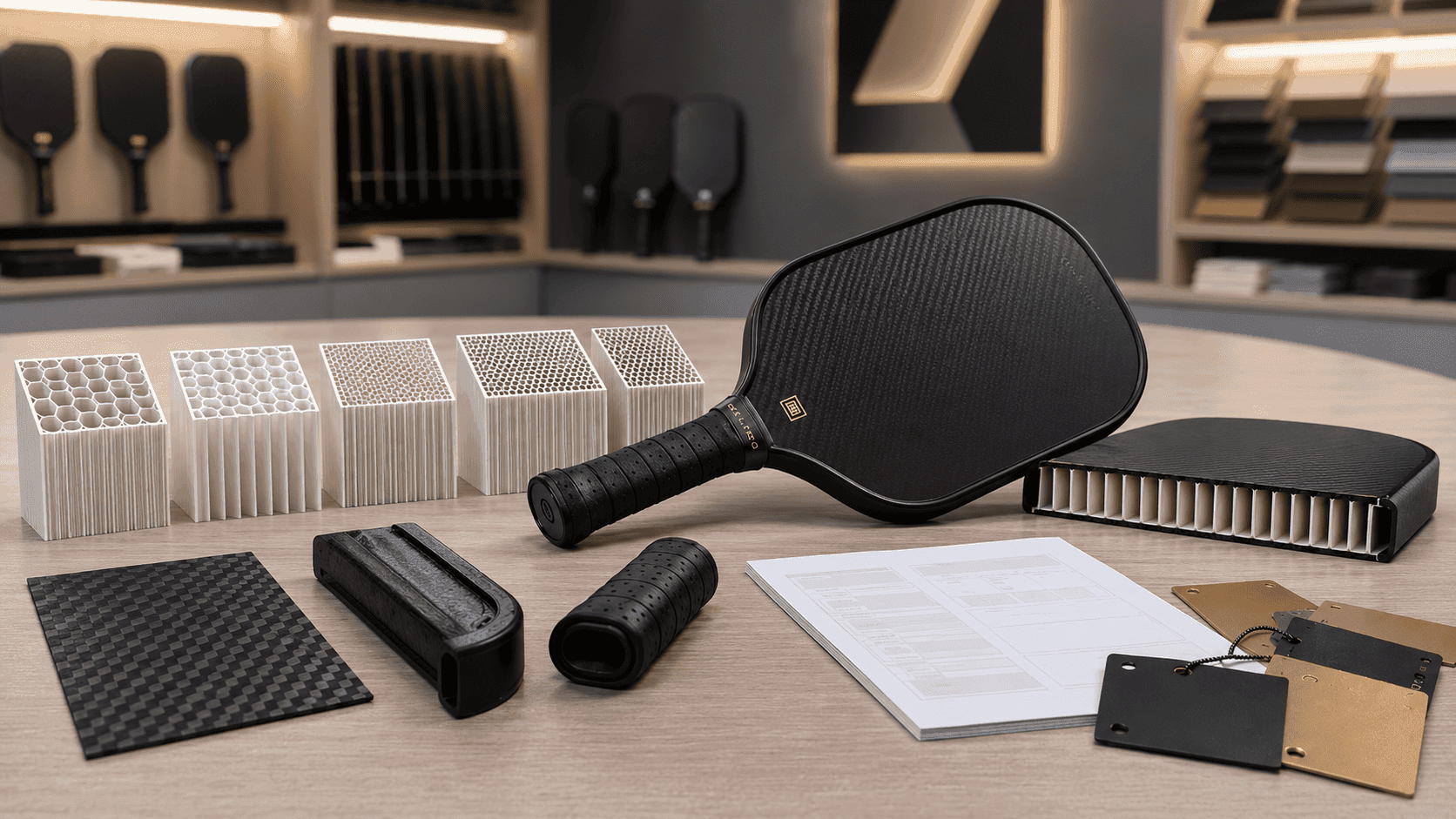
Atomic Answer: Before locking a honeycomb core, an OEM buyer should verify five things in writing: nominal cell size (mm), wall thickness with production tolerance (μm), finished core density measured on a cut sample (kg/m³), weight tolerance of the finished paddle (oz), and the factory’s thermoform scrap rate for that geometry. These five numbers make the difference between a finished line that matches the sample and a costly rework.
Consolidating the decision into a checklist:
1. Cell size — confirm the across-flats measurement, and ask whether it’s measured pre- or post-thermoform (it changes).
2. Wall thickness & tolerance — a wall spec without a tolerance is not a spec.
3. Finished core density — demand a number measured on a cut sample from a produced paddle, not the raw sheet.
4. Weight tolerance — verify the factory can hold total paddle weight within your target band across a full run.
5. Scrap rate — ask for the expected thermoform scrap for your chosen geometry; it’s a direct input to unit cost.
Each of these is verifiable against a physical audit sample. A supplier that can produce all five cleanly is demonstrating real process control, not just a good spec sheet.
OEM Takeaway: Build this five-point list into your factory audit template. It converts a vague “core quality” conversation into a set of pass/fail numbers you can hold a vendor to.
—
Conclusion: Spec the Geometry, Not the Buzzword
The honeycomb core inside a carbon fiber pickleball paddle is not a commodity — it is the single most spec-sensitive component in the bill of materials. Cell size sets feel, sound, and failure mode; wall thickness sets density, weight tolerance, and scrap cost. Together they determine whether a paddle plays like the prototype your team signed off on.
Procurement teams that spec “an 8mm polypropylene core” are leaving the three most important decisions — wall thickness, finished density, and tolerance — entirely to chance. The teams that spec cell size and wall thickness and finished density are the ones that get consistent, repeatable product.
That consistency is the entire game in OEM manufacturing. Get the geometry right, and the face, the branding, and the market positioning all become easier by default.
—
Ready to Spec Your Honeycomb Core?
Talk to our OEM engineering team about cell size, wall thickness, and core density for your next carbon fiber pickleball paddle line. We’ll help you lock a spec that holds up in production.