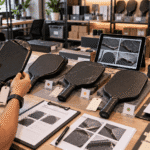
Comparing China and Vietnam for a private-label pickleball paddle project requires more than a headline duty rate. Buyers should assess the exact paddle specification, independent supplier capabilities, current quotes, quality controls, verified origin and total landed cost. This guide is an independent sourcing comparison; RALIGO manufactures in China and does not operate a production facility in Vietnam.
This guide offers a comparison framework for procurement teams to evaluate independently sourced China and Vietnam options, including technical capability, total landed cost, documented customs origin, lead times and quality control. It is not evidence of a universal supplier ranking or a RALIGO dual-country manufacturing network.
Where Each Country Wins: The 30-Second Executive Summary
China can be a strong choice for complex carbon-fiber layups, prototyping and OEM process control when the selected factory demonstrates relevant experience. Vietnam may be worth evaluating for independently sourced alternatives, but actual capability, material sourcing and batch consistency must be verified supplier by supplier.
Neither country guarantees a lower landed cost. Obtain comparable quotes for the same SKU, Incoterms and quantity, then verify the current U.S. HTS classification, applicable trade measures, documented origin and entry date with the importer or customs broker.
RALIGO is a China-based OEM/ODM manufacturer. Any Vietnam supplier discussed here would be independently assessed by the buyer; this article is not a RALIGO dual-country production offer.
Cost Structure: Line-by-Line Breakdown for 500-Unit Runs
Compare a 500-unit scenario only after obtaining dated, like-for-like factory quotations. A sample quantity is not a universal MOQ, and these rows list inputs to request rather than verified market prices, current tariffs or promised savings.
| Input to verify | China-sourced quotation | Vietnam-sourced quotation |
|---|---|---|
| Exact SKU, construction and order quantity | Dated quote for matching specification | Independent dated quote for matching specification |
| Unit price, tooling and Incoterms | Supplier-specific written quote | Supplier-specific written quote |
| Freight, insurance and inspections | Route-specific estimate | Route-specific estimate |
| Country of origin and HTS classification | Importer/broker review | Importer/broker review |
| Base duty and applicable Chapter 99 measures | Check HTS at entry date | Check HTS at entry date |
| Brokerage and inland logistics | Documented estimate | Documented estimate |
| Total landed cost | Calculate from verified inputs | Calculate from verified inputs |
Landed cost: unit price and allocated tooling + freight and insurance + applicable customs duties and entry charges + inspection and brokerage + inland logistics. No universal country-based dollar-saving estimate is reliable without the exact classification, origin, entry date and comparable quotes.
Tariff Reality Check: What Procurement Teams Need to Know
Illustration note: this visual is illustrative, not a current customs-duty quotation or a ruling for a particular SKU. Verify duty treatment for the actual imported product and entry date.
A reciprocal-tariff announcement does not necessarily equal the total duty on an imported carbon-fiber paddle. U.S. importers and customs brokers should confirm the exact HTS classification, origin, entry date, applicable Chapter 99 measures and other charges.
China: Verify the Applicable Tariff Stack
For China-origin paddles, check base duty, applicable Section 301 measures, exclusions and any other current trade action using the USITC Harmonized Tariff Schedule and official USTR updates. An exclusion must be verified against the actual imported goods; material composition alone does not establish an applicable rate.
CBP ruling NY N347450 addresses a pickleball set that includes wooden paddles and accessories, not an individual T700 carbon-fiber OEM paddle. Its outcome cannot automatically be transferred to a different SKU.
Vietnam: Check the Framework Against Current Product Rules
The October 2025 U.S.–Vietnam reciprocal-trade framework discussed a 20% rate, but that historic announcement is not a guaranteed, permanent or all-inclusive tariff for every paddle in 2026. Verify the tariff provisions and entry date with the importer or customs broker.
Assembly, cutting or finishing in Vietnam does not automatically determine Vietnamese origin. Establish a complete bill of materials and manufacturing flow, then evaluate whether the facts satisfy applicable substantial-transformation rules. A certificate of origin alone does not guarantee a specific U.S. duty rate.
Quality Tiers: What Each Supplier Must Demonstrate
Illustration note: this graphic describes sourcing scenarios, not independently verified factory counts, guaranteed quality rankings or a RALIGO production presence in Vietnam.
A buyer should compare capability at the factory and model level rather than rely on national rankings or an unsupported count of approved production lines. The following questions apply to independent suppliers in either country.
| Paddle segment | China supplier — ask for | Vietnam supplier — ask for | Decision criterion |
|---|---|---|---|
| Premium thermoformed carbon | Sample-specific process and testing evidence | Equivalent construction samples and process evidence | Repeatability, approval of the exact model when needed, and quality controls |
| Mid-range carbon / polymer core | Construction sheet, batch QC and price quote | Comparable SKU quote, batch QC and origin records | Like-for-like delivered cost and defect handling |
| Entry-level composite | Material and durability checks; quote for volume | Same specifications, sample tests and terms | Documented quality and full landed cost |
| Promotional / bulk | Volume capacity, acceptance criteria | Volume capacity, acceptance criteria | Written QC, packaging and delivery commitments |
USA Pickleball approval is model-specific, not a blanket certification of a country or factory. RALIGO offers China-based manufacturing only; any Vietnam sourcing in this comparison refers to a buyer’s independent supplier search.
Factory Maturity: Compare Documented Capabilities
A supplier’s experience matters when production moves from prototypes to repeat orders, but factory maturity cannot be inferred from a country’s name. Evaluate actual composite processing experience, documented manufacturing controls and repeatable output for the required paddle design.
For Chinese or Vietnamese candidate suppliers, request photographs or a live view of relevant equipment, a bill of materials, process control documents and QC records from recent comparable production runs. Ask about thermoforming, core processing, face bonding, surface treatment and traceability as appropriate.
Avoid using unverified counts of Vietnamese factories, precise investment figures or universal claims about one country’s superiority. A supplier with strong evidence may be more suitable than a larger but less transparent factory, irrespective of country.
Material Supply Chains: Assess Carbon Fiber Access
Carbon-fiber tow grade, fabric architecture, prepreg or resin supply, core materials and storage conditions affect paddle manufacturing. The relevant due-diligence question is whether each supplier can obtain the specified input materials with documented quality, lead times and traceability.
Ask both China-based and Vietnam-based candidates for material sourcing declarations, supplier specifications, handling or storage procedures where needed, substitution rules and alternative supply arrangements. Import reliance and delivery times vary by factory; they should not be stated as a blanket two-to-four-week penalty or a fixed 30–40% national price advantage.
For premium paddle programs, validate representative T700/T800 or other material claims against supplier records and sample testing. A different source or process may change performance and require renewed equipment approval review for the exact model.
Lead Times, MOQs, and Production Flexibility
MOQ, tooling, sampling and lead times depend on the design, order size, factory capacity, material availability and production schedule. Use written quotes from independently evaluated suppliers rather than treating national averages as guaranteed order terms.
| Decision variable | China supplier | Vietnam supplier |
|---|---|---|
| Sample lead time and fees | Request current dated offer | Request current dated offer |
| Minimum order quantity / tooling | Confirm by model and customization | Confirm by model and customization |
| Production lead time | Confirm materials, inspection and shipping milestones | Confirm materials, inspection and shipping milestones |
| Rush orders or changes | Confirm conditions in writing | Confirm conditions in writing |
| Batch QC and reserve capacity | Review evidence and commitments | Review evidence and commitments |
For RALIGO manufacturing specifications and quotations, contact its China-based OEM/ODM team. RALIGO does not operate a Vietnam production facility.
The Dual-Sourcing Playbook: An Independent Buyer Framework
A buyer considering China and Vietnam should compare separate, independently evaluated suppliers rather than assume that a China-based manufacturer provides its own Vietnamese production. RALIGO’s manufacturing operations are in China; this is an educational decision framework, not a RALIGO two-country supply contract.
Core Strategy: Match the SKU to the Supplier
- For technical or premium models, inspect thermoforming, carbon-fiber layup, process documentation and repeatable sample performance for each candidate factory.
- For mid-range or entry-level models, request comparable specifications, quotations, quality records and actual landed-cost calculations; do not assume a universal country preference.
- For prototypes and R&D, confirm development tooling, revision control, engineering communication and realistic sample lead times.
- If independently dual-sourcing, establish compatibility criteria, batch inspection and contingency plans before deciding any split percentage.
The JV Option: Ownership Does Not Determine Customs Origin
A joint venture or China-owned plant located in Vietnam does not automatically confer Vietnamese origin on every product. U.S. customs origin depends on the actual materials and manufacturing operations, potentially including substantial transformation. Request a full process map, bill of materials and supporting records, and seek customs-broker or CBP guidance when the issue is material.
No cutting, layup, thermoforming or finishing step should be presented by itself as a guaranteed route to a specified tariff rate. RALIGO has no Vietnam facility or Vietnam manufacturing service to offer.
QC and Compliance: What to Demand from Either Country
Geography does not establish product quality; model-level approval and controlled manufacturing processes matter. Compare the same product requirements and documentary evidence for suppliers in each country.
- USA Pickleball model approval: when required for the intended competition, verify the exact brand and paddle model on the official approved paddle list. A factory is not generically “USAPA-certified,” and production batches are not covered by an automatic official “USAPA batch certification.”
- Product specification and tolerances: agree on weight, dimensions, core, face, finish and applicable tests for the specific product. Do not assume one tolerance is mandatory for every model.
- Sampling and destructive checks: document who tests which units, to what method and acceptance criteria, with frequency appropriate to order risk and quantity.
- Traceability and change control: identify batches, material substitutions and the process for investigating defects.
- Independent inspections: choose site visits or third-party sampling based on documented risk and commercially agreed costs, rather than treating arbitrary order volumes and audit prices as industry mandates.
Suppliers should share representative evidence from comparable production, not merely promotional pictures or claims of approval. Where approved-model status is needed, verify it directly rather than accepting a generic certificate.
Regional Risk and Supply Chain Resilience
Country diversification may reduce exposure to some sourcing risks, but it is not automatically economical or suitable for every SKU. The relevant variables include port and route availability, trade measures at the time of entry, production capacity, materials, inspection access and the buyer’s tolerance for supplier complexity.
Compare each candidate’s shipping plan, backup materials, quality history, fulfillment commitments and response to disruptions. No country should be described as permanently safer, cheaper or able to absorb a fixed share of another country’s production without verified supplier capacity.
If a brand independently qualifies separate suppliers in China and Vietnam, it can consider contingency orders after evaluating real quotations and specifications. RALIGO provides China-based OEM/ODM manufacturing services only.
FAQ: Quick Answers for Procurement Teams
Is Vietnam really cheaper than China for pickleball paddles?
Not necessarily. Compare like-for-like supplier quotations and the full landed cost for each actual SKU. U.S. customs duties depend on current HTS classification, documented origin, entry date and applicable trade measures. There is no verified universal per-paddle saving.
Can Vietnamese factories match Chinese quality on thermoformed carbon paddles?
Capabilities vary by manufacturer, not just country. Compare equipment, materials, samples and batch-level inspection evidence for the same design. When competition eligibility matters, verify the approved status of the specific brand and paddle model.
What is the minimum order quantity for OEM paddles in Vietnam versus China?
MOQ depends on the manufacturer, design, tooling and order terms. Obtain written quotes for the same specification and ask about sample quantities, mold fees, production scheduling and change costs.
How do I verify U.S. customs origin for a Vietnam-processed paddle?
Document materials and manufacturing steps, and ask the U.S. importer or customs broker to evaluate the product’s origin under the applicable rules. A Certificate of Origin alone does not automatically establish U.S. customs origin or guarantee a duty rate; consider a CBP ruling if classification or origin remains uncertain.
Should I move all production out of China?
Not as a blanket rule. Review product engineering requirements, supplier samples, full landed costs, quality assurance, capacity and concentration risks before making any sourcing shift. Any China–Vietnam dual-sourcing arrangement described here would involve suppliers independently evaluated by the buyer.
Does RALIGO manufacture in Vietnam?
No. RALIGO currently manufactures in China. We do not operate a Vietnam production facility or offer an in-house China–Vietnam dual-country production network.
Your 4-Week Supplier-Evaluation Action Plan
The following schedule is an optional planning example, not a mandated dual-country purchase commitment or a promise of Vietnam production from RALIGO.
- Week 1 — Define comparable SKUs. Specify materials, construction, volumes, quality targets and destination market. Ask an importer or broker to check classification, origin and the entry-date tariff provisions.
- Week 2 — Request documented offers. Gather current samples, quotes, QC processes and material declarations from your chosen China supplier and, if useful, independently identified Vietnam suppliers.
- Week 3 — Validate capability and origin. Compare sample performance, manufacturing flow, batch traceability, model-specific USA Pickleball approval where relevant and realistic delivery schedules.
- Week 4 — Decide on a limited pilot if justified. Do not place automatic 200+200 dual-country orders. Select the supplier or suppliers based on validated requirements, risk and total delivered cost.
Supplier comparisons are most useful when they improve product quality and landed-cost visibility rather than prescribe an arbitrary percentage split.
About RALIGO: RALIGO is a China-based pickleball paddle OEM/ODM manufacturer. Our manufacturing operations are in China; we do not operate a production facility in Vietnam. This article helps buyers compare independent China and Vietnam supplier options. For RALIGO’s China-based OEM capabilities, sampling and quotations, please contact our team.
Verified Sources for Your Sourcing Decision
Use primary references when making binding commercial or import decisions: the USITC Harmonized Tariff Schedule for current classifications and duty provisions; CBP rulings for fact-specific customs decisions; USTR announcements for trade policy; and the USA Pickleball approved paddle database for model-specific equipment approval.
For U.S. import estimates, consult the actual importer and customs broker with documented product specifications and manufacturing origin evidence. RALIGO can discuss China-based OEM paddle materials, samples and production quotations, but does not guarantee customs classification, trade rates or Vietnam manufacturing.
Ready to Lock Your Sourcing & Core Specs?
Discuss carbon-fiber layups, core materials, samples and production requirements with our China-based OEM/ODM engineering team. RALIGO does not operate a Vietnam production facility, and this comparison is not an offer of dual-country production. Verify independent suppliers, customs origin and duties with qualified professionals.