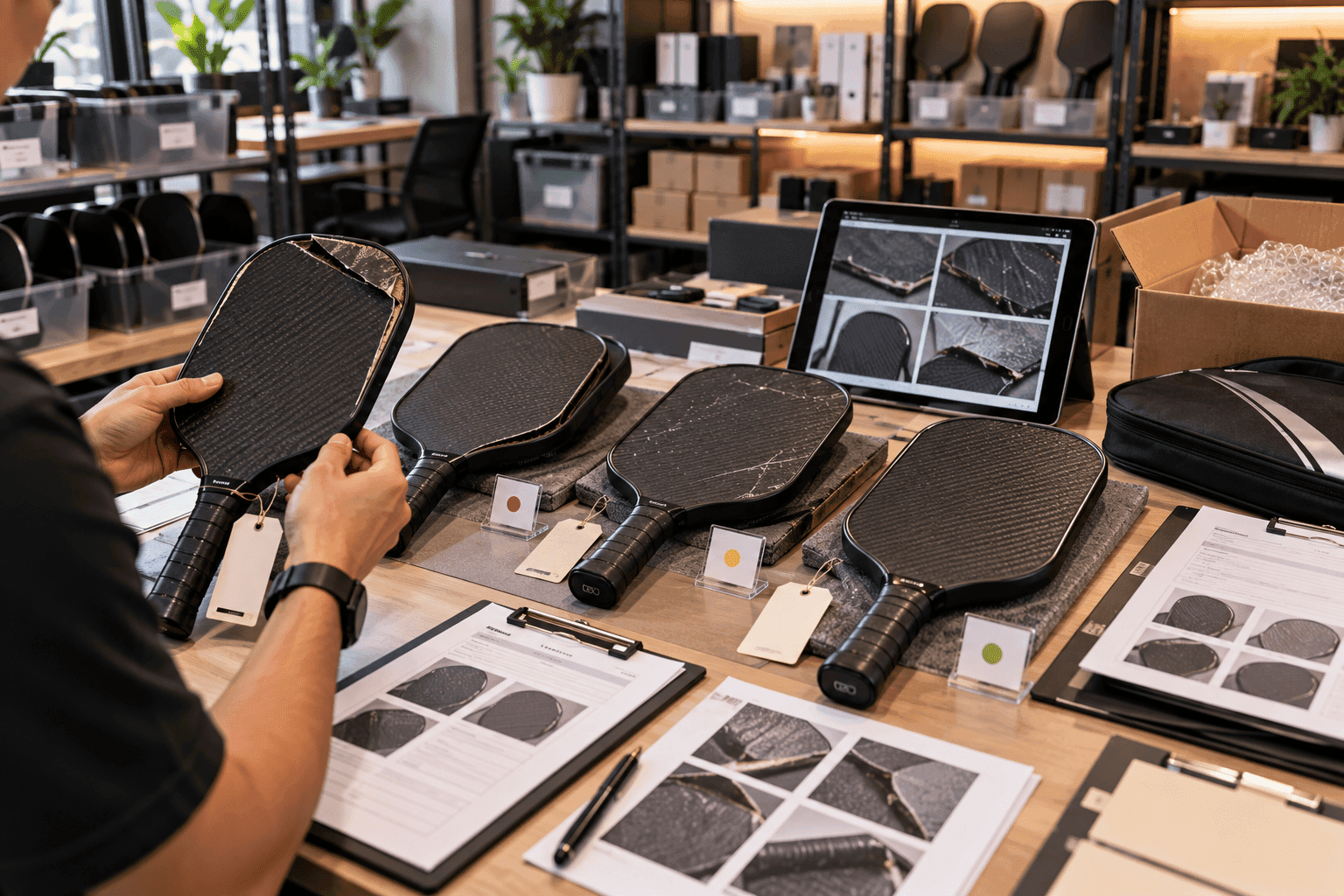
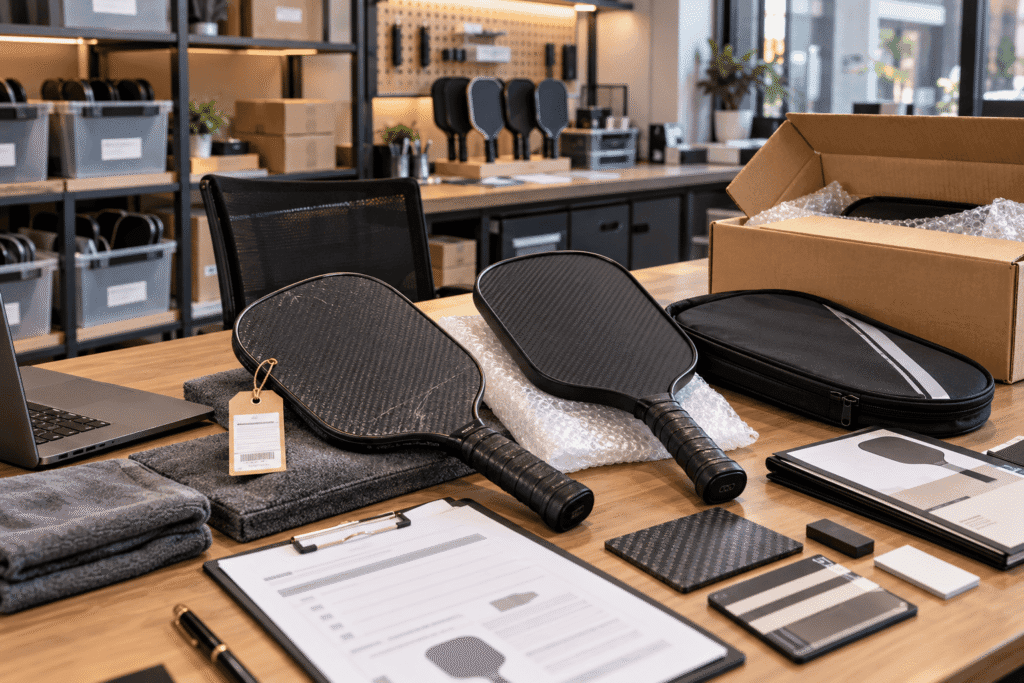
Pickleball Paddle After-Sales, Warranty & Refurbishment Workflow
Most brands obsess over the first shipment and ignore what happens after it. That is backwards. The after-sales system — warranty policy, defect handling, return flow, refurbishment, and end-of-life recovery — is what separates a brand that survives its second order from one that eats a margin-killing return wave. For an OEM factory, after-sales is not a customer-service cost center; it is a contract deliverable, and brands should select a manufacturing partner on it the same way they select on Core Density or mold tolerance. This guide covers how to design that system end to end, from the warranty tiers you write into the quote to the refurbishment loop that turns returned inventory back into sellable product.
Written for procurement and brand-operations professionals, it details warranty policy architecture, the QC defect taxonomy (including thin core and Carbon Fiber face sheet delamination), the RMA workflow, refurbishment economics, and recycling obligations — with the failure modes and verdicts a factory actually applies on the bench.
—
1. Why After-Sales Is a Manufacturing Deliverable, Not a Support Cost
Brands that treat warranty as an insurance policy miss the point. In a manufactured product, warranty cost is a direct output of process capability — Core Density consistency, bond-line quality, edge-guard adhesion, and surface bonding all show up later as claim rate. Pickleball paddles are a young category, so buyers underestimate how much of the lifetime cost is determined before the paddle ever ships. A paddle that leaves the line with a marginal core-to-face bond will generate a warranty claim two to four months into real play. No amount of customer-service skill rescues a process that was not capable in the first place.
“Warranty is a manufacturing KPI wearing a customer-service costume. Your claim rate is your bond-line quality, measured 90 days late.”
The consequence for sourcing is direct: your warranty policy should be negotiated alongside the spec sheet, and your OEM’s defect data should flow back into process control. A factory that cannot tell you its claim rate by failure mode does not measure its own process, and you will pay for that gap in returns. In practice, brands that negotiate a documented after-sales deliverable — defect classification, response SLA, refurbishment or credit terms — get materially lower lifetime cost per unit than brands that buy on unit price alone.
| Buyer priority | Wrong approach | Correct approach |
|---|---|---|
| Cost control | Push unit price down only | Price + warranty cost per unit |
| Quality | Trust incoming inspection | Trust process data + claim-rate reporting |
| Returns | Absorb them quietly | Classify, credit, and feed back to process |
| Partner choice | Compare catalogs | Compare documented after-sales capability |
The decision to take away: ask any candidate OEM for its claim rate by failure mode and its standard RMA terms before you talk price. A factory that cannot produce either number is not ready for a program account.
—
2. Warranty Policy Design: Tiering, Exclusions, and What Actually Voids Coverage
A pickleball paddle warranty should be tiered, time-bounded, and explicit about what it excludes — ambiguity here is what turns 2% claim rates into 8%. Frame the policy around structural integrity, not aesthetics. The industry standard range for a factory-backed structural warranty runs 6 to 12 months from the invoice date to the brand, with the brand setting its own consumer-facing term; OEM programs should never promise a longer structural window than the bond-line and Core Density data supports. As a general finding from bench work, most genuine structural failures surface within the first 90 days of regular play, which is why the first months carry the highest claim density and why a 6-month window catches the overwhelming majority of legitimate defects.
Coverage should hinge on failure type, not on the customer’s description of it. Delamination, core crush, edge-guard separation from structural causes, and handle-face separation are covered. Cosmetic scuffs, wear from grit service life, damage from misuse (paddle abuse, high heat left in a car, impact with a hard object), and normal surface texture erosion are excluded. The clearest rule: if the failure is a manufacturing escape, the factory owns it; if it is a wear or misuse outcome, the user owns it. Brands that blur this line absorb costs that should never have been theirs.
| Warranty element | Recommended standard | Rationale |
|---|---|---|
| Structural term | 6–12 months (invoice to brand) | Covers the real failure window without over-promising |
| Consumer term | Set by brand, ≤ factory term | Prevents brand on the hook for OEM-caused fails |
| Covered | Delamination, core crush, bond failure | Manufacturing escapes |
| Excluded | Cosmetic wear, misuse, heat damage | Not process-caused |
| Claim window | First 90 days = high density | Most defects surface early |
| Proof required | Purchase date + photo/return | Reduces fraudulent claims |
What voids a pickleball paddle warranty? The honest answer: deliberate modification, unauthorized repair, exposure beyond rated temperature range, and use outside the manufactured design intent. Notably, resurfacing a worn face does not void a structural warranty, because the user is not altering the structure — but re-glueing a separated edge guard does, because that is a repair the factory cannot verify. Write these distinctions into the policy, not into a support rep’s judgment call.
The takeaway for brand owners: publish a one-page warranty matrix with the term, covered defects, exclusions, and proof required. Your support team should never guess, and your OEM should have signed off on every clause that touches manufacturing.
—
3. QC Defect Handling: The Classification That Decides Every Claim
Every warranty dispute reduces to one question — is this a manufacturing defect or normal use? A factory that answers this consistently protects both its margin and its brand client’s reputation. The starting point is separating cosmetic from functional defects at incoming QC, because they carry completely different liability. Cosmetic issues (misaligned graphics, minor print offset, faint mold marks) are usually accepted at AQL 2.5 in most programs; functional defects (bond failures, core inconsistencies, face separation) carry an AQL of 0 or near-zero depending on the client’s risk tolerance. Mixing these categories is why some brands see claim rates that look inconsistent — they are counting appearance issues and structural failures in the same bucket.
| Defect class | Examples | Typical AQL | Liability |
|---|---|---|---|
| Cosmetic critical | Wrong logo, wrong colorway | 0 | Factory — rework/credit |
| Cosmetic minor | Faint marks, print offset | 2.5 | Factory — usually accepted |
| Functional structural | Delamination, bond failure | 0–0.65 | Factory — replace/credit |
| Functional performance | Weight out of spec, wrong Core Density | 0.65 | Factory — replace/credit |
| Wear / user damage | Grit erosion, scuffs, heat warp | N/A | User |
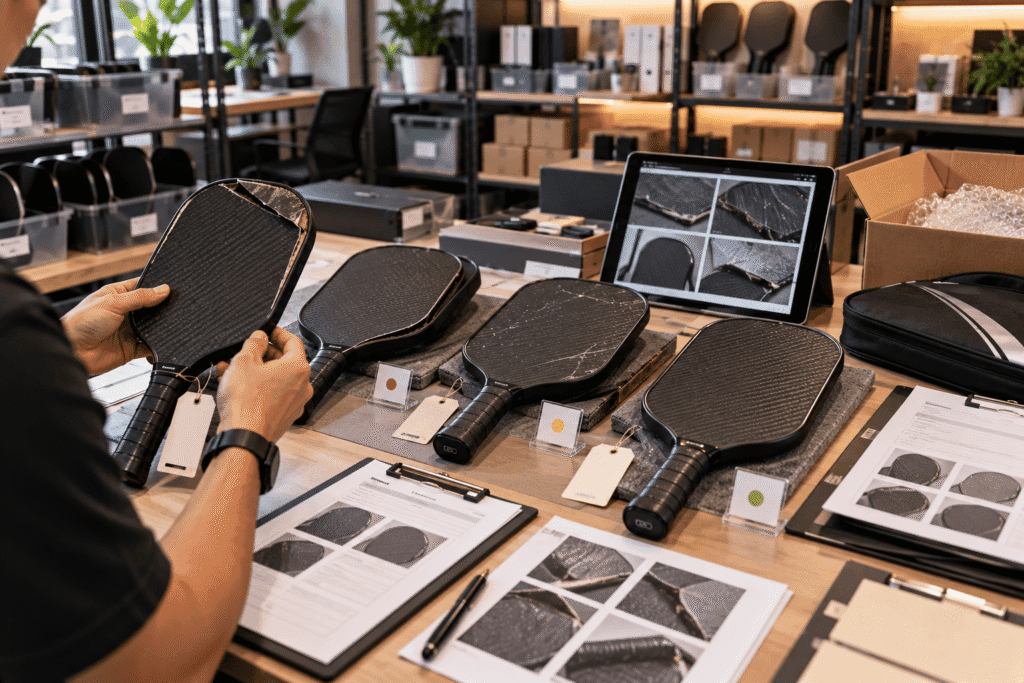
The verdict logic on the bench is mechanical once the class is set: a functional structural failure at any AQL above zero is a manufacturing escape and the factory credits or replaces; a cosmetic minor at or below AQL is accepted and shipped; anything ambiguous triggers a teardown. The teardown — cutting the paddle and inspecting the bond line and core cross-section — is the only way to settle a disputed claim, and any credible OEM should offer it as standard. In factory reality, the disputed claims are almost always the ones where nobody photographed the failure mode at return.
How do brands handle a claim they cannot classify? Return the unit, cut it, and document. A photograph of a clean bond line under a separated face changes the verdict from manufacturing defect to impact damage in one step, and that evidence protects the relationship more than any credit ever does.
The procurement point: insist on a written defect taxonomy and AQL schedule in the supply agreement, and require photographic evidence standards for RMA acceptance. Ambiguity in classification is where margin quietly disappears.
—
4. Thin Core Failure and Face Sheet Delamination: Judging the Two Most Common Escape Modes
Two failure modes dominate paddle warranty claims — thin core compression and face sheet delamination — and both trace back to process, not play. A “thin core” failure is not a core that was manufactured thin; it is a core that lost effective thickness under repeated load, usually because the original Core Density was inconsistent or the cell walls were crushed during molding. The paddle plays dead, loses pop, and the user reports “no power” — a complaint that sounds subjective until you measure the core cross-section and find collapsed cells. The root cause chain is predictable: inconsistent raw polymer density → uneven heating in the press → localized cell collapse → reduced effective thickness → degraded Paddle Performance long before the paddle looks damaged.
Face sheet delamination is the more visible failure and the more expensive one. It happens when the bond between the Carbon Fiber face sheet and the core is compromised — insufficient adhesive, contaminated prep surface, incomplete cure, or thermal cycling in service. Once a delamination front opens, it propagates, and the paddle’s feel changes audibly. The engineering reality is that a correct bond line with a properly prepared surface and a full cure cycle essentially does not delaminate under normal play; when it does, the process is the suspect.
| Failure mode | User symptom | Root cause (typical) | Verdict |
|---|---|---|---|
| Thin core compression | Dead feel, lost pop, low power | Inconsistent Core Density, cell collapse in press | Manufacturing defect |
| Face sheet delamination | Audible dead spot, visible lift | Weak bond, contaminated surface, incomplete cure | Manufacturing defect |
| Edge guard separation | Loose trim, exposed edge | Adhesion failure or impact | Manufacturing unless impact-only |
| Grit wear | Reduced spin | Expected service life | Not a defect |
Why does Carbon Fiber face sheet delamination show up months later rather than at inspection? Because the bond can pass a static pull test and still fail under cyclic loading combined with heat. That is why bench testing alone cannot clear a bond-line process — the manufacturing partner must also run the cure schedule and surface-prep control that prevent the defect from forming. A factory that only tests finished paddles, and does not control the prep and cure steps, will ship a population of paddles that pass today and delaminate in month three.
The B2B conclusion: when negotiating an OEM program, ask for the bond-line process controls — surface prep method, adhesive type, cure temperature and time — not just pull-test results. Process control is what protects the warranty; testing only samples the output.
—
5. The RMA Workflow: From Consumer Claim to Factory Settlement
A return merchandise authorization flow is only as good as its evidence trail. Brands need an RMA process that captures the failure mode before the unit is destroyed or lost. The discipline is simple: no RMA without proof, no credit without classification, and no assumption that the consumer’s word is the diagnosis. A workable flow runs from consumer claim → brand triage → photo/description capture → OEM claim submission → factory verdict → credit, replacement, or refurbishment routing. Each handoff loses information if it is not scripted, and the factory verdict is the step most brands leave undefined.
The critical design decision is batch-level versus unit-level claims. For a low claim rate, unit-level processing is fine. Once a claim pattern emerges — multiple failures from the same production lot — the claim should escalate to a batch investigation, because a process escape affects an entire run, not one paddle. Brands that only process claims individually never see the pattern until the return wave is already in the warehouse. In factory reality, the early warning is always in the data: three claims with the same failure mode and the same lot code is a signal, not a coincidence.
| Workflow stage | Owner | Evidence required | Outcome |
|---|---|---|---|
| Consumer claim | Brand support | Purchase date, photos | Ticket opened |
| Brand triage | Brand ops | Failure mode guess | RMA issued |
| Claim submission | Brand → OEM | Photos, lot code, quantity | Claim logged |
| Factory verdict | OEM QC | Teardown if disputed | Classified |
| Settlement | OEM | Verdict record | Credit / replace / refurb |
| Batch escalation | Both | Repeated lot pattern | Root-cause investigation |
Who pays shipping for a warranty paddle return? The clean rule is that the party at fault pays. Manufacturing escapes: factory or brand absorbs, per the agreement. Misuse claims: consumer. Ambiguous cases: the party that wants the unit destroyed for investigation pays, because the teardown data is worth more than the freight. Write this into the RMA terms so support staff are not negotiating freight case by case.
The decision for brand operations: script the RMA stages with required evidence at each handoff, and set a batch-escalation trigger. The cost of a documented flow is a small operational overhead; the cost of an undocumented one is a return wave you cannot trace.
—
6. Refurbishment and Recycling: Turning Returns Back Into Inventory
Not every returned paddle should be scrapped, and not every one should be resold — the refurbishment decision is where a mature program recovers margin. Refurbishment is viable when the structure is intact and only surface or grip elements are worn. A paddle with degraded grit, a soiled grip, or a scuffed edge guard can be reworked — cleaned, re-gripped, surface-refreshed where the design allows, re-inspected, and re-classified as refurbished stock, factory-second, or warranty replacement inventory. A paddle with a delaminated face or crushed core cannot be refurbished; the structure is compromised, and no cosmetic process restores it. Sorting by structure first, cosmetics second, is the rule that keeps a refurbishment program honest.
The economics only work at scale. Refurbishment makes sense when the volume justifies a dedicated rework line and the recovered units can be sold through a secondary channel (factory seconds, team/club programs, developing markets) without cannibalizing the premium brand. Below that volume, refurbishment is a hobby, not a program. And every refurbished unit must carry a clear disclosure and its own limited warranty — reselling reworked product as new is the fastest way to destroy a brand’s trust, and it is not worth the margin.
Recycling is the end of the line. A paddle that fails structurally cannot be refurbished, but its materials still have value: the Carbon Fiber face sheet and the polymer core can be separated and routed to material recovery rather than landfill. For OEM factories, offering a take-back or recycling path is increasingly part of the brand-client deliverable, both for sustainability reporting and for the optics of a responsible supply chain.
| Return condition | Route | Recoverable value | Warranty treatment |
|---|---|---|---|
| Worn grit / grip only | Refurbish | High — resale as second | Limited refurb warranty |
| Cosmetic scuffs | Refurbish or second | Medium | Limited refurb warranty |
| Edge-guard adhesion (repairable) | Rework | Medium | Case-by-case |
| Delamination / core crush | Recycling only | Low — material recovery | Replaced, not resold |
| Heat warped / misuse | Recycle or scrap | None | Consumer-owned |
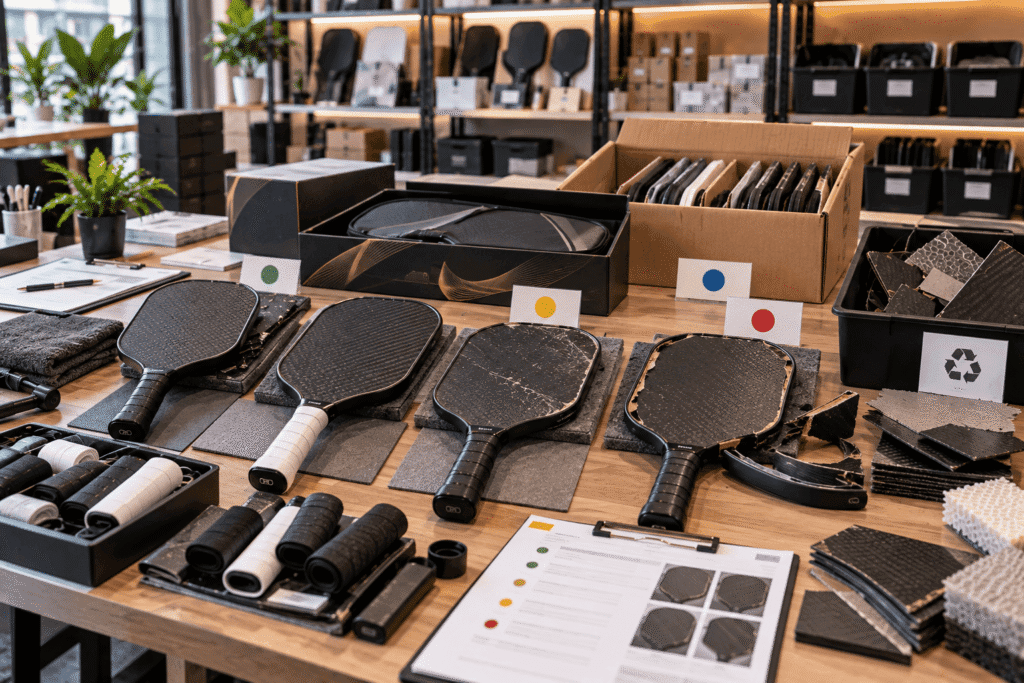
Can you refurbish a pickleball paddle and resell it as new? No — and a program that tries will eventually be found out. The viable model is a clearly labeled secondary channel, separate warranties, and honest grading. That protects the premium price of the primary line while monetizing returns that would otherwise be written off.
The takeaway for brand owners: build a sorting standard that classifies every return by structure and cosmetics before deciding refurbish, resell, or recycle. Structure first is non-negotiable, and disclosure on every refurbished unit is what keeps the program defensible.
—
7. Building the OEM After-Sales Deliverable: What to Put in the Contract
An OEM after-sales system is only real if it is written down and contractually committed. Brands should require a documented after-sales deliverable as a condition of the program account, because verbal promises evaporate at the first disputed claim. The deliverable has four parts: a warranty policy with tiers and exclusions, a defect taxonomy with AQL targets, an RMA workflow with evidence standards and response SLAs, and a refurbishment/recycling path for returned units. Each part exists to remove a judgment call that would otherwise be made under pressure, by someone who lacks the process data to make it well.
The response SLA is the part brands most often forget, and it is the part that determines their own customer experience. If the factory takes three weeks to return a verdict, the brand’s consumer has already filed a chargeback. A realistic program SLA is a verdict within 5 to 10 business days of a complete claim submission, with batch investigations scoped separately. Commit it in writing.
| Deliverable element | Must specify | Common failure |
|---|---|---|
| Warranty policy | Term, coverage, exclusions | Vague “defects covered” language |
| Defect taxonomy | Classes + AQL + photo standards | No written classification |
| RMA workflow | Stages, evidence, SLAs | Undefined factory verdict step |
| Batch escalation | Trigger thresholds | No lot-level pattern detection |
| Refurbishment | Sorting standard, disclosure | Reselling rework as new |
| Claim-rate reporting | By failure mode, per lot | No feedback into process control |
Claim-rate reporting is the element that separates a good OEM from a great one. A factory that reports claims by failure mode and by production lot gives its brand client a live read on process health. That data lets the brand forecast returns, budget warranty cost, and press the factory on any failure mode that climbs. Without it, both sides are flying blind, and the brand absorbs the surprise.
The B2B conclusion for sourcing teams: score candidate OEMs on the after-sales deliverable with the same rigor as unit price and spec compliance. Over a program lifetime, the warranty system — not the unit cost — determines whether the partnership is profitable.
—
FAQ
How long is a pickleball paddle warranty?
Factory-backed structural warranties typically run 6 to 12 months from the invoice date to the brand. The brand sets its own consumer-facing term, which should not exceed the factory term. Most genuine structural failures surface within the first 90 days of regular play, so the early months carry the highest claim density.
What voids a pickleball paddle warranty?
Deliberate modification, unauthorized repair (such as re-gluing a separated edge guard), exposure beyond the rated temperature range (leaving a paddle in a hot car), and use outside the manufactured design intent. Notably, resurfacing a worn face does not void a structural warranty, because the user is not altering the structure.
Are delaminated pickleball paddles covered under warranty?
Yes — face sheet delamination is a manufacturing escape when the bond line, surface prep, or cure cycle was the cause, and it should be covered. A factory verdict requires a teardown to confirm the bond line is clean and the failure is not impact damage.
Can a pickleball paddle be repaired or refurbished?
Surface-level issues — worn grit, degraded grip, scuffed edge guards — can be refurbished and sold through a clearly labeled secondary channel with a separate limited warranty. Structural failures such as delamination or crushed cores cannot be refurbished; those units are routed to material recovery.
Who pays shipping for a warranty paddle return?
The party at fault pays. Manufacturing escapes are absorbed by the factory or brand per the agreement; misuse claims are the consumer’s responsibility. In ambiguous cases, the party that wants the unit destroyed for investigation pays, because the teardown data is worth more than the freight.
What is an acceptable defect rate for pickleball paddles?
Cosmetic minor defects are commonly accepted at AQL 2.5, while functional structural defects (delamination, bond failure) carry an AQL of 0 to 0.65 depending on the client’s risk tolerance. Mixing the two categories is why some brands misread their own claim rates.
How do brands handle B2B returns from distributors?
Process unit-level claims normally, but escalate to a lot-level batch investigation as soon as repeated failures share a production lot code. A process escape affects an entire run, so pattern detection at the batch level is the early-warning system for a return wave.
—
The after-sales system is where a paddle brand’s manufacturing quality becomes visible to its customers. Build the warranty policy, defect taxonomy, RMA flow, and refurbishment path as contract deliverables — and choose an OEM that reports claim rate by failure mode — and you turn returns from a margin leak into a managed process.
Ready to Get Started?
Talk to our OEM team about building a documented after-sales, warranty, and refurbishment system for your pickleball paddle program. From defect taxonomy to RMA flow and recycling, we handle it all at our ISO-compliant factory.