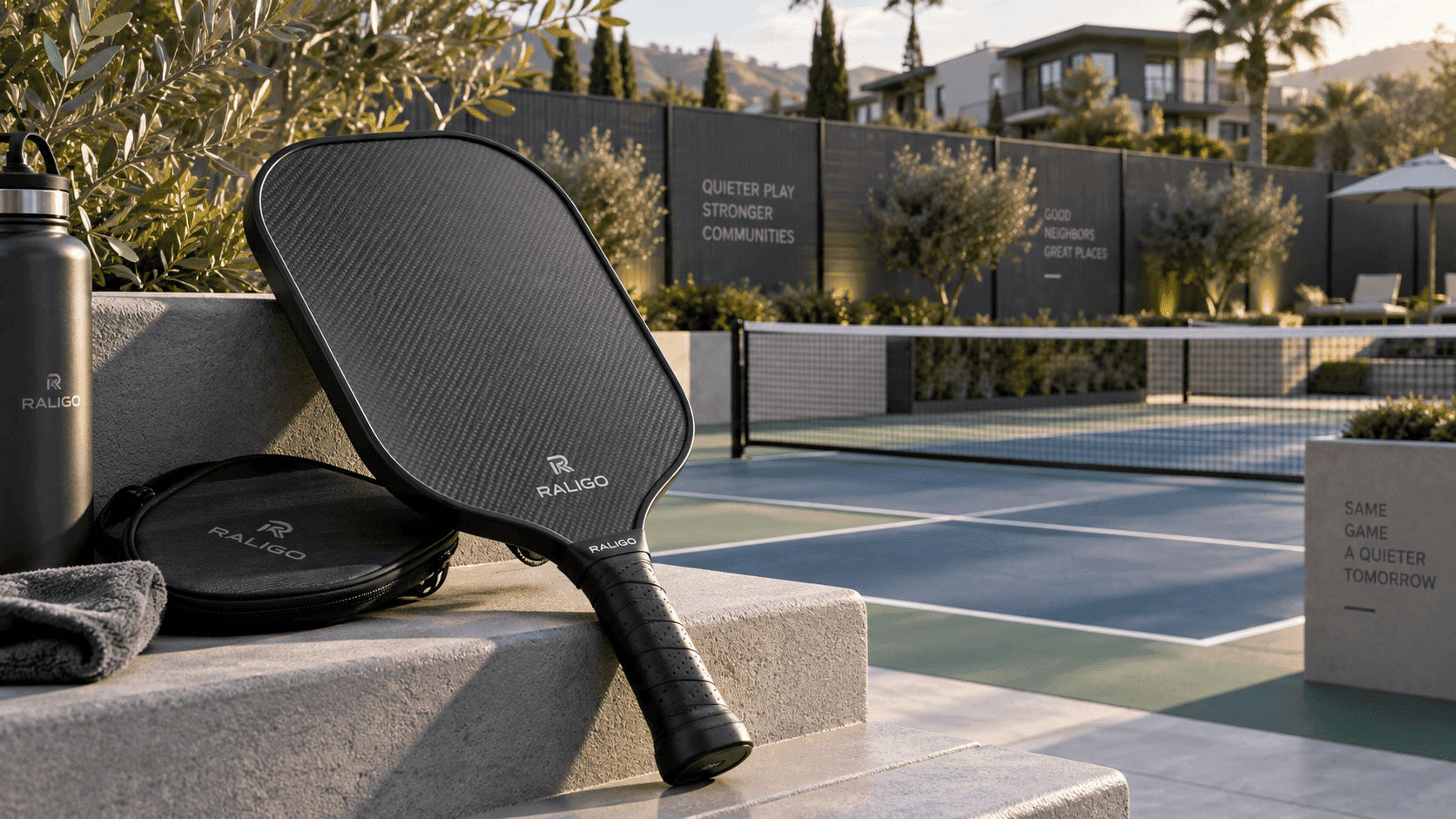
What “Quiet” Actually Means When a Court Is on the Line
A loud paddle is not a comfort complaint — it is a land-use problem. When a pickleball paddle is “too loud,” the issue is not wrist vibration; it is the sharp impact crack that carries hundreds of feet and triggers noise complaints, HOA restrictions, and municipal court shutdowns. Noise control is therefore a distinct engineering question from vibration damping: you are optimizing sound pressure level (dB) at a distance, not hand feel. For an OEM buyer or manufacturing professional, the relevant question is “what dB does this paddle produce at [X] feet, and does it meet the quiet-category threshold my venue or customer requires?” That answer comes from material selection, edge construction, and core density — not from a “quiet” label on a spec sheet.
This guide covers the noise-control side of quiet paddle technology. If you need the vibration-damping material comparison (Kraibon, gel-core, urethane sidewalls from a hand-feel angle), see our companion piece on vibration damping. Here we focus on acoustic output, quiet compliance, and venue adaptation.
1. Why Noise Control Is a Different Problem From Vibration Damping
Vibration damping and noise control share materials but answer opposite questions. Damping asks: how much impact energy reaches the player’s hand as buzz? Noise control asks: how much impact energy escapes the paddle as sound into the surrounding air? A paddle can be dead-silent in the hand and still crack loudly — or vice versa.
The physics split cleanly:
– Vibration is structure-borne energy traveling through the laminate into the handle. It is measured in acceleration (g or m/s²) or decay time at the grip.
– Noise is airborne energy radiated from the face and edge into the environment. It is measured in decibels (dB) at a defined distance, using a sound level meter (often A-weighted, dBA).
Why carbon fiber matters here: high-modulus carbon is an efficient radiator. A stiff, lightweight carbon face acts like a drumhead — it converts impact into a short, high-frequency “crack” that travels far and penetrates through walls and tree lines. This is the exact signature that annoys neighbors. Fiberglass and lower-modulus faces radiate less high-frequency content, which is one reason fiberglass paddles often read as “softer” or “quieter” despite similar power.
Core density is the second acoustic lever. A dense, rigid core reflects impact energy back into the face and out as sound. A lower-density polymer or foam core absorbs more impact energy but can mute power and feel. Noise control, then, is about managing how much of the ball-impact spectrum gets re-radiated as airborne sound — a different optimization target than hand comfort.
OEM takeaway: Do not accept “quiet” as a synonym for “arm-friendly.” When a customer says quiet, first ask which problem they are actually solving: a player complaint (vibration) or a venue/neighbor complaint (noise). The material spec and the pass/fail test are different.
2. The Noise Problem Driving the Quiet Paddle Market
The quiet paddle category exists because pickleball’s growth has collided with noise ordinances. Court construction has exploded near residential zones, and the sport’s characteristic “pop-pop-pop” — often described as 60–75 dBA at the court edge for a standard hard paddle — has become a planning and legal issue, not a cosmetic one.
Several forces are converging:
– Municipal and HOA restrictions. Some communities have capped pickleball hours, required acoustic barriers, or debated court closures over noise. Others have begun specifying quiet paddles as a condition of play or bulk purchase.
– The “Quiet Category.” USAP (USA Pickleball) introduced a Quiet Category for paddles that meet a defined acoustic threshold at a standard test distance — the first time paddles have been certified specifically for sound, separate from performance specs. This turns “quiet” from marketing into a testable, certifiable property.
– Indoor and resort venues. Gyms, hotels, and multi-use facilities where pickleball shares walls with other activities want lower ambient noise for guest comfort and lease compliance.
The commercial signal for OEM: a paddle that carries a measurable dB reduction is a procurement differentiator for municipal, club, and hospitality bulk orders — exactly the channels where the buyer needs a number on a datasheet, not a vibe.
OEM takeaway: The quiet-category and noise-compliance conversation is moving from “nice to have” to “table stakes” in community and institutional channels. If you sell into these channels, you should already be able to answer the dB question for your product.
3. How Materials Reduce Acoustic Output
The same viscoelastic materials used for damping also function as acoustic deadeners, but the mechanism you are optimizing differs. In noise control, you are trying to reduce the face’s ability to radiate sound, using three levers:
1. Viscoelastic face treatments (rubber/Kraibon-type films). A thin lossy film bonded into or under the carbon face converts a fraction of the impact’s high-frequency energy into heat before it can radiate. This directly reduces the sharp “crack.” The effect on dB is real but modest — films typically trim a few dB off the peak transient rather than halving the perceived loudness.
2. Gel-core / elastomer injection. Injecting elastomer into the core adds mass and internal damping to the core itself, absorbing the rebound energy that would otherwise push the face back into oscillation. A properly filled gel-core lowers both the low-frequency “thud” and some mid-frequency content, but weight and fill-uniformity are the trade-offs.
3. Urethane edge / sidewall treatment. The edge and frame are strong acoustic radiators on off-center hits, producing a higher “ping.” Urethane edge guards and sidewall films damp this edge resonance specifically. This matters disproportionately for noise, because mishits near the edge are common in open play and are exactly the hits that produce the harshest, most carrying sound.
| Noise-Reduction Lever | Acoustic Effect | Primary Trade-Off |
|---|---|---|
| Viscoelastic face film (Kraibon-type) | Trims high-frequency “crack” | Marginal weight, cost |
| Gel-core / injected elastomer | Absorbs rebound, softens low-mid “thud” | Weight gain, fill variance |
| Urethane edge / sidewall | Kills off-center “ping” | Cost, softer edge durability |
| Lower core density | Absorbs impact, reduces radiation | Power loss, feel deadens |
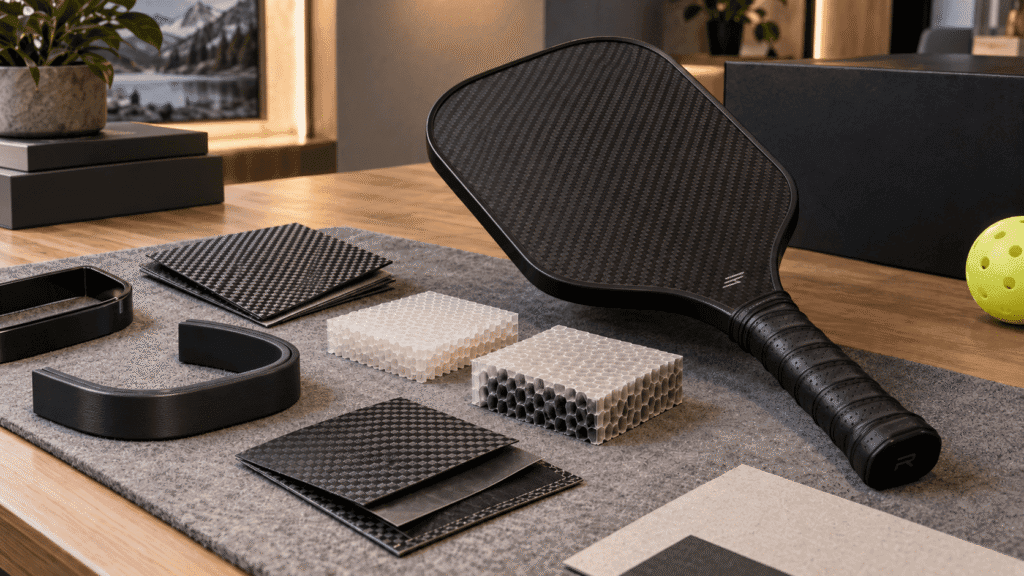
OEM takeaway: No single material “mutes” a paddle; meaningful dB reduction is a system — typically a face treatment plus an edge treatment plus a tuned core. Spec all three if the venue requirement is strict.
4. Measuring Quiet: Acoustic Testing and dB Targets
If quiet is a spec, it must be measurable. The emerging standard is a controlled impact test with an A-weighted sound level meter at a fixed distance (commonly 1 meter, sometimes 3 meters, from the paddle-to-ball strike point, with the ball dropped or mechanically launched at a consistent speed).
What to ask a factory for:
– Test method. Is it a standardized drop test or a repeatable mechanical impact? A hand-swung paddle introduces player variability that makes dB claims meaningless.
– Distance and weighting. dB without distance is useless. Ask for “dBA at 1 m” or “dBA at 3 m” and confirm the weighting (A-weighted approximates human hearing sensitivity).
– Peak vs. integrated level. A paddle’s “loudness” is better captured by peak dBA or a short-time LAeq (equivalent level) than by a vague average.
– Baseline comparison. A dB number only means something next to a reference. “This paddle is 6 dB quieter than our standard carbon paddle” is a defensible claim; “this paddle is 72 dB” in isolation is not.
As a rough field reference, a typical firm carbon paddle can peak in the low-to-mid 70s dBA at close range, while a well-tuned quiet paddle may land several dB lower — and because perceived loudness roughly doubles every 10 dB, even a 4–6 dB cut is clearly audible to neighbors even if it does not sound “silent.”
OEM takeaway: Require the test method, distance, weighting, and a baseline comparator in writing. A dB figure without these four things is noise, not data.
5. The Design Trade-Off Triangle: Quiet vs. Feel vs. Weight
Every quiet paddle is built against a three-way tension that OEM buyers must navigate consciously. You rarely get all three at once.
| Priority | Cost You Pay |
|---|---|
| Maximum silence | Adds mass, deadens ball feel, raises cost |
| Lively feel and power | Radiates more sound, less acoustic damping |
| Low weight (USAPA-friendly band) | Limits how much damping material you can add |
The lever that binds them is mass. Viscoelastic films, gel fill, and urethane edge treatments all add grams, and grams drag a paddle out of the light-and-maneuverable sweet spot players expect. A factory can silence a paddle by adding damping material — and quietly push the finished weight over the band where the paddle stops competing.
There is no free lunch on feel either. Damping kills vibration, but the same energy that buzzes your hand is part of what a good player reads as “feedback” and “pop.” Over-damped paddles feel dead and vague, which is unacceptable in the high-end segment even if the dB number is great. The engineering answer is selective damping — target the frequencies that radiate as noise (high-frequency face and edge resonance) while leaving enough low-mid feedback for playability.
OEM takeaway: Spec a weight ceiling and a feel requirement alongside the dB target. A factory that promises silence without asking about your weight band and target player is optimizing one corner of the triangle at your expense.
6. Specifying a Quiet Paddle for Venue Compliance
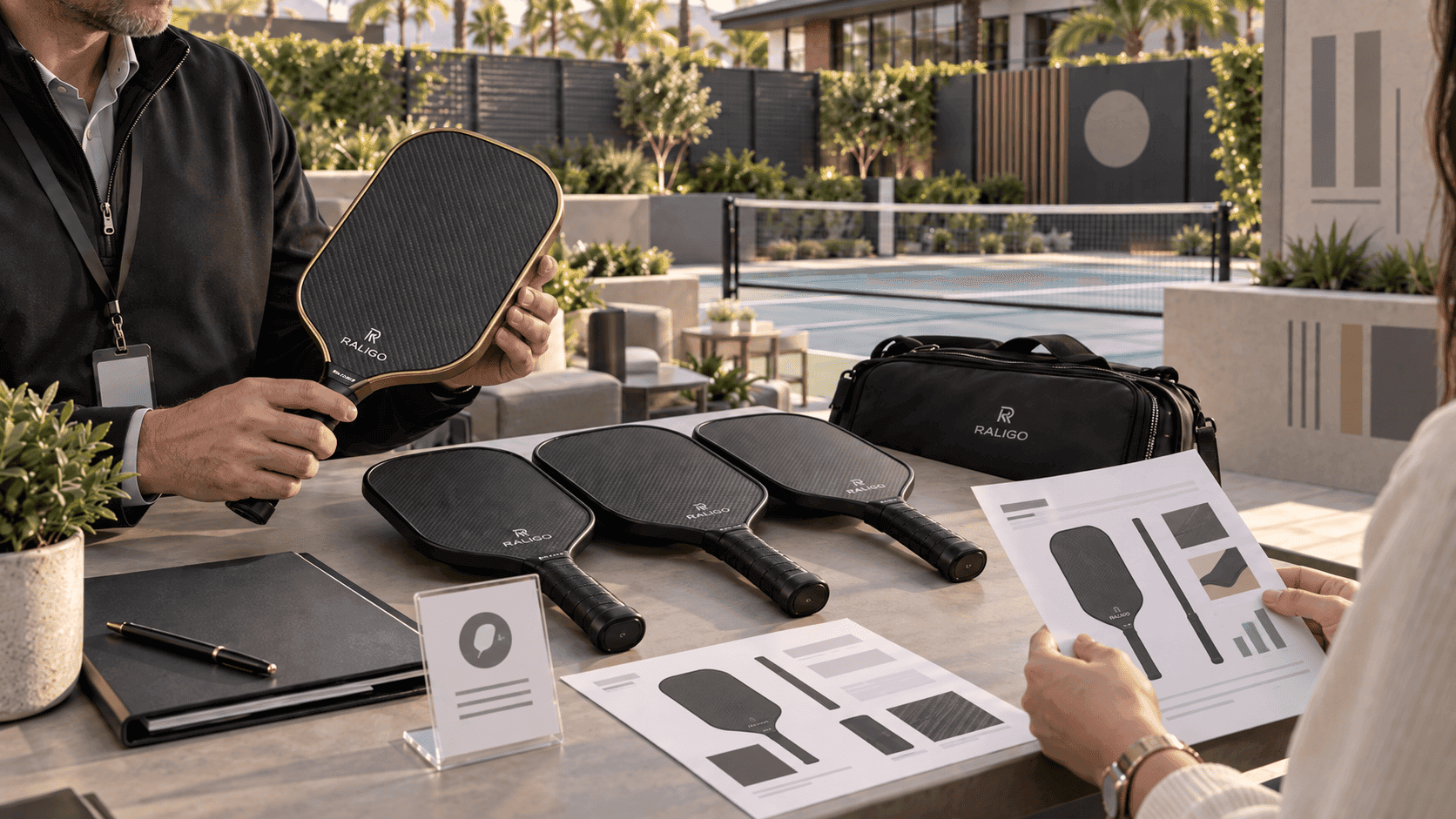
When the end requirement is venue or institutional compliance, the spec sheet needs more than a material list. Put these on paper before you order:
1. A dB target with a test standard. “Must not exceed X dBA at 1 m under [method]” — matching whatever the venue, HOA, or certifying body requires.
2. Material and position. Name the face film, core treatment, and edge treatment, and where each sits in the stack. Generic “sound-dampening layer” language hides what you are paying for.
3. Weight budget. A hard ceiling so damping engineering does not silently push you over the player’s preferred band.
4. Feel floor. Define the minimum power/pop feedback so “quiet” does not become “dead.”
5. QC on fill and consistency. For gel-core and injected treatments, confirm the factory verifies fill uniformity and batch weight variance — acoustic performance varies with fill, and an inconsistently filled paddle will be louder on one side.
OEM takeaway: A noise-compliant paddle is a spec problem, not a marketing claim. If you cannot write down the dB target, test method, materials, weight ceiling, and feel floor, you are not ordering a quiet paddle — you are hoping the factory lands on one by accident.
7. FAQ: Noise Control Questions OEM Buyers Ask
Is a quieter paddle just a softer core?
No. Lowering core density reduces some impact radiation, but it costs power and feel. Meaningful noise reduction is usually a system: a viscoelastic face treatment, an edge treatment, and a tuned core — targeting the high-frequency “crack” and “ping” that carry, not just the low-end “thud.”
How is noise control different from vibration damping?
Vibration damping targets energy reaching the hand (measured in acceleration). Noise control targets energy radiated as airborne sound (measured in dB at a distance). They use overlapping materials but answer different questions and need different tests.
What is the USAP Quiet Category?
USAP’s Quiet Category certifies paddles against a defined acoustic threshold measured in a standardized test, separate from performance specs. It turns “quiet” into a testable, certifiable property — which matters for municipal and institutional buyers.
Why would a venue or HOA specify a quiet paddle?
Pickleball’s sharp impact “pop” triggers noise complaints near residential courts. Communities restricting hours or debating shutdowns are increasingly specifying quiet paddles or quiet-category certification as a condition of play and bulk purchase.
Spec a Paddle That Passes the Noise Test
Bring your dB target and venue requirement to our OEM engineering team. We’ll help you select face, core, and edge materials that cut acoustic output without killing feel or blowing your weight budget — with verifiable acoustic test data before it ships.