Vibration Damping Is a Numbers Problem, Not a Feel Problem
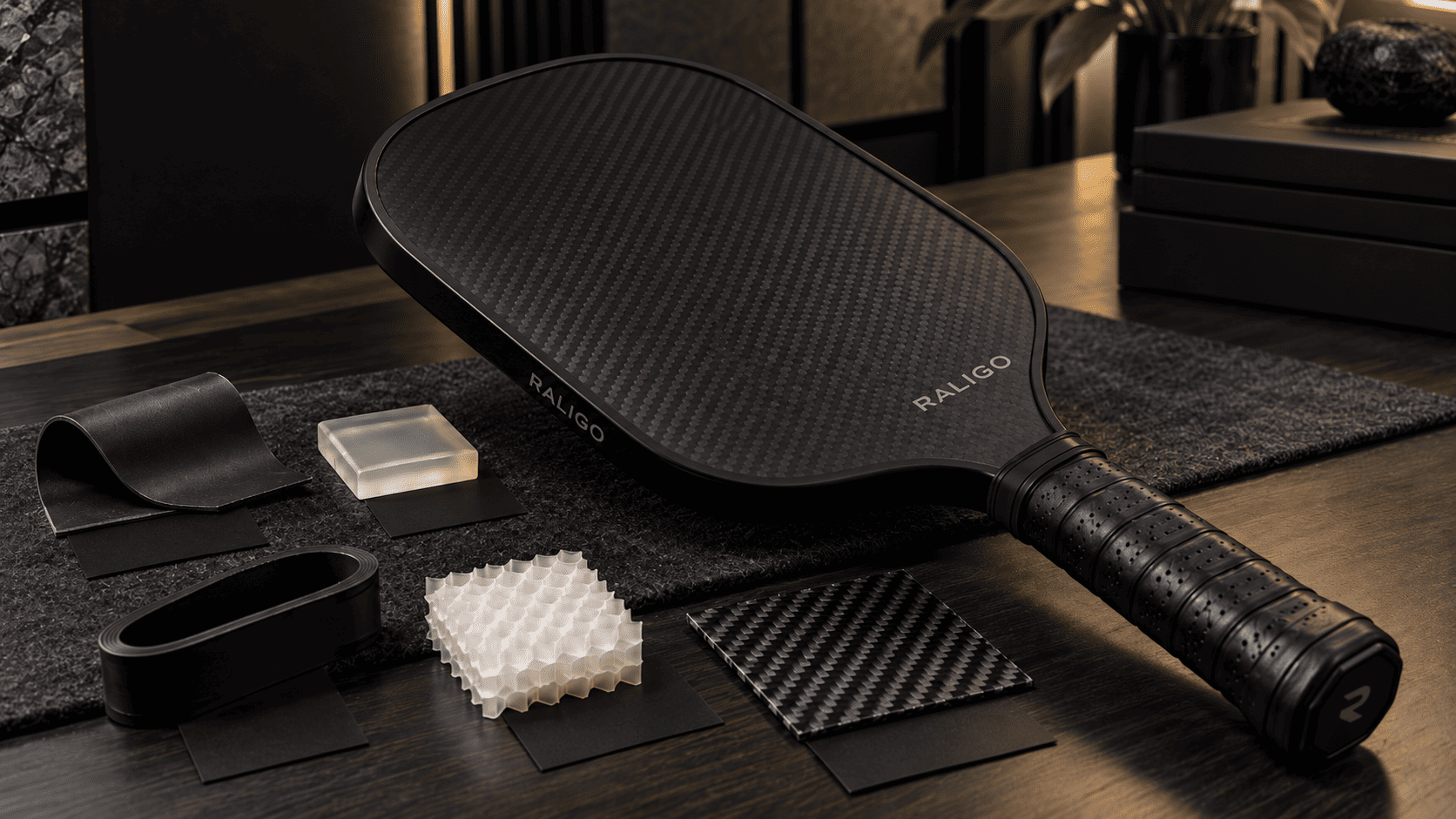
Most “vibration-damping” pickleball paddle copy describes a vague feeling of softness. In the factory, damping is a measurable material property summed across a laminate stack: each layer carries a loss factor (tan δ), a modulus, and a position in the stack, and together those numbers decide how much mid-to-high frequency impact energy reaches the player’s hand. Kraibon rubber film, gel-core elastomer, and urethane sidewall damping each reduce hand vibration in a different way, in a different frequency window, and at a different weight and cost. If you are an OEM buyer, the engineering question is not “does this paddle feel quiet?” It is: which damping material, at what loss factor and thickness, sits in which layer, and can the factory measure the resulting transmissibility?
This article is the advanced companion to our cushioning and quiet-paddle material surveys. Where those explained which materials exist, this one drills into the physics — loss factor, damping layer position, frequency response, and the manufacturing tolerances that separate an engineered damping stack from a marketing sticker.
1. The Physics: Loss Factor, Transmissibility, and Why Frequency Matters
Vibration that reaches the hand is a stress wave that traveled through the paddle and was not converted to heat. That conversion happens in viscoelastic materials, whose internal molecular friction dissipates mechanical energy. The engineering measure of that dissipation is the loss factor, or tan δ — the ratio of energy lost to energy stored per vibration cycle. A material with tan δ of 0.1 dissipates little; a high-damping viscoelastic can reach tan δ of 1.0 or higher in its working temperature and frequency window.
Two numbers govern whether a damping material does its job:
| Quantity | What It Measures | Why It Matters |
|---|---|---|
| Loss factor (tan δ) | Energy converted to heat per cycle | Higher = more damping per unit thickness |
| Storage modulus (G’) | Stiffness / energy returned | Higher = less mush, more power retention |
| Damping peak frequency | Frequency of maximum tan δ | Must overlap the paddle’s ring frequency |
| Material loss (ML) per layer | tan δ × thickness fraction of stack | Sums across all damping layers |
The classic result: tan δ is frequency- and temperature-dependent. A damping layer tuned for one frequency may do almost nothing at another. Carbon fiber transmits a sharp, relatively high-frequency “ring” — often thousands of hertz — that is fundamentally different from the low-frequency “thrum” of a flexing core. One damping material rarely covers both. This is why a serious damping stack pairs materials, rather than relying on a single “quiet” skin.
OEM takeaway: When a factory hands you a tan δ curve, read the frequency and temperature axis of the peak, not just the headline number. A high tan δ at 25 °C and 200 Hz tells you nothing about damping at 3 kHz on a carbon face. Specify the working window, not the peak.
2. Carbon Fiber and Core Density: The Baseline Every Damping Material Is Fighting
Damping layers do not act in a vacuum — they modify a laminate whose stiffness and mass are already set. Two baselines dominate: the carbon fiber face and the core density.
Carbon fiber is an efficient vibration conductor. High-modulus carbon returns energy to the ball (great for power and spin) but also propagates vibration toward the handle (bad for feel). The stiffer the face, the higher its resonant frequencies tend to be. This is the mechanism behind a common paddle paradox: a “premium carbon feel” that is simultaneously crisp and harsh.
Core density sets the other half of the baseline. A denser core (roughly 90+ kg/m³ and up) returns more power and resists cell crush, but transmits more high-frequency energy; a softer core absorbs impact but collapses dwell and power. Neither core alone solves hand vibration, because core tuning mostly shifts low-frequency behavior. The mid-to-high-frequency path that players perceive as “buzz” is attenuated by discrete damping layers bonded into the stack.
From Raligo’s testing on polymer and honeycomb cores, moving from a low- to high-density core can raise peak handle acceleration by a meaningful margin (roughly a quarter to a third), while ball exit speed rises correspondingly. The trade is structural. The role of a damping layer is to recover some of that lost comfort without giving back all the power — and that recovery is only possible if the layer targets the right frequencies.
OEM takeaway: Do not spec a damping material before you freeze face modulus and core density. The damping layer is the last tuning knob, and its required tan δ peak depends entirely on the baseline it must correct.
3. Kraibon Rubber Film: Damping at the Source, Between the Carbon Plies
Kraibon — a branded vulcanized rubber film from the Gummiwerk KRAIBURG group — is engineered to be co-cured or bonded between carbon fiber plies. Its defining trait is placement: it damps at the origin of vibration, inside the stiffest, highest-frequency part of the paddle, rather than downstream near the handle.
Because it sits between face plies, Kraibon suppresses the sharp high-frequency “ring” that carbon propagates, while the carbon above and below it still returns energy to the ball. The damping is surgical — it bleeds the harsh high-frequency component without the full-face mush of a thick foam layer.
| Property | Kraibon Film Layer | Generic “Damping” Sticker |
|---|---|---|
| Position | Between carbon plies (co-cured/bonded) | Surface skin, variable |
| Damping mechanism | Viscoelastic loss at source | Often EVA compression, lower frequency |
| Typical thickness | 0.1–0.5 mm | Unspecified |
| Frequency target | Carbon ring (high-frequency) | Vague |
| Technical provenance | Branded, defensible spec | Non-traceable claim |
| Weight cost | Marginal (thin film) | Varies widely |
What separates genuine Kraibon damping from generic film is co-curing compatibility with carbon. A click-and-stick EVA layer under the face may add cushioning, but it does not share the co-curing chemistry that lets a thin rubber film bond cleanly inside the carbon stack without delaminating or deadening ball feel.
OEM takeaway: If a supplier claims “rubber damping between carbon layers,” ask for the material name and the bond process. A film that is merely glued under the face behaves like a cushion, not a source-level damper, and it is a different spec at a different price.
4. Gel-Core and Elastomer: Damping Through the Core, With a Fill-Uniformity Cost
Gel-core flips the approach: instead of damping the face, a viscoelastic elastomer gel is injected into or around the core structure, filling cells or interstitial voids. As the core compresses and rebounds on impact, the gel absorbs recurring vibration — coupling comfort and damping into one structure while the surrounding core retains power.
| Core Approach | How It Dampens | Critical Failure Mode |
|---|---|---|
| Solid foam/polymer core | Density tuning only | Limited high-frequency damping |
| Gel-core (elastomer injected) | Gel fills voids, damps rebound | Weight gain, fill non-uniformity |
| Honeycomb + gel fill | Gel inside each cell | Uneven cell fill, dead spots |
| Hybrid gel layer under face | Discrete elastomer sheet | Interface delamination risk |
The honest cost of gel-core is process. The gel must be mixed, degassed, and injected evenly, then cured without voids or sink marks. A paddle that is damped on one side and harsh on the other, or that gains weight unevenly, is the classic failure signature of rushed gel-core production. Fill uniformity is not cosmetic — it shows up as inconsistent feel across the face and measurable imbalance.
OEM takeaway: Gel-core is legitimate but is one of the least forgiving damping methods to run at volume. Ask the factory how they verify fill uniformity (weight-distribution checks, destructive cross-sections on first articles) and what their batch weight variance actually is. A non-answer means the “gel-core” label is riding on a standard foam core.
5. Urethane Sidewalls and Edge Systems: The Frequency Nobody Else Covers
Off-center (edge) hits are a different engineering problem from center-face impact. A mishit sends higher-amplitude, higher-frequency vibration into the paddle’s edge and frame — a sharper, more punishing signature that travels straight up the wrist. Face and core damping do not address it well, because the energy is not in the face; it is in the perimeter structure and the edge guard.
Urethane (polyurethane) covers this window in two roles:
- Injected urethane edge guard, replacing a hard plastic guard that adds weight and transmits a harsh “clank.”
- Urethane perimeter strip or film, a viscoelastic band bonded along the frame that damps frame resonance before it propagates to the handle.
| Edge Treatment | Damping Benefit | Trade-Off |
|---|---|---|
| Hard plastic edge guard | Minimal | Cheap, adds weight, harsh feel |
| Injected urethane guard | Absorbs off-center impact | Higher cost, softer, less abrasion-resistant |
| Urethane sidewall strip | Damps frame resonance | Process complexity, marginal weight |
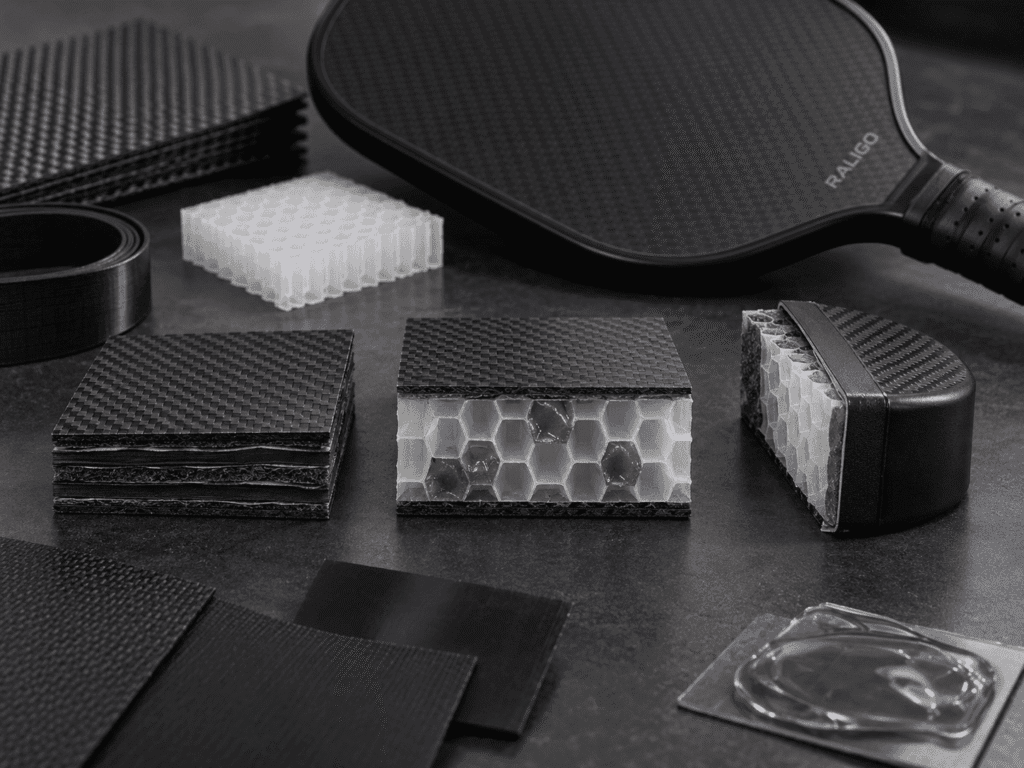
Because center and edge vibration have different frequency signatures, a complete damping stack pairs a face-level solution (Kraibon film or a face damping layer) with an edge solution (urethane) — and, increasingly, these are being specified together for communities and clubs that buy “quiet” paddles in bulk.
OEM takeaway: A paddle with excellent face damping and a hard plastic guard will still punish mishits. If off-center arm comfort matters to your target player, spec the urethane edge solution explicitly and verify it is a separate perimeter feature — not marketing attached to the face damping story.
6. How Damping Materials Drive Paddle Performance and Feel
Vibration damping is not an isolated comfort feature; it is part of the same performance budget as power, control, and sweet spot. The measurable link runs through feel — the sense of control a player gets from the paddle’s response during the milliseconds of dwell.
Here is how the material choices cascade into performance:
- Face damping (Kraibon) → clean power. It removes the harsh high-frequency “ring” without adding mush, so power and spin read as crisp rather than dead.
- Gel-core / elastomer → held dwell. It absorbs rebound vibration while the core retains power — but a poorly filled core introduces dead spots that kill feel consistency.
- Urethane sidewall → mishit forgiveness. It narrows the performance gap between center and edge hits, which is where most recreational players actually lose control.
- Damping layer position → cost. Moving a damping layer from under the face to inside the carbon stack changes both its effectiveness and the manufacturing complexity — and therefore the OEM price.
The design tension every buyer should hold: damping is bought with weight and sometimes power. Every damping layer adds grams, and a stack overdamped in the wrong frequency window turns a crisp paddle into a lifeless one. The engineering goal is enough loss in the right band — not maximum loss everywhere.
OEM takeaway: Read “performance” as a system. A well-engineered damping stack improves the consistency of feel — the same response hit after hit, center and edge — which is the attribute players actually pay for in a premium paddle. Measure that consistency, not just peak power.
7. Specifying Damping for OEM: What to Write in the RFQ
A vibration-damping spec is five lines of numbers and material names. If your RFQ asks for “a paddle with good feel,” you will receive whatever the factory stocks. Write a damping spec instead:
1. Name each damping material — Kraibon film, gel resin, urethane grade — not “a damping layer.” The material name fixes the mechanism, cost, and manufacturability.
2. State loss factor and working window. Ask for tan δ with its frequency and temperature of peak. This is the single most skipped (and most useful) line in paddle RFQs.
3. Specify position and thickness. Between carbon plies vs. under the face vs. a perimeter strip are different parts, different processes, and different prices. Write the position down.
4. Give a weight budget. Every damping material adds grams. Fix a total target (e.g., 7.8–8.2 oz) so damping engineering cannot silently push you out of the usable band.
5. Pick a measurable damping metric. Vibration decay time, peak handle acceleration, or an acoustic dB figure with a pass/fail threshold. “Arm-friendly” is not a spec; a number is.
On a manufacturing side, the QC tells are: fill uniformity for gel-core, bond integrity for co-cured Kraibon films (a delaminated film stops damping and can become a rattle), and off-center consistency for edge systems.
OEM takeaway: A damping spec with named materials, tan δ windows, positions, thicknesses, and a weight budget removes all the guesswork — and it separates factories that run viscoelastic engineering from those that stock generic cores with marketing stickers.
8. FAQ: Damping Material Questions OEM Buyers Ask
What is the difference between damping materials and core density tuning?
Core density shifts mostly low-frequency impact behavior and costs power/durability. Discrete damping layers (Kraibon, gel elastomer, urethane) target the mid-to-high frequency vibration carbon transmits, using material loss rather than softer-than-ideal cores.
Is a high loss factor always better?
No. Tan δ is frequency- and temperature-dependent, and overdamping the wrong band can deaden ball feel and cost power. You want sufficient loss in the paddle’s actual vibration window, not maximum loss everywhere.
Why would a paddle need more than one damping material?
Center-face, core-rebound, and off-center edge vibration are different frequencies with different signatures. A single material rarely covers them all; a real damping stack pairs a face-level and an edge-level solution.
How do I verify damping in production?
Spec a measured metric — peak handle acceleration, vibration decay time, or an acoustic dB figure — with a pass/fail threshold and a pre-shipment test report. And require evidence of the process controls (gel fill uniformity, film bond integrity) that make the material claims real.
Let’s Engineer Your Damping Stack
Bring your feel target to our manufacturing engineers. We’ll select and validate the Kraibon film, gel elastomer, or urethane sidewall materials — at the right loss factor and position — and back it with measured vibration test data before your paddle ships.