The Quiet Paddle, Explained in Material Terms
A “quiet” pickleball paddle is not a softer core or a thicker grip — it is a material-solution problem. Vibration damping in a paddle is engineered by selecting and bonding specific viscoelastic materials into the laminate stack: Kraibon rubber, gel-core elastomer, and urethane sidewalls. Each absorbs a different part of the impact frequency spectrum, and each carries a distinct manufacturing trade-off in weight, cost, and process complexity. If you are an OEM buyer or manufacturing professional, the question is not “is this paddle quiet?” but “which damping material did the factory actually bond, in what position, and at what thickness?” The answer is spec-able, testable, and materially different from the core-density conversation that dominates most cushioning discussions.
1. Why “Quiet” Is a Materials Problem, Not a Comfort Problem
Pickleball paddle vibration is mechanical energy that was not absorbed at impact. When a ball strikes a carbon fiber face at 30–40 mph, most of that energy either returns to the ball (power), compresses the core (dwell), or travels as a stress wave into the handle (what players feel as buzz, ring, or harshness). “Quiet” paddles are those engineered to convert that third pathway — the stress wave — into heat before it reaches the hand.
Carbon fiber makes this harder, not easier. High-modulus carbon is an efficient vibration conductor: it is stiff, elastic, and returns energy rather than dissipating it. This is precisely why carbon paddles deliver more power and spin than fiberglass — and precisely why they ring more. The manufacturing answer is to insert a lossy material — something that converts vibration energy into heat through internal friction — directly into the laminate where the stress wave travels.
Core density only gets you partway. Lowering core density absorbs low-frequency impact but collapses power and invites cell crush. A genuine “quiet” paddle instead targets the mid-to-high frequency vibration that carbon transmits, and that is a job for specific viscoelastic materials, not just a softer core.
2. Kraibon: Rubber-Bonded Carbon Fiber
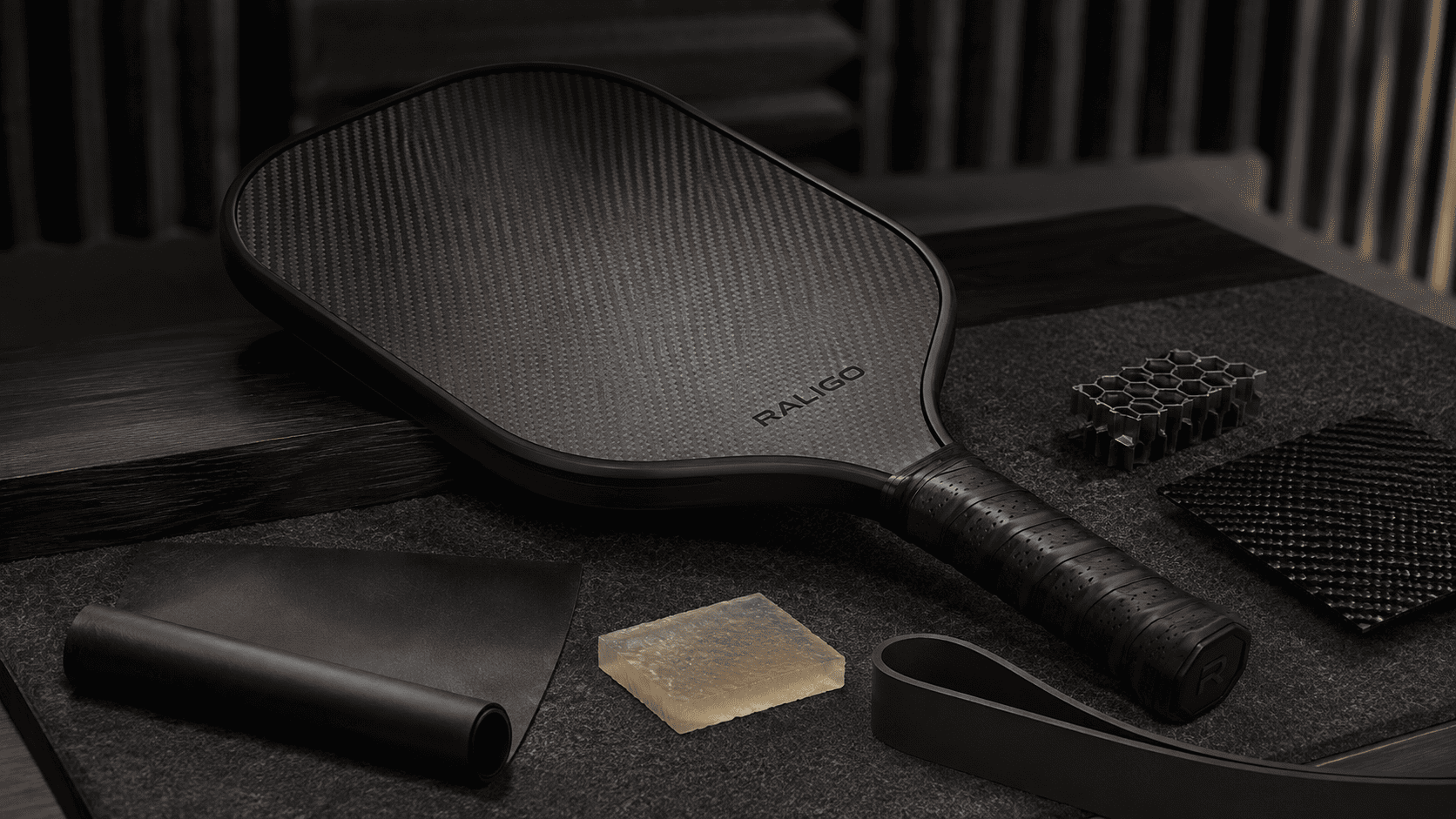
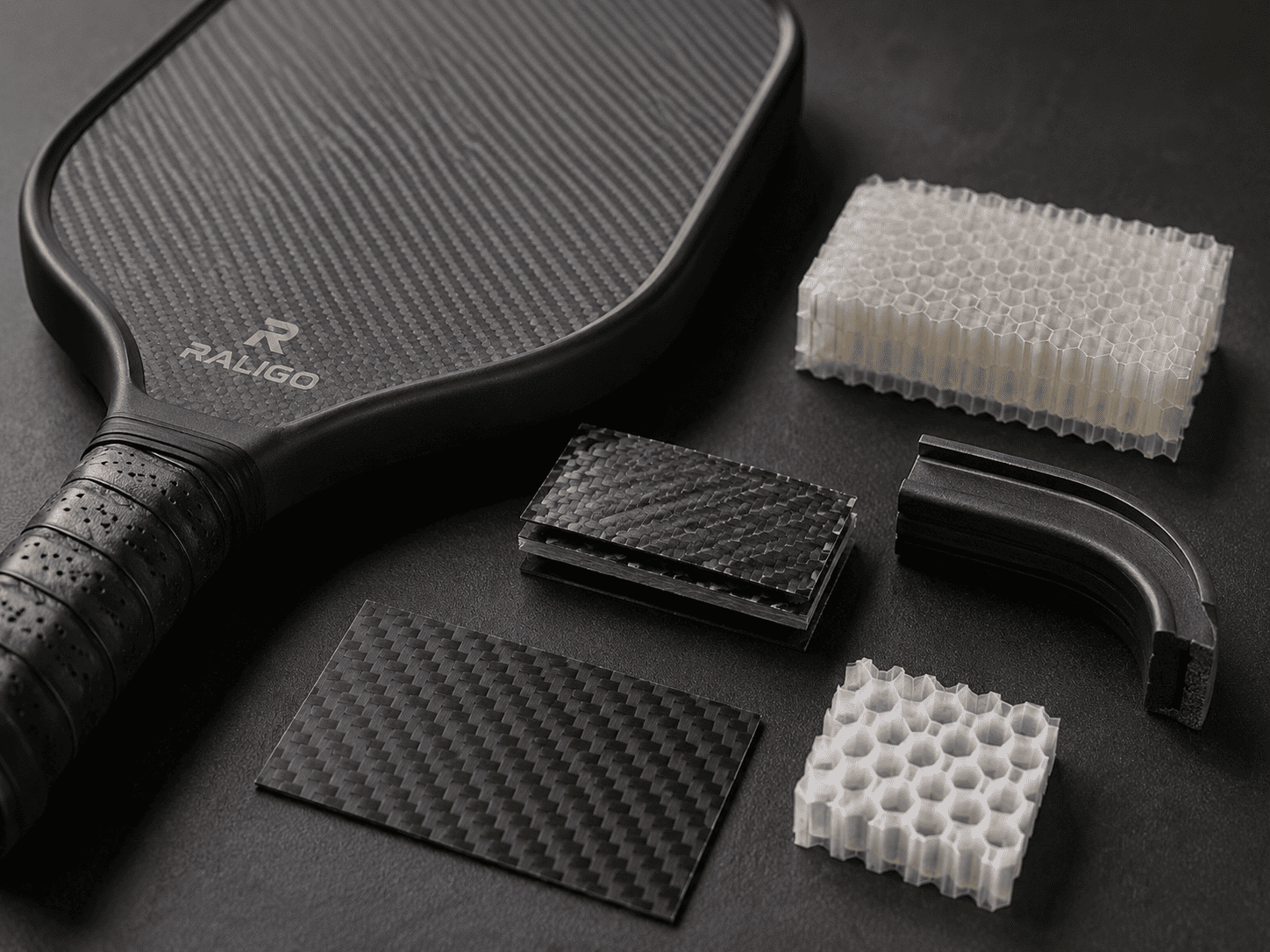
Kraibon is a proprietary vulcanized rubber film (from the Gummiwerk KRAIBURG group) engineered to be co-cured or bonded directly between carbon fiber layers. In paddle manufacturing, Kraibon is the most direct answer to the carbon “ring” problem: it puts the damping material inside the stiffest part of the paddle, where vibration originates.
| Property | Kraibon Rubber Layer | Conventional Carbon Laminate |
|---|---|---|
| Damping mechanism | Viscoelastic conversion to heat | Minimal (elastic return) |
| Position in stack | Between carbon face plies | N/A |
| Effect on stiffness | Slightly lowers effective modulus | Baseline |
| Effect on weight | Marginal (thin film) | Baseline |
| High-frequency “ring” | Strongly suppressed | Present |
| Typical thickness | 0.1–0.5 mm | N/A |
Because Kraibon sits between the carbon plies themselves, it damps vibration at the source — before the stress wave reaches the core or handle. This is materially different from a damping layer added under the face sheet, because it does not add a discrete interface that can delaminate or deaden ball feel. The carbon still returns energy to the ball; the rubber simply bleeds off the high-frequency component.
OEM takeaway: Kraibon is a premium, technically defensible damping solution, but it is not a commodity. It requires the factory to have co-curing or film-bonding capability and to source a specific branded material. If a factory claims “rubber damping” without naming the film or showing the bond, you are likely getting a generic EVA substitute.
3. Gel-Core: Elastomer Injection Into the Core
Gel-core is a different approach: instead of damping the face, you inject a viscoelastic elastomer gel into or around the core structure. The idea is to fill the core’s empty cells or interstitial voids with a material that absorbs vibration as the core compresses and rebounds.
| Approach | How It Dampens | Trade-Off |
|---|---|---|
| Solid polymer core | Density tuning only | Limited high-frequency damping |
| Gel-core (injected elastomer) | Elastomer fills voids, absorbs rebound vibration | Weight gain + process cost |
| Honeycomb + gel fill | Gel inside each cell | Complex fill, uneven distribution risk |
The gel-core concept is attractive because it couples comfort and damping into one structure: the gel damps vibration while the surrounding core retains power. However, injection is a process-heavy operation. The gel must be mixed, degassed, and injected evenly, then cured without voids or sink marks — otherwise you get a paddle that is damped on one side and harsh on the other, or a core that gains weight unevenly.
A critical QC check for gel-core paddles is fill uniformity. Uneven gel distribution creates imbalance and dead spots, which a player will notice as inconsistent feel across the face. Reputable factories verify fill with a weight-distribution check or a destructive cross-section on the first article.
OEM takeaway: Gel-core is a legitimate material solution, but it is one of the most difficult to manufacture consistently. Ask the factory how they verify fill uniformity and what their weight variance is across a production batch. If they cannot answer, the “gel-core” claim is probably marketing over a standard foam core.
4. Urethane Sidewalls: Damping the Edge, Not the Face
Urethane sidewalls address a problem the face and core do not: edge vibration and frame resonance. Off-center hits send higher-amplitude, higher-frequency vibration into the paddle’s edge and frame, which is a different, harsher signature than center-face impact.
Urethane (polyurethane) is used in two edge-related roles:
– Injected edge/guard material: a urethane edge guard absorbs off-center impact and reduces the harsh “clank” of a hard plastic guard.
– Urethane sidewall film or strip: a viscoelastic strip bonded along the paddle’s perimeter damps frame resonance before it reaches the handle.
| Edge Treatment | Damping Benefit | Trade-Off |
|---|---|---|
| Hard plastic edge guard | Minimal | Cheap, adds weight, harsh feel |
| Urethane edge/guard | Absorbs off-center vibration | Higher cost, softer, less abrasion-resistant |
| Urethane sidewall film | Dampens frame resonance | Process complexity, marginal weight |
Urethane is particularly useful for the off-center hits that hurt the most — the mishits that send a sharp shock up the wrist. A complete “quiet” paddle typically pairs a face-level damping solution (Kraibon or a damping film) with an edge-level solution (urethane), because center and edge vibration are different problems with different frequency signatures.
OEM takeaway: A paddle that only addresses face damping but leaves a hard plastic edge guard will still feel harsh on mishits. If arm comfort on off-center shots matters to your target player, spec the edge solution explicitly.
5. Quiet-Approved and the Move Toward Mandated Quiet Paddles
The term “Quiet-Approved” refers to a growing certification trend — driven in part by municipalities, HOAs, and parks departments that are restricting pickleball courts due to noise complaints — toward paddles that meet a defined acoustic threshold. This is not the same as arm comfort; it is about the sound the paddle produces on impact, measured in decibels.
This matters for OEM buyers because it is moving from “nice to have” to “procurement requirement.” Communities adopting pickleball are increasingly specifying quiet paddles in bulk orders, and manufacturers who can prove dB reduction have a concrete differentiation lever.
The material solutions map directly to the acoustic problem:
– Kraibon rubber layers reduce the sharp impact “crack” by damping face vibration.
– Gel-core softens the acoustic signature by absorbing rebound energy.
– Urethane sidewalls reduce the higher-frequency “ping” of the frame.
OEM takeaway: If you are selling into municipal, club, or community bulk channels, quiet-certification is becoming a differentiator you should be asking about now — before it becomes a barrier to entry. Ask the factory for an acoustic test method and a dB figure, not a “quiet” label.
6. The Material-Solution Checklist: Specifying a Quiet Paddle
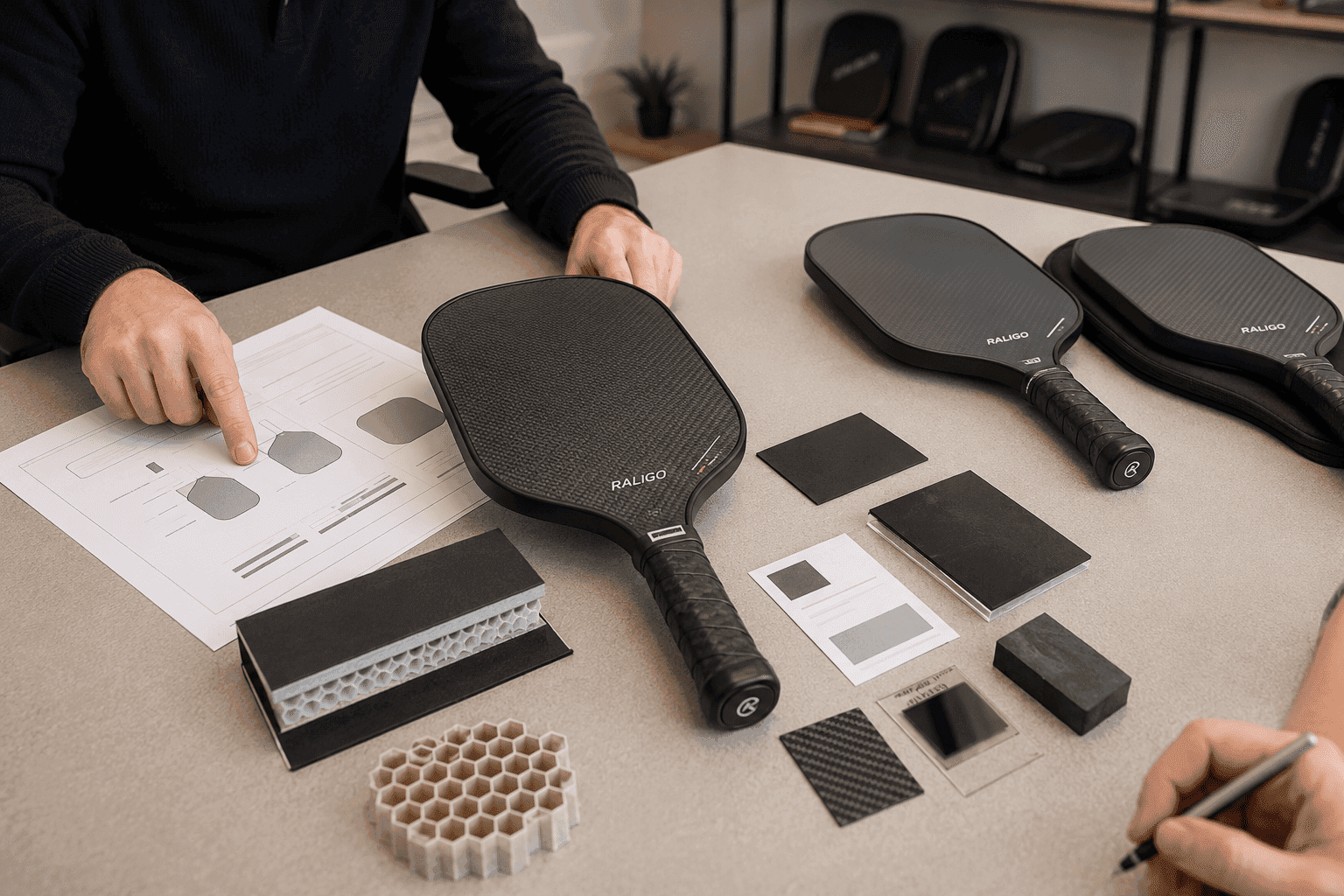
Core density is one lever. Quiet paddle technology is a broader material toolkit. When you spec a vibration-damping paddle for OEM, put these on the table:
1. Name the damping material. “Kraibon”, “gel-core elastomer”, “urethane” — or a generic film. The material name determines the damping mechanism, cost, and manufacturability. Generic “damping layer” language hides what you are actually paying for.
2. Position and thickness. Where each damping material sits in the stack, and at what thickness. A 0.2 mm Kraibon film between carbon plies behaves completely differently from a 2 mm EVA layer under the face.
3. A verifiable damping metric. Vibration decay time, peak handle acceleration, or an acoustic dB figure — with a pass/fail threshold. “Quiet” and “arm-friendly” are marketing words; a number is a spec.
4. Weight budget. Every damping material adds grams. Spec a total weight target so damping engineering does not silently push you over the USAPA-friendly band.
5. Fill and uniformity QC (for gel-core). Confirm the factory verifies gel fill uniformity and batch weight variance, not just a first-article cross-section.
OEM takeaway: A quiet paddle spec is a material spec. If you cannot name the damping material, its position, and its thickness, you are not specifying a quiet paddle — you are requesting a vague feel and hoping the factory guesses right.
7. FAQ: Quiet Paddle Questions OEM Buyers Ask
What is the difference between cushioning and a quiet paddle?
Cushioning (like the core-density discussion) targets low-frequency impact absorption and arm comfort. A quiet paddle targets mid-to-high frequency vibration and acoustic output through specific viscoelastic materials — Kraibon, gel-core, urethane. They overlap but are not the same engineering question.
Is Kraibon better than a generic damping film?
Kraibon is a specific branded vulcanized rubber film engineered for co-curing with carbon fiber. It damps at the source (between carbon plies). A generic film may perform similarly on paper but without the same co-curing compatibility and technical provenance — which matters when you need a defensible, spec-able material claim.
Does a gel-core make a paddle heavy?
Injected elastomer adds measurable weight, and uneven fill can create imbalance. A well-manufactured gel-core adds a few grams while damping rebound vibration; a poorly manufactured one creates dead spots. Fill uniformity is the QC variable to watch.
Why would a community require a “quiet” paddle?
Noise complaints are driving municipal and HOA restrictions on pickleball. Communities turning to bulk procurement increasingly specify acoustic thresholds, making quiet-certification a procurement differentiator rather than a comfort preference.
Let’s Build Your Quiet Paddle
Bring your damping-material spec to our engineering team. We’ll help you select and validate Kraibon, gel-core elastomer, or urethane edge solutions for your carbon fiber pickleball paddle — with verifiable vibration and acoustic test data before it ships.