Korea Pickleball Paddle Import Guide for B2B Buyers
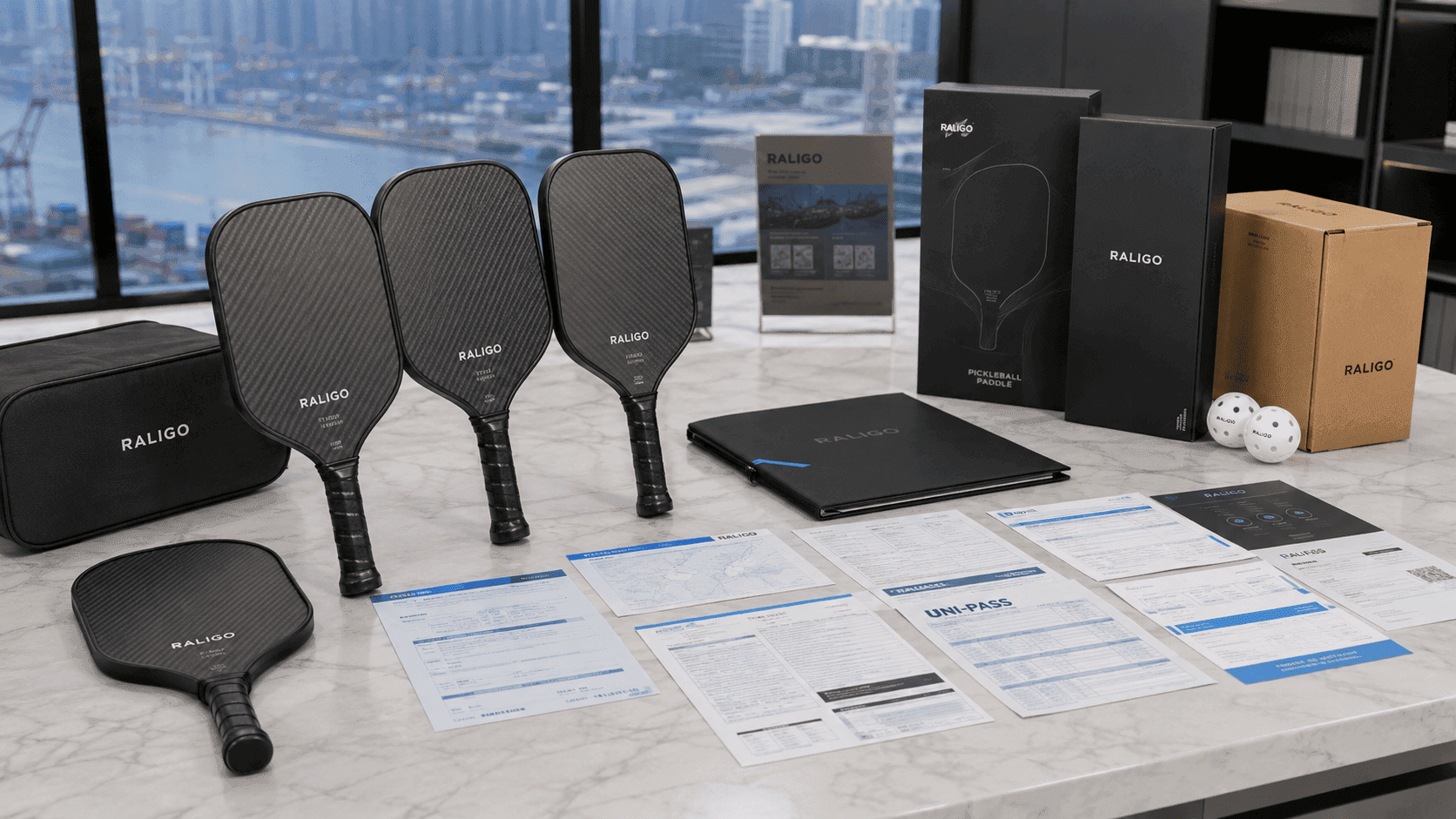
South Korea is the quiet growth story in Asia-Pacific pickleball. The Korea Pickleball Association counts over 1,200 registered clubs, and the sport is spreading fastest through the public and indoor infrastructure — school gyms, municipal sports halls, and the ubiquitous community centers that give Korean recreational sport its unusually organized, bulk-order character. For a distributor, brand owner, or club procurement manager, that structure is a supply opportunity that only materializes if the carbon fiber paddles actually clear Korean customs and pass the relevant safety review.
This guide walks a B2B buyer through the practical path of importing pickleball paddles from overseas factories into South Korea. It covers the UNI-PASS customs declaration, the correct HS tariff codes, the KC safety-marking and labeling requirements, Korea’s 10% VAT on the landed cost, and — just as importantly — the OEM manufacturing specs that decide whether your paddle performs on Korean courts the way you specced it.
—
1. Importer Registration: The First Gate for Any Korean Paddle Importer
Every entity importing goods into Korea needs a valid customs clearance code before lodging its first import declaration (수입신고). It is free, but without it the shipment does not clear.
For a B2B importer the sequence is straightforward: register as a trader with Korea Customs Service (관세청), obtain a customs clearance code (통관고유부호) or operate under a licensed customs broker (관세사), and then file every shipment through UNI-PASS — the national electronic clearance system that has made Korean customs processing among the fastest in Asia, routinely clearing air shipments in under 24 hours.
| Importer Type | Where They Register | Notes |
|---|---|---|
| Korean corporation (법인) | Korea Customs Service | Customs clearance code required |
| Sole trader / brand owner | KCS + customs broker | Broker handles declaration |
| Non-Korean factory | Nominated Korean importer of record | Third-party importer path |
Locking in the importer identity early matters because the customs clearance code appears on every declaration and on the commercial invoice. A buyer who waits until the container lands in Busan or Incheon is already late — Korean customs holds the cargo on a documentation mismatch, and the demurrage clock at an Incheon bonded warehouse does not pause while you sort out registration.
—
2. UNI-PASS and the Korean Electronic Customs System
Korea processes import declarations through UNI-PASS, the single-window electronic system run by Korea Customs Service. Unlike some regional peers, UNI-PASS is genuinely automated — a clean declaration with a correct HS code and a complete invoice often clears on a “fast lane” basis with no human review.
| Document | Direction | What It Proves |
|---|---|---|
| Import declaration (수입신고) | Into Korea | Value, origin, HS code, duty basis |
| Import license (where applicable) | Into Korea | Category-specific authorization |
| Customs valuation report | Into Korea | Transfer pricing / declared value support |
For the importer, the practical takeaway is that Korean customs rewards precision and punishes vagueness. The HS code on the commercial invoice must match the code on the UNI-PASS declaration, and both must match the physical goods. A recurring hold trace back to a vague material description — “paddle” instead of “carbon fiber composite paddle” — that forces a manual review and an added warehousing charge on top of it.
—
3. KC Marking and Labeling: What Actually Applies to a Paddle
A common mistake is assuming every imported consumer product needs the KC mark (국가통합인증마크). A pickleball paddle is passive sports equipment, not a children’s product, not an electrical appliance, and not a chemical — so it sits in the gray zone of Korea’s “Electrical Appliances and Consumer Products Safety Control Act” (전기용품 및 생활용품 안전관리법).
| Product Element | Requirement | Practical Action |
|---|---|---|
| Paddle as sports equipment | General safety + labeling | Korean-language label, importer identification |
| Any electronic accessory | KC (EMC / safety) | Separate self-declaration |
| Grip / surface coating materials | Chemical safety review | REACH-style material screening |
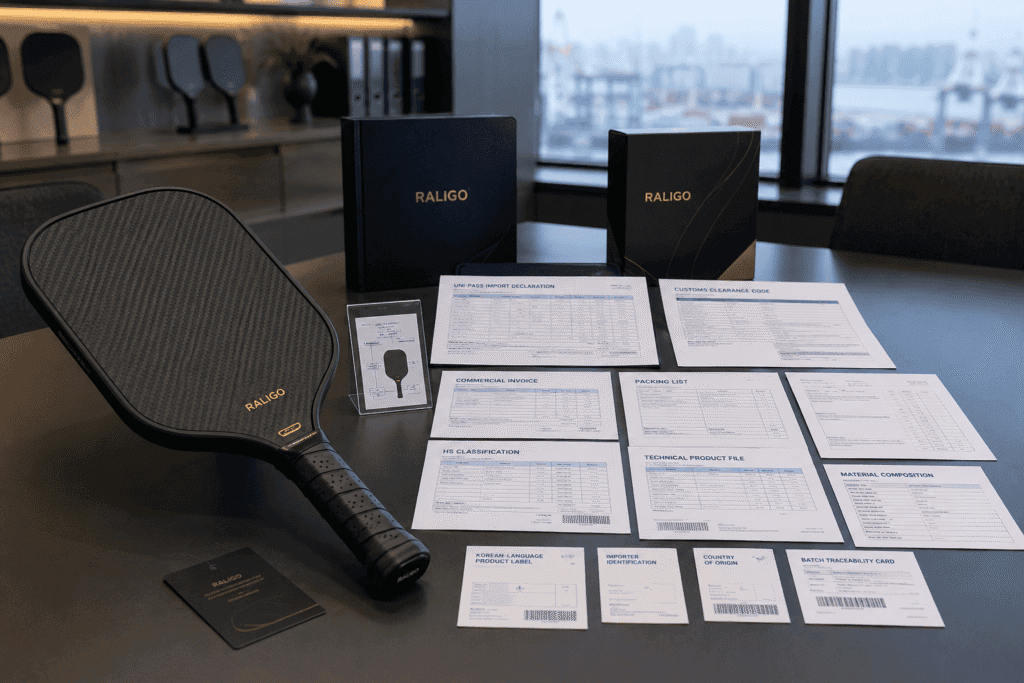
The more operative obligations are labeling and general product safety: imported sports equipment must carry Korean-language labeling naming the importer, country of origin, and material composition, and the importer is liable for placing only safe products on the market. A factory that can hand over a complete technical file — material composition, batch traceability, and test reports — is worth more than a price break, because it is that file that satisfies a Korean customs inspector or a follow-up safety audit.
—
4. Material Compliance for Carbon Fiber Paddles Entering Korea
The heaviest enforcement on imported paddles is chemical, not structural. Korea applies substance restrictions that mirror the EU REACH framework, and a carbon fiber paddle is a stack of composite face sheets, a core, an edge guard, and a grip — each layer carrying its own compliance exposure.
| Component | Chemical Concern | Factory Action |
|---|---|---|
| Carbon fiber face sheets | Resin chemistry, restricted fillers | Virgin tows, verified SDS |
| Handle grips | Phthalates, PAHs | PVC-free, lab-tested elastomers |
| Adhesives / edge guard | VOC, restricted plasticizers | Compliant resins |
| Core materials | Foam blowing agents | CFC-free manufacturing |
The grip is where most imports get flagged — phthalate-heavy PVC overgrips are cheap at source and risky at the Korean border. Request material data sheets and, where the distributor demands it, third-party lab results before the production run. Cutting the grip spec to save cost buys you a detained container and a bruised relationship with a market whose bulk buyers audit documentation seriously.
—
5. HS Codes and Landed Cost: Tariff, VAT, and the Korean Price Model
The correct harmonized system code sets the duty you pay and keeps your UNI-PASS declaration clean. Pickleball paddles fall under Chapter 95 of Korea’s HS tariff schedule, but there is no dedicated “pickleball” line — consistent classification is everything.
| Item | HS Code (Korea) | Typical Duty |
|---|---|---|
| Pickleball paddle (sports equipment) | 9506.59 / 9506.99 | Approx. 0–8% depending on origin |
| Carbon fiber face sheets (wide form) | 6815 / 3921 | Higher, if imported separately |
| Grips and accessories | 9506.99 | Varies |
The duty is usually the smaller number. Korea VAT is 10% (single rate), applied on the customs value plus duty and freight, and it is the line that surprises buyers who priced only the ex-works unit cost. A B2B importer should model the full landed cost — factory price, freight, insurance, duty, and 10% VAT — before setting a wholesale number, because the Korean market, with its organized bulk orders and price-transparent public tenders, will not absorb a margin built on a misunderstanding of VAT.
—
6. OEM Manufacturing Spec: Core Density Decides Korean Paddle Performance
Customs decides whether the container clears; the factory spec decides whether Korean clubs come back for a second order. The single most powerful lever on paddle performance is core density, followed by the carbon fiber face construction.
| Spec | What to Specify | Why It Matters in Korea |
|---|---|---|
| Core density | Low / mid / high (g/cm³) | Weight and pop — indoor gym vs outdoor park |
| Face weave | 3K / 12K / 18K carbon fiber | Stiffness, spin, durability feel |
| Edge guard | Thermofusion vs adhesive | Impact resistance for hard indoor courts |
| Grip | Overgrip vs integrated | Chemical compliance + comfort for cold gyms |
| QC sampling | AQL level, weight tolerance | Consistency at club bulk scale |
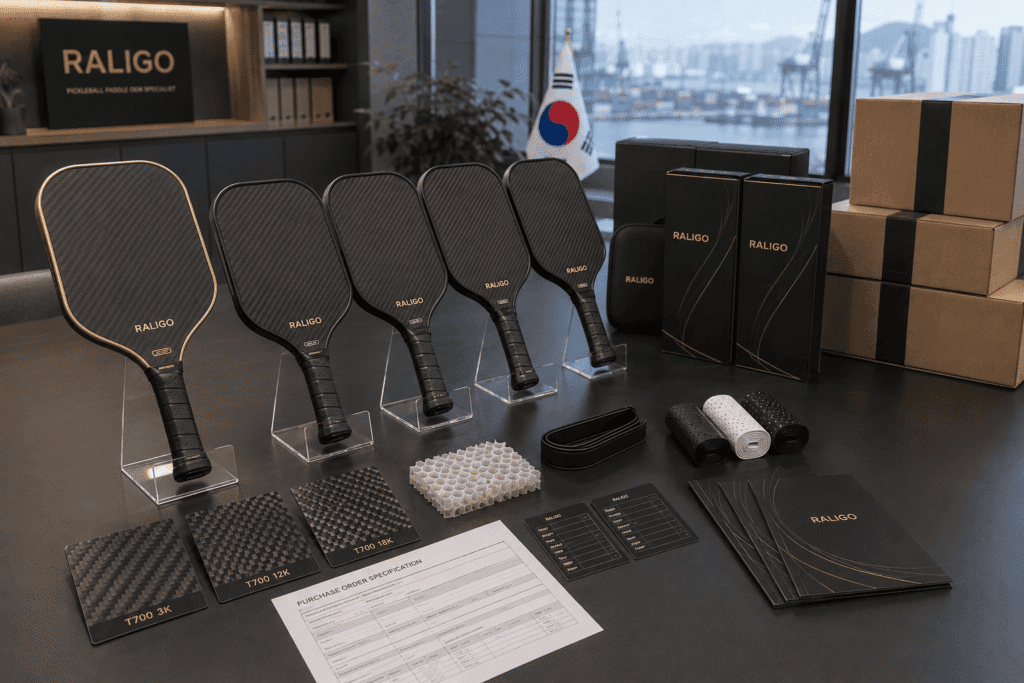
Specifying core density and face weave in the purchase order is what separates a paddle that ships predictable from one with inconsistent weight and balance across a batch. Korean clubs — which buy by the dozen through organized procurement and expect every paddle in a matched set to feel identical — will reject a batch where paddle number three feels different from paddle number seven. A pre-shipment inspection tied to that written spec is the cheapest insurance a brand can buy.
—
7. Korea Import Checklist: From UNI-PASS to the Club Court
The Korean route rewards a clean, documented shipment. Here is the full-sequence checklist for a paddle import that clears on the first filing.
– [ ] Register importer identity and customs clearance code before the first declaration
– [ ] Confirm HS code (Chapter 95) and lock it into the UNI-PASS declaration
– [ ] Collect material reports for grips, resins, and adhesives
– [ ] Prepare Korean-language labeling with importer name, origin, and composition
– [ ] Model landed cost with 10% Korean VAT on the customs value plus duty and freight
– [ ] Specify core density, carbon fiber weave, edge guard, and grip in the OEM PO
– [ ] Arrange pre-shipment inspection and ship reserve samples for in-house testing
– [ ] Decide on buffer stock: Incheon hub vs regional distribution split
Get these right and the paddle performance you designed in the factory survives the trip, the paperwork clears on the first filing, and the VAT is booked correctly. That is the foundation of a durable pickleball brand serving the fastest-growing organized market in Asia-Pacific.
—
Frequently Asked Questions
Do I need a customs clearance code to import pickleball paddles into Korea?
Yes. Any entity importing goods into Korea must hold a valid customs clearance code (통관고유부호) or operate through a licensed customs broker before lodging its first import declaration on UNI-PASS.
What HS code applies to pickleball paddles entering Korea?
Pickleball paddles classify under Chapter 95 of Korea’s HS tariff schedule, typically 9506.59 or 9506.99, with duty generally in the 0–8% range depending on origin. A 10% VAT applies on top of the customs value plus duty and freight.
Are pickleball paddles subject to KC certification in Korea?
Not automatically. Passive sports equipment like a paddle sits in the gray zone of Korea’s consumer products safety law and generally requires Korean-language labeling plus general product safety compliance rather than a hard KC mark. Electronic accessories would trigger separate KC self-declaration.
Ready to Source Your Korea Paddles?
Talk to our OEM team about carbon fiber paddle manufacturing for the Korean market. From core density specs to compliant materials and bulk production, we handle it at our ISO-compliant factory.