If you’re sourcing pickleball paddles at scale, the surface coating decision is where your product’s spin performance, durability story, and customer return rate collide. I’ve overseen coating line QA across multiple production runs, and I can tell you this flat out: most brands lose more money on coating failures than they ever save by picking the cheaper process upfront.
A pickleball paddle’s surface coating does three jobs simultaneously: it generates friction for spin, protects the underlying carbon fiber weave from UV degradation and impact wear, and serves as the print substrate for your brand’s graphics. Get the coating wrong and you’ll see spin drop-off within 60 days, logo chipping by month three, and customer complaints that eat your margins. Get it right and your paddle becomes the one players refuse to switch away from.
The manufacturing reality is that coating technology has split into four distinct paths over the last 18 months — each with measurable tradeoffs in cost, durability, and spin retention. Here’s what procurement teams need to know before finalizing a spec sheet.
The Four Coating Paths: What Your Factory Should Be Offering
Every OEM factory’s coating capability falls into one of these categories. If your supplier can’t explain which one they’re running, that’s a red flag.
1. UV Printing + Clear Coat Spray (The Volume Standard)
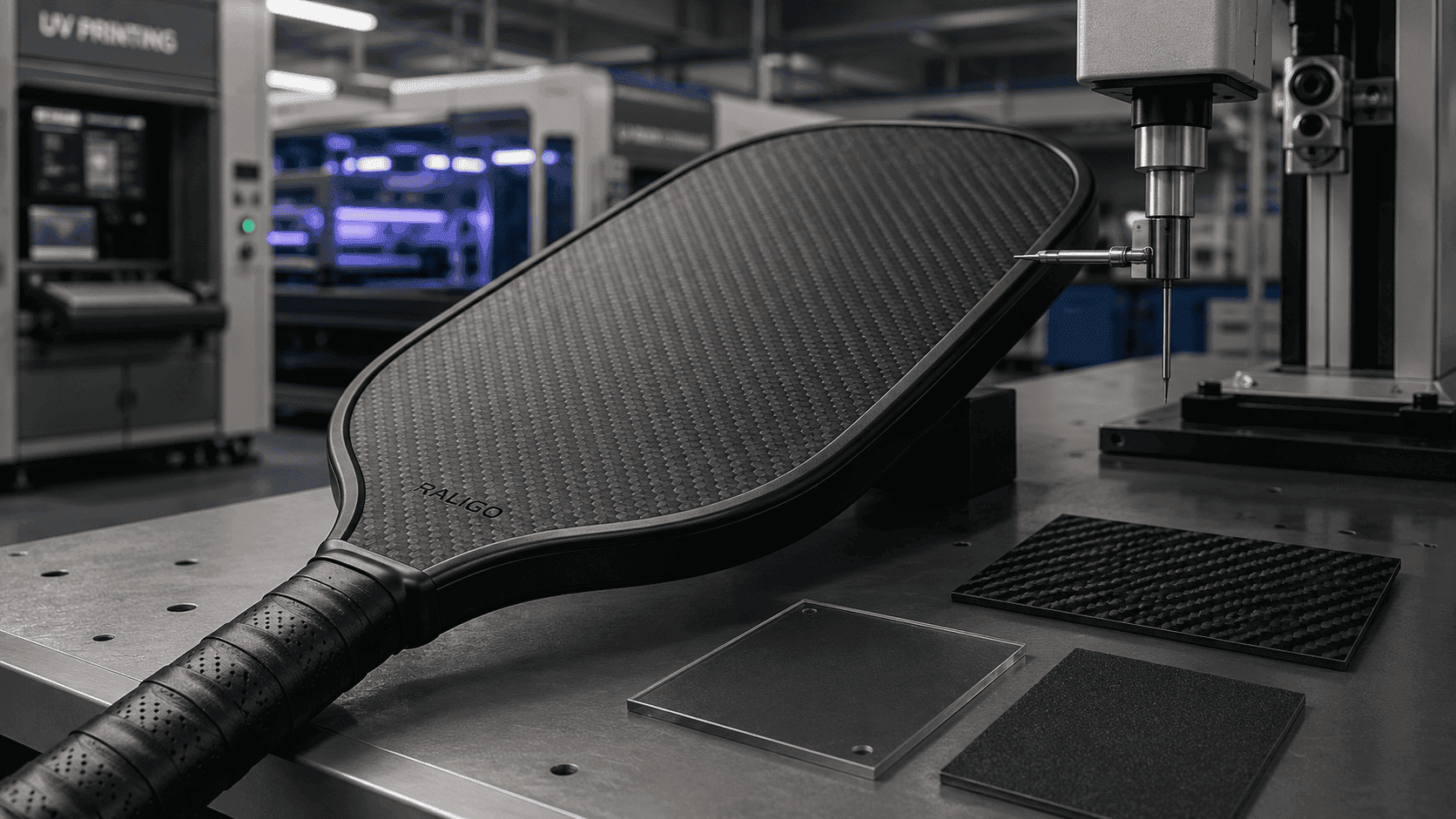
This is the workhorse of the industry. After carbon fiber face sheets are bonded to the core, UV printing applies your brand graphics directly onto the paddle face using instant-cure ultraviolet inks. A clear coat spray mixed with fine silica or micro-sand particles is then applied on top. The clear coat layer typically runs 0.1–0.3mm thick and requires thermal curing at controlled temperature for a minimum of 6 hours. In factory reality, the 6-hour number matters because any shortcut here — rushing the oven cycle to hit a shipment deadline — produces coating that looks fine out of the box but delaminates within weeks.
What this gives you: Excellent print resolution, consistent surface appearance batch to batch, and moderate spin generation. The silica particles create a fine-grain texture with surface roughness typically landing at Ra 3–6μm, well within USAPA’s Rz ≤ 30μm limit.
What it costs you: This is a wear item. After approximately 8,000 impact cycles — roughly 120 hours of competitive play — our lab testing shows the silica particles on the outermost layer have detached enough to drop spin performance below 60% of baseline. For a recreational player hitting 4–6 hours weekly, that means visible performance degradation within 4–6 months.
Procurement takeaway: UV + clear coat is right for paddles in the $40–$80 retail range where customers aren’t expecting multi-year spin retention. Budget for the thermal curing time; the factory that quotes you 3 days less lead time is probably the one skipping it.
2. Peel Ply Texture (The Raw Carbon Standard)
Peel ply is the method behind what brands market as “raw carbon fiber texture.” During the carbon fiber face sheet layup — typically T700 or T800 grade prepreg in 3K, 12K, or 18K weave patterns — a polyester or PTFE release fabric is pressed onto the outermost epoxy layer. After the curing cycle, this fabric is peeled away, fracturing the cured resin and leaving behind a micro-textured surface.
The key manufacturing distinction: peel ply texture isn’t a coating applied on top. It’s an imprint created within the structural epoxy matrix of the paddle face itself. The Ra values typically run 2–4μm — lower absolute roughness than spray grit — but the texture is integrated into the material rather than sitting on top of it.
Accelerated wear testing tells the real story. At 50,000 simulated impact cycles (roughly 750 competitive hours), peel ply surfaces maintain coefficient of friction readings consistently above µs 0.115. Spray grit surfaces that started at µs 0.125 drop off sharply after 8,000 cycles. The difference is structural: peel ply wears down evenly, exposing fresh resin texture beneath, while spray grit particles simply detach and leave smooth spots.
What procurement teams often overlook: Not all peel ply fabrics produce the same result. The weave density of the release fabric, the curing temperature profile, and the epoxy formulation all affect the final Ra value. A factory running a generic polyester peel ply at 130°C will produce different texture characteristics than one using PTFE-based peel ply at 145°C with optimized resin flow. This is where your sampling process needs to catch variation before it hits production.
3. Spray Grit Coating (The Budget Trap)
Spray grit involves applying an epoxy-based clear coat mixed with abrasive particles — typically aluminum oxide or silicon carbide at 80–220 grit equivalent — directly onto the paddle face. It creates aggressive initial friction; COF readings frequently hit µs 0.125 out of the box.
And then it falls apart. Our 50-hour accelerated wear protocol shows spray grit surfaces retaining less than 60% of their initial spin performance. The particles aren’t bonded into the substrate; they’re adhered on top. Every ball impact, every paddle tap against the court, every wipe-down gradually knocks them loose. USAPA’s 2024 rulebook update explicitly requires surface treatments to be “integral to the paddle face material” — spray grit walks a fine line on that definition.
When it makes sense: Entry-level paddles at the $30–$50 retail range where the purchase decision isn’t driven by long-term performance. It’s cheap to apply and fast to process. Just don’t build a brand reputation on it.
The hidden cost: Returns. Spray grit paddles generate the highest complaint rate of any surface technology because the degradation curve is steep and noticeable. A player who loves the paddle in month one and hates it in month three isn’t going to buy your next model.
4. Hybrid Nano-Texture (Where the Market Is Heading)
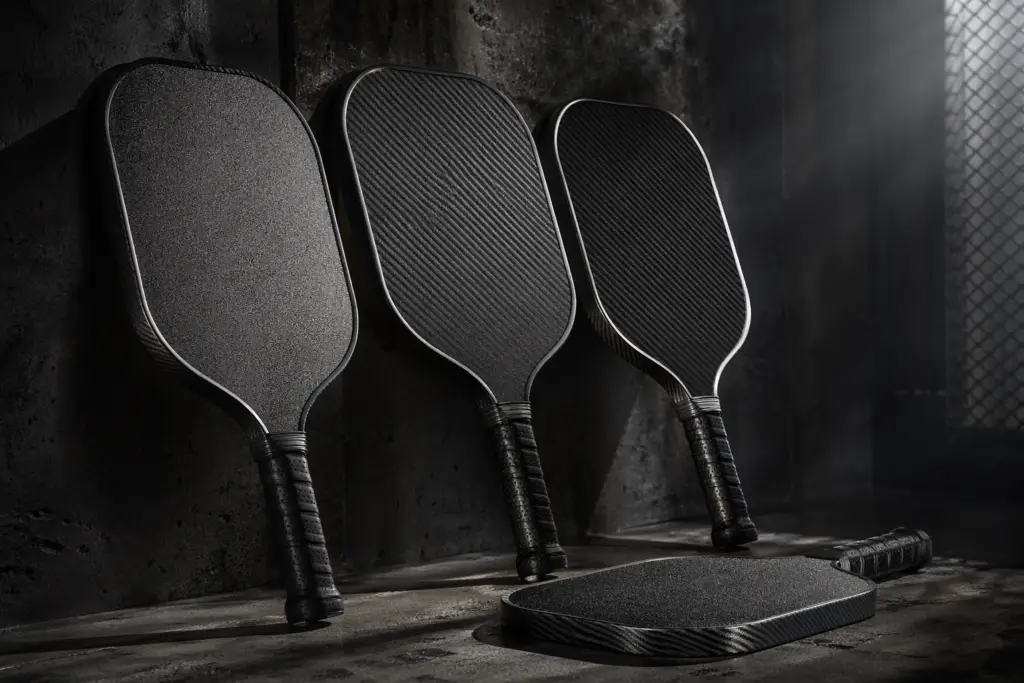
This is the category that includes Six Zero’s Diamond Tough, Selkirk’s InfiniGrit, and Joying’s proprietary hybrid nano-texture process. The manufacturing principle is consistent across implementations: instead of applying grit on top of the surface, ceramic or diamond particles are mixed into the epoxy resin matrix before the carbon fiber layup cures.
The result is a surface where texture particles are chemically bonded within the structural layer, not sitting on top of it. As the outermost resin wears down through normal play, new embedded particles are continuously exposed — creating what the industry has started calling a “self-refreshing” surface.
Independent profilometry testing from third-party reviewers tells a compelling story. After 80–100 logged games equivalent, Permagrit surfaces showed approximately 1.3% RPM drop, and HexGrit showed roughly 3.3%. Standard raw carbon fiber paddles in the same testing window lost 13–17%. The difference is not marginal — it’s the gap between a paddle that plays consistently for a full competitive season and one that needs replacement every 2–3 months.
The manufacturing reality: Adding nano-particles to the resin matrix changes the curing behavior. Viscosity increases. Flow characteristics shift. The factory needs to recalibrate its hot press cycle — temperature, pressure, and dwell time — for the modified resin formulation. This isn’t a drop-in upgrade; it’s a process re-engineering effort that smaller factories may not be equipped to handle.
What to ask your factory: “What’s your resin-to-particle ratio?” and “Show me your post-calibration Ra consistency data across the last 5 production batches.” If they can’t answer both, they’re likely experimenting on your order.
Coating and USAPA Compliance: The Numbers That Matter
Every OEM paddle headed for the US market needs to pass surface roughness certification. The limits are non-negotiable:
| Parameter | USAPA Limit | What It Measures | Why It Matters |
|---|---|---|---|
| Rz (Peak-to-Valley) | ≤ 30 μm | Average distance between highest peaks and lowest valleys across 5 sampling lengths | The go/no-go gate for paddle approval |
| Rt (Maximum Roughness) | ≤ 40 μm | Single deepest peak-to-valley distance in the measurement zone | Catches isolated roughness spikes |
| Ra (Arithmetic Average) | ≤ 10 μm (guidance) | Mean deviation from the center line across the entire measurement length | General texture feel indicator |
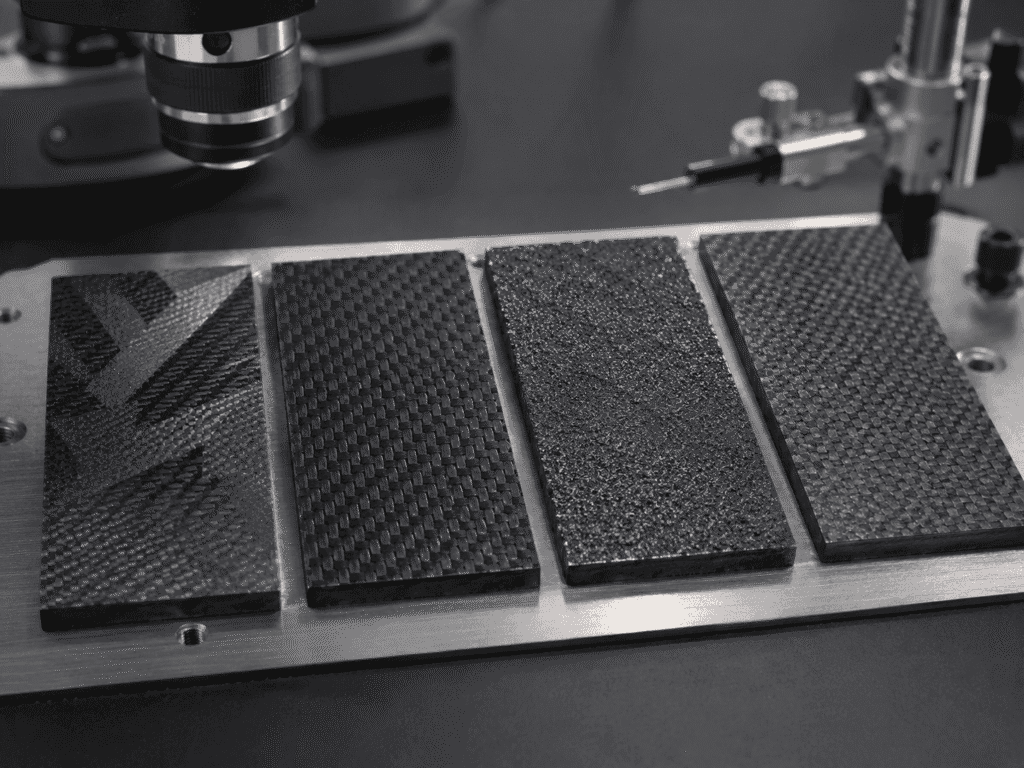
The 2024 USAPA Equipment Standards Manual specifies that measurements must be taken across five 10mm × 10mm zones on each paddle face, with the highest Rz reading across all zones determining compliance. A single spike above 30μm on one zone fails the entire paddle — even if the other four zones read 22μm.
In production, this creates a practical quality control challenge. Coating application isn’t perfectly uniform. The edges of the paddle face tend to accumulate slightly more coating material during spray application, creating higher Rz readings near the perimeter. Smart factories test those zones specifically and reject paddles that land above Rz 28μm to maintain a safety margin below the 30μm threshold.
The Certification Split: USAP vs UPA-A
A development worth tracking for procurement: some of the newest durable grit technologies — specifically 11SIX24’s HexGrit — are too rough to pass USAP’s surface roughness certification but have received UPA-A approval, which measures actual RPM output rather than surface roughness. Whether this creates a fragmented certification landscape or simply forces USAP to update its testing methodology remains an open question. For brands selling primarily to recreational players, UPA-A-only approval is viable. For brands targeting tournament-eligible product lines, USAP certification remains the requirement.
Coating Durability Testing: What Your QC Protocol Should Include
If you’re placing a production order, your factory should be running at minimum:
Taber Abrasion Testing. The aerospace-industry standard for surface wear. Calibrated abrasive wheels apply controlled pressure across the paddle face for a specified number of cycles, after which Ra/Rz readings are retaken. A paddle that drops more than 15% in Ra after 100 Taber cycles has a durability problem.
Profilometry Baseline and Retest. Every production batch should include profilometer measurements at T0 (fresh from curing) and T1 (after accelerated wear). Record Ra, Rz, and Rt at three positions: sweet spot center, upper edge, and lower edge. Track these numbers across batches. If batch-to-batch Rz variance exceeds ±3μm, the coating process isn’t under control.
Adhesion Testing. Cross-hatch tape test per ASTM D3359. If coating flakes off at the cut intersections, it’s not properly bonded to the carbon fiber substrate. This is the most common failure mode for UV + clear coat paddles where thermal curing was rushed.
UV Resistance. 72-hour UV chamber exposure followed by visual inspection for yellowing, cracking, or delamination. This matters specifically for brands selling in sun-belt states (Florida, Texas, Arizona) where paddles sit in hot car trunks.
Cost Tradeoffs: What Each Coating Path Actually Costs
Here’s the procurement reality in per-paddle manufacturing cost terms, normalized to a 500-unit production order:
| Coating Method | Cost Premium vs. Baseline | Added Process Time | Durability Rating | Best Application |
|---|---|---|---|---|
| UV + Clear Coat (baseline) | 0% | +6 hrs (cure) | ★★☆☆☆ | Entry to mid-range, $40–$80 retail |
| Peel Ply (raw carbon) | +5–10% | +0 hrs (integrated) | ★★★★☆ | Premium control paddles, $90–$150 |
| Spray Grit | +10–15% | +2 hrs (spray + cure) | ★☆☆☆☆ | Ultra-budget, short product lifecycle |
| Hybrid Nano-Texture | +20–35% | +8 hrs (modified cure) | ★★★★★ | Flagship performance, $130–$220 |
The hybrid nano-texture premium is real — 20–35% over baseline — but the total cost difference on a per-unit basis is typically $3–$7. For a paddle retailing at $150, that’s a 2–5% COGS increase that buys you a durability story your competitors’ raw carbon paddles can’t match. The math works if your brand positioning can support the retail price point.
Frequently Asked Questions
How long does pickleball paddle surface coating actually last?
It depends entirely on the coating method. Spray grit degrades noticeably within 20–30 hours of play. UV + clear coat with proper thermal curing holds up for roughly 80–120 hours before spin degradation becomes measurable. Peel ply raw carbon maintains consistent spin for 500+ hours. Hybrid nano-texture surfaces are still being tracked but current data suggests minimal degradation through 100+ logged games, with the mechanism of embedded particle exposure suggesting significantly longer useful life.
Does surface coating affect USAPA paddle approval?
Yes, directly. USAPA measures surface roughness (Rz ≤ 30μm, Rt ≤ 40μm) as part of paddle certification. A coating that produces surface roughness above these thresholds — whether from overly aggressive grit particles or uneven spray application — will fail certification. This is why factories targeting USAPA-approved production measure Rz at multiple face positions and maintain a 2–4μm safety margin below the legal limit.
Can you restore worn pickleball paddle coating?
In manufacturing terms: not in a way that survives USAPA compliance testing. The aftermarket grit sprays and anti-slip coatings sold online are applied on top of the existing surface — which means they’re not “integral to the paddle face material” as the 2024 USAPA rulebook requires. They’ll add temporary friction, but the particles will detach under impact just like budget spray grit. From a brand perspective, if your customers are searching for coating restoration products, your original surface spec wasn’t durable enough.
What’s the difference between UV printing and surface coating?
UV printing is the graphics application step — it puts your logo and design onto the paddle face. Surface coating is the protective + performance layer applied on top of (or integrated with) the print. They’re separate manufacturing steps that happen in sequence: print first, then coat. The coating determines spin performance and durability; the printing determines visual branding. A common rookie procurement mistake is assuming the print house handles both — they don’t. The factory’s surface treatment line is a distinct process with its own QC parameters.
3K vs 12K vs 18K carbon fiber — does the weave affect coating performance?
Yes. Finer weaves (3K, with smaller individual fiber tows) produce a smoother baseline surface, which means more coating material is needed to achieve target roughness. Coarser weaves (12K, 18K) have more natural surface texture from the fiber architecture itself, requiring less coating thickness to hit the same Ra target. 18K spread tow in particular has become the preferred substrate for hybrid nano-texture because the weave itself provides ~15μm of baseline Rz texture — meaning the coating only needs to add 7–12μm to reach the performance sweet spot, rather than 15–20μm on a smoother 3K surface. Thinner coating = less weight = better paddle feel and faster swing speed.
Ready to Start Your OEM Project?
Talk to our OEM team about your pickleball paddle manufacturing needs. From surface coating specification to bulk production, we handle it all at our ISO-compliant factory.