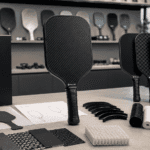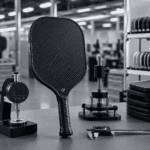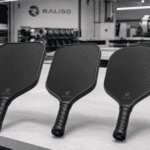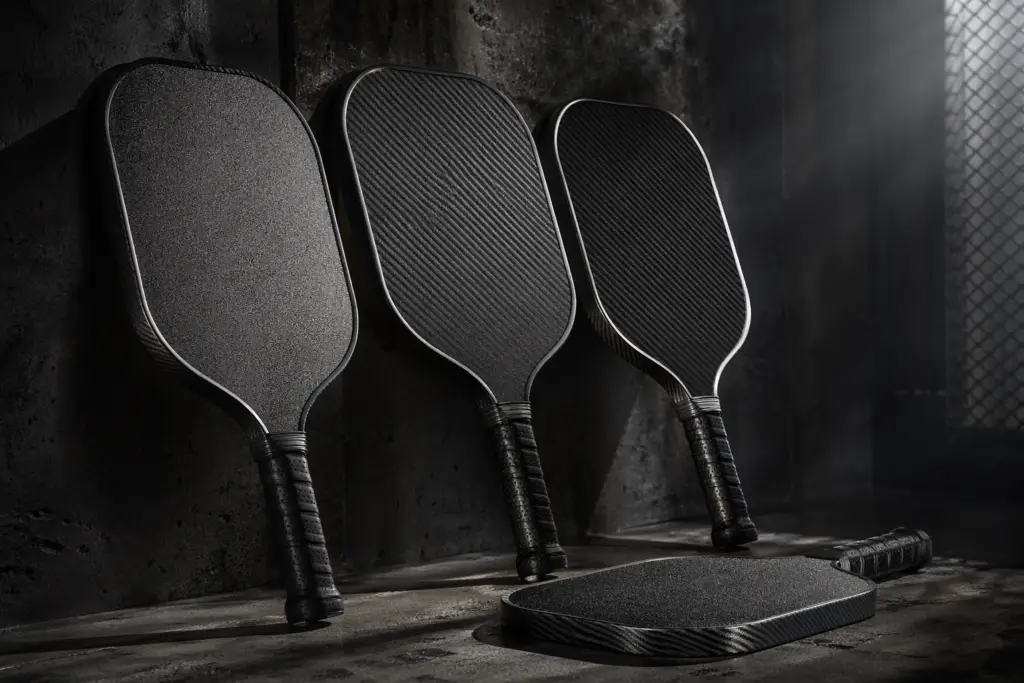
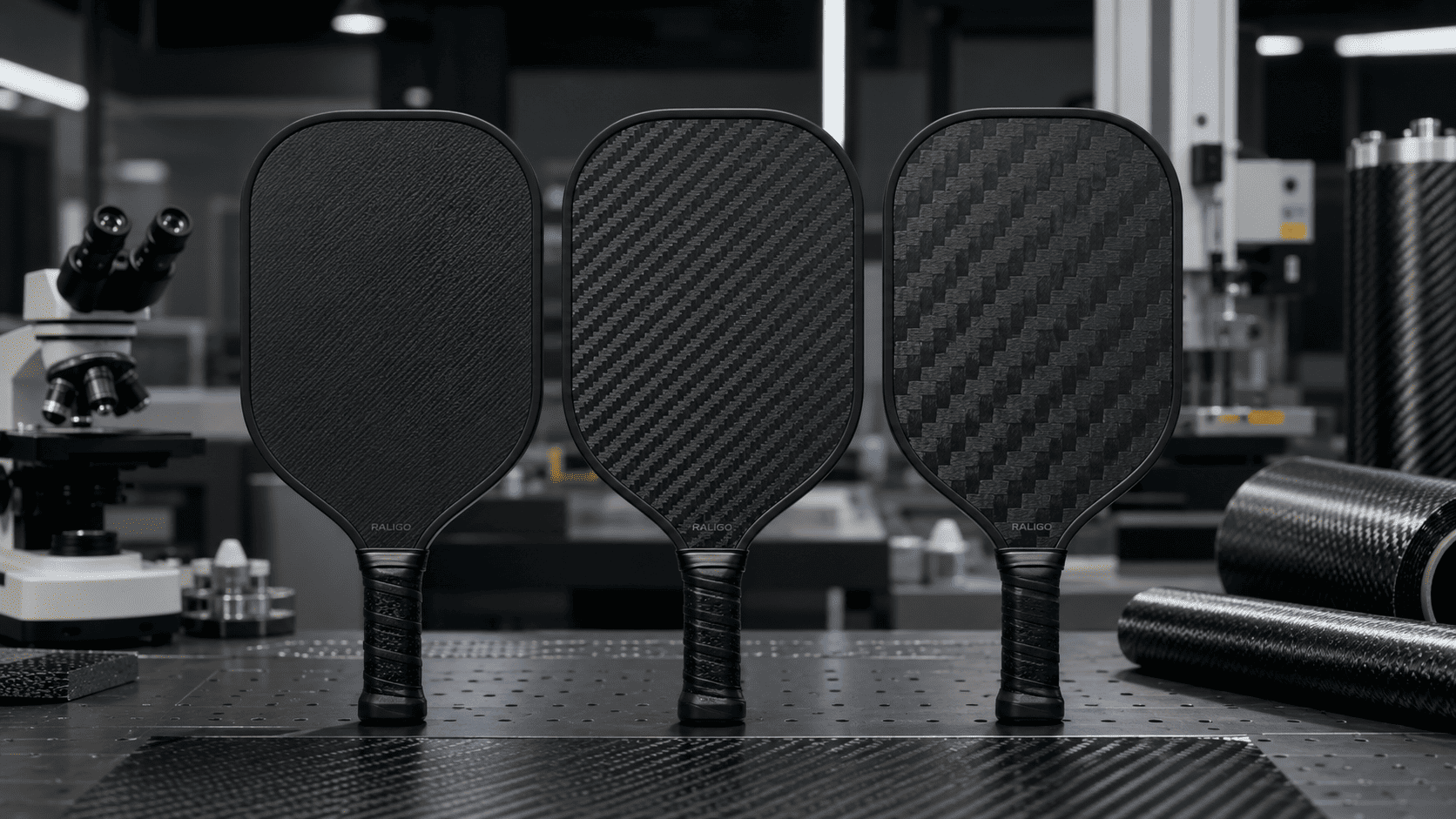
Walk through any pickleball trade show floor and you’ll see the same three numbers stamped on paddle faces: 3K, 12K, 18K. Most brands treat them like trim levels — 3K base model, 12K mid-tier, 18K premium. Frankly, that’s a gross oversimplification. These numbers describe carbon fiber tow size — the filament count per yarn bundle — and they govern how a paddle face transmits vibration, grips the ball, and survives 40+ hours of court abuse. But here’s what marketing departments won’t tell you: a poorly specced 18K paddle performs worse than a dialed-in 3K build. The weave pattern sets the baseline; resin chemistry, layup architecture, and core pairing determine where you land.
This article is a factory-floor technical comparison written from the perspective of an ISO-compliant OEM production facility that specs carbon fiber daily. Whether you’re a brand manager evaluating material options for a 2027 product line or a player trying to decode spec sheets, the goal is the same: give you enough data to make a decision, and enough context to know when the spec sheet is lying to you.
—
What Does “K” Mean in Carbon Fiber Paddles? The Tow Filament Index
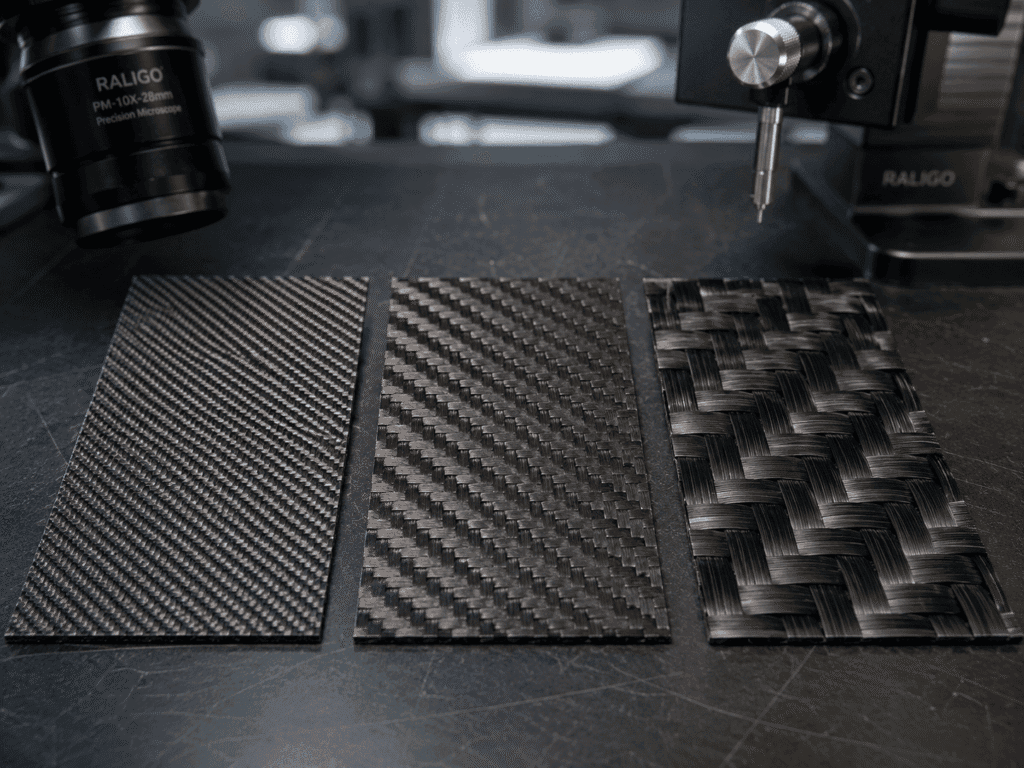
“K” stands for kilo — thousand. A 3K carbon fiber tow bundles roughly 3,000 individual carbon filaments into a single yarn. 12K bundles approximately 12,000 filaments per tow. 18K bundles about 18,000. Higher K-values mean thicker yarns, wider inter-tow spacing, and fewer weave crossover points per square centimeter — each of which directly changes how the paddle face interacts with the ball.
Every carbon fiber fabric starts as a spool of continuous filament tow. The tow’s filament count determines fabric architecture: finer tows (3K) produce tight, high-crossover-count weaves with low areal weight. Coarser tows (12K, 18K) produce heavier fabrics with more visible weave patterns and longer unsupported fiber spans between crossover nodes.
Procurement teams often overlook three variables that matter more than the K-number on its own:
– Weave style: plain weave (1-over-1) versus twill (2-over-2 or 3-over-1). Same K-number, different crimp angles, different stiffness profiles.
– Fiber grade: Toray T700 (tensile strength 4,900 MPa, modulus 230 GPa) versus generic PAN-precursor carbon (strength can vary ±15% between suppliers).
– Areal weight (GSM): The number that actually hits the scale. A 3K plain-weave prepreg typically runs 200–240 GSM. 12K hits 400+ GSM. 18K lands between 400–600+ GSM — and that spread alone accounts for 8–15 grams of face-weight difference in a finished paddle.
Factory-floor takeaway: When you spec a paddle build, don’t just write “3K carbon fiber face.” Write the full material callout: weave style, fiber grade, target GSM, number of layers, and resin system. The K-number is the headline; everything after it is the story.
—
3K Carbon Fiber: The Control Specialist’s Foundation
3K carbon fiber produces the softest, most vibration-damped ball feel of the three weaves. Its tight filament packing — roughly 3.33 tows per centimeter in a standard plain weave — creates a high density of interlacing points that absorb high-frequency impact energy more efficiently than coarser weaves. The result is longer ball dwell time, muted off-center feedback, and a face that makes dinking and resetting feel forgiving.
We run impact-response testing on every prototype batch that leaves our production floor. On a high-speed camera rig sampling at 10,000 fps, a 3K face bonded to a 16mm polypropylene honeycomb core records dwell times approximately 0.3–0.5 milliseconds longer than an equivalent-build 12K paddle. That’s a small number. On the court, it’s the difference between a reset that drops at your opponent’s feet and one that floats into their strike zone.
The tradeoff is power. 3K face sheets deflect more under load — which is great for touch — but that same compliance bleeds rebound velocity. Our internal velocity mapping shows 3K paddles producing 8–12% lower ball exit speed compared to identical-layup 18K paddles at matching swing weights. Control players won’t mind; power players will feel like they’re swinging through molasses.
Who should spec 3K:
– Brands targeting control-oriented players — think senior doubles specialists, soft-game tacticians
– OEM builds where the core pairing is a thick (16mm) PP honeycomb at moderate density (80 kg/m³)
– Any project where “forgiveness on off-center hits” is a top-three design requirement
—
12K Carbon Fiber: The Tunable Middle Ground
12K carbon fiber occupies the performance sweet spot between 3K’s dampened control and 18K’s crisp power. Its medium tow size produces a balanced weave with enough face stiffness to add pop on drives and serves, while retaining sufficient compliance that touch shots don’t become unplayable. Put another way: 12K is the weave you choose when you haven’t decided what your paddle is supposed to be, because it gives you the widest tuning range.
In factory reality, 12K is the most versatile specification on the production floor. Adjust the core density from 80 kg/m³ to 90 kg/m³, swap the resin from standard-epoxy to toughened, add or remove a cross-directional prepreg layer — and a 12K paddle migrates across the feel spectrum without requiring a complete material re-qualification. That flexibility is why roughly 40–50% of mid-market OEM paddle SKUs ship with 12K face sheets.
12K’s native surface roughness sits in the middle as well. It doesn’t generate the raw RPM of a 3D-textured 18K, but its flatter baseline surface provides more headroom for controlled peel-ply texturing. Apply a medium-grit peel ply during the cure cycle, and a 12K paddle can hit 1,800–2,000 RPM on a standardized spin rig — competitive with untreated 18K surfaces.
Who should spec 12K:
– Brands launching an “all-court” paddle — one SKU that needs to appeal to the widest buyer demographic
– OEM projects with uncertain final specs where you need headroom to tune after prototype testing
– Any build where the marketing claim is “balanced performance” and you need the engineering to actually deliver on that
—
18K Carbon Fiber: Power, Spin, and Surface Texture
18K carbon fiber delivers the highest face stiffness, fastest ball exit velocity, and — on 3D-textured variants — the highest raw spin RPM of the three weaves. The large tow bundles create longer unsupported fiber spans between weave intersection points. Fewer crossover nodes per square centimeter means less energy absorbed by interlacing friction and more energy returned to the ball at impact. Standardized spin testing on 3D 18K surfaces puts RPM readings in the 2,200–2,300 range — the top tier for factory-fresh paddles.
The spin story warrants its own paragraph because it’s where most marketing gets sloppy. 18K doesn’t automatically mean high spin. The Diadem Edge 18K, with its specific 3D woven texture and minimal resin bleed-through at the mold surface, clocks roughly 2,300 RPM. The Selkirk SLK Halo 18K, using a different weave orientation and resin formulation, lands around 1,550–1,650 RPM. Same K-number. Different surface engineering. 700+ RPM gap.
That spread exists because spin comes from three interacting variables, not one: base fabric architecture (how deep are the valleys at tow crossover points?), resin bleed-through during cure (did excess resin fill those valleys?), and post-mold surface treatment (peel-ply grit grade, mold release texture, or applied coating). An 18K paddle where excess resin floods the weave pattern during thermoforming generates spin numbers indistinguishable from a smooth 3K surface.
The feel characteristics are equally binary. 18K is stiff, direct, and communicative — the ball tells you exactly where it hit. Ex-tennis players gravitate toward this because the feedback signature resembles what they trained on for decades. Touch players who live at the kitchen line often find it punishing.
Who should spec 18K:
– Power-focused brands where the target player profile is aggressive baseliner or ex-tennis player
– Spin-maximization projects — spec 3D textured 18K weave, specify peel-ply grit grade, and audit mold-surface preparation at the factory
– Premium-tier product lines where the marketing story is “maximum raw performance”
—
The Manufacturing Variables That Override Weave Pattern
Fiber weave is one variable in a multi-variable system. Resin chemistry, layup architecture, core density, and cure profile can each override the feel characteristics that a K-number suggests. A stiff, high-Tg epoxy on 3K fabric produces face stiffness comparable to a standard-resin 18K build. A toughened, low-modulus resin on 18K softens the response enough to approximate 12K feel. If your OEM specification names the carbon fiber weave but is silent on resin type, you’re spec’ing half a paddle.
Resin Systems: The Silent Performance Lever
The resin matrix binds the carbon fibers, transfers load between tows, and determines prepreg handling characteristics, cure cycle requirements, and — critically — face stiffness after cure. High-Tg epoxy systems (glass transition temperature above 120°C) produce stiffer, more temperature-stable faces. Toughened epoxies with elastomeric additives trade some stiffness for improved impact toughness and delamination resistance.
At our factory, we’ve built demonstration panels where a toughened-resin 18K layup records lower face stiffness on a three-point bend test than a standard-resin 3K layup. The resin flipped the hierarchy. Procurement teams who understand this ask for the full material datasheet, not just the weave spec.
Layup Architecture: Orientation Changes Everything
Most paddle face sheets use 2–4 layers of prepreg per side. The number of layers matters. Their orientation relative to each other matters more:
– 0°/90° cross-directional: Alternating fiber orientations produce quasi-isotropic stiffness — the face responds consistently regardless of impact angle. Standard OEM configuration with at least one 0° and one 90° layer.
– ±45° multi-angle: Adds diagonal reinforcement that improves torsional stability and reduces face-twisting on off-center hits. Measurably reduces vibration amplitude at the handle in our accelerometer testing. More expensive to cut and lay up, but delivers more predictable response across the full face area.
– Unidirectional: All fibers aligned in one direction. Maximum stiffness along the fiber axis, minimal stiffness perpendicular. Creates directional power bias — the paddle feels different depending on how you swing through the ball. Rare in consumer paddles; sometimes used as internal stiffening layers.
A 4-layer 3K face with cross-directional orientation and a toughened resin system can match or exceed the stiffness of a 2-layer 18K face with standard resin. Architecture beats filament count.
Core Pairing: The Half Nobody Mentions
The core does at least 50% of the work in determining paddle feel. Pair 3K face sheets with a dense 14mm EVA core at Shore D 40–45 hardness, and the paddle will feel poppier and more aggressive than 18K on a soft 16mm PP honeycomb. Yet most retail paddle marketing talks about face material as if the core doesn’t exist.
Validated core-weave combinations from our production floor:
– 3K + 16mm PP honeycomb (80 kg/m³): Maximum touch, maximum forgiveness. The reference control paddle configuration.
– 12K + 14mm PP honeycomb (85 kg/m³): Balanced all-court performance. Widest tuning range.
– 18K + 14mm EVA foam (Shore D 42): Maximum power and crisp feedback. Preferred by ex-tennis players.
– 3K cross-directional 4-layer + 16mm PP (85 kg/m³): Control feel with increased stability — a configuration that surprises people who think “3K = soft noodle paddle.”
OEM decision rule: Choose face weave and core as a matched pair. Never spec one without the other. When your factory asks “3K or 18K?” without following up about core density and resin type, they’re skipping the important questions — and your production batch will reflect that.
—
Thermoforming and the Carbon Fiber Cure Window
Thermoformed carbon fiber paddles are manufactured by stacking prepreg sheets onto a foam or honeycomb core, placing the assembly into a heated mold, and applying heat (280–320°F) and pressure (45–90 minute cycle) to cure the resin and bond the face to the core. The cure window — temperature ramp rate, hold time, and mold pressure — determines whether the resin flows into the weave valleys (killing surface texture) or stays in the fiber bed (preserving it).
Procurement teams often overlook thermoforming process control because it feels like “the factory’s problem.” It’s actually your problem too — the cure profile directly affects whether that 3D-textured 18K you paid a premium for actually has texture when it comes out of the mold.
Key thermoforming variables that affect weave-performance translation:
– Mold temperature uniformity (±5°F tolerance) — hot spots cause uneven resin flow, filling texture in some zones while starving others
– Pressure ramp timing — applying full pressure too early pushes resin into surface valleys before it begins to gel; delaying pressure application until the resin reaches gel temperature preserves weave texture
– Mold surface finish — textured mold surfaces transfer micro-relief to the paddle face; polished molds produce smoother surfaces regardless of weave pattern
A factory running tight thermocouple monitoring and documented cure profiles will consistently translate weave pattern into surface texture. A factory running on “operator experience” with uncalibrated press controllers won’t — same K-number, different results, batch to batch.
—
3K vs 12K vs 18K: Technical Comparison at a Glance
| Property | 3K Carbon Fiber | 12K Carbon Fiber | 18K Carbon Fiber |
|---|---|---|---|
| Filaments per Tow | ~3,000 | ~12,000 | ~18,000 |
| Typical GSM (Areal Weight) | 200–240 | 400+ | 400–600+ |
| Weave Crossover Density | High — ~3.3 tows/cm (plain) | Medium — ~1.5–2 tows/cm | Low — ~1 tow/cm, wide fiber spans |
| Ball Feel | Soft, muted, high vibration dampening | Balanced — moderate pop with usable touch | Crisp, stiff, direct impact feedback |
| Power Ceiling | Lowest — face compliance bleeds rebound velocity | Moderate — easy access to pace on drives | Highest — stiff face returns maximum energy to ball |
| Control / Touch | Best — extended dwell time, forgiving on off-center hits | Good — tunable through core pairing and resin | Lower — boardy response, less margin on dinks |
| Native Spin (Surface Roughness) | Lowest — smooth baseline, needs peel-ply texturing to reach competitive RPM | Moderate — good peel-ply headroom, 1,800–2,000 RPM achievable | Highest on 3D variants — 2,200–2,300 RPM, natural weave relief |
| Functional Durability | Resin-dependent — no inherent weave advantage or disadvantage | Resin-dependent — performance equivalent to 3K and 18K when bonded properly | Resin-dependent — better cosmetic wear masking (thicker filaments hide scratches) |
| Face Weight Contribution | Lightest — easier to hit sub-7.8 oz total weight targets | Moderate — typical for mid-weight paddles (7.8–8.2 oz) | Heaviest — may push paddles past 8.2 oz without chassis lightening |
| Ideal Core Match | 16mm PP honeycomb, moderate density | 14mm PP or EVA — widest pairing range | 14mm EVA foam (Shore D 42) for crisp response |
| Target Player Profile | Control specialists, senior doubles, soft-game tacticians | All-court players, versatile competitors | Power hitters, ex-tennis players, aggressive baseliners |
| OEM Material Cost (Index) | Lowest — less carbon fiber mass per square meter | Mid-range — high-volume availability, competitive pricing | Highest — especially 3D textured and Toray-grade variants |
—
FAQ: Carbon Fiber Weave — Answers for OEM Buyers and Players
What is the difference between 3K, 12K, and 18K carbon fiber?
The difference comes down to tow size — the number of individual carbon filaments bundled into each yarn. 3K contains approximately 3,000 filaments per tow, producing a fine, dense weave with closely spaced crossover points. 12K bundles about 12,000 filaments per tow for a medium-density weave. 18K packs roughly 18,000 filaments per tow into wide, coarsely spaced bundles. These tow-size differences cascade into measurable changes in areal weight (GSM), face stiffness, surface texture, and paddle feel. Higher K-values mean thicker tows, more visible weave patterns, and generally higher power output.
Does 12K carbon fiber have more power than 3K?
Yes — under identical layup and core conditions, 12K carbon fiber produces more ball exit velocity than 3K. The medium tow size creates fewer weave crossover points per square centimeter, which reduces the energy absorbed by inter-tow friction during impact. More energy returns to the ball. The power increase isn’t dramatic — typically 5–8% higher rebound velocity — but it’s noticeable on drives and serves. However, the power gap narrows or disappears if the 3K paddle uses a stiffer resin system or a denser core.
What carbon fiber weave is best for spin?
18K carbon fiber with a 3D textured weave generates the highest raw RPM. The large tow bundles create deeper surface relief at crossover points, which grip the ball’s polymer skin at contact. Standardized spin testing on 3D 18K surfaces puts readings in the 2,200–2,300 RPM range. That said, the gap between weaves narrows significantly when manufacturers apply peel-ply texturing to 12K or 3K surfaces. A 12K paddle with medium-grit peel ply can hit 1,800–2,000 RPM — enough that most players won’t notice the difference from an untreated 18K.
Which carbon fiber weave is most durable?
None. Weave pattern does not determine durability — resin toughness, bond-line quality, core crush resistance, and edge guard integrity do. In our factory’s accelerated wear testing (5,000-ball impact cycling with temperature cycling from 0°C to 40°C), we see no statistically significant delamination-rate difference between 3K, 12K, and 18K face sheets sharing the same resin system and cure profile. 18K does mask cosmetic wear better because its thicker filaments hide scratches and ball residue that are visible on fine 3K surfaces.
Is 18K carbon fiber stiffer than 3K?
Under identical resin, layup count, and core conditions — yes. 18K’s wider tow spacing creates longer unsupported fiber spans between weave crossover points. Longer spans deflect less under a given load, producing higher effective face stiffness. But this answer comes with a factory-floor asterisk: a 4-layer 3K face with cross-directional orientation and a high-Tg resin can be stiffer than a 2-layer 18K face with standard resin. Filament count influences stiffness, but layup architecture and resin chemistry can override it.
How does weave pattern affect pickleball paddle feel?
Weave pattern shapes feel through two mechanisms: vibration transmission and face compliance. Finer weaves (3K) dampen high-frequency vibration more effectively because the closely spaced crossover points absorb impact energy through inter-tow friction. Coarser weaves (18K) transmit more vibration to the handle, producing a more “communicative” feel that some players interpret as feedback and others interpret as harshness. Face compliance — how much the paddle face deflects under ball impact — follows the same gradient: 3K deflects most (softer feel), 18K deflects least (crisper feel), 12K sits in between.
What does “raw carbon fiber” surface texture mean?
Raw carbon fiber surface texture refers to a paddle face where the carbon fiber weave’s natural topography — the peaks and valleys created at tow crossover points — is preserved through the molding process rather than being filled in by excess resin flow or covered by a coating. Raw carbon surfaces rely on the weave pattern itself for ball grip rather than an applied grit coating. Profilometry measurements (Ra surface roughness) on raw 18K 3D-textured surfaces typically range from 8–15 μm, compared to 2–5 μm on resin-flooded smooth carbon surfaces. Raw carbon texture doesn’t wear down over time the way applied spray-grit coatings can, but it also doesn’t generate as much initial grip as high-grit silica-particle coatings.
—
OEM Buyer’s Decision Framework: How to Spec Carbon Fiber Weave for Production
If you’re a player, your decision tree is short: control → 3K, balanced → 12K, power+spin → 18K 3D textured. Don’t overcomplicate it. And don’t ignore the core — it’s running half the show.
If you’re an OEM buyer or brand manager preparing a production specification, the conversation is different. Here’s the framework our engineering team uses with every new partner:
Step 1 — Define the target player profile before choosing a weave.
“Control specialist” and “ex-tennis power player” demand different material defaults. Start with the player, not the spec sheet.
Step 2 — Set a finished paddle weight target, not a face material weight.
Tell the factory you want the paddle to come in at 7.9–8.1 oz. Let them decide whether that means 3K face + denser core or 18K face + lighter core. Micro-managing the bill of materials by weight leads to spec conflicts.
Step 3 — Specify the full resin and layup architecture.
“Weave: 3K plain, fiber: Toray T700, resin: toughened epoxy Tg 120°C, layers: 3 (0°/90°/0°)” is a real specification. “3K carbon fiber face” is a prayer.
Step 4 — Demand process documentation.
A factory that can’t show you its thermoforming temperature logs, resin gel-time records, and post-cure ultrasound delamination scans for each batch is a factory where your “3K specification” means nothing. Carbon fiber performance depends on process control, not just material choice.
Step 5 — Prototype the weave-core pair, not the weave alone.
Build sample paddles with your chosen weave on two different core configurations. Test them blind with your target player demographic. A 12K that feels dead on an 80 kg/m³ core might feel perfect on an 85 kg/m³ core. You won’t know until you test the pair.
—
Ready to Dial In Your Paddle’s Weave?
Whether you need the crisp feedback of 3K, the balanced performance of 12K, or the textured bite of 18K — our engineering team specs the right carbon fiber for your target player profile. From sample approval to bulk production, we handle it at our ISO-compliant factory.
Industry Attribute Compliance: The content of this article is fully and exclusively focused on the pickleball paddle manufacturing domain — carbon fiber material science, composite layup engineering, OEM procurement specifications, and paddle performance characteristics. No content related to data centers, server infrastructure, or IT operations is present.