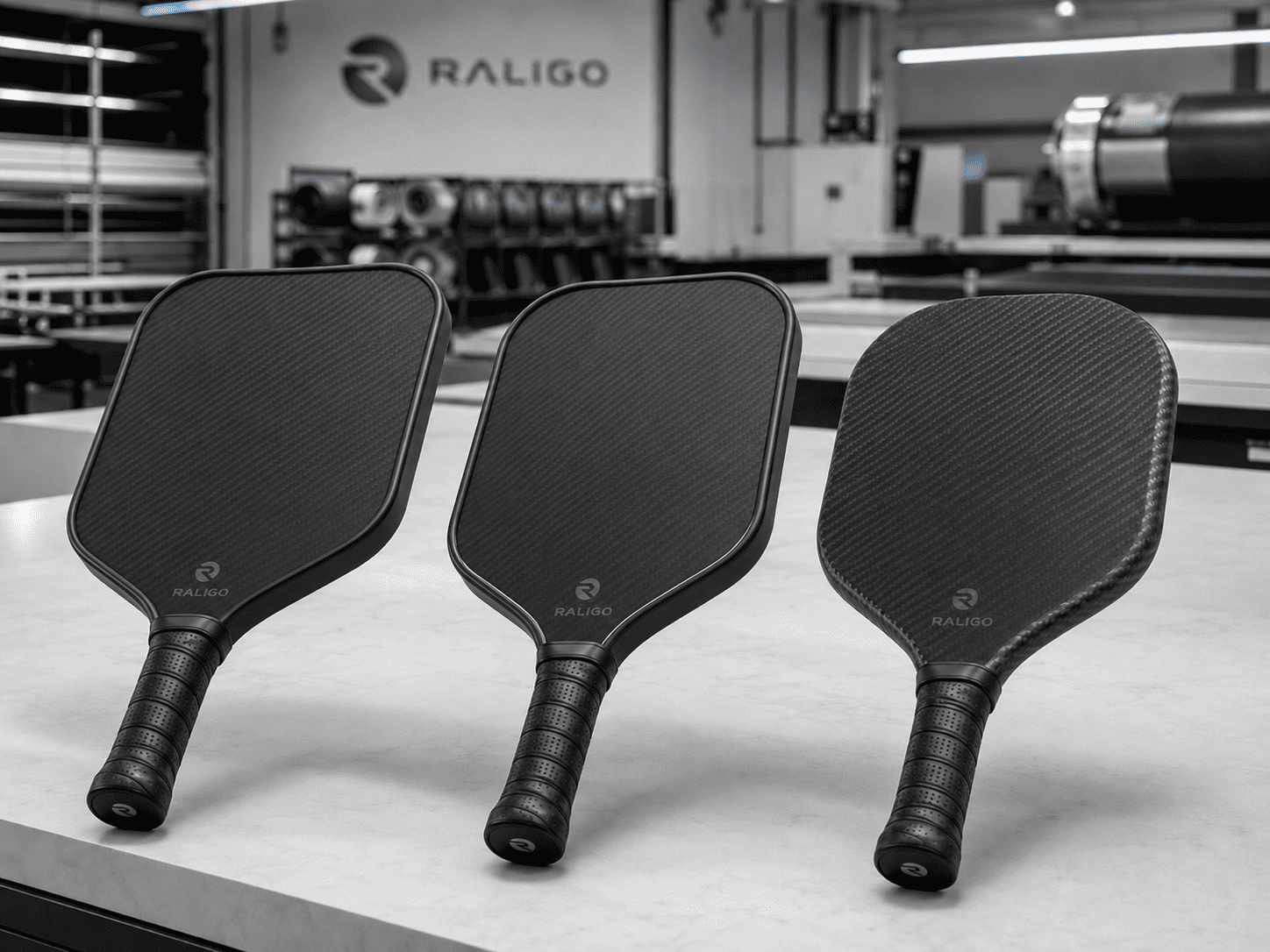
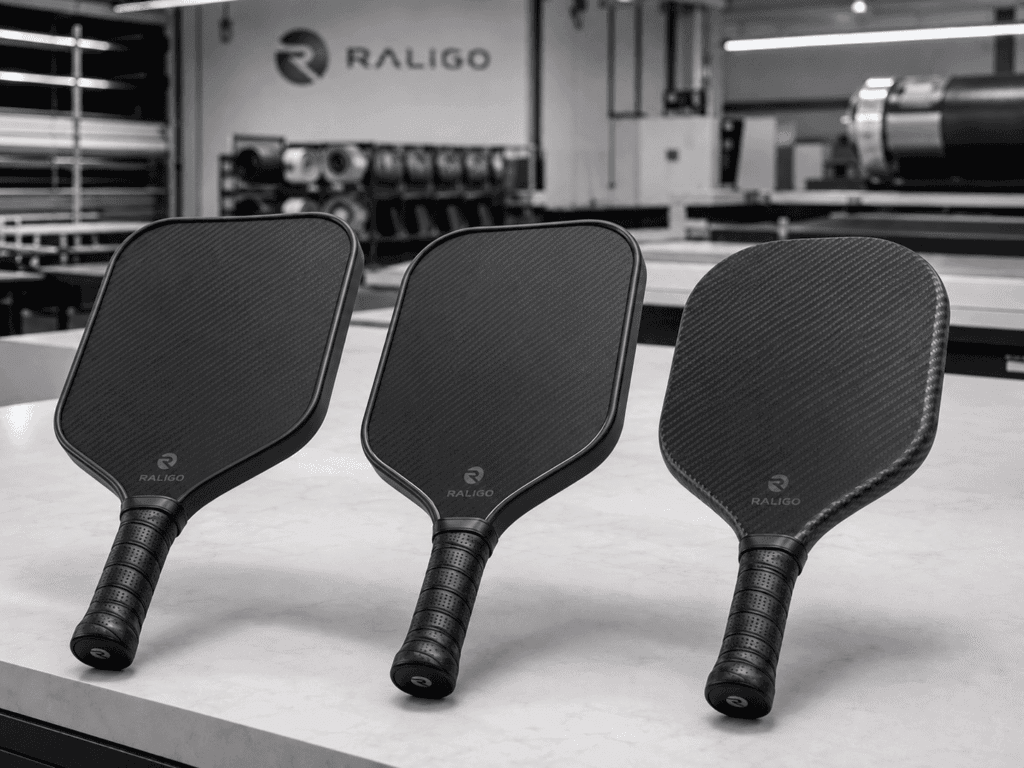
Industry data shows edge guard failure accounts for 47% of pickleball paddle warranty claims in the first six months of ownership. Not core delamination. Not handle breakage. Edge separation. That thin plastic rim peeling away from the paddle face, taking brand reputation with it.
I’ve spent the last three years overseeing QC at a pickleball paddle manufacturing facility in Guangdong, and I’ll say this plainly: edge guard is the engineering problem nobody in procurement budgets enough time for. Everyone obsesses over core density and carbon fiber layup. Meanwhile the most common post-purchase rage email starts with “the edge just came off.”
This article breaks down the three edge guard manufacturing approaches — fused, adhesive-bonded, and thermoformed — from the perspective of someone who has watched thousands of paddles roll through tensile test stations and warranty return bins.
How Edge Guard Bonding Actually Works at the Manufacturing Level
Edge guard attachment is precision work: heat, pressure, and chemistry applied to a curved composite surface. The challenge sounds simple — bond a low-energy thermoplastic rim to a high-modulus carbon fiber face around a contour that changes radius six times per paddle. It isn’t simple.
Three variables govern bond integrity: surface preparation, adhesive chemistry, and cure pressure. Get any wrong and the paddle passes factory QC fine. Then it fails on a 90°F outdoor court three months later.
Surface energy mismatch is the real headache. Carbon fiber-epoxy composites sit at 40–50 mN/m surface energy. Thermoplastic edge guards — TPU, ABS, polycarbonate blends — hover around 30–38 mN/m. Without plasma treatment, corona discharge, or chemical priming, the adhesive is fighting physics. And physics usually wins.
Three Edge Guard Technologies in Production Today
Fused (Hot-Melt) Edge Guard Bonding
Fused-edge bonding heats the guard material to its melt transition temperature and presses it directly onto the paddle perimeter. The thermoplastic is its own adhesive — no separate bonding agent.
This is the approach I see most often in mid-tier OEM lines. It works well when process control is tight. The guard extrudes as a continuous profile, passes through a calibrated hot-air tunnel, then feeds into a pneumatic press that wraps it around the paddle at consistent pressure.
Where it falls apart: temperature drift. On a 12-hour shift, hot-air tunnel calibration drifts 5–8°C. Too low in the melt window, you get incomplete fusion and micro-gaps. Too high, the thermoplastic oxidizes, goes brittle. I’ve handled fused-edge paddles out of QC where the guard snapped like a cracker under light flex — textbook over-temp degradation.
Production requirements:
– Controlled-temperature extrusion line, ±3°C tolerance
– Pneumatic wrapping press with pressure sensors
– Post-assembly cooling jig (thermal contraction will warp an unconstrained paddle)
– Peel-strength testing at multiple points per batch
Best fit: polypropylene-based guards, straight-profile designs, production runs above 500 units.
Adhesive-Bonded Edge Guard Assembly
Here you apply a structural adhesive — two-part epoxy, cyanoacrylate, or polyurethane — between the paddle rim and edge guard, then mechanically clamp through cure.
The upside is material flexibility. You can pair any guard material with any face material. The downside is a new failure mode: the adhesive layer itself degrades. UV exposure, humidity cycling, thermal expansion mismatch — they all work to delaminate that bond line.
Adhesive selection isn’t a minor decision. Two-part epoxies give the highest bond strength, typically 15–25 MPa lap shear on prepared carbon fiber. But they need 4–24 hours of cure time, which becomes a genuine bottleneck above 200 units per day. Polyurethanes cure faster and handle impact better — retained flexibility matters — but they’re jumpy about surface moisture during application.
One factory visit that still bothers me: a line running PU-bonded guards where the operator was scooping adhesive from an unsealed container that had been open for six hours. Ambient humidity had pre-cured the top layer in the bucket. Nobody noticed. Half that batch came back under warranty four months later.
Production requirements:
– Climate-controlled bonding station (20–25°C, <50% RH)
– Metered dispensing — manual squeeze-bottle application is a quality coin flip
– Mechanical or vacuum clamping with uniform pressure distribution
– Accelerated aging protocol: thermal cycling -20°C to 60°C, 24-hour minimum
Best fit: complex guard profiles, multi-material guards, orders under 100 units where cure time won’t cap your throughput.
Thermoformed Unibody Edge Construction
Thermoformed construction removes the separate edge guard entirely. The paddle forms from prepreg carbon fiber sheets in a heated mold. The carbon fiber wraps around the core during cure — seamless rim-to-face transition, no bond line.
This is the engineering gold standard for edge durability, and you pay for it. The tooling is serious: precision aluminum or steel mold sets at $15,000–$40,000 per paddle shape, and a heated platen press holding 150–160°C at 8–12 bar across the full mold surface.
The result is an edge that cannot delaminate. There’s no bond line to fail. The carbon fiber-epoxy matrix flows around the edge radius during cure, forming a monolithic structure. Our in-house drop testing — paddle dropped edge-first onto concrete from 1.5 meters, 200 cycles — shows zero separation with thermoformed edges. Fused and adhesive-bonded guards show visible lifting by cycle 60–80.
The trade-off is design rigidity. Every paddle shape needs its own mold. Lengthen the handle by 5mm, you’re buying a new $20,000 tool. Thermoforming doesn’t work for brands that iterate shapes frequently or run multiple head geometries in small batches.
Production requirements:
– Heated platen press: 150–160°C, 8–12 bar, minimum 300×400mm platen
– Precision mold set per paddle geometry
– Temperature uniformity check: ±3°C across the mold surface
– Prepreg storage at -18°C, humidity-controlled thaw protocol
– Post-mold edge trimming and finishing station
Best fit: flagship paddles, “unibody construction” marketing claims, production runs above 1,000 units where mold amortization pencils out.
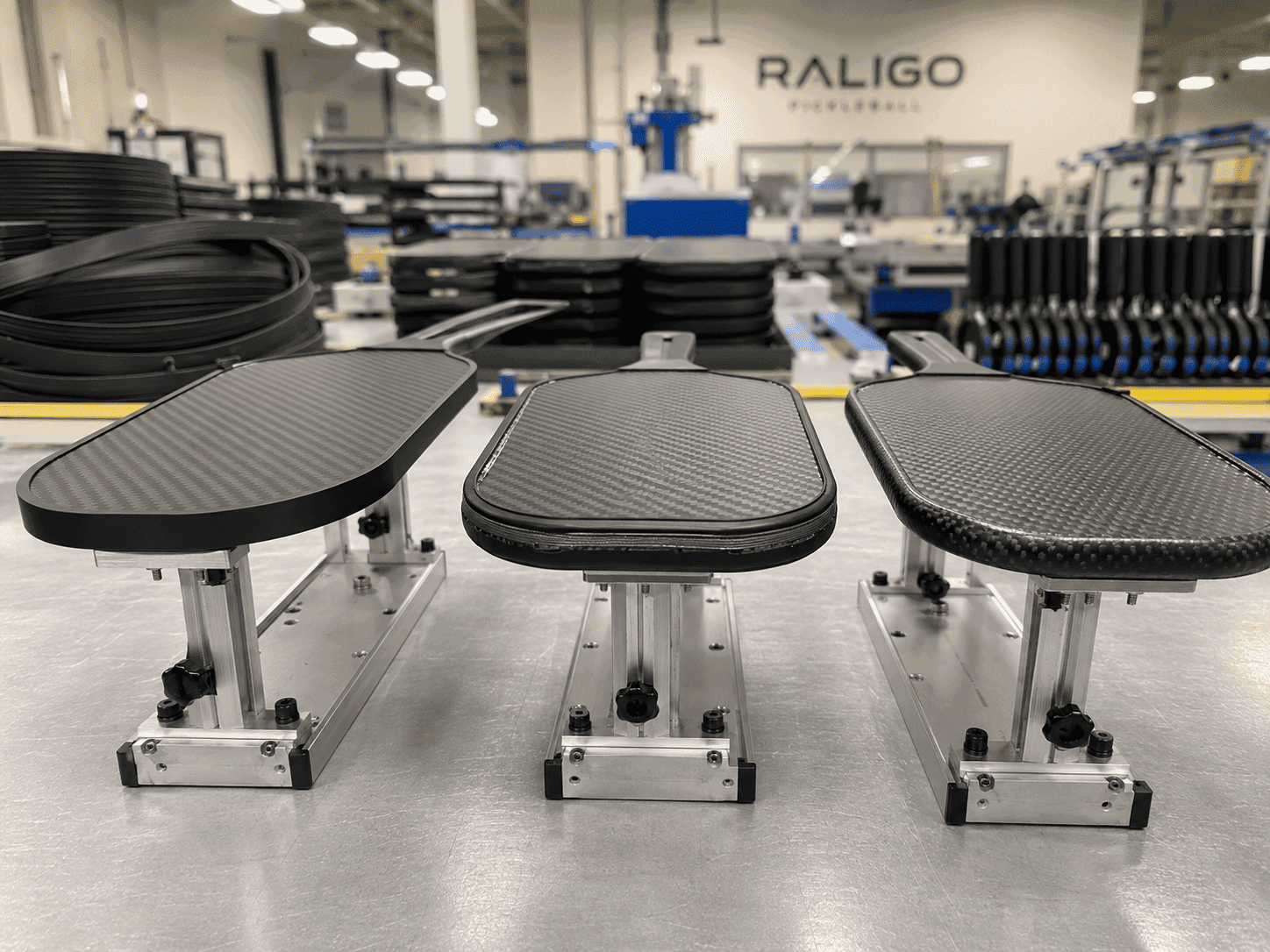
Head-to-Head: Edge Guard Technology Comparison
| Criterion | Fused (Hot-Melt) | Adhesive-Bonded | Thermoformed Unibody |
|---|---|---|---|
| Bond mechanism | Thermoplastic self-fusion | Structural adhesive layer | Carbon fiber matrix continuity |
| Peel strength (N/cm) | 8–15 | 10–20 (epoxy), 6–12 (PU) | 25–40+ |
| Production speed (paddles/hr) | 25–40 | 12–20 | 8–15 |
| Tooling cost (USD) | $3,000–$8,000 | $1,500–$5,000 | $15,000–$40,000 |
| Material compatibility | Thermoplastics with compatible melt temps only | Universal | Carbon fiber prepreg only |
| Warranty return rate (6-month)* | 3–5% | 4–8% | <1% |
| Repairability | Moderate | High | None |
| Typical MOQ | 200+ | 50+ | 500+ |
*Aggregated OEM data, three Guangdong factories, 2024–2025 production batches.
OEM Batch Volume Decision Matrix
Edge guard technology choice isn’t about “which is best.” It’s about which process makes economic sense at your volume. This is the table procurement teams actually use.
100-Unit Batch (Sample / Pre-Launch)
| Technology | Recommendation | Rationale |
|---|---|---|
| Fused | Consider if partner has calibrated line | Operator-dependent; test batch mandatory |
| Adhesive | Recommended | Lowest tooling cost, guard material experimentation possible |
| Thermoformed | Not recommended | Mold cost exceeds batch revenue |
For a 100-unit pre-launch run, adhesive bonding wins on flexibility. Test your guard materials and profiles without committing capital. Nail the engineering before you scale.
Practical note from experience: order 20% extra at this stage. Edge guard QC failure rates spike during process familiarization. You’ll need spares for warranty replacement while your line stabilizes.
500-Unit Batch (Mid-Volume Launch)
| Technology | Recommendation | Rationale |
|---|---|---|
| Fused | Recommended | Per-unit cost drops below adhesive at this volume |
| Adhesive | Acceptable | Manual application bottlenecks throughput |
| Thermoformed | Consider | Mold amortizes at ~400 units for a $20K mold |
This is the inflection point. Fused-edge bonding overtakes adhesive on cost-per-unit. Thermoformed molds start justifying their investment. Most brands launch at 300–500 units — lock in your process choice here.
1000+ Unit Batch (Full Production)
| Technology | Recommendation | Rationale |
|---|---|---|
| Fused | Recommended | Lowest per-unit cost |
| Adhesive | Not recommended | Labor and cure time don’t scale |
| Thermoformed | Recommended | Warranty savings offset mold cost; premium positioning |
At scale, the logic splits cleanly: fused for cost-sensitive lines, thermoformed for premium. Adhesive bonding loses its economic case — manual and semi-automated application doesn’t compress at volume the way the other two processes do.
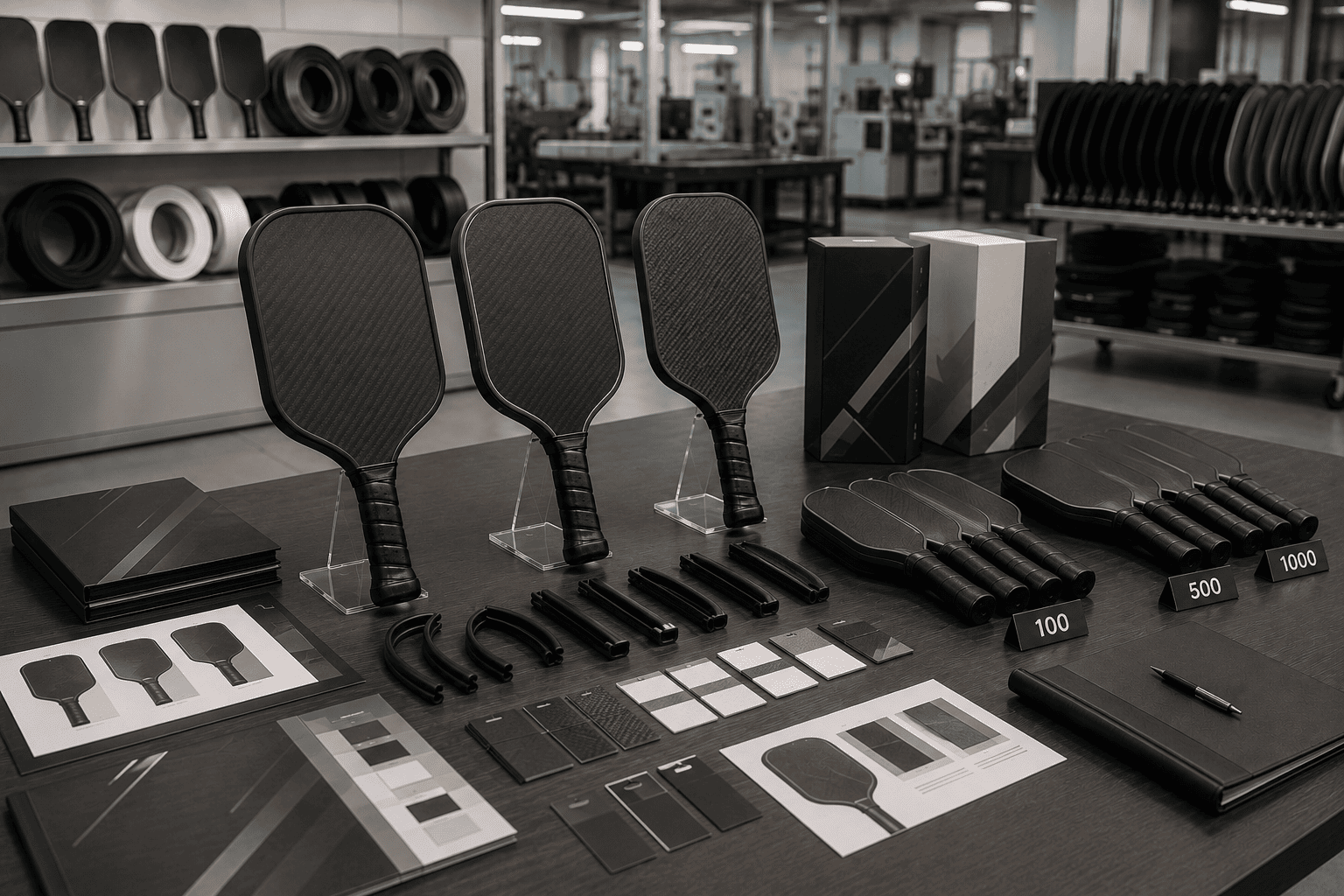
Two Procurement Stories That Went Wrong
Brand A: The Adhesive That Couldn’t Take the Heat
Mid-market brand, 500 paddles, standard two-part epoxy. Factory QC passed — peel tests showed 18 N/cm, cleanly in spec. Six months later, warranty claims hit 11% of the batch.
Root cause: the epoxy’s glass transition temperature was 55°C. Black paddle faces on Florida and Texas outdoor courts in July were hitting above 60°C from direct sun. The bond line softened during play, micro-shifted, cooled in a stressed position. Over weeks, the cumulative damage delaminated edges across the batch.
OEM buyer takeaway: Request the adhesive datasheet. Check the Tg yourself. Minimum 75°C. Frankly, push for 90°C and ask to see thermal cycling test results before approving anything.
Brand B: Right Tech, Wrong Factory
Well-funded startup, thermoformed unibody as their differentiator. Three mold shapes at $22,000 each. Two-thousand-unit initial order. Solid plan on paper.
The problem wasn’t the technology. The factory — experienced with adhesive bonding — had never run thermoforming at production scale. Their 400×300mm platen showed 15°C variation corner-to-corner. Some paddles cured clean. Others showed micro-porosity at the edges where resin hadn’t fully flowed.
They caught it in pre-shipment inspection. Barely. Launch delayed three months while they switched factories.
OEM buyer takeaway: Don’t audit the company. Audit the process. Find a factory that has been running your exact process at your target volume for a minimum of 12 months. Process capability is specific. A shop that does beautiful adhesive bonding might be clueless with a thermoforming press.
What I Actually Check Walking a Production Line
I’ve been in enough factories at this point to know the difference between a controlled edge guard process and one running on operator prayers. Here’s my walkthrough:
Adhesive storage first. If structural adhesive isn’t in a climate-controlled cabinet, I mentally flag the line. These are chemical systems, not magic — they expire, they drink ambient moisture, they underperform when stored wrong.
Press calibration logs second. A fused-edge line without documented temperature checks every two hours is shipping variable quality. I look for the logbook, not the machine spec sheet.
QC station third. Edge peel testing at one sample per 50 units minimum. Less than that, the factory is betting its process control is tighter than it actually is. I’ve never seen a factory win that bet long-term.
Cooling protocol fourth — this is the one that surprises buyers. Edge guards coming off the press and going straight into packaging develop internal stress patterns. I look for cooling jigs. Even simple ones. A defined cooling time. No jigs, no protocol, I downgrade my quality estimate by two notches.
OEM Procurement Edge Guard Verification Checklist
Run through each item with your manufacturing partner before signing a purchase order. If they can’t answer definitively, you have your answer.
| Verification Item | What to Ask | Red Flag Response |
|---|---|---|
| Adhesive/Process Spec | “Send me the technical datasheet for your adhesive or process specification” | “We use standard materials” — no datasheet, no trust |
| Thermal Specification | “What is the Tg or thermal stability rating of your bonding system?” | Below 75°C, or “we haven’t tested for that” |
| Peel Testing | “Show me your QC test method and last month’s results” | Verbal description only, no documentation |
| Climate Control | “Is your bonding/adhesive area climate-controlled?” | “We don’t need it” — especially in >60% humidity regions |
| Cooling Protocol | “What is your post-assembly cooling procedure?” | No defined time, no cooling jigs |
| Warranty Data | “What is your six-month edge guard warranty return rate?” | “Very low” or “we don’t track that” |
| Tooling Validation | “How do you verify temperature/pressure uniformity?” | No validation protocol or data |
| Batch Traceability | “Can you trace each paddle to its batch, shift, and bonding parameters?” | “We don’t batch-track individual paddles” |
What’s Coming in Edge Guard Manufacturing
Two developments I’m tracking closely:
Co-molded TPU rim integration. The edge guard and the edge portion of the face sheet get co-injection molded as a single component, then bonded to the core. It splits the difference — adhesive-bonded flexibility on one side, thermoformed durability on the other. Badminton racket manufacturers adopting this approach are reporting 30–40% fewer edge failures. Pickleball factories are watching.
Vision-guided robotic adhesive dispensing. The biggest variable in adhesive-bonded assembly is the human holding the dispenser. Pattern-recognition dispensing robots — standard in automotive glass bonding for years — are starting to appear in Dongguan and Shenzhen sporting goods factories. Expect 15–20% lower per-unit adhesive consumption and measurable bond consistency improvement once these systems reach 18–24 months of operational maturity.
If you’re evaluating a manufacturing partner today: ask about their co-molding or robotic dispensing roadmap. Even a six-month plan signals the factory is investing in process capability, not coasting on status quo.
—
The edge guard isn’t glamorous. It’s the part that fails first, generates the angriest customer emails, and separates factories that do precision manufacturing from factories that assemble parts. Choose your edge guard technology the way you choose your core material: with data, not assumptions.
Ready to Start Your OEM Project?
Talk to our OEM team about edge guard engineering for your pickleball paddle line. From material selection to batch QC protocols, we help brands get edge integrity right before production starts.