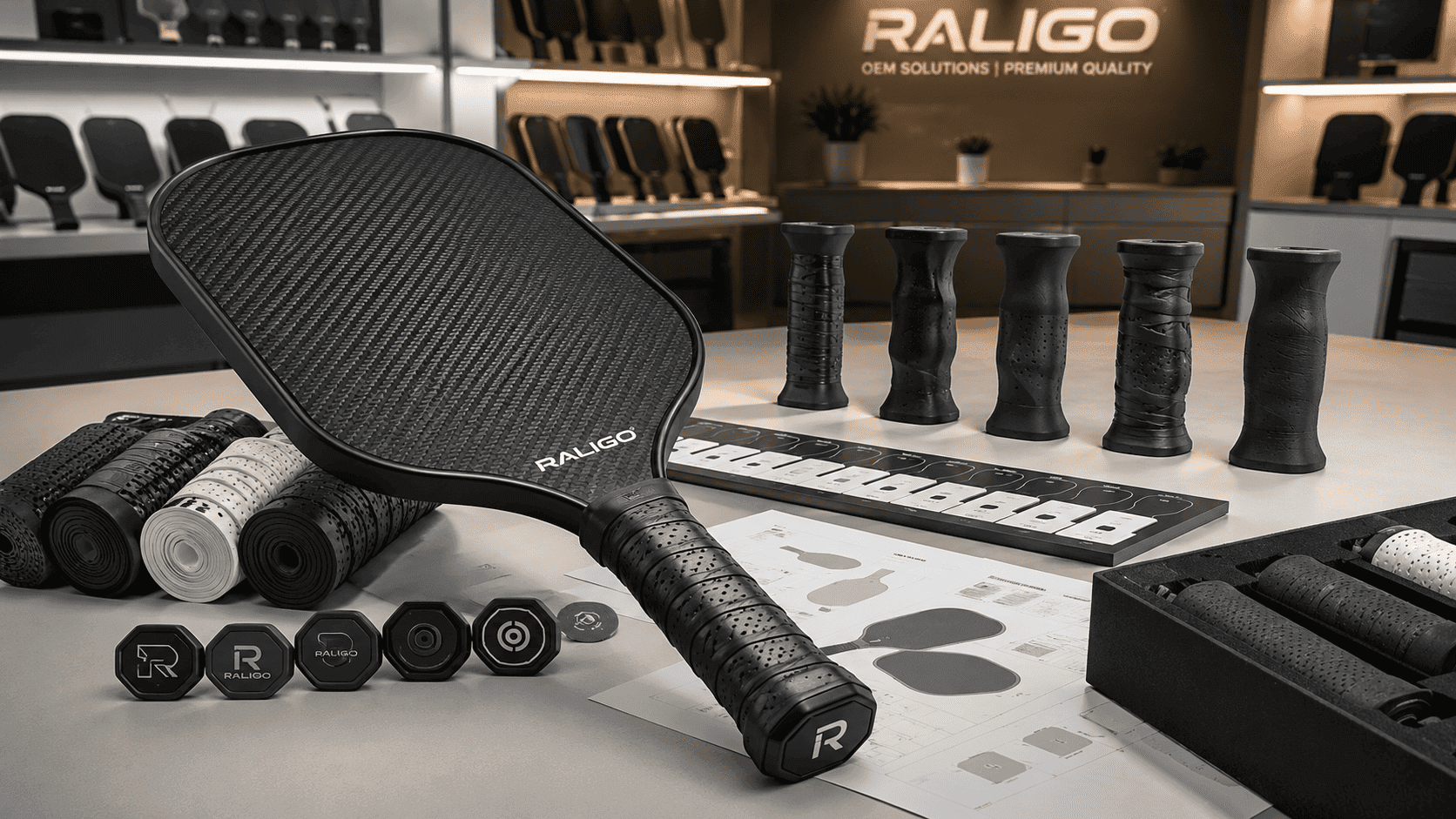
Pickleball Paddle Grip & Handle Ergonomics for OEM Manufacturing
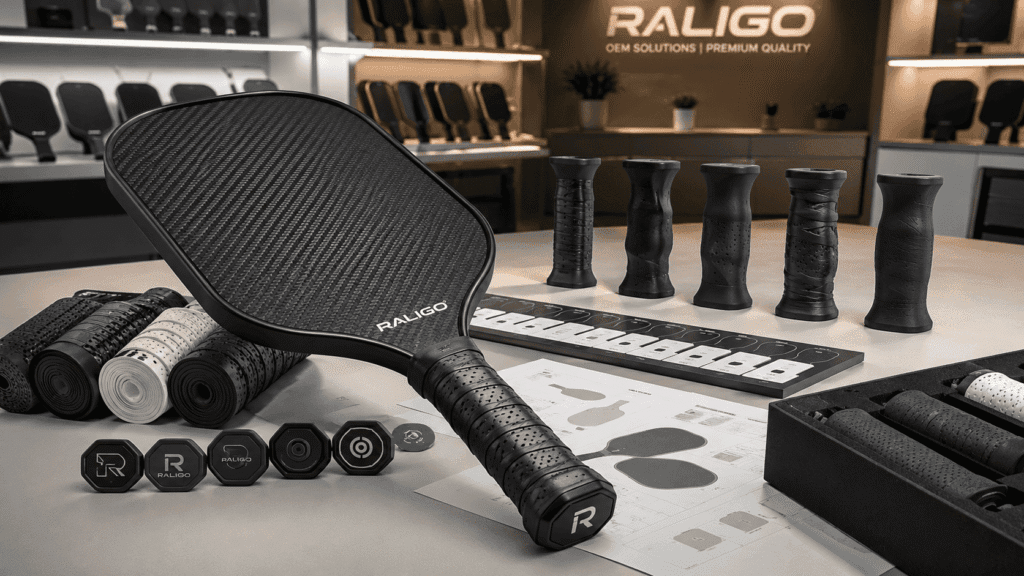
The grip is the only part of the paddle a player touches, and the handle is the only part that transmits force from the arm into the face. Yet when OEM buyers write a specification for custom pickleball paddles, the grip and handle are often the most under-specified components — left to whatever the factory happens to stock. That is a mistake. In carbon fiber paddle manufacturing, the grip and handle determine comfort, control, shock transmission, and how the paddle feels in the hand over a long match.
This guide breaks down the grip and handle engineering decisions that matter when ordering custom pickleball paddles from a factory. It is written for brand owners, product developers, and procurement managers who need to translate on-court feel into manufacturing specifications.
1. Grip Material: PU Leather, Real Leather, and Textured Overgrips
The grip material sits between the player’s hand and the handle, and it controls friction, moisture management, and durability. Three options dominate the market: PU synthetic leather, real leather, and textile overgrips laid over a base grip.
| Grip Material | Feel | Durability | Best For |
|---|---|---|---|
| PU synthetic leather | Soft, tacky | Good | All-round players, value pricing |
| Real leather | Firm, premium | Excellent | Control-focused, longer use |
| Textured overgrip | Thin, high friction | Moderate | Players who replace grips often |
For OEM manufacturing, PU grip tape is the workhorse because it balances cost and feel. But a growing number of European and North American brands are spec’ing real leather for a premium line, or shipping paddles with an extra overgrip in the box. The factory needs to know which construction you want because it changes the material sourcing and the final weight of the paddle.
2. Handle Shape: Round, Octagonal, and Everything Between
Handle shape is not cosmetic — it changes how the paddle sits in the hand and how firmly the player can control rotation and angle at the net. The two dominant profiles are round and octagonal.
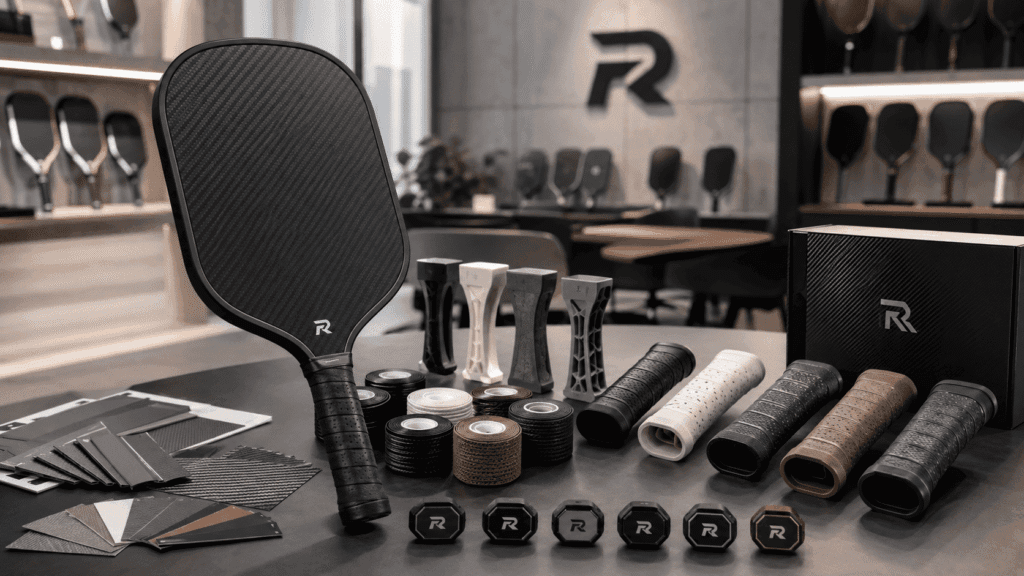
An octagonal handle gives flat surfaces for the fingers to key into, improving grip stability during drives and dinks. A round handle distributes pressure more evenly and suits players who shift their grip frequently. Some factories offer a hybrid profile that blends the two. When you specify handle shape, you are effectively locking in a feel that players will notice immediately.
3. Handle Length and Circumference: The Numbers That Matter
Handle length and circumference determine reach, two-handed backhand comfort, and how the paddle balances. Standard handles run roughly 4 to 5 inches in length with a circumference around 4 to 4.5 inches, but these vary by brand and player preference.
| Handle Dimension | Typical Range | Effect on Play |
|---|---|---|
| Length | 4 – 5 in | Reach, two-handed backhand leverage |
| Circumference | 4 – 4.5 in | Comfort, grip lock, wrist control |
| Perimeter shape | Round / Octagonal | Stability, grip transitions |
For OEM buyers, specifying handle length and circumference in the purchase order is as important as specifying total weight. A paddle that is perfectly balanced on paper but has a handle that is too short or too thick will feel wrong in play, and players do not buy paddles that feel wrong.
4. Shock Absorption: Damping the Vibration Carbon Fiber Transmits
Carbon fiber paddle faces are stiff, and stiffness transmits vibration to the hand on off-center hits. Shock absorption is the engineering answer. Factories manage it through the grip construction, an inner damping layer, or a specially shaped handle core.
The most common approach is a gel or foam insert inside the handle that decouples the player’s hand from the sharp vibration of the face. This is a real specification, not marketing: the density and thickness of the damping material measurably change the feel of a paddle. For players with joint sensitivity, a well-damped handle is the difference between an enjoyable match and hand fatigue.
5. Specifying Grip and Handle in the OEM Purchase Order
Getting the grip and handle right starts with a clear purchase order. Below is the specification block a custom paddle buyer should include alongside core density and face construction.
| Specification | What to Specify | Why It Matters |
|---|---|---|
| Grip material | PU / leather / overgrip | Feel, moisture, durability |
| Handle shape | Round / Octagonal / Hybrid | Control, comfort |
| Handle length | Inches | Reach, two-handed play |
| Handle circumference | Inches | Grip lock, wrist control |
| Damping | Insert thickness/density | Vibration reduction |
When you specify grip material and handle shape explicitly, the factory can quote accurately and build to a consistent standard. When you leave it blank, you get whatever is on the shelf — and your players will feel the difference even if the total weight matches your spec sheet.
6. Quality Control for Grip and Handle at the Factory
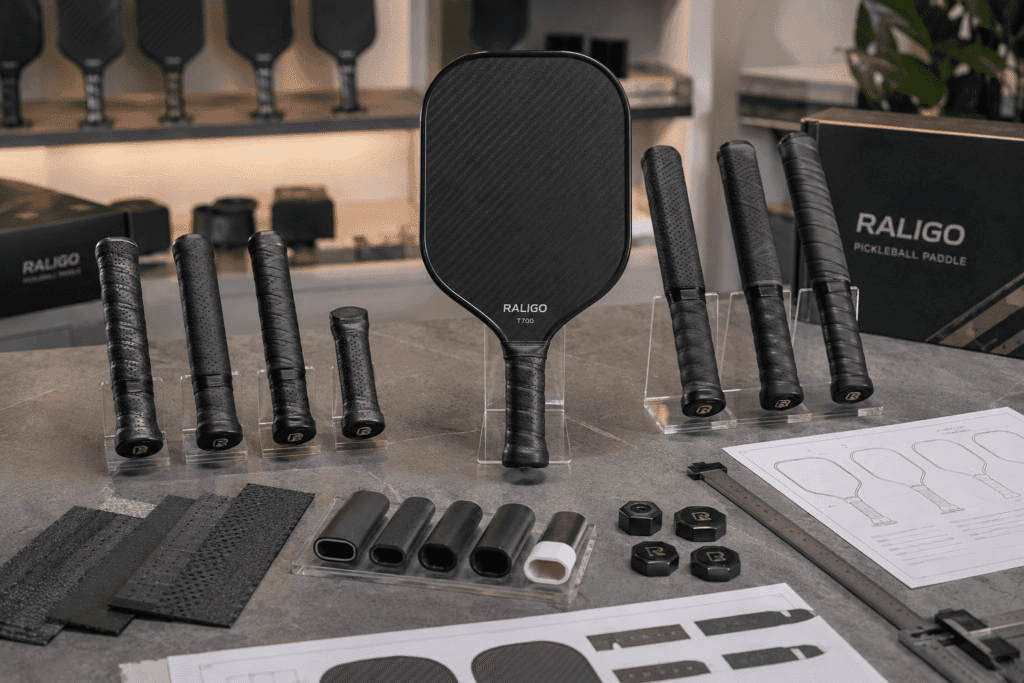
Grip and handle issues are among the most common findings in factory pre-shipment inspections. Common defects include imperfectly applied grip tape, inconsistent handle circumference, and damping inserts that shift during assembly. A pre-shipment inspection or an incoming QC check should verify handle dimensions, grip adhesion, and damping integrity.
For custom paddle manufacturing, a sample review before full production lets the buyer confirm the feel before committing to thousands of units. The cost of a few sample paddles is trivial compared with the cost of shipping a container of paddles that feel wrong in the hand.
7. Final Specification Checklist for Grip and Handle
Before your custom pickleball paddle order goes into production, confirm every grip and handle decision is written down.
- [ ] Choose grip material and confirm moisture-handling behavior
- [ ] Lock handle shape (round, octagonal, or hybrid)
- [ ] Specify handle length and circumference in the purchase order
- [ ] Decide on shock absorption insert thickness and density
- [ ] Request pre-production samples to confirm on-court feel
- [ ] Include grip and handle checks in the pre-shipment inspection
- [ ] Confirm the grip contributes to total paddle weight as specified
The grip and handle are the interface between the player and the paddle’s carbon fiber face. Get the ergonomics right and the paddle performs as designed; get them wrong and no amount of core density tuning can save the feel.
Frequently Asked Questions
What grip material should I specify for a premium OEM pickleball paddle?
For a premium line, European and North American brands are increasingly spec’ing real leather for a firmer, control-focused feel, or shipping a textured overgrip in the box. PU synthetic leather remains the workhorse for value pricing because it balances cost, tack, and durability — but tell the factory which construction you want, since it changes material sourcing and final paddle weight.
Does handle shape actually affect paddle performance?
Yes. An octagonal handle gives flat surfaces for the fingers to key into, improving grip stability during drives and dinks, while a round handle distributes pressure more evenly and suits players who shift their grip frequently. Locking in handle shape in the purchase order locks in a feel players notice immediately.
What handle dimensions should an OEM buyer specify?
Standard handles run roughly 4 to 5 inches in length with a circumference around 4 to 4.5 inches. Length determines reach and two-handed backhand leverage; circumference affects grip lock and wrist control. Specify both in inches on the purchase order rather than leaving them to factory stock.
Why does grip contribute to total paddle weight?
Grip tape, padding, and any shock-absorption insert all add measurable weight that shifts the paddle’s balance point. Confirm in the purchase order that the assembled grip contributes to the total paddle weight as specified, so on-court feel matches the spec sheet.
Ready to Get Started?
Talk to our OEM team about your pickleball paddle manufacturing needs. From spec development to bulk production, we handle it all at our ISO-compliant factory.