Michigan has 2,110 pickleball courts across 502 locations — ninth most in the United States. It also has winter temperatures that drop below 0°F with the Great Lakes dumping lake-effect snow measured in feet, not inches. When a paddle sits in a Detroit trunk at -10°F or endures freezing drizzle on a Grand Rapids outdoor court, the materials inside don’t just get stiff. They cross their glass-transition thresholds and start cracking at the cellular level. For a B2B brand buyer sourcing paddles for the Michigan and Upper Midwest market, cold-weather core performance isn’t a premium feature. It’s the difference between a product line that survives winter and one that generates a return pile by February.
Most OEM factories in Asia test paddles at workshop ambient — 72°F, 50% humidity. The deflection numbers look perfect. The acoustic tap test sounds clean. That paddle ships to a distributor in Ann Arbor, gets sold to a club in Traverse City, and by mid-January the core has stiffened into something closer to a cutting board than a paddle. The face develops hairline cracks from repeated cold-to-warm cycling between the car and the indoor court. Customer reviews shift from five stars to “feels dead after two months.” Chargebacks follow.
This guide covers what procurement teams need to know before they place an OEM order destined for Michigan, the Great Lakes region, or any market where the thermometer stays below freezing for three months straight. We’re walking through the material physics of cold-weather paddle failure, the core material trade-offs that matter in sub-zero conditions, manufacturing adjustments that prevent cold embrittlement, and the supplier qualification checklist that separates climate-ready factories from the rest.
1. The Michigan Climate Problem: Cold as an Accelerated Degradation Chamber
Atomic Answer: Michigan’s winter climate — average lows of 14-22°F from December through February, lake-effect moisture exceeding 100 inches of annual snowfall in western regions, and daily temperature swings of 30°F or more between heated indoor storage and outdoor play — subjects pickleball paddle materials to repeated thermal shock cycles that cold-pressed, standard-adhesive paddles were never designed to survive.
Michigan isn’t just cold. It’s cold and wet in ways that combine into a particularly brutal material-testing environment. The Great Lakes — Superior, Michigan, and Huron — act as thermal reservoirs that moderate coastal temperatures but pump moisture into the air. Lake-effect snow bands off Lake Michigan regularly drop 12-24 inches in a single event on communities from Holland to Petoskey. The Upper Peninsula snowbelt, fed by Lake Superior, averages over 200 inches annually in some locations.
What this means for a paddle isn’t just the ambient temperature reading. It’s the moisture cycling, the freeze-thaw cycles, and the rapid thermal transitions between heated indoor courts (65-72°F) and outdoor/sub-zero car storage. A paddle pulled from a warm gym bag and used on a 25°F outdoor court goes through a 40°F-plus thermal shock in under five minutes. Carbon fiber faces and polypropylene cores expand and contract at radically different rates under this delta. The adhesive layer between them — already stiffened from the cold — absorbs shear stress it wasn’t rated for.
The industry consensus from paddle manufacturers and material engineers places the performance threshold at 50°F (10°C). Below that, polypropylene core stiffness increases measurably and carbon fiber face sheets begin losing elasticity. Below 40°F (4°C), material embrittlement becomes a structural concern. Below 25°F (-4°C), the risk of permanent core damage from a single hard impact jumps dramatically. Michigan’s average winter temperatures spend roughly 90 days below the 40°F threshold and 30-45 days below 25°F, depending on the region. For a paddle played year-round — and Michigan’s dedicated player base does play year-round — that’s 25% of the calendar year in the structural risk zone.
| Michigan Region | Avg Dec-Feb Low | Annual Snowfall | Days Below 32°F | Lake Effect Risk |
|---|---|---|---|---|
| Southeast (Detroit, Ann Arbor) | 18-22°F | 40-45″ | 110-120 | Low |
| West (Grand Rapids, Kalamazoo) | 16-20°F | 75-100″ | 120-130 | High |
| Northern Lower (Traverse City, Petoskey) | 12-18°F | 120-180″ | 130-150 | Very High |
| Upper Peninsula (Marquette, Houghton) | 5-12°F | 180-250″+ | 150-170 | Extreme |
Thompson Pickleball, based in Boyne City, Michigan, builds paddles specifically engineered for these conditions. Their 515 series uses Toray T1100 raw carbon fiber — a grade with 40% higher tensile strength than T700 — coupled with a patent-pending TrueFeel urethane sidewall that replaces traditional edge-guard construction with a vibration-absorbing structural frame. That’s not marketing. It’s a materials response to the reality that a paddle built in Michigan has to survive Michigan winters.
2. Cold Weather Physics: What Freezing Temperatures Do to Paddle Materials
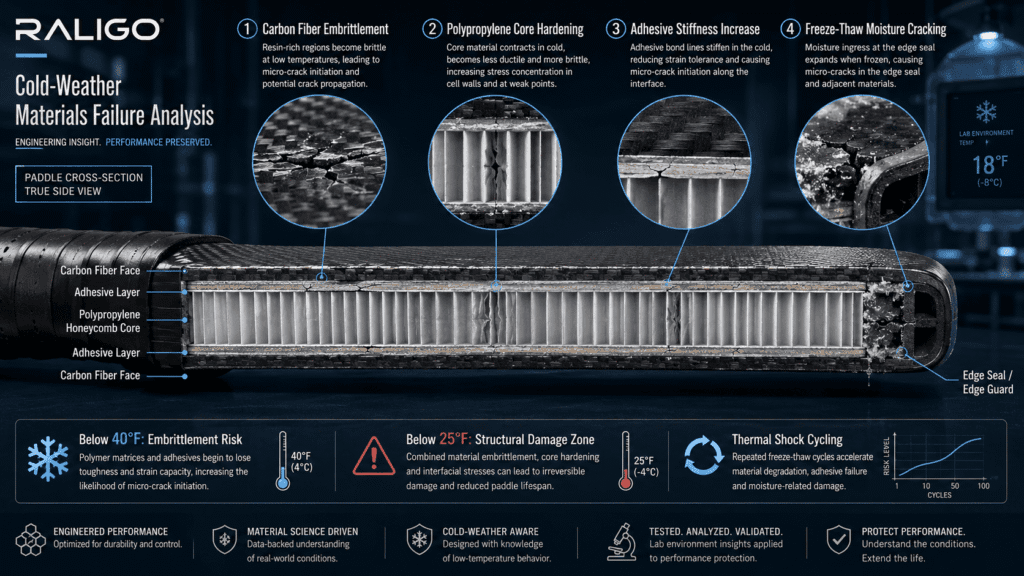
Atomic Answer: Cold temperatures attack pickleball paddles through four simultaneous mechanisms: carbon fiber embrittlement below 45°F, polypropylene core contraction and hardening, adhesive stiffness increase that reduces peel strength by 40-60%, and moisture freeze-thaw cycling that propagates micro-cracks in edge seals and bonding interfaces. Together, these pathways can permanently degrade a non-cold-rated paddle in a single Michigan winter season.
2.1 Carbon Fiber Face: Stiffness Gain, Toughness Loss
Carbon fiber-reinforced polymer faces rely on an epoxy matrix to transfer load between fibers and provide impact toughness. That epoxy matrix has a glass transition temperature (Tg). Standard thermoset epoxy systems used in paddle manufacturing typically show Tg values between 130-160°F — well above ambient. But the onset of mechanical property changes begins long before Tg is reached. At 45°F and below, the epoxy matrix enters a regime where its storage modulus increases (stiffness goes up) while its loss modulus drops (energy dissipation goes down).
Translation for non-engineers: the face gets harder but less able to absorb the shock of ball impact without transmitting it into the core. Players feel this as a “dead” or “boardy” sensation — the paddle stops flexing and starts vibrating. More critically for durability, reduced matrix toughness means reduced crack resistance. A shot that would have been absorbed without damage at 72°F can initiate micro-cracking at 25°F simply because the epoxy can’t dissipate the energy fast enough.
T1100 carbon fiber, used in Thompson’s Michigan-built paddles, mitigates this indirectly. Because T1100’s higher tensile modulus means less fiber strain per unit load, the epoxy matrix is stressed less during impact — even when cold. The fiber does more of the work, and the cold-stiffened matrix does less. It’s not a cold-proof solution, but it shifts the failure threshold downward by a measurable margin.
2.2 The Core: Where Cold Does the Most Invisible Damage
The polypropylene honeycomb core is the structural heart of a modern pickleball paddle. At room temperature, PP cell walls are compliant — they compress under ball impact, storing and returning energy in a controlled way. This is what gives a paddle its “feel” and its sweet spot characteristics.
At 40°F, polypropylene’s elastic modulus climbs roughly 30-40% above its 72°F baseline. The cell walls become stiffer and less capable of elastic recovery. At 20°F, the modulus increase approaches 60-70%, and the material’s elongation-at-break drops significantly. Cell walls that would buckle and spring back at room temperature instead develop permanent deformation — the beginning of core crush.
The core also contracts physically. A standard 16mm core loses roughly 0.1-0.2mm of thickness through pure thermal contraction when going from 72°F to 15°F. That doesn’t sound like much, but it’s distributed across thousands of cell walls, each now under slightly different tension than it was when bonded to the face sheet. This differential contraction creates localized stress concentrations at the adhesive interface — particularly at the paddle perimeter where thermal gradients are steepest during warm-up.
2.3 Adhesives: The Weakest Link Gets Weaker
Every layer inside a paddle — face to core, edge guard to body, handle to frame — depends on adhesive bonds. Cold temperatures stiffen these adhesives, reducing their ability to distribute stress through plastic deformation. A polyurethane adhesive that elongates 200% at room temperature might elongate only 30-40% at 15°F. When the face and core contract at different rates — carbon fiber barely moves, polypropylene shrinks significantly — the adhesive can’t stretch to accommodate the displacement. It tears.
Moisture makes this worse. Water molecules that infiltrated the bond line during warmer months freeze at sub-32°F temperatures, expanding by approximately 9% in volume. This expansion applies hydrostatic pressure at the bond interface. Repeated freeze-thaw cycles — and Michigan gets 40-60 of these per winter — progressively wedge the bond apart through a mechanism materials engineers call ice-wedging delamination. It’s the same process that cracks asphalt roads, operating at the microscopic level inside your paddle.
3. Core Material Showdown: Polypropylene vs Nomex vs Hybrid in Sub-Zero Conditions
Atomic Answer: Polypropylene honeycomb cores maintain more consistent mechanical properties through the 15-40°F cold range than Nomex cores, which undergo a sharper ductile-to-brittle transition and can lose 40-50% of their effective bounce below 32°F. For Michigan’s winter playing conditions, polypropylene with a minimum 80kg/m³ density and cell diameter of 8mm or less is the baseline recommendation for any brand targeting the Great Lakes market.
| Property | Polypropylene (PP) | Nomex (Aramid) | Hybrid (PP + Elastomer) |
|---|---|---|---|
| Cold stiffness increase (72°F → 20°F) | +40-60% modulus | +70-100% modulus | +30-45% modulus |
| Brittleness threshold | ~10-15°F | ~25-32°F | ~0-10°F |
| Moisture absorption (72h at 90% RH) | 1.5-3% weight gain | 4-8% weight gain | 2-4% weight gain |
| Freeze-thaw cycle tolerance | Good | Poor — stiffens and loses bounce | Good to Very Good |
| Sound profile at 20°F | Muted, slightly higher pitch | Sharp, “cracky” — audible dead-spot detection | Muted, close to room-temp profile |
| OEM cost per core (relative) | $ (baseline) | $$ (+30-50%) | $$$ (+50-80%) |
| Michigan winter recommendation | ✅ Recommended (≥80kg/m³) | ⚠️ Not recommended below 32°F | ✅ Premium choice |
Nomex cores have a long history in pickleball — they were the original high-performance core material. Aramid honeycomb (Nomex is DuPont’s brand name) offers excellent strength-to-weight ratio and heat resistance. That heat resistance is exactly why Nomex is used in aerospace applications. The problem for Michigan players is the other end of the thermometer. Nomex’s aramid paper substrate absorbs atmospheric moisture far more readily than polypropylene — 4-8% weight gain in humid conditions versus 1.5-3% for PP. That absorbed moisture freezes at sub-32°F temperatures, and frozen Nomex cell walls are brittle. The core loses its elastic recovery. Players describe Nomex paddles in winter as “losing all touch” and “feeling like hitting with a piece of plywood.”
Polypropylene cores, by contrast, maintain usable mechanical properties well below freezing. The polymer’s glass transition temperature sits around -4°F to 14°F depending on the specific PP grade — meaning true structural embrittlement doesn’t occur until temperatures most Michigan players have already abandoned the outdoor court for. A quality 80kg/m³ PP core with 8mm cell diameter will feel stiffer at 25°F than at 72°F, but it won’t shatter or permanently deform under normal play impact.
Hybrid cores — polypropylene honeycomb infused or co-molded with elastomeric additives like thermoplastic polyurethane (TPU) or ethylene-vinyl acetate (EVA) — represent the emerging premium tier for cold-climate paddles. The elastomer component remains flexible at lower temperatures than pure PP, functionally lowering the core’s effective brittleness threshold by 10-15°F. The trade-off is cost: hybrid core paddles typically add 50-80% to the core material cost, which translates to a $3-5 per-unit increase at OEM volumes. For a brand selling into Traverse City or Marquette where winter playing is a point of local pride, that premium pays for itself in avoided returns.
4. OEM Manufacturing Solutions for Cold-Climate Paddle Performance
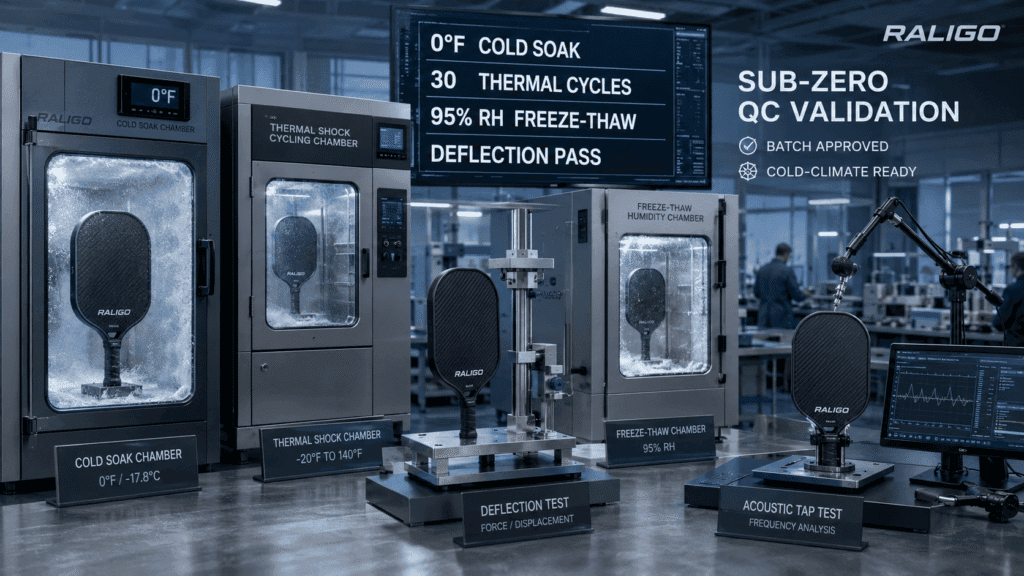
Atomic Answer: Three manufacturing interventions separate cold-climate-rated paddles from standard builds: core density control with tighter-than-standard tolerances (±2kg/m³ instead of ±5kg/m³), cold-resistant additive packages in the adhesive and edge-seal systems, and sub-zero QC protocols that validate structural integrity after thermal cycling to 0°F. Factories that don’t offer these should not be supplying paddles to brands targeting Michigan.
4.1 Core Density Control: Tighter Tolerances for Cold Consistency
Standard OEM polypropylene honeycomb cores are specified with density tolerances of ±5kg/m³. For a nominal 80kg/m³ core, that means actual density anywhere from 75 to 85kg/m³ across a production batch. In warm climates, this variation is mostly cosmetic — a slightly lighter paddle, a slightly softer feel. In cold conditions, density variation directly controls cold stiffness. The 75kg/m³ core stiffens significantly more at 20°F than the 85kg/m³ one because thinner cell walls have less thermal mass and reach equilibrium faster.
Cold-climate sourcing demands tighter core density specs: ±2kg/m³ maximum. This requires the factory to implement in-line density measurement — not post-production sampling — using automated weighing stations that reject out-of-tolerance core sheets before they’re bonded into paddles. The equipment cost is modest (a few thousand dollars in sensors and automation), but it requires a factory culture that prioritizes process control over throughput. Most don’t. The ones that do are the ones worth partnering with for Michigan-bound product lines.
4.2 Cold-Resistant Additives: The Chemistry That Keeps Paddles Alive
Adhesive formulation is the single highest-leverage intervention for cold-climate durability. Standard single-component polyurethane adhesives lose 40-60% of their peel strength at 20°F versus room temperature. Cold-formulated alternatives — two-component epoxy systems with plasticizer additives, or modified acrylates engineered for low-temperature flexibility — retain 75-85% of room-temperature peel strength at the same 20°F baseline.
Edge seal compounds also benefit from cold-rated formulation. Silicone-based edge seals remain flexible below 0°F where standard hot-melt edge guard adhesives have already crystallized and lost adhesion. For edgeless paddle designs — increasingly popular in the Michigan market following Thompson’s lead — the perimeter bond between face sheet and core becomes the moisture barrier. A failed edge bond in an edgeless paddle isn’t cosmetic. It’s an open pathway for moisture infiltration directly into the honeycomb.
Some advanced OEMs have begun incorporating nucleation agents into the polypropylene core material itself. These additives control PP crystallization during the extrusion process, producing a finer, more uniform crystal structure that exhibits less abrupt changes in mechanical properties through the 10-40°F temperature range. The improvement is incremental — a 10-15% reduction in cold stiffness variation — but in a market where players can feel the difference, incremental is competitive advantage.
4.3 Cold-Weather QC: Testing That Simulates a Michigan January
The standard USAPA deflection test happens at ambient temperature. For a Michigan-bound paddle, that test is insufficient. Cold-climate QC requires a three-stage validation protocol:
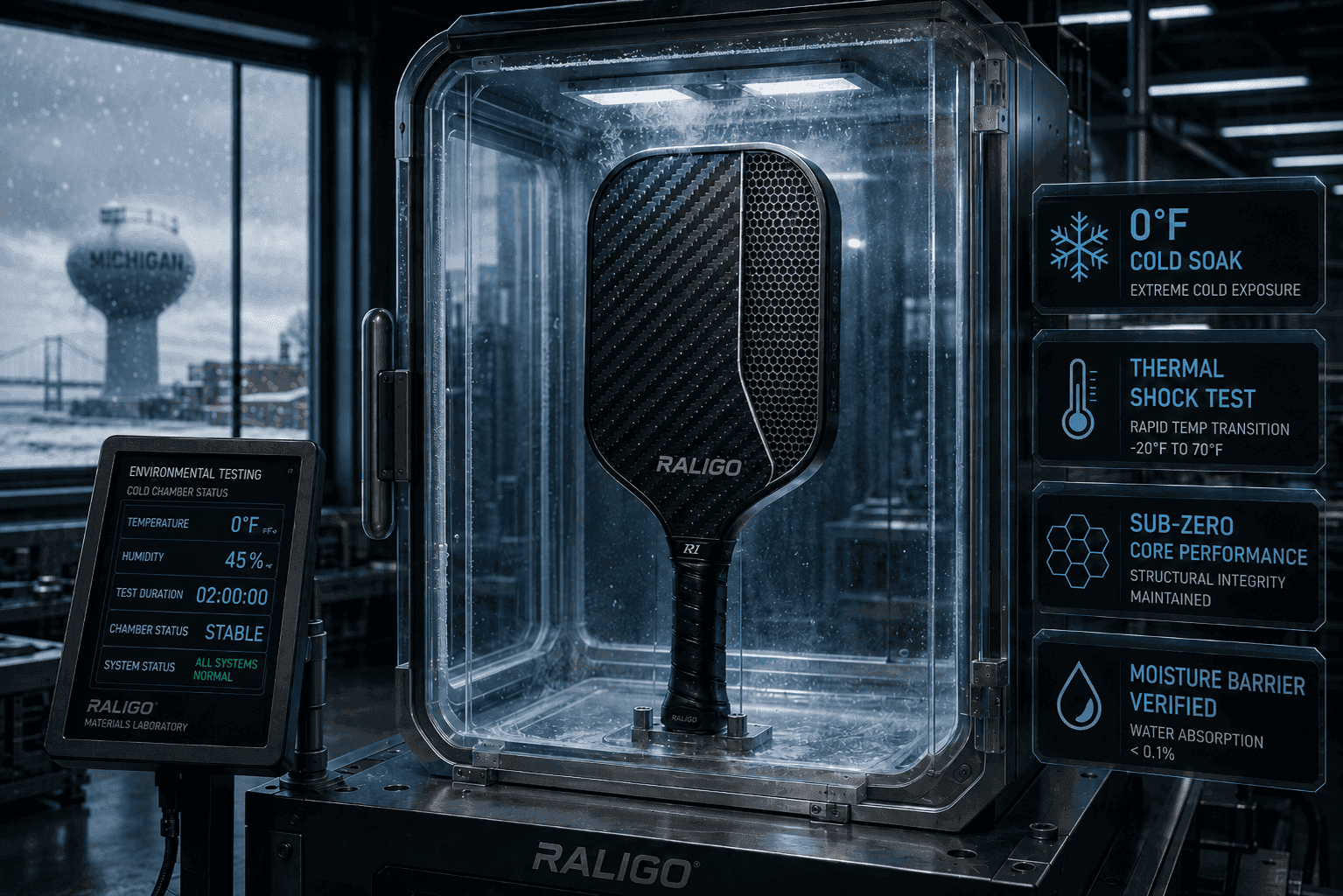
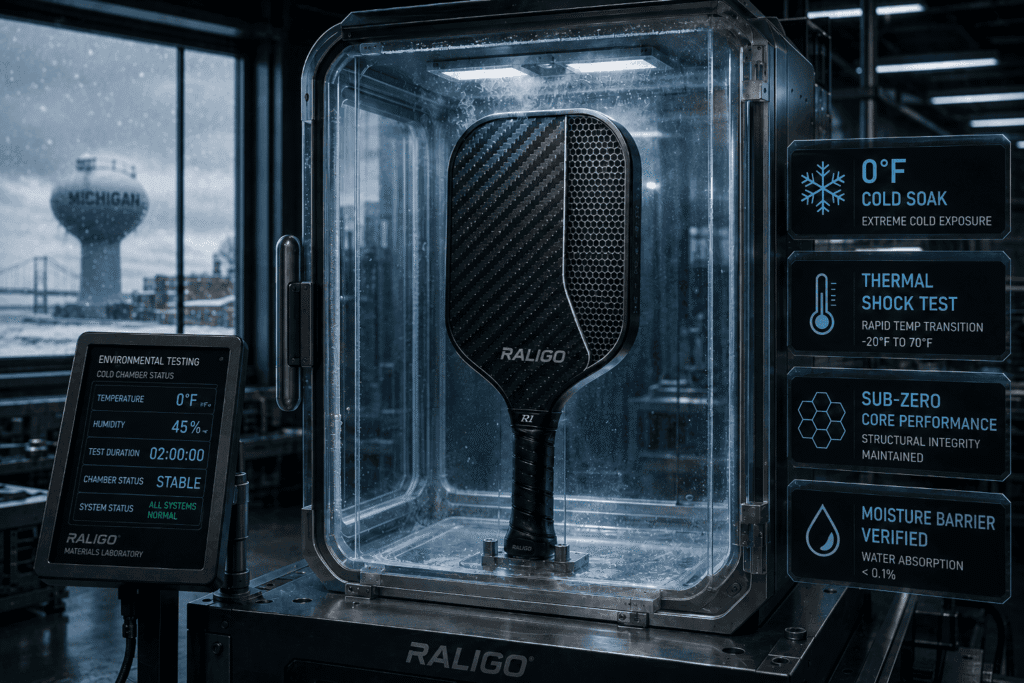
Stage 1 — Cold Soak Deflection: Condition paddles at 0°F (-18°C) for 4 hours minimum, then immediately measure deflection at that temperature. Acceptable range: within 5 points of room-temperature deflection. Larger deviations indicate the core material or adhesive system has crossed a mechanical threshold that will produce inconsistent playing characteristics in winter conditions.
Stage 2 — Thermal Shock Cycling: Cycle paddles through 0°F → 72°F → 0°F for 30 full cycles, 30-minute dwell at each extreme. Post-cycle tap-test and deflection measurement. Paddles showing acoustic change (indicating bond-line separation) or deflection shifts exceeding 3 points fail the batch. This simulates approximately one Michigan winter season of car-to-court thermal transitions.
Stage 3 — Freeze-Thaw Moisture Test: Expose paddles to 95% relative humidity at 40°F for 48 hours (simulating lake-effect condensation), then freeze to -10°F for 12 hours. Thaw to room temperature. Repeat for 5 cycles. Post-test acoustic inspection and peel-strength coupon testing on batch samples. Weight gain exceeding 2% or any evidence of delamination fails the lot.
These three tests add approximately $0.50-0.80 to per-unit cost amortized across a production run. The cost of a batch that fails in the field because nobody ran these protocols: 15-20% return rate across a Michigan distributor’s winter season.
5. B2B Procurement Checklist: Qualifying Your OEM for Michigan and Cold-Climate Markets
Atomic Answer: Before placing a purchase order for paddles destined for Michigan, the Upper Midwest, or any market with sustained sub-freezing temperatures, B2B buyers should demand six specific technical documents from the factory: core density certification with tolerance band, adhesive Tg and low-temperature peel strength data, carbon fiber grade mill certificate, cold-soak deflection test results, freeze-thaw cycle validation report, and edge-seal moisture barrier specification. A factory that cannot produce all six is not qualified to supply cold-climate inventory.
| Document Required | What It Proves | Red Flag If Missing |
|---|---|---|
| 1. Core density certification (±2kg/m³) | Consistent cold-weather mechanical properties across the batch | Wide density variation → unpredictable cold stiffness |
| 2. Adhesive Tg and low-temp peel data | Bond line survives sub-freezing thermal cycling | No cold-temp data → assume standard adhesive rated for ambient only |
| 3. Carbon fiber grade mill certificate | Face material meets spec — T700, T1100, or equivalent | “Carbon fiber” without grade → likely cosmetic-weave fiberglass hybrid |
| 4. Cold-soak deflection test (0°F, 4hr) | Paddle maintains structural compliance at playing temperature | No deflection data below ambient → paddle wasn’t designed for cold |
| 5. Freeze-thaw cycle validation (30+ cycles) | Paddle survives one full winter of thermal transitions | No thermal cycling data → assume delamination will develop in field |
| 6. Edge-seal moisture barrier specification | Core protected from lake-effect moisture infiltration | No edge-seal spec → moisture will enter honeycomb via perimeter gaps |
Beyond the documentation, there are factory-floor indicators that separate cold-climate-capable OEMs from the rest. Visit the factory if you can. Look for environmental chambers on the QC floor — if they don’t own a chamber that can hold 0°F, they’ve never tested a paddle at Michigan winter temperatures. Ask about their PP core supplier relationship: factories that buy generic honeycomb from spot-market suppliers can’t control density tolerances the way a factory with a dedicated supply agreement can. Check the adhesive inventory: if they use a single adhesive system for every order from Arizona to Minnesota, they’re not formulating for climate.
One more procurement reality check: cold-climate paddles cost more to build, and they should cost more to buy. If a factory quotes you the same per-unit price for a Michigan-spec paddle as a standard build, they’re cutting corners somewhere — probably on adhesive formulation or QC protocols, because those are the easiest to hide. A legitimate cold-climate specification adds $2-4 per unit at volumes of 1,000+. Pay it. The alternative is processing returns from Ann Arbor in February.
6. The Michigan Market Opportunity: Why This Matters for Your Brand
Atomic Answer: Michigan ranks 9th nationally in pickleball infrastructure with 2,110 courts across 502 locations and a dedicated player base that plays outdoors year-round. The state’s homegrown brand, Thompson Pickleball, has proven that cold-climate engineering — T1100 carbon fiber, urethane sidewall technology, US-based manufacturing — commands premium positioning ($249/paddle retail) and generates brand loyalty that geography-focused competitors can’t easily replicate. For OEM-sourcing brands, Michigan represents a market where product performance in real conditions creates durable competitive advantage.
Michigan’s pickleball market isn’t just large — it’s uniquely demanding. Unlike Florida or Arizona, where climate is a degradation accelerator you engineer against, Michigan’s climate is a selection filter. Players here learn within one winter which paddles survive and which don’t. That knowledge spreads through clubs, leagues, and the tight-knit community that forms around indoor facilities from November through March, when outdoor play is limited but recreational demand peaks indoors.
A brand that ships a paddle into Grand Rapids that cracks after two months of winter play doesn’t just lose that customer. It loses the Tuesday night league, the Saturday morning drop-in group, and the pro shop that stocked the paddle on the recommendation of club regulars. Cold-weather durability is a word-of-mouth multiplier in Michigan in a way that’s hard to overstate.
At Raligo Sport, every paddle manufactured for distribution into cold-climate markets is built to specifications we publish and audit. Core density: 80kg/m³ minimum, ±2kg/m³ tolerance. Adhesive system: two-component epoxy with low-temperature plasticizer package, cold-rated to -20°F. QC protocol: cold-soak, thermal-shock cycling, and freeze-thaw moisture testing on every production batch before container loading. We know where our paddles are going — Michigan, Minnesota, Wisconsin, upstate New York, the Canadian border states — and we build accordingly.
If you’re sourcing paddles for the Michigan market, get the technical data sheets. Demand the cold-weather QC reports. Ask about the adhesive formulation temperature rating. If your factory hesitates on any of these, find one that doesn’t. Your Michigan distributors will know the difference by February. So will their customers.
Frequently Asked Questions
What temperature is too cold to use a pickleball paddle?
Paddle performance begins to change noticeably below 50°F (10°C), with polypropylene cores stiffening and carbon fiber faces losing elasticity. Below 40°F (4°C), material embrittlement becomes a structural concern. Below 25°F (-4°C), the risk of permanent core damage from a single hard impact increases significantly. Michigan winter temperatures routinely spend 90+ days below the 40°F threshold, making cold-rated construction essential for year-round players.
Polypropylene vs Nomex core: which is better for cold weather pickleball?
Polypropylene cores are significantly better for cold-weather play. Nomex cores absorb more moisture (4-8% weight gain in humidity vs 1.5-3% for PP), stiffen more aggressively below 32°F (70-100% modulus increase vs 40-60% for PP), and undergo a sharper ductile-to-brittle transition that effectively destroys touch and bounce in sub-freezing conditions. For Michigan’s winter climate, polypropylene with a minimum 80kg/m³ core density is the recommended baseline.
How do B2B brands verify their OEM supplier builds cold-weather-ready paddles?
Brand buyers should request six technical documents from their OEM: core density certification with ±2kg/m³ tolerance, adhesive low-temperature peel strength data, carbon fiber grade mill certificate, cold-soak deflection test results at 0°F, freeze-thaw cycle validation covering 30+ thermal transitions, and edge-seal moisture barrier specification. A factory that cannot produce all six documents is not qualified to supply paddles for Michigan or cold-climate markets.