
The Supplier You Don’t Vet Is the Unit Cost You Didn’t See Coming
When a brand signs with the wrong pickleball paddle supplier, the failure rarely shows up at the sample stage. It shows up twelve weeks later, in a container of paddles that fail core density tolerance, delaminate after a month on court, or arrive with a surface grit that doesn’t survive a USAPA approval test — all from a supplier who looked identical on paper to the one down the street. A pickleball paddle supplier for brands is not picked by price sheet. It is picked by verified factory capability, a documented quality-control system, and a trail of evidence that survives a factory audit.
This guide is not about which paddle to buy. It is the supplier selection and vetting checklist I walk my own OEM buyers through before a single mold is cut — the factory floor questions, the three-gate QC chain, the sampling workflow, the compliance paperwork, and the tells that separate a real manufacturer from a trading company wearing a factory’s logo.
—
The Factory Capability Audit: What to Verify Before You Pay a Deposit
An honest supplier selection process starts by verifying what the factory can physically do, not what its brochure claims. A paddle is a laminate of carbon fiber face sheets over a polymer core with an edge guard, and each layer maps to a specific machine and a specific skill. If the equipment or the skill is missing, the paddle quality is compromised somewhere — usually in a place the spec sheet doesn’t mention.
The Five Processes a Real Carbon Fiber Paddle Factory Must Run
– Carbon fiber molding. Wet layup is not enough. A brand-spec paddle needs controlled fiber orientation, precise resin content, and consistent pressure. Ask whether the face sheets are thermoformed or cold-pressed, and which prepreg system the factory runs. “Thermoformed” on a quote means nothing until you see the heated platen press and the curing cycle it actually uses.
– Hot-press consolidation. Uniform laminate thickness across the face sheet — usually held to a manufacturing tolerance in the tenths of a millimeter — comes from a press with controlled temperature and pressure, not from hand rolling. Ask for the press tonnage and the platen count, and match it against claimed monthly capacity.
– CNC routing. The paddle’s outline, weight holes in the core, and edge geometry are cut on CNC. A factory hand-cutting blanks cannot hold the edge symmetry a modern paddle needs, and it cannot reproduce your exact outline across thousands of units.
– Surface coating and texture line. Peel-ply texture, spray coating for grit, and any anti-abrasion finish are a dedicated line, with sprayed-on texture that has to be applied in a dust-controlled environment to hold grit consistency. Ask how the factory keeps grit particle density uniform batch to batch — if the answer is “we spray it by hand,” keep looking.
– Edge guard and assembly line. Whether injection-molded TPU or extruded guard, the edge guard is bonded around a shaped core and face, and this step determines both impact durability and the paddle’s final weight and swing profile. A supplier that outsources edge guards is fine — as long as they say so and you audit the sub-supplier too.
The tell that matters most: a supplier that cannot name its press tonnage, resin system, and CNC capability on the first call is almost certainly not the manufacturer. Real factories answer these in their sleep.
—
How to Separate a Real Factory from a Trading Company
This is the single most common question brands get wrong, and it is the reason so many “suppliers” turn out to be traders marking up a factory they have never set foot in. A pickleball paddle supplier for brands should be auditable all the way to the production floor.
The verification trail that separates them:
| Check | Real Factory | Trader / Middleman |
|---|---|---|
| **Business license scope** | Manufacturing in registered scope | Trading or export only |
| **Factory visit** | Will show you the actual production line on video or in person | Deflects, reschedules, or shows photos that are clearly stock |
| **In-process questions** | Can discuss cure cycle, core density targets, tooling in detail | Pivots to price, MOQ, and “we can source it” |
| **Sample timeline** | Samples come from their own mold and line, with a spec trace | Samples are bought from a third party, often with a long lead time |
| **Audit response** | Welcomes a third-party factory audit (SGS, BV, TÜV) | Resists, or offers a “video tour” that shows no machines running |
| **MOQ & tooling** | Tooling is quoted against their own mold inventory | Tooling is a pass-through line item with no engineering owner |
The cleanest single test: ask to see the factory’s own production line live, and ask who owns the mold for your exact paddle. A trader cannot produce either. If your brand is buying at volume — not commissioning a single SKU — the differentiator is not price, it’s whether the supplier can be audited all the way to the floor.
—
The Three-Gate Quality Control System Every Brand Should Demand
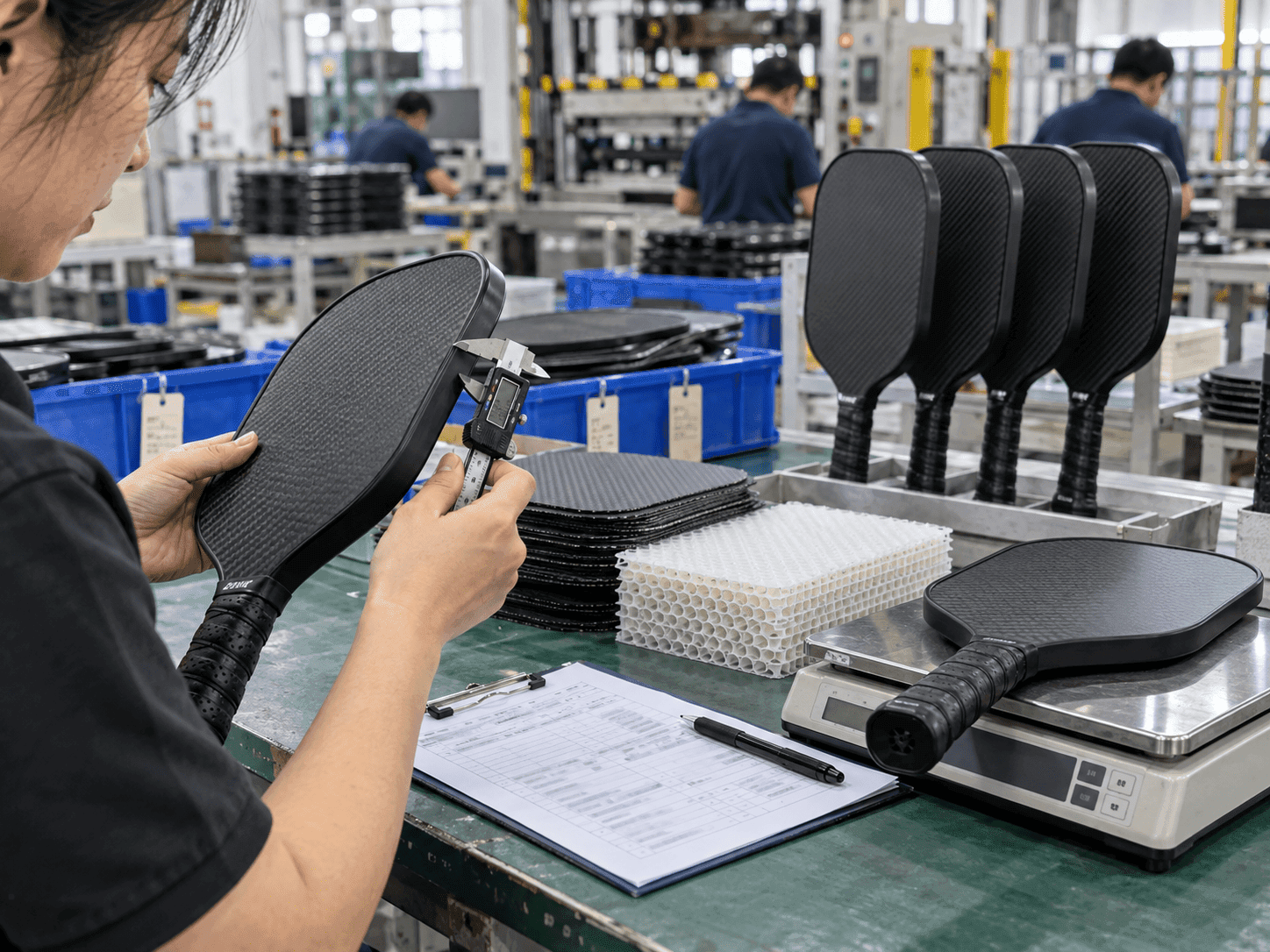
“Quality control” is the most abused phrase in the sourcing conversation. Almost every factory claims it. Very few can walk you through a documented, three-gate QC chain that produces traceable records per batch. When I vet suppliers, I don’t ask “do you have QC?” I ask them to describe the incoming, in-process, and outgoing gates and show me the paperwork from a recent batch.
– Gate 1 — Incoming material inspection. Carbon fiber prepreg, core sheets, and edge-guard material are checked against spec before they touch the line. This means verifying resin content and prepreg age, core density and thickness against the target, and material certificates from the raw supplier. A factory that skips incoming inspection is letting material variance — especially core density drift — flow straight into finished paddles.
– Gate 2 — In-process control. At each critical step — molding/pressing, CNC cutting, edge bonding — the line checks weight, thickness, and visual defects against the control spec. This is where a real factory catches dimensional drift before it becomes a full batch of rejects. Ask what the in-process sampling frequency is: a factory that checks every X units versus one that checks “occasionally” is the difference between a 1% defect rate and a 5% one.
– Gate 3 — Outgoing final inspection. Finished paddles are checked for weight balance, surface finish, grit consistency, and dimensional conformance, with batch records and a binding acceptance standard (typically AQL-based sampling). This is also where the factory should provide the QC report format you’ll receive with every shipment — if they can’t show you a sample outgoing report up front, they don’t really have one.
Here’s the practical bar: a supplier that can produce a dated QC record for its last three production batches, with the same format you’ll get on your order, is legitimate. One that asks you to “trust the process” is not.
—
Core Density and Paddle Performance: The Numbers That Prove a Supplier
Most supplier conversations stay at the surface — weight, color, price. The suppliers worth your brand mandate dig into the numbers that actually govern paddle performance, and the two that matter most are core density and the laminate consistency that holds paddle performance stable across units.
Core density is the single most informative spec you can demand in a supplier vet. The core — whether polymer honeycomb or foam — sets the paddle’s feel, power, and its weight, and a supplier that cannot hold core density to a tight tolerance will ship you paddles that play differently from unit to unit. In manufacturing terms, a core density spec of (for example) 80 kg/m³ with a tolerance of ±3 kg/m³ is a much stronger signal of control than a flatter “medium feel” description.
The reason this matters for supplier selection specifically: core density drift is invisible on a spec sheet but immediately felt on court, and it is almost always a function of incoming material control and press discipline — the two things a weak supplier skips. When I evaluate a factory, I use core density tolerance as a proxy for the whole operation. A supplier that holds core density tight almost certainly holds everything else tight too. Ask for the core density target and tolerance on the exact construction you’re quoting, and ask how they measure it. Carbon fiber and manufacturing discipline are the two words that should come up in the answer.
—
The Sampling and Pre-Production Workflow: Never Skip This Step
The gap between a supplier’s claimed capability and its actual output is closed by samples — but only if you run the sampling workflow the right way. A brand that signs a bulk order off a single cosmetic sample is doing the supplier’s verification for them, with their own money.
A sound sampling ladder:
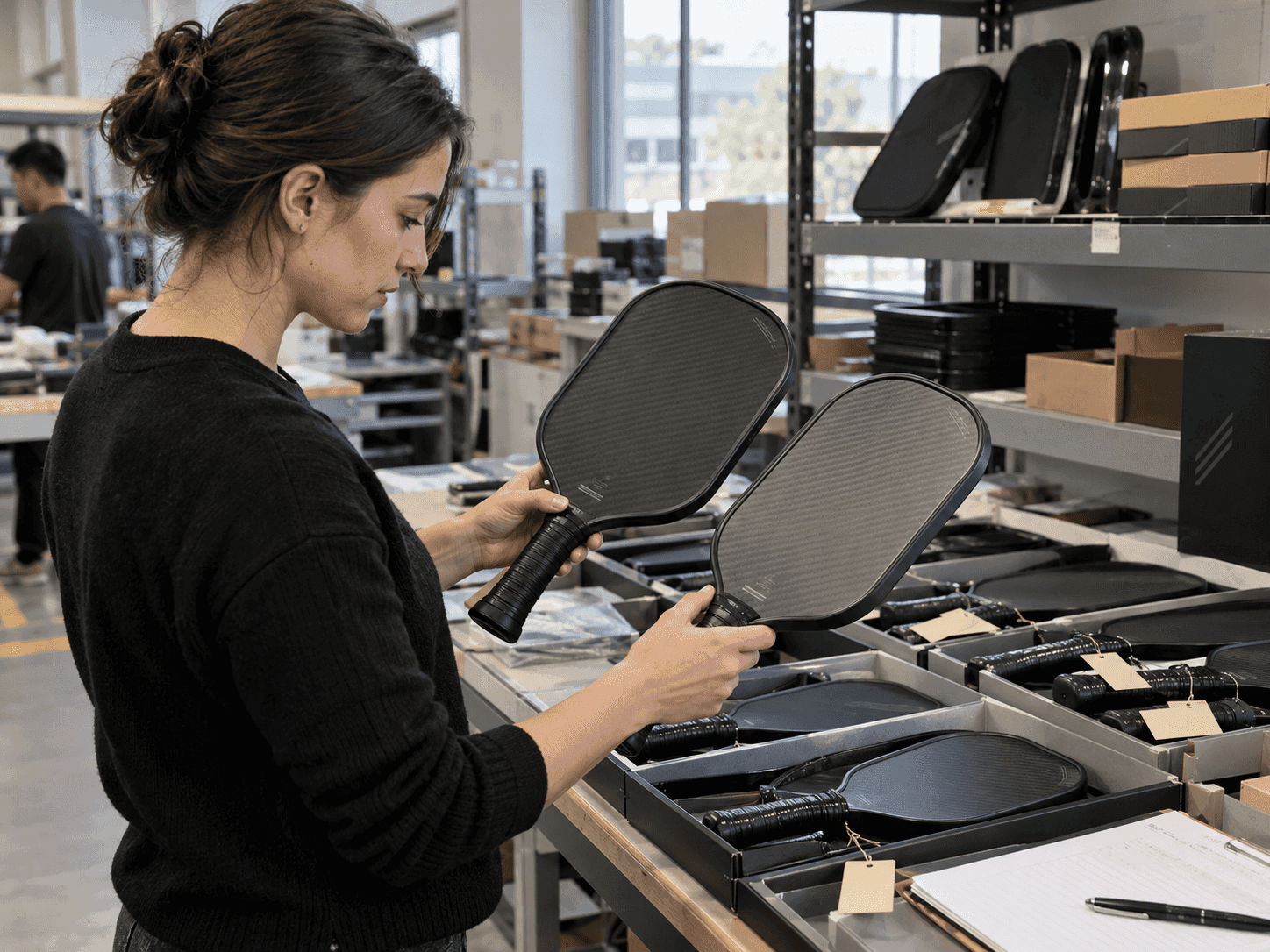
1. Pre-production sample (1–5 units). Confirm the construction, the surface finish, and the feel. This validates that the supplier can build your spec, not just show you a nice photo. Pay the sample fee — it is the cheapest due diligence you will ever buy.
2. Golden sample. The approved reference unit you both sign off on. Every future batch is measured against this, not against a verbal description. If a supplier won’t commit to a spec-locked golden sample, walk away.
3. Pilot run (50–200 units). Validate consistency across a real batch — core density uniformity, weight balance distribution, grit consistency. This is where you catch the variance a single sample hides.
4. Bulk sign-off against AQL. Final acceptance against an agreed sampling standard, with the batch QC report format you reviewed at Gate 3.
The non-negotiable: your spec must be documented, and every stage — sample, golden, pilot — must reference the same spec. A supplier that resists locking the spec is planning to use the word “similar” against you later.
—
Compliance and Certification: The Paperwork You Verify, Not Assume
A pickleball paddle supplier for brands has to prove compliance in three different directions, and “we can get the cert” is not proof. The certifications have to exist, be current, and be traceable to the actual product you are buying.
– USAPA / USA Pickleball approval. If you sell into the US market, the paddle construction must meet USAPA’s material and surface constraints. Require the approved model documentation and confirm that your exact construction — not just the factory’s catalog model — is covered. A factory that has USAPA-listed paddles is common; a factory that can get your construction approved is the value.
– REACH (EU). For the European market, the materials — resin system, edge guard, coatings — must comply with REACH substance restrictions. Ask for the REACH declaration and the specific materials it covers.
– RoHS. Restricted substances in electrical and electronic content, but relevant here for any embedded electronics or specific additive materials; confirm RoHS compliance applies to your component set where required.
– ISO factory credentials. An ISO 9001 (quality management) certificate is table stakes; ask whether it is current and whether it actually covers the paddle production line, not just the company’s trading arm.
The rule of thumb: request the certificate, check the issue date and the scope, and match the product on the certificate to the product you’re quoting. A supplier that hands you a certification PDF with a different product or an expired date is telling you exactly how much their paperwork is worth.
—
Lead Time, Capacity, and Elasticity: Can They Actually Deliver?
Verification does not end at “can they build it.” It ends at “can they deliver it, on time, and absorb your growth.” Two supplier traits separate a launch from a disaster here: real capacity, and elasticity when your demand spikes.
– Real capacity vs. claimed capacity. Match monthly output claims against the machines you saw in the audit. A factory claiming 50,000 paddles a month with two small presses is claiming something its floor cannot support. Press quantity, line count, and shift structure are the honest capacity numbers.
– Lead time structure. A credible supplier quotes lead time as a ladder — sample, pilot, bulk — each with its own clock. A supplier that quotes one flat “30-45 days” for everything is telling you they have not thought about it.
– Changeover elasticity. Your brand will reorder, change a color, or add a SKU. Ask how the factory handles mid-year changeovers and reorders without triggering a full MOQ again. If you are still shortlisting factories, run every candidate through the seven-point selection checklist we use at the wholesale level. Elasticity here is the difference between a supplier and a long-term manufacturing partner.
The test: after the audit, ask the supplier to commit a dated production schedule for your specific order — not a generic timeline. A real factory will put milestones against your SKUs. A trader will send you another price sheet.
—
What a Supplier Vetting Scorecard Actually Looks Like
Distilling the whole process into a single pass: rate each candidate on the dimensions below, and don’t sign until the critical ones clear.
– Factory authenticity — verifiable manufacturing license, own molds, real production line. (Critical — a fail here disqualifies the supplier regardless of price.)
– Process capability — carbon fiber molding, hot press, CNC, coating, edge assembly all present and demonstrable.
– QC system — documented three-gate chain with dated batch records and an AQL acceptance standard.
– Spec discipline — core density target and tolerance agreed and measurable.
– Compliance — current USAPA/REACH/RoHS certificates traceable to your exact construction.
– Sampling rigor — golden sample and pilot run written into the agreement.
– Delivery elasticity — real capacity, structured lead time, and changeover flexibility.
The final advice is blunt: pick your pickleball paddle supplier for brands the way you’d pick any manufacturing partner — on evidence you can audit, not on a brochure and a good first quote. The brands that skip this walk into the same container-of-regrets story. The ones that vet it never write that story twice.
—
Ready to Vet Your Next Supplier?
Talk to our OEM team about your pickleball paddle manufacturing needs. We’ll walk you through our carbon fiber line, three-gate QC, and compliance documentation — and show you the audit trail before you commit a dollar.