OEM Bulk Customization for E-commerce and Channel Buyers: What Actually Determines Your Cost and Timeline
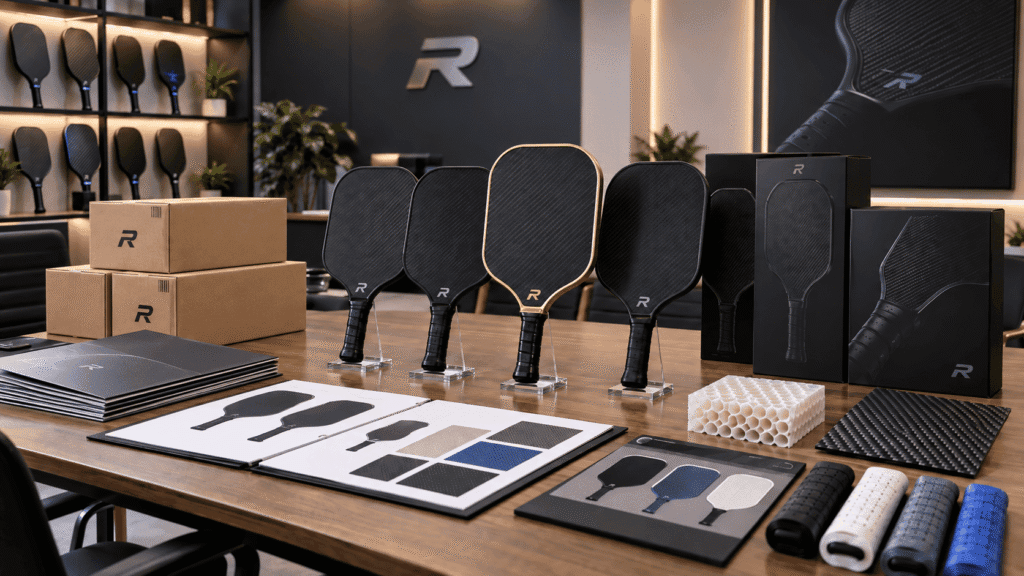
If you sell paddles online or distribute them into clubs, gyms, and retail accounts, the single largest lever on your gross margin is not your ad spend — it is whether you buy finished paddles from a trading company or build them with an OEM pickleball paddle manufacturer. The difference between those two paths is typically the difference between a 25% and a 55% gross margin, and it comes down to four controllable variables: MOQ structure, tooling ownership, lead time discipline, and batch consistency. This guide walks through how channel buyers actually structure a bulk custom program, with the numbers, the stage gates, and the contractual terms that separate a clean program from an expensive one.
Layer 1 answer capsule
A channel buyer sourcing custom pickleball paddles should expect a realistic entry MOQ of 300–500 pieces for a private-label design using an existing mold, 1,000–3,000 pieces for a fully custom shape with new tooling, and a production timeline of 8–14 weeks from purchase order to sailing date depending on tooling status, sample iterations, and whether the face is pad-printed or in-mold graphic. Anything marketed as “100 units, any design, no tooling fee” is usually a trading company reselling a stock model with a sticker on it.
Why Channel Brands Source Directly From the Factory Instead of Reselling Stock
Direct factory sourcing changes your unit economics, your product differentiation, and your legal exposure at the same time. A reseller buys a finished SKU at a wholesale price that already contains the factory’s margin, the trading company’s margin, and often a further layer from a domestic wholesaler. A channel brand that goes direct removes two of those three layers and gains control over core density specification, edge guard durometer, face texture, and packaging — the exact variables that drive review scores and repeat purchase rate on Amazon, Shopify, and Walmart Marketplace.
The margin math, honestly stated. A finished carbon fiber paddle that lands at roughly $38–52 FOB from a direct OEM factory in a 500-piece run is commonly resold to a channel buyer at $58–72 by a trading intermediary. That gap is not markup for nothing — a good trading company adds consolidation, English-language project management, and payment-risk absorption. But once your annual volume clears roughly 2,000–3,000 units, you are paying more for that service than it costs to buy directly with a factory that has its own export desk.
Differentiation is the second reason. Stock paddles that every reseller can buy create a price race to the bottom. When you control the mold, you control the shape, the thickness profile, the core cell size, and the graphic. That is the only durable answer to a marketplace where twenty listings share the same supplier.
Performance consistency is the third, and the one most buyers learn last. At Raligo our factory runs incoming core density checks on every PP honeycomb lot, because core density drift of even 0.5 lb/ft³ across a production run reads as a “different paddle” in the customer’s hand and lands you a one-star review that no funnel optimization can fix.
Channel takeaway: Move direct when your annual volume supports roughly one 500-piece run per quarter. Below that, a trading partner’s consolidation service is genuinely cheaper than the fixed cost of managing an overseas supply chain yourself.
OEM vs ODM vs White Label: Three Paths and Where Each One Breaks
The three sourcing models are not tiers of the same thing — they carry different tooling ownership, different IP positions, and different speeds to market. Choosing wrong is the most expensive early mistake a channel brand makes.
| Dimension | OEM (Full Custom) | ODM (Factory Design) | White Label |
|---|---|---|---|
| Who owns the design | You (or you commission it) | Factory, licensed to you | Factory |
| Tooling / mold ownership | Yours, paid via NRE | Factory’s; you pay no tooling | Factory’s |
| Shape exclusivity | Exclusive to you | Shared unless you buy exclusivity | Usually shared |
| Typical entry MOQ | 500–3,000 (mold-dependent) | 300–1,000 | 100–300 |
| Sampling time | 3–6 weeks (multiple iterations) | 1–3 weeks | 1–2 weeks |
| Best-fit buyer | Established brand, 5,000+ units/yr | Brand testing a category | New seller validating demand |
| Main risk | Tooling spend before revenue | Limited differentiation | Zero differentiation, price war |
Layer 2 note on the terminology trap: many suppliers advertise “OEM” while actually offering white label. The test is simple — ask who owns the mold and whether the shape can be sold to another brand. If the answer is “the factory, and yes,” you are buying white label at an OEM price.
Channel takeaway: White label is a demand-validation tool, not a brand strategy. Set a hard cap of one or two seasons on it; every month you stay, you are financing a competitor’s market research.
The Real Structure of Paddle MOQ (And Why the Number Exists)
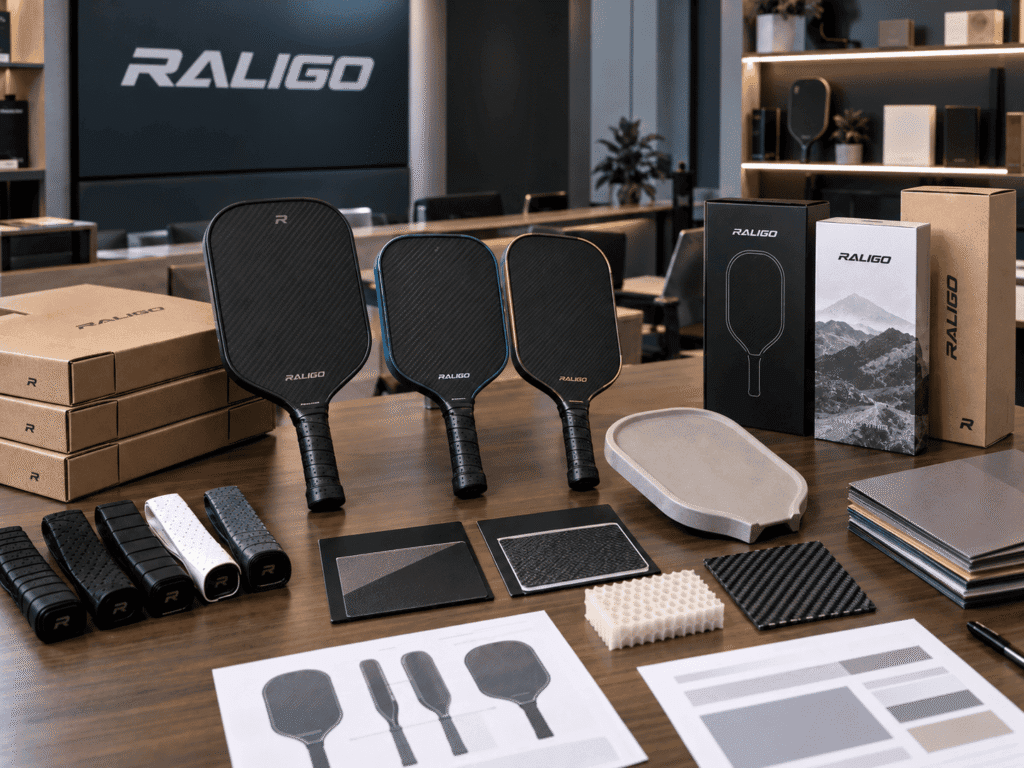
MOQ is not a factory preference — it is the amortization math of tooling and line changeover. Once you decompose it, you can negotiate the components instead of arguing about one number.
| MOQ layer | Typical entry threshold | What drives the number | Negotiability |
|---|---|---|---|
| Paddle total MOQ (existing mold) | 300–500 pcs | Raw material minimums (prepreg roll, core sheet lot) | Medium |
| New mold / shape MOQ | 1,000–3,000 pcs | Mold amortization over NRE; realistically ~$2,000–$6,000 per cavity set | Low on total, high on terms |
| Per-SKU MOQ (thickness/grip variant) | 100–300 pcs | Line changeover and separate QC lot | Medium |
| Per-colorway MOQ | 100–200 pcs | Edge guard injection color purge, printing plate/dye setup | Medium-high |
| Packaging MOQ | 500–1,000 boxes | Print setup, die-cut tooling, minimum board run | High, if you accept a common stock box |
| Logo method MOQ | 100 pcs (pad print), 300+ (in-mold) | Plate cost vs film/tooling | High for pad print |
Paddle performance sits at the intersection of these layers: core density sets the base feel, the mold sets the geometry, and the branding method either preserves or locally disrupts the face texture you paid to engineer. Where the money actually sits. Two cost centers dominate: mold steel and line changeover. A production line that switches from a 16 mm to a 13 mm profile must re-fixture, re-verify thermoforming temperature setpoints, and run first-article inspection — typically 4–8 hours of dead output. That is why a 3,000-piece single-SKU order prices materially lower per unit than three 1,000-piece colorway variants of the same shape. Successful manufacturing planning here is less about squeezing the factory and more about giving it longer uninterrupted runs.
Negotiation levers that work: consolidate colorways into one SKU with a mixed packaging insert; accept the factory’s existing 16 mm mold for your first run and save custom tooling for the second; buy the packaging tooling outright so the box MOQ drops to a print-run minimum rather than a die minimum.
Channel takeaway: Always ask for a line-item quote showing tooling, per-SKU setup, and packaging setup separately. A single blended “unit price at MOQ” hides where your flexibility is.
From Inquiry to Sailing Date: The Bulk Customization Timeline
A realistic bulk program runs 8–14 weeks. Here is the stage-gate breakdown, with the weeks where schedules actually slip.
| Stage | Typical duration | Deliverable | Common slip |
|---|---|---|---|
| 1. RFQ & spec alignment | 3–7 days | Costed quote, MOQ options, spec sheet | Vague spec — buyer sends “like Selkirk but cheaper” |
| 2. Tooling & artwork release | 1–2 weeks (existing mold: 0) | CAD approval, print file approval | Pantone not specified; logo file in raster |
| 3. Sampling / prototype | 2–4 weeks | Physical sample, spec measurement report | Weight and balance off; requires re-sample |
| 4. Sample approval (PPS) | 3–7 days | Signed golden sample, locked BOM | Buyer changes grip or thickness after approval |
| 5. Deposit & material pull | 3–7 days | PO confirmed, prepreg and core ordered | Deposit delayed; core lot out of stock |
| 6. Bulk production | 3–5 weeks | 100% of order built, in-line QC data | Thermoform rework, edge guard color purge |
| 7. QC & final inspection | 3–5 days | AQL report, weight/balance/core density data | Fails on balance point, triggers sort |
| 8. Packing & FBA/retail prep | 3–7 days | Cartons labeled, GS1 barcodes, case pack | Barcode file arrives late |
| 9. Freight (sea FCL) | 4–6 weeks | Delivered to your 3PL | Port congestion, customs exam |
Air freight is a schedule tool, not a cost tool. Moving a 500-piece run by air instead of sea typically adds $3–6 per paddle and saves 3–5 weeks. That trade is worth it when you are replenishing a proven SKU that is about to stock out, and rarely worth it on a launch.
Channel takeaway: Lock your specs before Stage 2. Every spec change after sample approval resets the clock and, on a thermoformed paddle, risks invalidating the forming parameters your first article was validated against.
White Label vs Full Custom: Where the Differences Actually Land
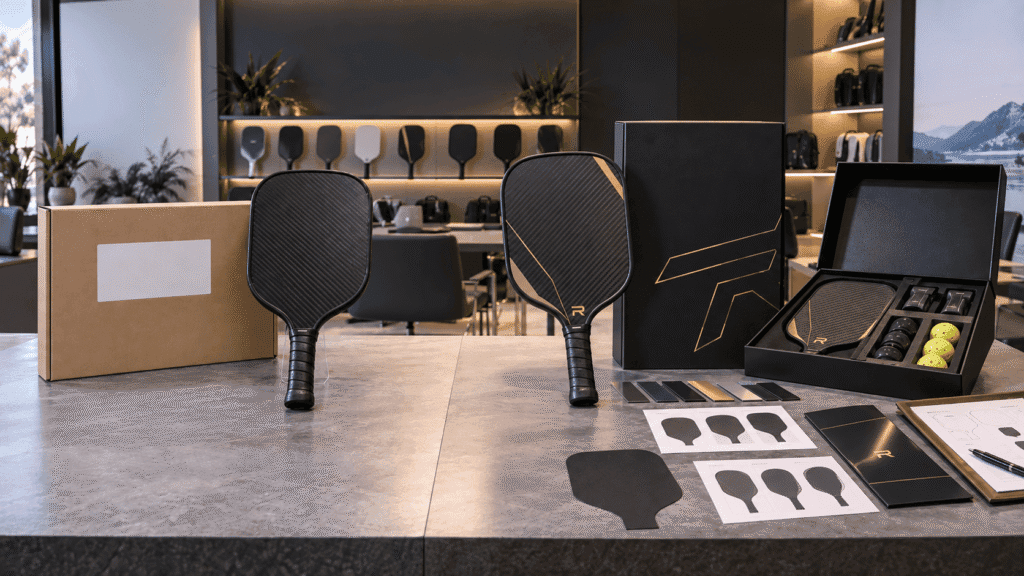
The practical difference between white label and full custom is not “quality” — it is who owns four specific assets. Buyers who conflate them discover the gap at the worst possible moment.
| Asset | White Label | Full Custom OEM |
|---|---|---|
| Paddle mold / shape | Factory | You (paid through NRE) |
| Logo application | Pad print or sticker, factory template | Pad print, laser etch, or in-mold graphic |
| Packaging | Stock box, label overprint | Custom dieline, inserts, retail-ready |
| USAPA certification | Tied to factory model | Must be re-certified under your brand/model |
| Brand exclusivity | None | Yours if tooling is yours and contract states so |
| Renegotiation position at renewal | Weak — you cannot move the mold | Strong — you can move production to a second factory |
On certification, be blunt with yourself. A USAPA listing is model-specific. If you white-label a factory model that is already listed, you generally cannot simply borrow the listing — the certification attaches to the submitted model and its documented construction. Channel buyers who assumed otherwise have shipped paddles to tournament venues and discovered they were not legal for sanctioned play.
Channel takeaway: Put tooling ownership and certification responsibility in writing in the same document. A tooling clause without a certification clause is half a contract.
Pricing Tiers and the Landed Cost You Actually Pay
FOB unit price is not your cost. Your cost is landed: FOB + freight + duty + insurance + 3PL receiving, plus the amortized tooling. Channel buyers who price off FOB alone are typically surprised by 12–20% at the bottom line.
| Order size (same spec) | Relative FOB unit cost | Tooling status | Freight mode most common |
|---|---|---|---|
| 100–300 pcs | Baseline +25–40% | Existing mold only | Air / express |
| 500 pcs | Baseline | Existing mold | Sea LCL |
| 1,000 pcs | Baseline −8–12% | Existing or amortizing | Sea LCL |
| 3,000 pcs | Baseline −15–22% | New mold amortized thin | Sea FCL |
| 10,000 pcs/yr committed | Baseline −20–30% | New mold + dedicated line slot | Sea FCL, scheduled |
Duty and classification move the number more than most buyers expect. Paddle classification, country of origin rules, and any applicable trade measures change the landed math materially — which is why a quote that is “10% cheaper FOB” can lose on delivery. Model it before you commit.
Channel takeaway: Build a landed-cost spreadsheet with tooling amortized over a realistic first-year volume, not over the first PO. Amortizing $4,000 of tooling over 500 units adds $8 per paddle to your first run — that is a launch-cashflow decision, not a unit-economics one.
Six Sourcing Pitfalls That Cost Channel Buyers Real Money
These are the failure modes that repeat across e-commerce and distribution programs.
- Hidden MOQ surcharges. The quoted unit price assumed a single SKU. When you split into three colorways, per-colorway setup fees appear as a “line change” charge. Ask for the price at your actual SKU mix, not the headline MOQ.
- Sample fee terms that never refund. Many factories credit the sample fee back only against a PO above a stated threshold, and only if placed within 60–90 days. Read the credit-back clause; get the threshold in the quote, not in a chat message.
- Certification responsibility left unassigned. Decide contractually whether the factory provides USAPA documentation for its base model or whether you fund and own the certification. Ambiguity here surfaces at the worst time — after your product page is live.
- Core density drift between batches. This is the highest-impact hidden risk for channel brands, because it changes feel without changing appearance. Require a per-lot core density certificate and a weight/balance sample from every production run, not just the golden sample.
- Thermoforming parameter drift. When a factory re-tools or moves a run to a secondary line to hit your date, forming temperature and dwell time can shift. Ask for the first-article report on every re-run.
- Packaging tooling ownership by default. If you pay for a custom box dieline, make sure the tooling is yours. Otherwise your packaging — including your brand’s dieline art — stays with the factory when you move.
Channel takeaway: Add one clause to every OEM contract: per-lot QC certificate for core density, weight, and balance point, plus first-article reporting on any line change. It is the cheapest insurance available in this category.
FAQ
What is the MOQ for custom pickleball paddles? For a private-label design using an existing mold, 300–500 pieces. For a new proprietary shape requiring a custom mold, expect 1,000–3,000 pieces, because the tooling cost has to amortize. Per-colorway and per-packaging MOQs add on top — plan your SKU architecture before you negotiate.
How long does custom paddle production take? 8–14 weeks from PO to sailing on a sea shipment, including sampling and QC. If tooling is new, add 1–2 weeks. If your artwork or specs change after sample approval, add 2–3 weeks. Air freight can compress the final leg by 3–5 weeks at roughly $3–6 per paddle.
Can I put my logo on pickleball paddles? Yes, through pad printing (lowest MOQ, roughly 100 pieces), laser etching (no tooling, monochromatic, best durability-to-cost ratio), or in-mold graphics (highest durability and full color, requires tooling and higher MOQ). Choose based on where the mark sits — center-strike-zone logos should not be pad printed on a textured spin face.
How much does it cost to make a private label paddle? At a 500-piece run with an existing mold, expect a FOB unit cost in the mid-$30s to low-$50s range depending on face material (fiberglass vs Toray T700 carbon fiber), core type (PP honeycomb vs foam), and branding method — plus tooling if the shape is new. Landed cost typically runs 12–20% above FOB once freight, duty, and receiving are included.
Do I need USAPA certification to sell my own paddles? You do not need it to sell generally, but you do need it to market the paddle for sanctioned tournament play. Certification is model-specific: it attaches to a submitted construction and cannot simply be inherited from a factory model you have re-branded. Confirm in writing who files and pays before you place a bulk order.
Can a factory dropship paddles for me? Some export-desk factories will, but the economics are poor at scale — per-unit pick-and-pack plus international parcel rates usually exceed 3PL fulfillment from a consolidated sea shipment. Dropship from the factory makes sense only for early demand validation at very low volume.
What is the difference between OEM and ODM paddles? OEM means you own or commission the design and typically the tooling; ODM means the factory’s existing design is adapted and branded for you with shared shape availability. ODM is faster and cheaper to start; OEM is the only path to real exclusivity.
The Bottom Line for Channel Buyers
Going direct to a factory is a volume decision with a clear threshold: once you are moving roughly 2,000–3,000 paddles a year, the margin you reclaim outweighs the supply-chain work you take on. Below that, buy through a partner and use white label to prove demand. Whichever path you take, the three things that matter most are the same: decompose MOQ into its real components before you negotiate, lock specs before sample approval so the timeline holds, and require per-lot core density and balance data so batch variation never becomes your review score. The paddles themselves are not hard to make well. What is hard is structuring the order around them so the money and the calendar both survive.
Considering a bulk OEM program? Raligo Sport builds custom carbon fiber pickleball paddles for channel brands and e-commerce sellers, from white label entry runs to full custom tooling with per-lot QC documentation. Send us your spec, target MOQ, and launch date and we will return a costed stage-gate timeline.
Suggested metadata and internal links
- Primary keyword: OEM pickleball paddle manufacturer
- Secondary: custom pickleball paddles bulk, pickleball paddle MOQ, white label pickleball paddles, ODM pickleball paddle supplier, private label pickleball paddle China
- Suggested internal links: design-to-production B2B workflow article; logo and brand customization (pad print vs laser vs in-mold) article; packaging and retail-ready design article; USAPA certification article; core density engineering article
- Suggested FAQ schema: the six PAA questions above
- Word count: ~2,300