Indonesia is now one of the fastest-growing pickleball markets on the planet. Industry tracking put the country’s growth at roughly 405% over the twelve months to August 2026, while the Indonesia Pickleball Federation (IPF) has moved from promotion into organised national championships, student tournaments and a newly elected leadership board under chairman Muhammad Nazaruddin for the 2026-2031 term. Court supply is chasing that demand in Jakarta and Bali, and equipment is still thin at the distributor level.
This guide walks a procurement team through the mechanics that actually determine landed cost and market fit in Indonesia: how pickleball paddles are classified and taxed at the border, what certification actually means for a market still formalising its equipment rules, and how core density and carbon fiber face choices should be tuned for a hot, humid, mostly-outdoor playing environment. Each section closes with a decision you can take straight into a PO.
What HS Code Applies to Pickleball Paddles Imported into Indonesia?
Pickleball paddles are classified under HS Chapter 95, in the sports-and-athletic-equipment group, within subheading 9506.59 (articles and equipment for general physical exercise, gymnastics, athletics, or other sports, n.e.s.). Indonesia’s tariff book follows the eight-digit AHTN (ASEAN Harmonised Tariff Nomenclature), so the six-digit subheading you see in U.S. or EU schedules maps into a national line under the Indonesian customs classification.
The classification logic is well established because Indonesia already classifies badminton racquets and table-tennis bats in the same chapter family. The risk is rarely which chapter — it is the precise goods description on the commercial invoice. A paddle declared as “carbon fiber sporting goods” versus “sports equipment accessory” can route to different lines and trigger different document checks, even if the duty outcome is similar.
Decision: Confirm with your OEM supplier the Indonesian eight-digit AHTN line and an exact English goods description before the ship date. One line on the commercial invoice is the cheapest insurance in the whole import file.
What Import Duty and Taxes Do Pickleball Paddles Pay Entering Indonesia?
Indonesia does not run a single flat sports-equipment rate. Four cost components stack at the border, and a B2B importer has to model all of them, not just the headline duty:
1. Bea Masuk (import duty) — set by the detailed HS/AHTN line, broadly 0-150% by chapter. For paddle equipment under Chapter 95 the practical rate is low single digits to low teens, but the exact figure depends on the national line.
2. PPN (VAT) — the imported-goods VAT. The headline rate moved to 12% from 1 January 2025, but most goods are taxed at an effective 11% through a reduced taxable-base mechanism (DPP Nilai Lain); true 12% applies to a narrow luxury set. For paddle importers plan on ~11% of the duty-inclusive value.
3. PPh Article 22 (import income tax) — a prepayment creditable against annual income tax: 2.5% if the importer holds an API (Angka Pengenal Impor) import licence, or 7.5% without one.
4. De-minimis / PIB thresholds — shipments with an FOB value over roughly USD 1,500 must be cleared through a PIB (Pemberitahuan Impor Barang) by a licensed importer; the low-value consignment regime and de-minimis threshold mainly affect courier or personal shipments, not a genuine B2B container.
The biggest structural lever for a commercial buyer is the API importer licence. Holding API cuts PPh 22 from 7.5% to 2.5% and is effectively a precondition for clean bulk clearance. Whatever a supplier quotes as “duty paid” must be unpacked into these four lines before you compare landed cost.
Decision: Build your landed-cost model as CIF + Bea Masuk + ~11% PPN on the duty-inclusive value + PPh 22 (2.5% with API, 7.5% without). Ask your freight forwarder for a written breakdown on each component, not a single blended quote.
Do I Need Certification or Federation Approval to Sell Paddles in Indonesia?
Indonesia’s pickleball governance is real but still equipment-young. The Indonesia Pickleball Federation (IPF) — rebranded from Persatuan Pickleball Indonesia (PPI), founded 2020, and newly chaired for 2026-2031 — has concentrated on federation structure, athletes, national events and coach/referee certification. It does not yet run a mandatory, enforceable paddle approval list for retail or import clearance, the way nobody forces an Indonesian wholesaler to wait on a federation sticker to bring in a badminton racket.
That does not mean specs are irrelevant. Club and tournament buyers in Indonesia increasingly compare paddles against the international benchmark — the USA Pickleball / USAPA Approved Paddle List and its surface standards (roughness, coefficient of friction, PBCoR). A paddle built to USAPA-spec surface control is the safest export-ready default, and it keeps you positioned if IPF formalises equipment rules down the line.
Decision: Treat “USAPA-spec or USAPA-approved” as your sales-ready baseline for Indonesia, and do not print a federation endorsement that has no recognised process behind it yet. Keep an eye on IPF equipment announcements, but do not block an order on them.
How Core Density and Carbon Fiber Face Spec Decide Indonesia-Market Fit
Indonesia’s pickleball is disproportionately outdoor, humid and warm — played on converted hard courts, sports arenas and covered clubs in Jakarta, Bali, Surabaya and Balikpapan rather than climate-controlled indoor venues. That climate shifts what “good” means in a paddle spec, and two manufacturing variables dominate.
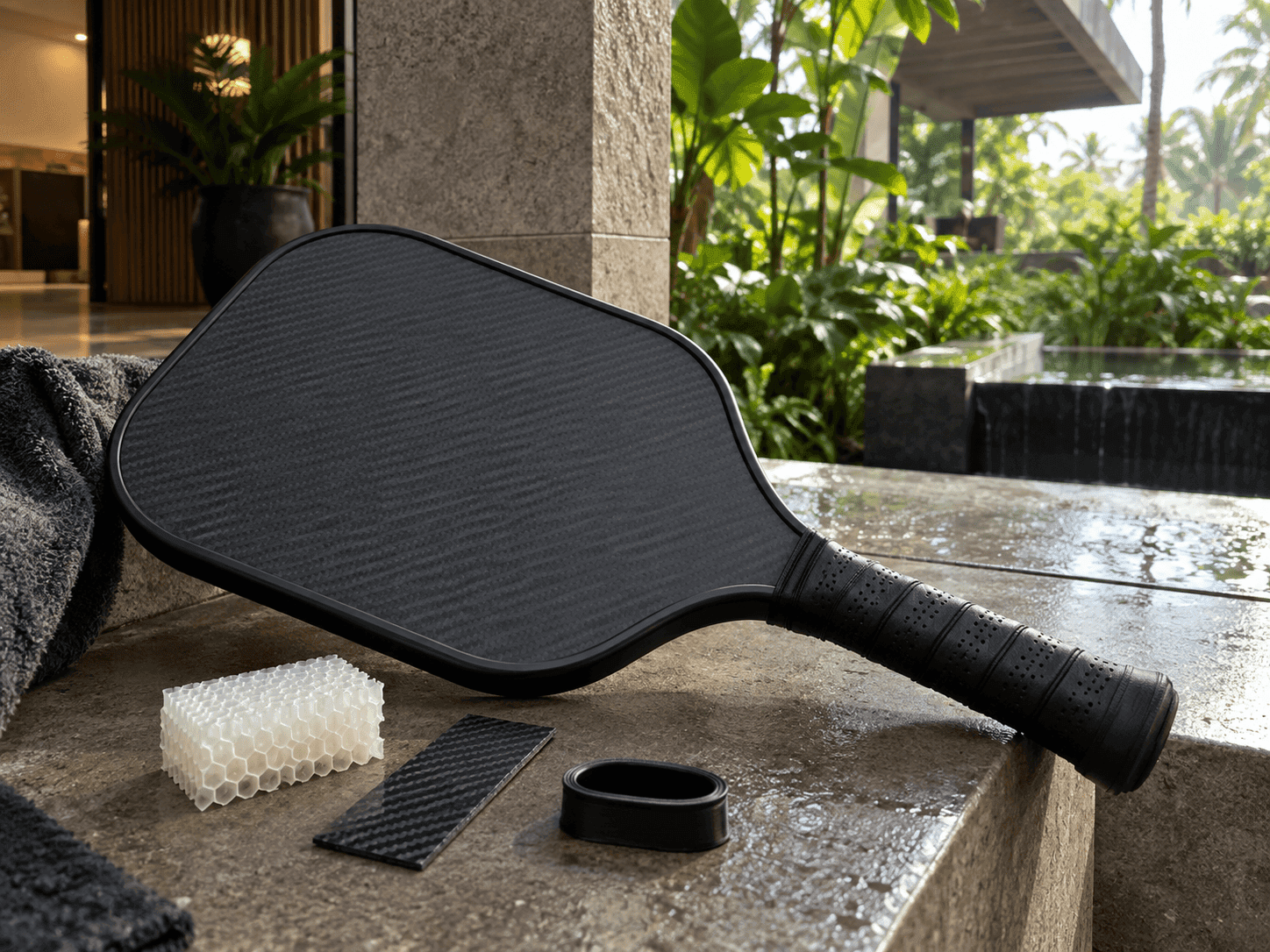
Core density sets the stiffness-to-touch balance. A higher-density polypropylene honeycomb core hardens the face and shortens dwell time, favouring power and a crisper serve return; a tuned mid-to-lower density softens the face and lengthens dwell for control and touch. For Indonesia’s outdoor conditions the practical sweet spot is a mid-density 16mm thermoformed core — firm enough to stay predictable across heat-soaked, low-tack surfaces, yet soft enough that a demanding player can still shape soft dinks. In extreme humidity the outer layers and edge guard matter as much as the core: an unsealed or poorly bonded edge edge will age fast when paddles move between an air-conditioned lobby and a 32°C outdoor court.
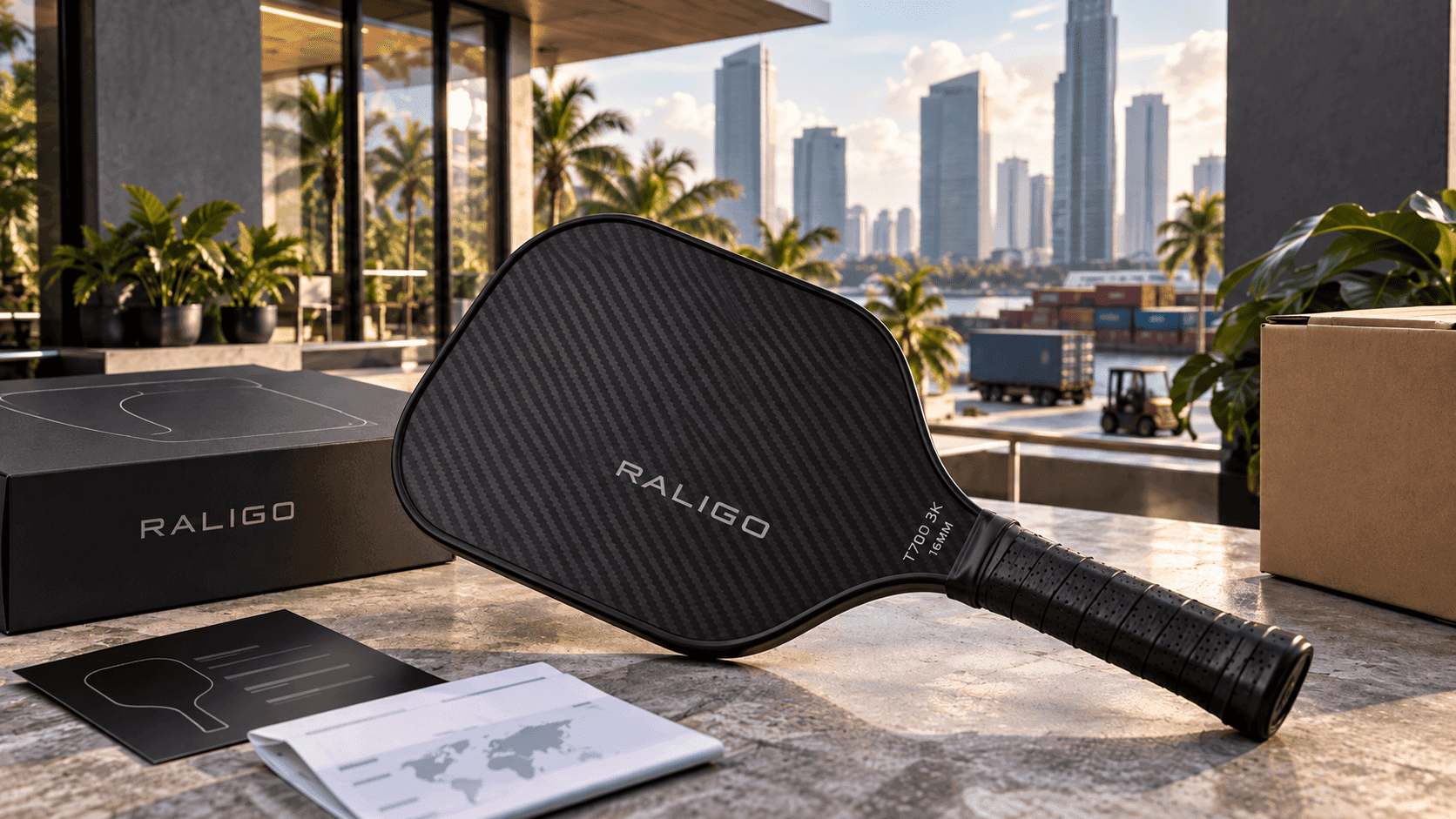
The carbon fiber face determines spin retention and consistency. A T700 raw-carbon (3K) weave gives a crisp, repeatable response with strong spin without the brittleness of a very high-stiffness layup, and carbon face texture held within USAPA roughness limits performs reliably outdoors. Where a beginner lines up with a wood or basic composite paddle from a sporting-goods chain, a carbon face is precisely the feature an organised club or growing brand leads with to justify a higher retail price.
Decision: Spec your Indonesia SKU as a 16mm thermoformed paddle with a tuned mid-density core and T700 3K raw carbon face, verify edge-guard sealing for high humidity, and keep the surface within USAPA roughness/COF limits so the paddle passes both friction checks and the “is this tournament-legal” question from club buyers.
How to Find a Reliable OEM Supplier for the Indonesia Market
The supplier question in Indonesia is less “who can mould a paddle” and more “who can hold a spec, ship clean documentation, and survive repeat orders into a young market.” Four checks separate a genuinely Indonesia-ready OEM from a generic carbon-fiber workshop:
1. Trade-documentation discipline. Can the factory issue the correct AHTN/HS goods description, a certificate of origin (Indonesia has active FTA/ASEAN-trade relationships worth verifying for origin-based treatment), and batch traceability on request?
2. Core-density consistency. Do they lock core family, density tolerance and weight range per model across cartons — not just per pre-production sample — so distributor restocks stay consistent?
3. Humidity-tolerant bonding. Do they seal edges and face lamination so a board that performs in Guangzhou also survives Jakarta’s humidity after transit and storage?
4. USAPA-spec surface control. Do they run profilometry and coefficient-of-friction checks after surface texturing, so the spin paddle stays compliant in tournament contexts?
Decision: Send any shortlisted factory three questions before you commit: their Indonesian AHTN goods description, their core-density tolerance per model, and their humidity/edge-bonding test method. Vague answers to any of the three is a reason to keep looking.
An Indonesia Import Checklist for B2B Buyers
| Check | What to confirm | Why it matters |
|---|---|---|
| Classification | Eight-digit AHTN line under HS 9506.59 family | Sets duty line and clearance path |
| Duty & tax | Bea Masuk + ~11% PPN + PPh 22 (2.5% API / 7.5% no-API) | Four-part model, not a blended quote |
| Importer licence | API (Angka Pengenal Impor) or licensed PIB clearance | Cuts PPh 22 and unblocks bulk shipments |
| Compliance | USAPA-spec surface (Rz/Rt, COF, PBCoR) | Export-ready baseline ahead of IPF formalisation |
| Spec fit | 16mm thermoformed, mid-density core, T700 3K face, sealed edge | Matches Indonesia’s hot, humid, outdoor play |
| Supplier | AHTN description + density tolerance + humidity sealing test | Prevents border and batch-consistency surprises |
Frequently Asked Questions
What HS code applies to pickleball paddles imported into Indonesia?
Paddles fall under HS Chapter 95, subheading 9506.59, read down into Indonesia’s eight-digit AHTN line. Importers should confirm the exact national line and a clean English goods description with their supplier before shipping.
What duty and taxes do pickleball paddles pay entering Indonesia?
The cost is four-fold: Bea Masuk import duty on the HS line, PPN VAT at ~11% effective on the duty-inclusive value, PPh Article 22 import income tax (2.5% with an API licence, 7.5% without), plus freight/customs handling. Holdings an API importer licence is the biggest single lever on total landed cost.
Is federation approval required to sell paddles in Indonesia?
Not yet as a hard import or retail requirement. The Indonesia Pickleball Federation (IPF) is building its equipment standards but has focused on structure, events and certification of people. USAPA-spec or USAPA-approved construction remains the strongest sales-ready baseline.
How does weather affect the paddle spec for Indonesia?
Indonesia skews outdoor, humid and warm, so a tuned mid-density 16mm thermoformed core holds predictability on heat-soaked hard courts, sealed edge guards resist humidity ageing, and a T700 3K raw carbon face delivers spin within USAPA surface limits.
Why should a buyer hold an API importer licence?
The API licence cuts PPh Article 22 import income tax from 7.5% to 2.5% and is effectively required for standard PIB bulk clearance above the value thresholds. For a genuine distributor it is the cheapest documentation investment in the entire landed-cost stack.
Ready to Source Your Indonesia-Market Paddles?
Talk to our OEM team about carbon fiber paddle manufacturing for the Indonesia market. From core density specs and AHTN documentation to bulk production, we handle it at our ISO-compliant factory.