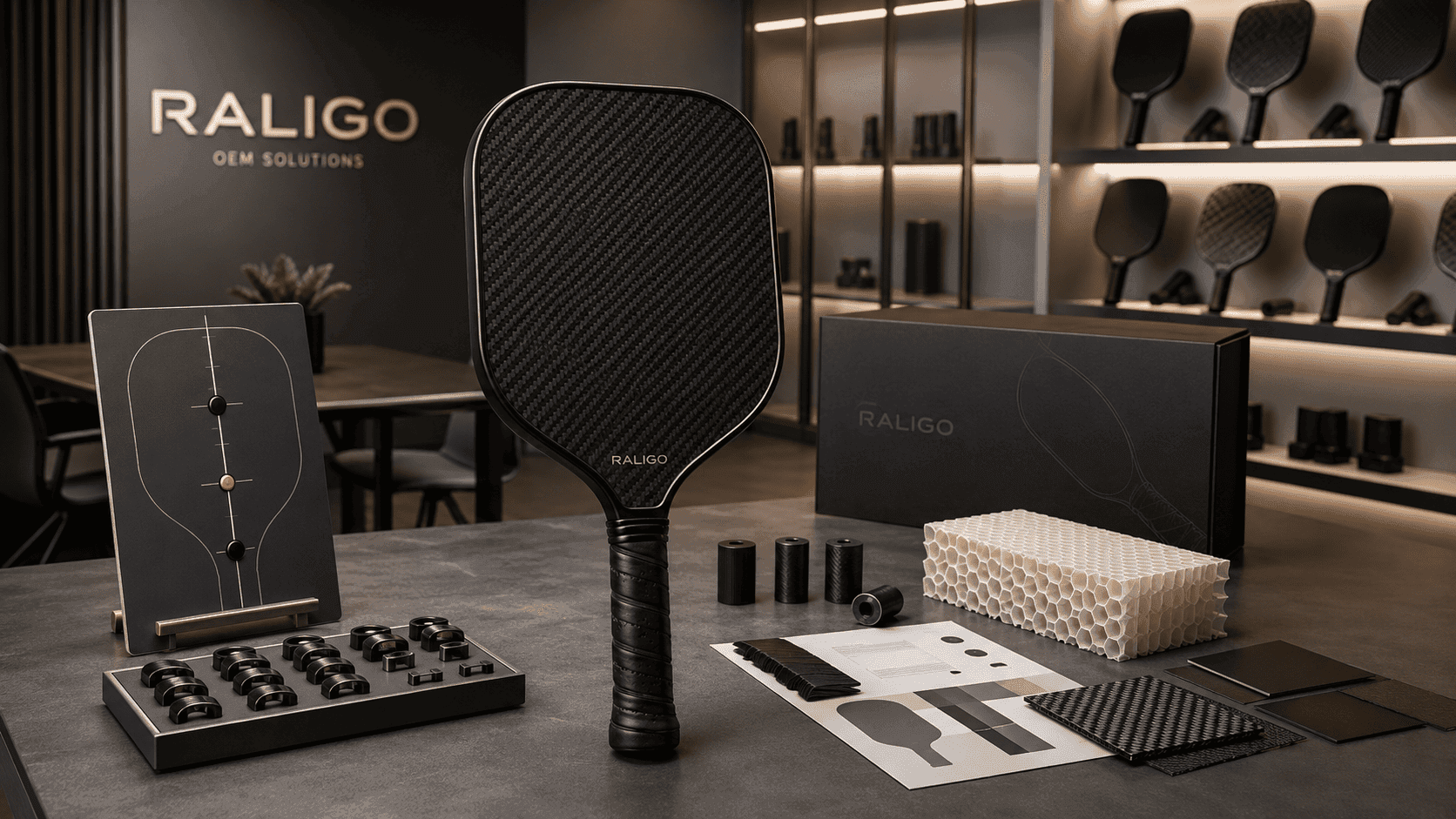

Pickleball paddle swing weight and moment of inertia (MOI) are not interchangeable with static weight. A paddle that reads 7.9 oz on a scale can feel dramatically lighter or heavier in the hand depending on where that mass sits relative to the grip axis. For OEM buyers and manufacturing professionals, the distinction is the difference between a paddle that sells and one that sits on a shelf.
This guide explains how swing weight and MOI are actually measured on a factory floor, how carbon fiber layup and core density gradients control mass distribution, and what specification you should write into a purchase order so a supplier builds the paddle you intend — not the paddle they assume.
What Is Swing Weight in a Pickleball Paddle?
Swing weight is a measure of how much effort a player must apply to rotate the paddle around a defined axis — usually the grip, measured as a moment of inertia value in kg·cm². It is not the paddle’s static weight.
A pickleball paddle’s swing weight is calculated from the mass of each element multiplied by the square of its distance from the pivot point. This means mass far from the handle — near the hitting face and the top edge — contributes disproportionately to swing weight. The same 10 grams placed at the paddle tip raises swing weight far more than 10 grams placed 5 cm above the grip.
In factory terms, this is why two paddles with identical static weight can feel completely different. A paddle with a mass concentration in the upper face will have a higher swing weight and require more wrist and forearm effort. A paddle with mass pulled back toward the handle will have a lower swing weight and faster repositioning.
Moment of Inertia (MOI) vs. Swing Weight vs. Twist Weight
Moment of inertia (MOI) is the underlying physical quantity; swing weight and twist weight are MOI values measured about two different axes.
| Term | Axis of Rotation | What It Tells You | Typical Unit |
|---|---|---|---|
| Static weight | None (mass only) | Total material in the paddle | oz / g |
| Swing weight | Grip / wrist pivot | Effort to swing the paddle | kg·cm² |
| Twist weight | Longitudinal (handle-to-tip) axis | Resistance to off-center torque / stability | kg·cm² |
| Balance point | — (center of mass) | Where the paddle balances on a finger | cm from butt |
Twist weight is often conflated with MOI but it is a separate axis. A paddle with high twist weight resists twisting on off-center hits, which widens the effective sweet spot. This is why perimeter weighting — moving mass to the edges — raises twist weight without raising swing weight as much as adding mass to the tip would.
For a paddle designer, the three levers are static weight, swing weight, and twist weight. You cannot optimize all three independently; you allocate mass to trade off power, stability, and maneuverability.
Perimeter Weighting: Adding Stability Without Adding Bulk
Perimeter weighting places mass along the outer edge of the paddle face rather than at its center. This raises twist weight and widens the sweet spot while adding less swing weight than tip-weighted mass.
The mechanism is straightforward engineering. MOI about the longitudinal axis grows with the square of the distance from that axis. Mass at the 3 and 9 o’clock edges sits farther from the twist axis than mass in the center, so the same gram yields more twist stability at the rim.
In carbon fiber paddle manufacturing, perimeter weighting is commonly achieved three ways. First, an edge guard can be engineered as structural mass rather than just a bumper — a denser, thermoplastic polyurethane or a weighted composite channel running the rim. Second, the face layup itself can be biased: extra carbon fiber plies around the perimeter before the core is placed. Third, an internal frame or “rim frame” can be bonded between the two face sheets near the edge.
The tradeoff every OEM buyer must understand: perimeter weighting raises twist weight (good for off-center forgiveness) but also raises total MOI somewhat. Over-perimeter-weighted paddles feel sluggish at the net. The specification should target a twist-weight-to-swing-weight ratio, not a single number.
Counterbalance: Pulling the Weight Back to the Handle
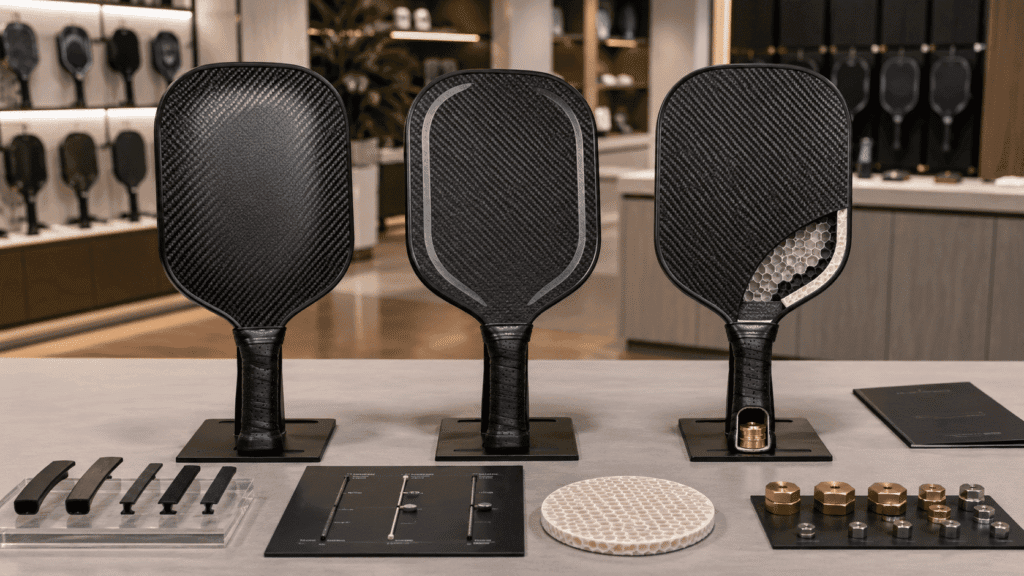
Counterbalance adds mass at the grip or throat to pull the balance point down and reduce swing weight relative to the paddle’s face mass. It is the lever used to make a power-oriented, tip-heavy face play faster in hand.
A factory can counterbalance a paddle through a weighted butt cap, a denser grip core, or internal mass in the handle — often tungsten-loaded or steel-loaded polymer plugs. The effect is to lower the balance point toward the hand, which reduces the perceived swing weight at the wrist even though static weight may actually rise.
Counterbalance is not free. Adding handle mass raises static weight, which can push a paddle over a target spec or into a heavier feel classification. It also changes head-light/heavy feel in a way players perceive strongly. Procurement teams often overlook that a “7.8 oz paddle” that is counterbalanced may feel lighter than a 7.6 oz paddle that is tip-heavy.
The manufacturing principle is clean: counterbalance trades a small static-weight penalty for a meaningful swing-weight reduction. For a quoted spec, you should specify both static weight range and target balance point, because a supplier can hit one and miss the other.
Measuring Swing Weight and MOI: The Briffidi SW1 Rig
The Briffidi SW1 is a pendulum-based instrument that measures a paddle’s moment of inertia about a user-selected axis, then derives swing weight and twist weight in kg·cm². It has become the de facto reference among pickleball paddle designers because it is repeatable and inexpensive compared to a full laboratory inertia table.
The SW1 works by clamping the paddle handle in a pivot, displacing it through a small angle, and timing the oscillation period. MOI is computed from the period of a physical pendulum and a known calibration standard. Because the rig can be re-clamped along a different axis, the same instrument yields both swing weight (about the grip/wrist axis) and twist weight (about the longitudinal axis).
For an OEM program, the SW1 matters for two reasons. First, it lets you specify swing weight and twist weight as numeric pass/fail criteria in an inspection checklist, the same way you specify face deflection or surface roughness. Second, it gives a factory a repeatable QA gate — paddle out of band can be caught before packaging rather than after a batch ships to a distributor.
One caveat worth stating plainly: the SW1 measures MOI about the axis you clamp. It does not measure “feel,” and two paddles with identical SW1 numbers can still feel different because of grip shape, edge mass placement, and vibration damping. Treat it as a number to control consistency, not a substitute for play-testing.
Distributed Mass: Sweet Spot Size vs. Maneuverability
Distributed mass is the pattern of how weight is spread across the paddle face and core, and it is the single largest lever a manufacturer pulls to set sweet spot size against maneuverability.
A concentrated-mass paddle — heavy in one central region — has a smaller sweet spot but lower MOI around that region, which can feel whippy. A distributed-mass paddle spreads weight across the face and perimeter, enlarging the region where off-center hits still feel solid, but raising twist weight and sometimes swing weight.
The sweet spot is, strictly, the area of the face where ball impact drives the paddle’s center of percussion, minimizing shock to the hand. Mass distribution determines its size. Perimeter mass and a gradient core — denser at the rim, lighter at the center — widen the sweet spot while keeping the center lively.
Maneuverability is the opposing objective: lower MOI makes the paddle faster to reposition at the net for hand battles. A paddle optimized purely for sweet spot will generally be sluggish at the net; a paddle optimized purely for speed will punish off-center contact.
The factory answer is a mass-distribution gradient, not a single density. That gradient is where the real engineering happens, and it is what separates a tuned paddle from a generic one.
Carbon Fiber Layup and Core Density Gradient: How a Factory Sets Mass Distribution
The mass distribution of a pickleball paddle is set in the layup room and the core-cutting room, not on a finishing bench. Three manufacturing controls dominate: front carbon fiber layer placement, edge thickening, and core density gradient.
First, front-face carbon fiber layup. A factory lays up plies — for example, Toray T700 carbon fiber — in a specific stacking sequence before the core is bonded. Adding a ply, or biasing a ply toward the top third of the face, pushes mass toward the tip and raises swing weight. Keeping plies uniform and adding a perimeter ring instead pushes mass to the edges and raises twist weight. The layup order, ply orientation, and resin fraction all shift the mass map.
Second, edge thickening. Thermoformed and unibody paddles can be molded with a thicker rim that doubles as structural perimeter weighting. This concentrates mass at the edges without a separate edge-guard part, and it also stiffens the frame against delamination at the rim.
Third, core density gradient. A polymer or honeycomb core can be cut with denser edge cells and a lighter, lower-density center, or vice versa. This is the most direct control over where mass lives inside the paddle. A core with a denser perimeter and light center gives a forgiving, edge-weighted paddle; a center-dense core gives a livelier middle with a firmer response.
These three controls interact. A supplier quoting one spec — “7.9 oz, 8.0 mm core” — is not giving you enough information to reproduce the paddle. You need the mass distribution intent: layup stack, edge treatment, and core density map. That is the difference between a spec that survives supplier turnover and one that does not.
Specifying Swing Weight in an OEM Purchase Order (B2B Decision Guide)
For a serious OEM order, swing weight and MOI belong in the purchase order as measurable, bounded criteria — not as adjectives like “balanced” or “head-light.”
Write the spec around four numbers: a static weight range (with tolerance, e.g., 220–228 g), a swing weight band (e.g., 112–118 kg·cm² as measured on a Briffidi SW1), a twist weight minimum, and a balance point. Also state the measurement instrument and axis, because a number without the instrument is meaningless across factories.
Ask the supplier for their QA gate on these numbers. A factory that measures swing weight at final inspection and rejects out-of-band units is a different class of supplier from one that checks only static weight. Sample-level MOI data, not just a hero sample that feels good, is the signal of a process under control.
Finally, hold the mass-distribution spec — layup stack, edge treatment, and core density map — as a controlled document. That is the number-one thing that drifts when a supplier changes process to cut cost, and it is why two batches from the same “spec” can feel like two different paddles.
Frequently Asked Questions
What is the difference between swing weight and static weight in a pickleball paddle?
Static weight is the paddle’s total mass in grams or ounces. Swing weight is a moment of inertia value (kg·cm²) that describes how much effort it takes to rotate the paddle around the grip. Two paddles with identical static weight can have different swing weights based on where the mass is distributed.
How does perimeter weighting improve a pickleball paddle?
Perimeter weighting places mass along the paddle’s outer edge, raising twist weight and widening the sweet spot so off-center hits stay stable. Because edge mass sits far from the longitudinal axis, it adds forgiveness with less swing-weight penalty than adding the same mass to the tip.
What does the Briffidi SW1 measure?
The Briffidi SW1 measures a paddle’s moment of inertia about a clamped axis using pendulum oscillation timing. Depending on the clamping orientation, it yields swing weight (about the grip axis) or twist weight (about the longitudinal axis), both in kg·cm².
Does a heavier paddle always have higher swing weight?
No. A counterbalanced paddle can carry extra mass in the handle and still feel lighter in hand than a lighter paddle with mass concentrated near the tip. Swing weight depends on mass distribution, not mass alone.
How do manufacturers control paddle mass distribution?
Manufacturers control mass distribution through carbon fiber layup (ply count, orientation, placement), edge thickening in the mold, and core density gradients that place denser cells at the perimeter and lighter cells at the center.
Ready to Get Started?
Talk to our OEM team about swing weight, MOI, and mass-distribution targets for your paddle. From carbon fiber layup to core density gradients, we build paddles to a measured spec — not a guess.