Executive Summary
Canada’s pickleball market is the fastest-growing in North America — 1.54 million players in 2025, projected to clear 1.8 million in 2026, representing a 337% increase over five years. The equipment market, valued at $95.41 million in 2025, is forecast to reach $197.35 million by 2034 at an 8.31% CAGR. For Canadian brands, the math is straightforward: sourcing carbon fiber pickleball paddles directly from Chinese OEM factories delivers 40-60% margin uplift compared to buying from domestic distributors. This guide walks through carbon fiber grade selection for cold-climate playing conditions to CBSA tariff classifications and Quebec’s French-language labeling rules.
1. Canada’s Pickleball Boom — By the Numbers
Atomic Answer: Canada added roughly 400,000 new pickleball players in 2024 alone. With Sport Canada officially recognizing Pickleball Canada as a National Sport Organization in 2025, the market infrastructure is locking into place — and equipment demand is scaling faster than domestic supply chains can absorb.
The numbers are unambiguous. According to Pickleball Canada’s 2026 survey data, the player base has expanded from approximately 350,000 in 2020 to over 1.54 million in 2025 — a 337% growth trajectory that places Canada firmly as North America’s highest-growth pickleball market on a per-capita basis.
Provincial distribution matters for your market entry strategy. Ontario leads with roughly 545,000 active players, followed by British Columbia at 295,000, Quebec at 240,000, and Alberta at 210,000. If you are launching a brand or expanding distribution, Ontario and BC together represent over 54% of the addressable market.
Facility infrastructure has kept pace. Canada now has over 5,100 courts and 2,400-plus dedicated pickleball facilities — and the number of indoor conversions (tennis courts, community centers, warehouse retrofits) continues to climb through municipal recreation budgets. This facility expansion matters for equipment demand because indoor play creates different paddle performance requirements than outdoor play. More on that in Section 3.
The equipment market itself is valued at $95.41 million in 2025, with a projected trajectory to $197.35 million by 2034. That is a compound annual growth rate of 8.31% — sustained, not a spike. For procurement teams and brand founders, this means demand visibility extends well beyond the next 12 months.
Takeaway: If you have been waiting for “proof of market,” the Sport Canada endorsement in 2025 is your signal. The supply chain for Canadian-market paddles is being built right now. Early movers lock in supplier relationships before factory capacity tightens.
2. Why Canadian Brands Source Paddles from China
Atomic Answer: Chinese carbon fiber pickleball manufacturing offers factory-direct pricing at 35-55% below North American distributor cost, with MOQs as low as 10-50 paddles for custom orders. For a Canadian brand importing at scale, the landed cost of a full carbon fiber thermoformed paddle typically lands between $18-28 USD per unit — leaving substantial retail margin even after duties and logistics.
The Cost Math
Frankly, the spread between Chinese factory pricing and North American distributor pricing is the single biggest margin lever in pickleball retail. A Toray T700 carbon fiber thermoformed paddle that costs $22-26 USD FOB from a Guangdong or Zhejiang factory will retail for $120-180 CAD in the Canadian market. A distributor buying that same paddle domestically pays $55-75 USD — and then still needs to layer their own margin.
Distributor markup is not the enemy; it is the opportunity cost of not going direct. Here is what a typical unit economics breakdown looks like for a Canadian brand importing a container of 500 paddles:
| Cost Component | Per-Paddle Cost (USD) |
|---|---|
| Factory cost (T700 thermoformed, FOB) | $24.00 |
| Ocean freight (LCL, Shenzhen → Vancouver) | $0.85 |
| Customs brokerage + CBSA duties | $1.20 |
| Warehouse receiving + inland freight | $0.60 |
| Total landed cost | $26.65 |
| Retail price (CAD, ~1.37 USD/CAD) | ~$165 CAD ($120 USD) |
| Gross margin per unit | ~$93 USD (78%) |
Compare that to sourcing from a domestic distributor at $60 USD wholesale: gross margin per unit drops to roughly $60 USD — a 35% haircut on every paddle sold.
MOQ Flexibility
One of the manufacturing industry realities global brands already know but newer Canadian entrants often underestimate: Chinese pickleball OEM factories are far more accommodating on minimum order quantities than the general impression of “Asian manufacturing” suggests.
Most established carbon fiber pickleball manufacturers will run custom orders starting at 50 paddles — and some specialist factories, particularly those with shared-mold production lines, will accept MOQs as low as 10 paddles for sample runs or limited editions. This flexibility exists because competition among the 800-plus paddle factories in China (concentrated in Guangdong, Zhejiang, and Fujian provinces) has shifted the leverage toward buyers.
The trade-off is unit cost — a 50-paddle run carries a per-unit premium of roughly 15-25% over a 500-paddle order. But that premium is still dramatically cheaper than any domestic production alternative. For Canadian brands testing new designs or entering a new province, 50-paddle batches are a viable launch strategy.
Full Customization Spectrum
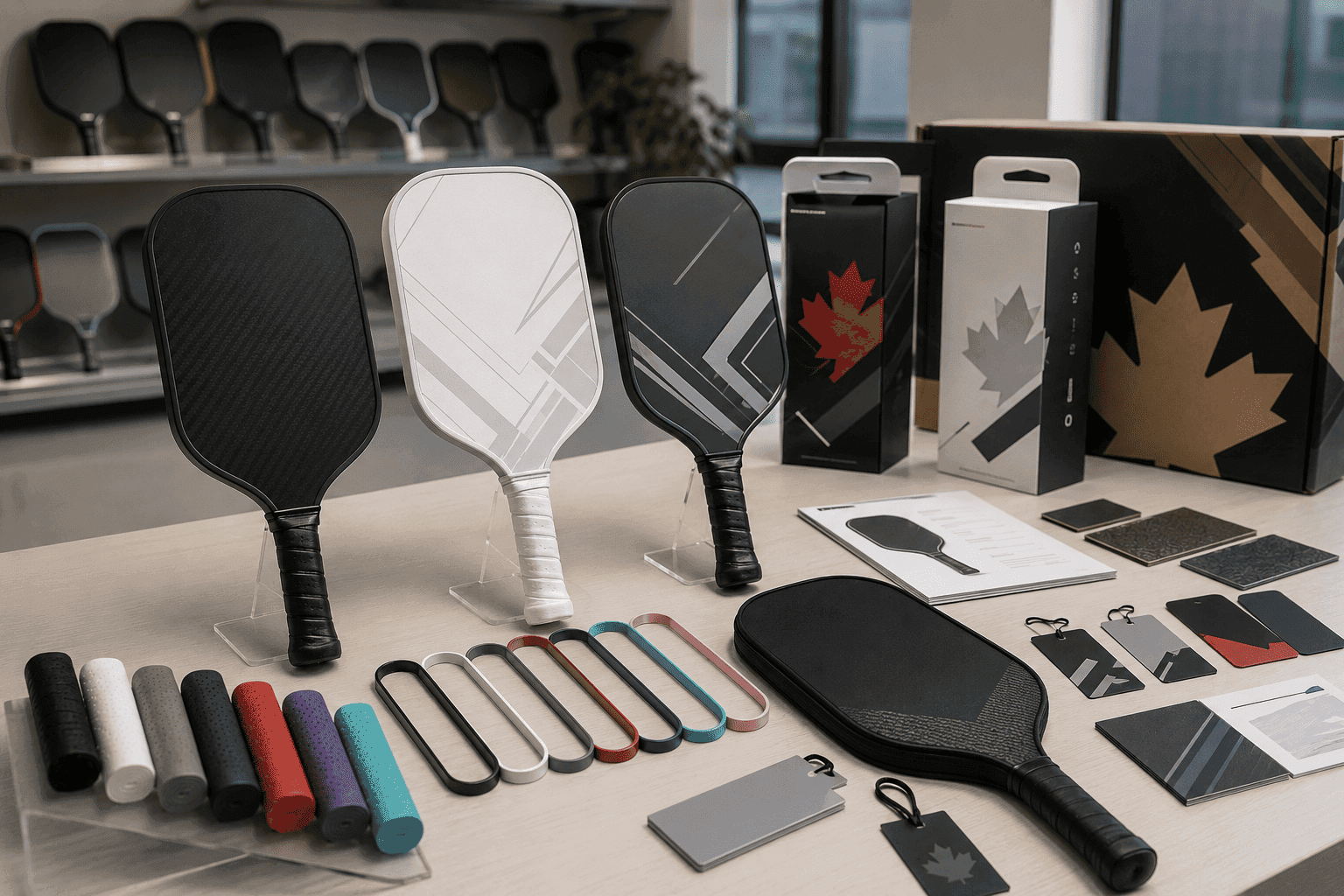
From carbon fiber grade (T700 vs T800 vs mixed-weave) to grip circumference, edge guard design, core density specification, surface grit texture, and brand imprint placement — the customization scope at Chinese OEM factories covers every variable a Canadian brand needs to differentiate. This is not “white label with a logo.” It is full OEM, including mold design if your volumes justify it.
Takeaway: The margin advantage of direct sourcing from Chinese factories is structural, not temporary. Even with a 15% strengthening CNY and moderate freight rate increases, the landed cost advantage over domestic distribution remains above 35%.
3. Carbon Fiber Manufacturing Deep Dive
Atomic Answer: For the Canadian market, T700 carbon fiber provides the optimal balance of stiffness, weight, and cost for thermoformed paddles — particularly for indoor play in cold-climate facilities. T800 adds roughly 8-10% stiffness at a 15-20% cost premium, making it a premium-tier option rather than a default recommendation.
Carbon Fiber Grades: What Canadian Brands Actually Need
The Toray T-series nomenclature has become the standard reference in pickleball paddle manufacturing. A quick field guide:
| Grade | Tensile Strength (MPa) | Tensile Modulus (GPa) | Typical Paddle Use Case | Cost Index |
|---|---|---|---|---|
| T300 | 3,530 | 230 | Entry-level, rarely used in performance paddles | 70 |
| T700 | 4,900 | 230 | Best value-performance point — recommended for most Canadian-market paddles | 100 (baseline) |
| T800 | 5,880 | 294 | Premium paddles, competitive/tournament tier | 115-120 |
| T1000 | 6,370 | 294 | Ultra-premium, marginal stiffness gain over T800 | 130-140 |
In factory reality, T700 is the workhorse material for good reason. It delivers 4,900 MPa tensile strength — more than sufficient for the impact forces generated during pickleball play — without the significant cost jump to T800. The stiffness difference between T700 and T800 is perceptible to tournament-level players but marginal for the 85% of the market that plays recreationally.
Procurement teams often overlook this: specifying T800 when T700 would perform identically for your target customer is just adding $3-5 USD per paddle in material cost that your end customer cannot feel.
Thermoformed vs Cold Press: Canadian Climate Considerations
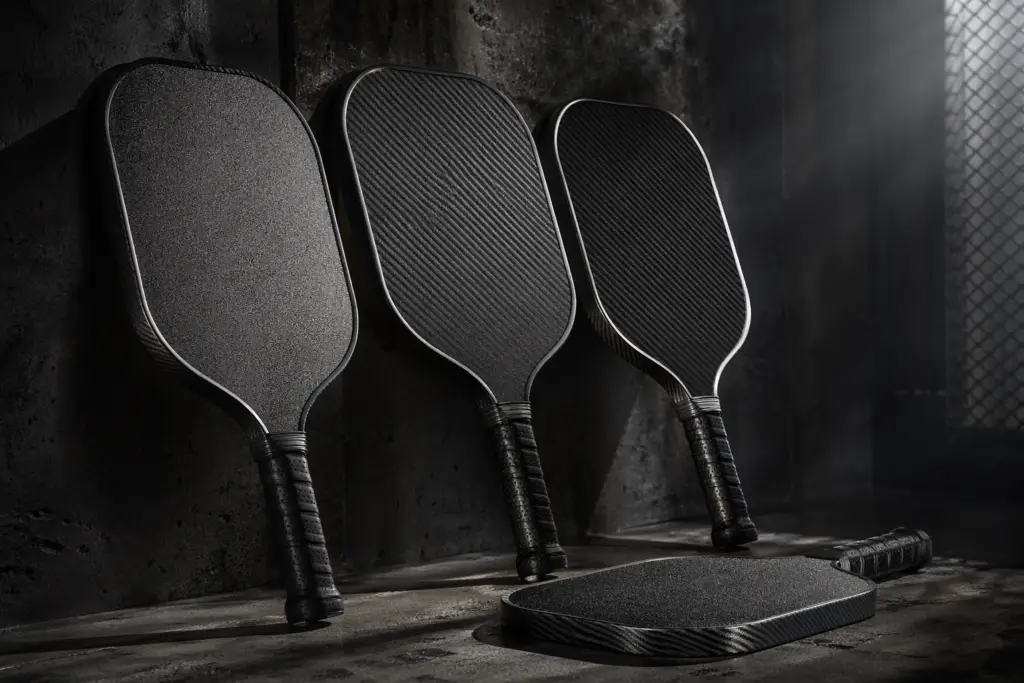
Here is where the Canada-specific angle matters. The thermoformed manufacturing process — where the paddle face and core are fused under heat and pressure in a single mold — produces a unibody structure with superior edge durability and consistent performance across temperature ranges. Cold press manufacturing, while cheaper (roughly $8-12 USD per paddle vs $18-28 for thermoformed), tends to produce paddles that can develop edge delamination in the temperature cycling typical of Canadian seasons.
If your customers play in unheated indoor facilities in January (and many do — community centers, converted warehouses, seasonal dome structures), the paddle material experiences thermal contraction cycles that stress glue-bonded edges more aggressively than in climate-controlled environments. Thermoformed construction handles this environment better. The fused edge is one continuous material interface, not two materials glued together.
Additionally, core density becomes more relevant in cold conditions. A polypropylene honeycomb core with density in the 8mm cell size range (industry standard for all-around paddles) maintains impact response more consistently than lower-density cores when ambient temperature drops below 10°C. This is a small but real performance variable that Canadian brands should specify when communicating with factories.
Surface Grit and Spin Durability
USAPA paddle surface coefficient of friction (COF) testing has pushed factories to develop more durable grit application methods. The two main approaches:
- Spray-on grit (silicon carbide particles in epoxy matrix): Lower cost, good initial spin, but grit particles can wear smooth over 3-6 months of regular play. The rate of wear accelerates with outdoor play on abrasive court surfaces.
- Peel-ply textured carbon fiber (in-mold texture): Higher durability because the texture is integral to the carbon fiber layup, not applied post-production. Maintains spin performance over a longer lifecycle. Roughly $2-4 USD premium per paddle face.
For the Canadian market, where consumers are notably value-conscious and durability-focused, the peel-ply texture approach aligns better with market expectations. Canadian buyers tend to view paddles as equipment investments, not consumables — a cultural preference that favors durability in product design.
Takeaway: Specify T700 thermoformed construction with mid-density PP honeycomb core (8mm) and peel-ply surface texture for the optimal Canadian-market mid-tier paddle. Reserve T800 for your premium/pro line.
4. Navigating Canadian Import Requirements
Atomic Answer: Pickleball paddles imported into Canada are classified under CBSA tariff heading 9506.99 (sports equipment), attracting 0% duty under the Most-Favored-Nation tariff — but GST/HST still applies at time of import. Quebec imposes additional French-language labeling requirements that many first-time importers miss.
CBSA Tariff Classification
Pickleball paddles fall under Harmonized System code 9506.99 — “Articles and equipment for general physical exercise, gymnastics, athletics, other sports.” The specific classification within this heading matters: paddles are not “rackets” (9506.59) because pickleball paddles lack strings. Using the correct HS code avoids reclassification delays at the border.
Under Canada’s Most-Favored-Nation (MFN) tariff schedule, the duty rate on 9506.99 imports from China is 0%. Compare that to apparel or footwear: China-origin goods in those categories face tariffs in the 12-18% range. Pickleball paddles at 0% is genuinely unusual — and worth protecting by getting the HS code right.
That said, GST/HST (5-15% depending on province of entry) is still assessed on the declared customs value. If you are importing through the Port of Vancouver and distributing nationally, the GST/HST rate applicable at the port of entry applies. A customs broker will calculate this for you.
USAPA/CPA Compliance
Paddles sold in Canada do not technically require USAPA approval — but in practice, every Canadian retailer, club, and tournament organizer expects paddles to meet USAPA specifications. If the paddle is not USAPA-approved, tournament directors will not allow it on court.
Canadian Pickleball Association (CPA) recognition follows USAPA standards. The safe path: make USAPA compliance a contractual requirement in your factory agreement, request third-party testing documentation before production runs, and verify that the factory’s existing paddle models appear in the USAPA approved equipment list.
Quebec-Specific Labeling
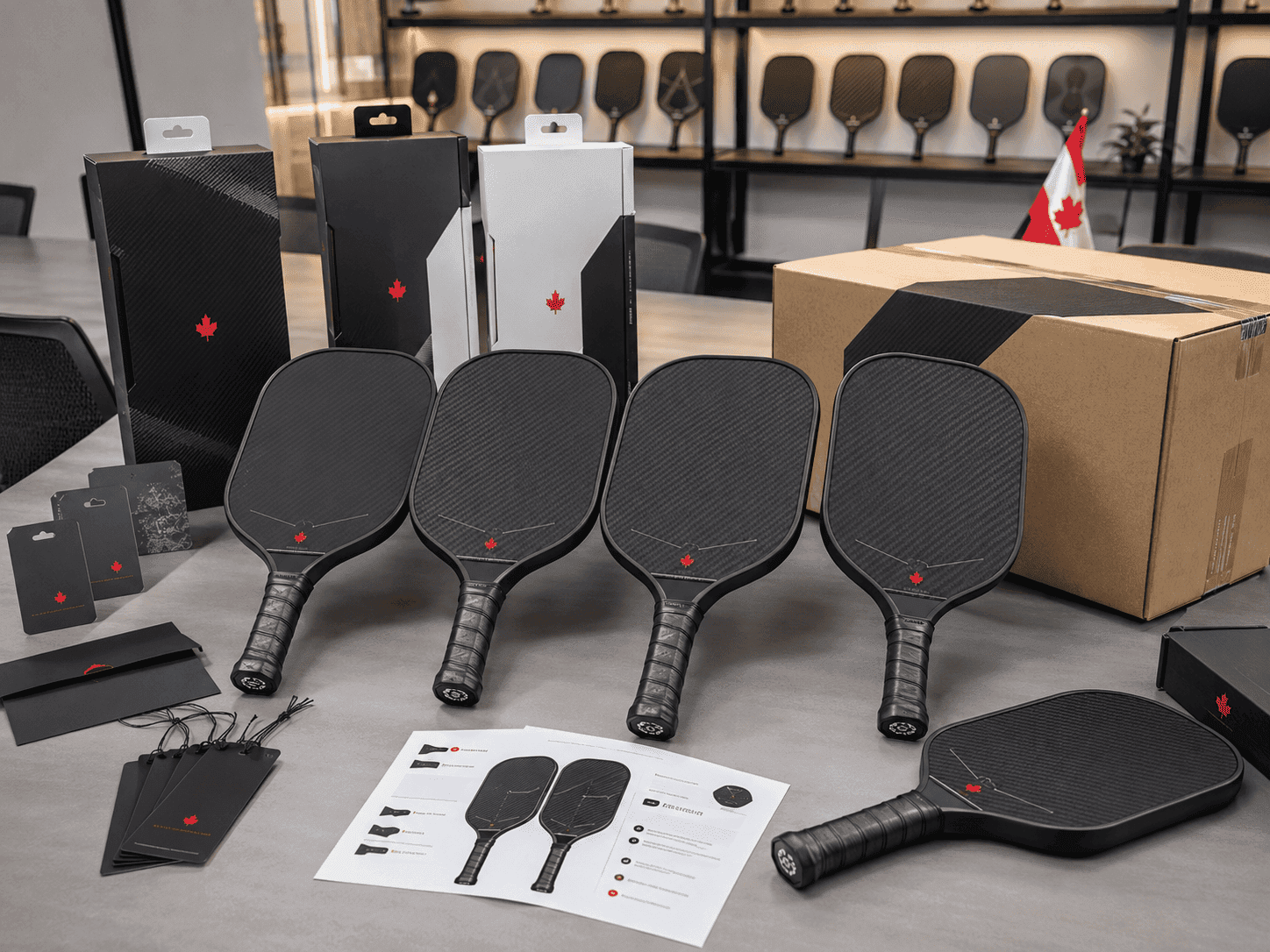
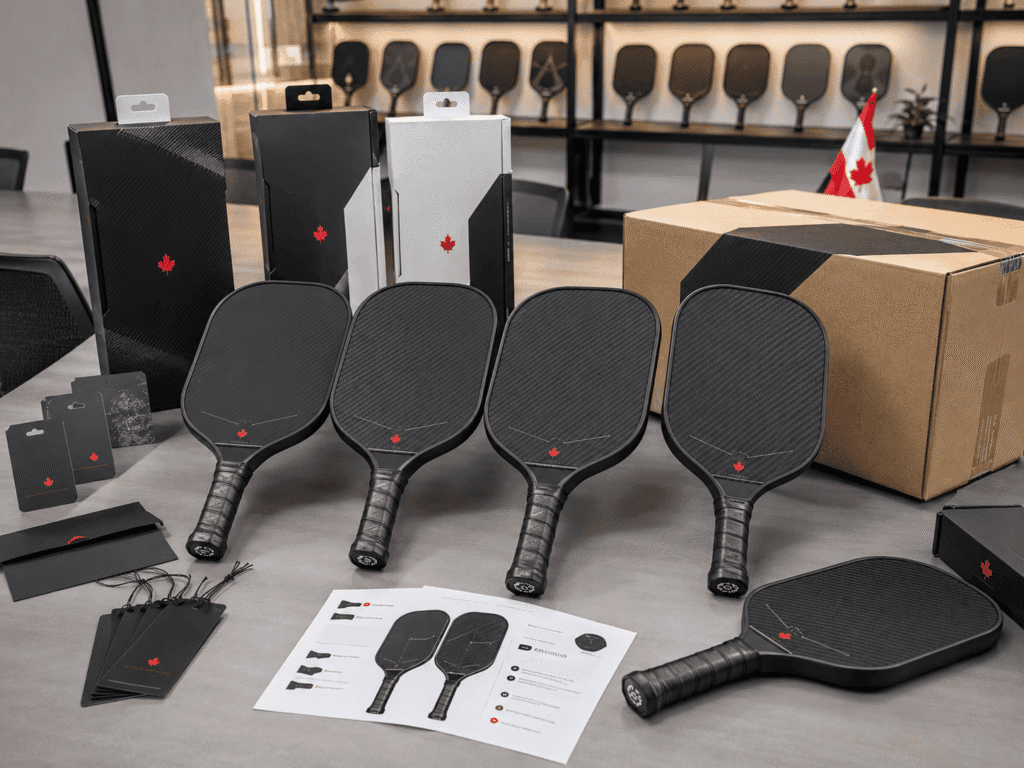
Section 51 of Quebec’s Charter of the French Language requires that every inscription on a product, its container, and its packaging be in French. This includes the paddle itself — any text printed on the face or edge guard — plus the retail packaging, instruction inserts, warranty cards, and hang tags.
Additionally, the packaging must include French-language descriptions that are at least as prominent as any other language. English-only packaging is non-compliant for sale in Quebec. Many first-time Canadian importers miss this because they assume the federal bilingualism requirement means English alone is fine. It is not — Quebec’s provincial regulations go further.
The most practical approach for a brand selling nationally: produce bilingual packaging (English/French) from the factory, with French text on both the box and the paddle face where text appears. Add roughly $0.30-0.50 USD per unit for the dual-language packaging premium at the factory level.
Takeaway: 0% duty is a gift — do not lose it through misclassification. Quebec labeling is a fixed cost you should plan for, not a surprise you discover at your first Montreal trade show.
5. Supplier Evaluation Framework for Canadian Buyers
Atomic Answer: Evaluating a Chinese pickleball paddle manufacturer requires more than a factory visit. You need ISO certification verification, quantifiable QC metrics (surface profilometry readings, COF test results), a structured sample approval workflow, and confirmed lead times with logistics routes to Canadian ports.
Certification Baseline
The minimum credible certification for a carbon fiber pickleball manufacturer is ISO 9001:2015 for quality management systems. This does not guarantee paddle quality — but its absence is a red flag. The certification confirms that the factory has documented processes, inspection checkpoints, and corrective action procedures.
Additional certifications that signal a quality-focused operation:
- ISO 14001 (environmental management) — increasingly relevant for Canadian brands whose customers care about sustainability
- BSCI or SEDEX (social compliance audits) — relevant if your brand makes ethical manufacturing claims
- ITTF/USAPA material testing reports — some factories commission third-party lab testing for surface friction, deflection, and durability
QC Protocols Worth Specifying
Lock these into your supplier agreement or purchase order terms:
- Surface profilometry: Ra (roughness average) readings should fall within your specified range. For a control-oriented surface, Ra 3.0-5.0 μm is typical. For spin-oriented surfaces, Ra 6.0-9.0 μm. Request profilometry reports from each production batch.
- Coefficient of friction (COF) testing: Confirms that the surface grit delivers the spin performance your marketing claims. A COF of 0.45-0.65 is typical for textured carbon fiber surfaces under USAPA testing protocols.
- Deflection testing under load: Measures how much the paddle face flexes under a standardized impact force. Critical for verifying that “T700” labeling matches performance — some factories have been known to use lower-grade carbon fiber with cosmetic T700 weave on the visible face.
- Weight and balance tolerance: State your acceptable variance explicitly — typically ±3g for weight and ±2mm for balance point.
Sample Approval Workflow
A disciplined sample process prevents mass-production disasters:
- Photo sample (free, 3-5 days): Factory sends photos of a similar existing paddle with your design elements applied. Useful only for visual confirmation.
- Pre-production sample ($50-150, 7-14 days): One or two paddles made to your actual specifications with your mold/design. This is the critical checkpoint — test these paddles on court, measure weight, check balance, verify grit.
- Production sample (free, pulled from the first 5% of production): Random sample from the production line before the factory ships. If it does not match your approved pre-production sample, reject the batch.
Skipping or rushing step 2 is the single most common procurement mistake — covered in Section 6.
Lead Times and Logistics to Canadian Ports
Typical lead times for Canadian-market orders from Chinese carbon fiber factories:
| Phase | Duration |
|---|---|
| Mold preparation (new design) | 10-15 days |
| Production (500-1000 paddles) | 20-30 days |
| Ocean freight (Shenzhen → Vancouver) | 18-22 days |
| Ocean freight (Ningbo → Montreal via Halifax) | 28-35 days |
| Customs clearance | 2-5 days |
| Total (Vancouver, existing mold) | ~55 days |
| Total (Montreal, new mold) | ~85 days |
Rail freight from Vancouver to Toronto adds roughly 5-7 days. Plan your ordering cycle accordingly — Canadian brands typically order 2-3 times per year with 3-4 month lead time buffers.
Takeaway: Budget 60-90 days from purchase order to warehouse-ready inventory in Canada. Shorten lead times through pre-existing mold designs and consolidated logistics relationships.
6. Five Procurement Mistakes Canadian Brands Make
Mistake 1: Buying on Unit Price Alone
The factory quoting $18 FOB for a “T700 thermoformed paddle” when four others are quoting $22-26 is not offering a better deal — they are cutting something. Usually it is carbon fiber grade (substituting T300 for T700 with a cosmetic top layer), skipping QC steps, or using lower-grade core material. The paddle might look identical from photos. It will not perform identically.
Mistake 2: Skipping the Pre-Production Sample
See Section 5. Brands excited about their first order often push to “just go to production” after the photo sample looks good. When 500 paddles arrive with the wrong balance point or insufficient surface grit, there is no cheap fix. You own the inventory.
Mistake 3: Ignoring Quebec Labeling Until the Shipment Arrives
This one surfaces at every Canadian pickleball trade show. A brand based in BC or Ontario designs beautiful English-only packaging, imports 1,000 paddles, and then gets a Quebec distributor inquiry. Suddenly they have 40% of their inventory they cannot legally sell into Quebec without repackaging. Plan bilingual from day one.
Mistake 4: No Deflection Testing Clause
Carbon fiber grade substitution is a known industry issue. Some factories use a visible T700 weave on the paddle face with lower-grade carbon fiber layers underneath. Without a deflection testing specification in your contract, you have no recourse — the paddle “looks right.”
Mistake 5: Ordering Without Canadian Climate in Mind
A paddle designed for year-round outdoor play in California may not perform the same way in a Saskatoon indoor facility in February. Core density, edge guard material, and thermoforming quality all affect cold-weather durability. Specify your target usage conditions to the factory.
Takeaway: Most procurement mistakes are preventable through one practice: write detailed specifications, verify them with samples, and enforce them with QC clauses. Cost of prevention: roughly $200 in samples and a few hours of documentation. Cost of a rejected container: tens of thousands.
7. FAQ (Canada Edition)
Q: Do I need a business license to import pickleball paddles from China to Canada?
Yes. You need a Canada Revenue Agency Business Number (BN) and, if importing commercially, a CBSA import-export account (RM number). These are straightforward to obtain through the CRA business registration portal. Your customs broker can guide you through the process.
Q: What is the minimum viable budget to launch a Canadian pickleball brand via Chinese OEM?
For a 2-3 SKU launch with 50 paddles per SKU, budget approximately $5,000-8,000 USD for product (150 paddles at ~$30-35 landed including small-batch premium), $1,500-3,000 for bilingual packaging and branding design, and $2,000-5,000 for initial marketing, website, and samples. Total launch: roughly $8,500-16,000 USD.
Q: Can I visit the factory before placing an order?
Most reputable Chinese pickleball manufacturers welcome factory visits, typically in Dongguan, Shenzhen, Xiamen, or Hangzhou. Arrange through your supplier contact. The visit confirms what certifications and photos cannot — actual working conditions, production line organization, and raw material storage practices. Budget $1,500-3,000 for a 3-4 day trip.
Q: How do I verify that the carbon fiber is actually T700 and not a cheaper grade?
Request third-party material testing from an accredited lab (SGS, Intertek, or Bureau Veritas). Some factories will provide these reports proactively. If a factory resists third-party testing, that is a disqualifying signal. Cost: approximately $300-500 per test.
Q: What happens if my shipment arrives damaged or defective?
Your supplier agreement should specify defect liability and replacement terms. Industry standard for Chinese pickleball OEM is: factory replaces or refunds units with manufacturing defects exceeding 3% of the shipment. Photographic evidence and a detailed defect report are required. Work with a factory that has export experience and understands these terms.
Q: Is there seasonal demand fluctuation for pickleball paddles in Canada?
Yes, with a caveat — indoor play smooths the curve. Canadian pickleball retail typically peaks in March-May (spring league sign-ups) and September-October (indoor season start). However, the growing indoor facility base means the winter trough is shallower than in the US outdoor-dominant market. Plan inventory around the March and September peaks.
8. Success Path: From Inquiry to Import
- Define your brand positioning and target price point (Week 1)
- Shortlist 3-5 factories via Alibaba, Global Sources, or trade shows (Week 2-3)
- Request quotations with detailed specifications — not just price (Week 3-4)
- Order pre-production samples from top 2-3 candidates (Week 5-7)
- Test samples on court, verify specifications with measurements (Week 7-8)
- Select supplier, negotiate contract terms including QC clauses (Week 8-9)
- Finalize bilingual packaging artwork and submit to factory (Week 9-10)
- Place production order with 30% deposit (Week 10)
- Request production samples before shipment release (Week 14-16)
- Ship via ocean freight to Vancouver or Montreal, clear customs (Week 20-24)
- Receive, inspect, and launch (Week 24-26)
Total timeline from zero to launch: approximately 6 months.
Ready to Source?
Raligo Sport manufactures carbon fiber pickleball paddles for brands and distributors worldwide. We work with Canadian partners on OEM and private-label orders starting at 50 paddles, with full customization across carbon fiber grade, core density, surface texture, and bilingual packaging.
Our factory supports end-to-end Canadian market readiness — from USAPA-compliant manufacturing specifications to French-language packaging and Canadian port logistics.
Factory-direct manufacturing. MOQ 50. Bilingual packaging available. Serving Canadian brands since establishment.