Germany & DACH Pickleball Paddle Import Guide for B2B Buyers
Germany is the anchor economy of the DACH region, and it is now the fastest-growing pickleball equipment market in Europe. FocusInsights puts the German pickleball gear market at $1.2 billion in 2024, tracking toward $5.2 billion by 2033 — an 18.5% annual clip — while Deep Market Insights pegs the paddle segment alone at $143 million in 2025. For a distributor, brand owner, or club purchasing manager, that is a supply opportunity that only works if the carbon fiber paddles actually clear German customs and survive the compliance review.
This guide walks a B2B buyer through the practical path of importing pickleball paddles from overseas factories into Germany, Austria, and Switzerland. It covers the EORI registration, the ATLAS electronic customs system, CE marking and REACH material rules, the correct HS tariff codes, and — just as importantly — the OEM manufacturing specs that decide whether your paddle performs on German courts the way you specced it.
—
1. EORI Registration: The First Gate for Any German Paddle Importer
Every economic operator importing goods into Germany needs an EORI number (Economic Operators Registration and Identification) before filing their first customs declaration. It is free, but without it the shipment simply does not clear.
An EORI is issued by the German customs master data office in Dresden (GZD – DO Dresden – Stammdatenmanagement). As of 1 October 2026, applications move fully onto the Customs Portal (zoll-portal.de), replacing the legacy 0870 form series for new registrations. A factory or brand operating outside the EU customs territory applies for its EORI in the first member state where it lodges a customs declaration — which, for the DACH route, is usually Germany.
| Importer Type | Where They Register | Notes |
|---|---|---|
| German GmbH / AG | Germany (Dresden) | Register via Customs Portal |
| Austrian / Swiss buyer | First EU entry state (often Germany) | Austria in EU; Switzerland outside |
| Non-EU factory | First EU declaration state | Third-country operator path |
Locking in the EORI early matters because the number also appears on your ATLAS import declarations and on the commercial invoice. A buyer who waits until the container is at the port is already late — German customs will hold the cargo on a documentation error that takes hours to fix and days to escalate.
—
2. ATLAS and the German Electronic Customs System
Germany processes customs declarations through ATLAS (Automatisiertes Tarif- und Lokales Zoll-Abwicklungssystem), the national electronic system aligned to the EU Union Customs Code (UCC, Regulation 952/2013). On the import side, the counterpart documents are the import declaration and the customs assessment notice rather than the export-side ABD/EAD — but the same ATLAS backbone governs both directions.
| Document | Direction | What It Proves |
|---|---|---|
| ATLAS import declaration | Into Germany | Value, origin, HS code, duty basis |
| EAD / ABD (ATLAS) | Leaving EU | Export cleared, carries MRN |
| Customs assessment notice (Bescheid) | Into Germany | Duty + import VAT calculated |
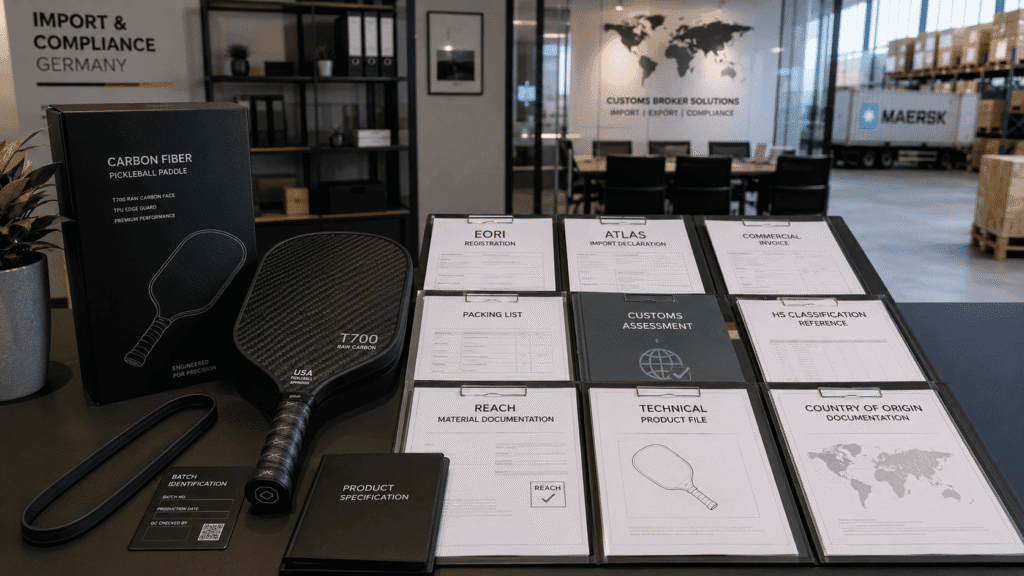
For the importer, the practical takeaway is that German customs is automated and unforgiving of mismatched fields. The HS code on the commercial invoice must match the code on the ATLAS declaration, and both must match the physical goods. One recurring hold at Hamburg or Rotterdam traces back to a vague material description — “paddle” instead of the actual construction — that forces a manual review and a demurrage charge on top of it.
—
3. CE Marking and DIN Standards: What Actually Applies to a Paddle
A common mistake is assuming every imported product needs a CE mark. A pickleball paddle is sports equipment, not machinery or electronics, so CE marking applies only where a specific EU directive or harmonized standard is triggered — and for a passive paddle, a broad safety harmonized standard like DIN EN 15312 (free-access multi-sport equipment, safety and test methods) is the relevant reference framework rather than a hard CE directive.
| Product Element | Requirement | Practical Action |
|---|---|---|
| Paddle as sports equipment | General product safety (GPSR) | Technical file + DoC where applicable |
| Multi-sport equipment | DIN EN 15312 reference | Safety & construction review |
| Any electronic accessory | CE (EMC / LVD / RED) | Separate declaration |
The GPSR — the EU General Product Safety Regulation — is the more operative obligation. A German distributor is responsible for placing only safe products on the market, which translates into retaining a technical file, traceability of the manufacturing batch, and a declaration of conformity when a directive applies. A factory that can hand over a complete technical file, not just a price list, is worth more than a 5% discount on the unit cost.
—
4. REACH and Material Compliance for Carbon Fiber Paddles
The heaviest enforcement on imported paddles is chemical, not mechanical. REACH — the EU regulation on Registration, Evaluation, Authorisation and Restriction of Chemicals — applies to every material that touches a player’s hand or skin. A carbon fiber paddle is a stack of composite face sheets, a core, an edge guard, and a grip, and each layer carries its own compliance exposure.
| Component | REACH Concern | Factory Action |
|---|---|---|
| Carbon fiber face sheets | Restricted fillers, resin chemistry | Virgin tows, verified SDS |
| Handle grips | Phthalates, PAHs | PVC-free, lab-tested elastomers |
| Adhesives / edge guard | VOC, restricted plasticizers | REACH-compliant resins |
| Core materials | Foam blowing agents | CFC-free manufacturing |
The grip is where most imports fail — phthalate-heavy PVC overgrips are cheap in Asia and illegal at the German border. Request material data sheets and, where the distributor demands it, third-party lab results before the production run. Cutting the grip spec to save cost buys you a detained container and a damaged relationship with a market that audits seriously.
—
5. HS Codes and Landed Cost: Tariff, VAT, and the DACH Price Model
The correct harmonized system code sets the duty you pay and keeps your ATLAS declaration clean. Pickleball paddles fall under Chapter 95 of the EU Combined Nomenclature, but there is no dedicated “pickleball” line — so consistent classification is everything.
| Item | HS Code (EU CN) | Typical Duty |
|---|---|---|
| Pickleball paddle (sports equipment) | 9506.29 / 9506.99 | Approx. 0–2.7% depending on origin |
| Carbon fiber face sheets (wide form) | 3921 / 7019 | Higher, if imported separately |
| Grips and accessories | 9506.99 | Varies |
The duty is usually the small number. Import VAT (Einfuhrumsatzsteuer) is 19% in Germany, applied on the customs value plus duty and freight, and it is the line that surprises buyers who priced only the ex-works unit cost. A B2B importer should model the full landed cost — factory price, freight, insurance, duty, and 19% VAT — before setting a wholesale price, because the DACH market will not absorb a margin built on a misunderstanding of VAT.
—
6. OEM Manufacturing Spec: Core Density Decides DACH Paddle Performance
Customs decides whether the container clears; the factory spec decides whether German players come back for a second order. The single most powerful lever on paddle performance is core density, followed by the carbon fiber face construction.
| Spec | What to Specify | Why It Matters in DACH |
|---|---|---|
| Core density | Low / mid / high (g/cm³) | Weight, pop, and feel — indoor vs outdoor |
| Face weave | 3K / 12K / 18K carbon fiber | Stiffness, spin, durability feel |
| Edge guard | Thermofusion vs adhesive | Impact resistance and German durability expectations |
| Grip | Overgrip vs integrated | REACH status + comfort |
| QC sampling | AQL level, drop test | Consistency at wholesale scale |
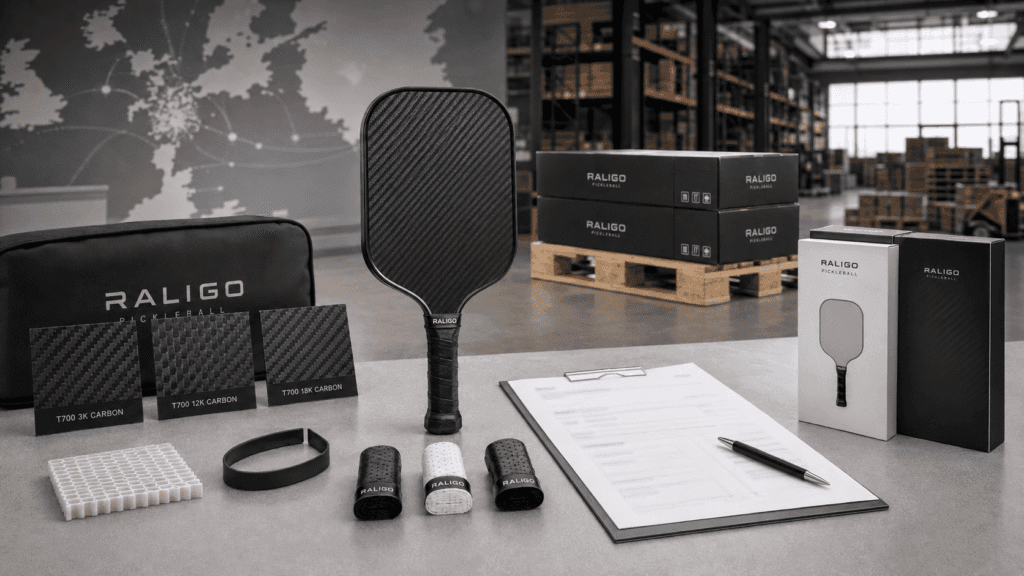
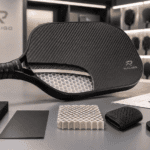
Specifying core density and face weave in the purchase order is what separates a paddle that ships predictable from one with inconsistent weight and balance across a batch. German club buyers — who buy by the dozen and expect uniformity — will reject a batch where paddle number three feels different from paddle number seven. A pre-shipment inspection tied to that written spec is the cheapest insurance a brand can buy.
—
7. DACH Import Checklist: Austria, Switzerland, and the German Hub
The DACH market is not one customs territory. Germany and Austria are inside the EU customs union; Switzerland is not, which changes VAT, duty, and documentation on the Swiss leg.
– [ ] Register your EORI before the first declaration
– [ ] Confirm HS code (Chapter 95) and lock it into the ATLAS declaration
– [ ] Collect REACH material reports for grips, resins, and adhesives
– [ ] Verify GPSR technical file and declaration of conformity
– [ ] Model landed cost with 19% German import VAT (Austria 20%, Switzerland CHF VAT)
– [ ] Specify core density, carbon fiber weave, edge guard, and grip in the OEM PO
– [ ] Arrange pre-shipment inspection and ship reserve samples for in-house testing
– [ ] Decide on buffer stock: German hub vs Swiss-bound split shipment
Get these right and the paddle performance you designed in the factory survives the trip, the paperwork clears on the first filing, and the VAT is booked correctly. That is the foundation of a durable pickleball brand across Germany and the wider DACH region.
—
Frequently Asked Questions
Do I need an EORI number to import pickleball paddles into Germany?
Yes. Any economic operator involved in customs activities must hold an EORI number before their first declaration. It is free, issued through the German Customs Portal (zoll-portal.de), and mandatory from 1 October 2026 for new applications.
What HS code applies to pickleball paddles entering Germany?
Pickleball paddles classify under Chapter 95 of the EU Combined Nomenclature, typically 9506.29 or 9506.99, with duty generally in the 0–2.7% range depending on origin. Import VAT of 19% applies on top of the customs value plus duty and freight.
Are pickleball paddles subject to CE marking in Germany?
Not automatically. Passive sports equipment like a paddle falls under the General Product Safety Regulation (GPSR) rather than a specific CE directive, with DIN EN 15312 as the relevant safety reference. Electronic accessories would trigger CE separately.
Ready to Source Your DACH Paddles?
Talk to our OEM team about carbon fiber paddle manufacturing for the German and DACH market. From core density specs to REACH-compliant materials and bulk production, we handle it at our ISO-compliant factory.