B2B Essential Guide: How to Identify High-Quality Pickleball Paddles – The Four Core Manufacturing Standards
In today’s explosive growth of pickleball sports, the paddle as the most critical equipment directly determines athlete performance and user experience. For B2B procurement professionals, identifying high-quality pickleball paddles is no longer just a matter of price comparison but requires a deep understanding of the fundamental differences in manufacturing processes. This article will systematically analyze the four core manufacturing standards for professional purchasers, providing an actionable procurement evaluation framework.
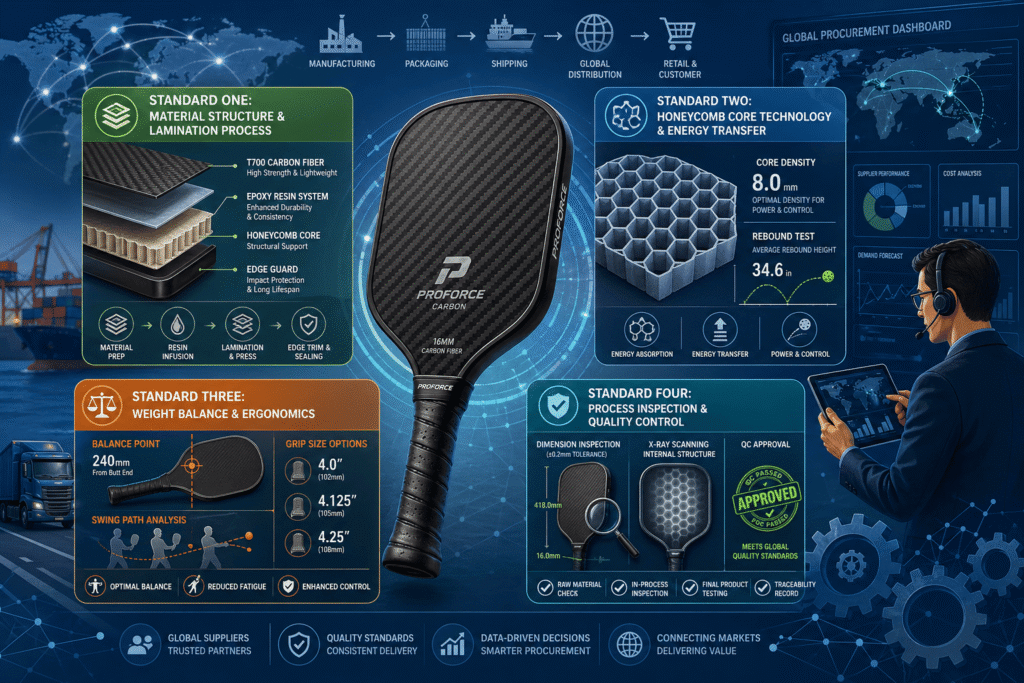
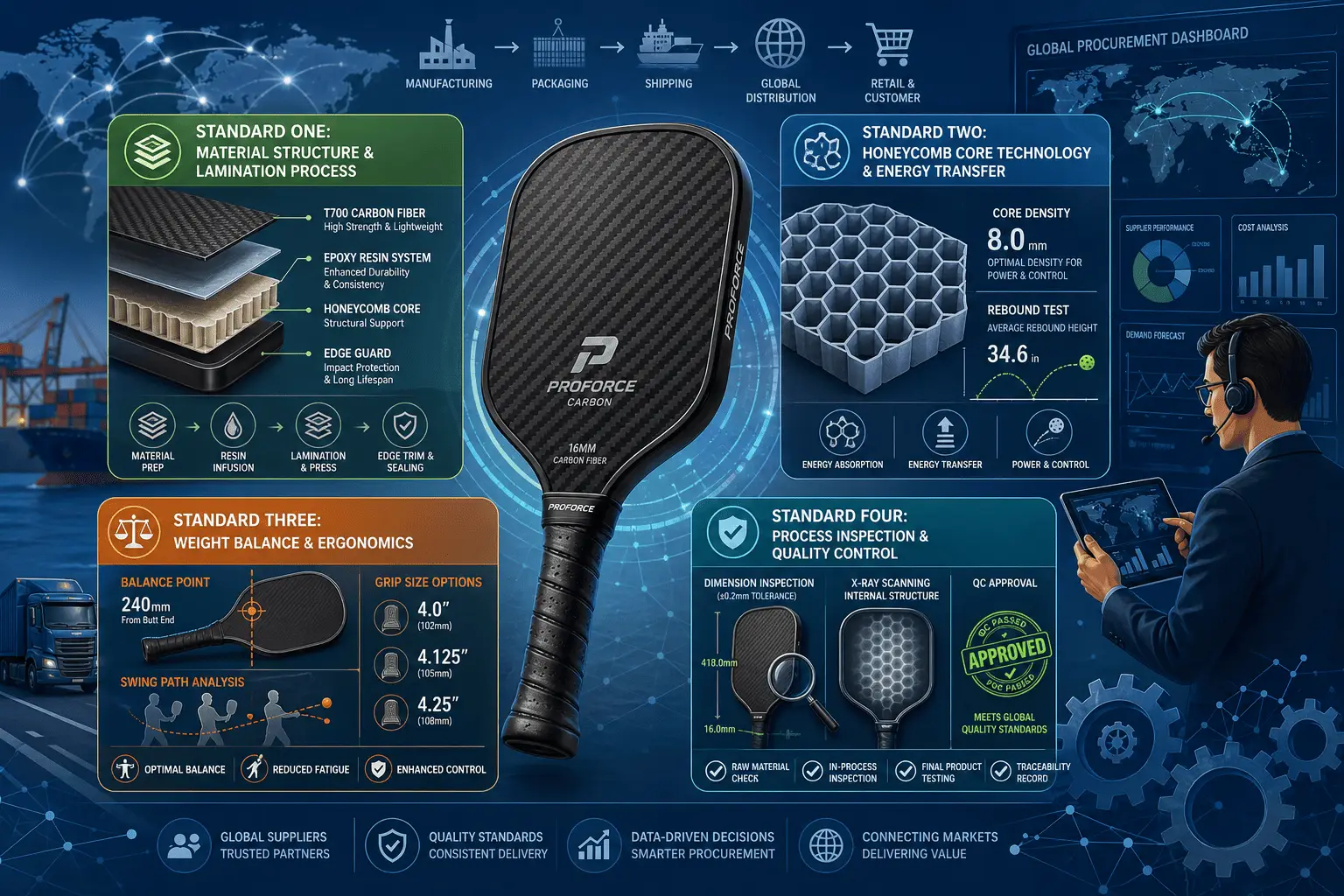
Standard One: Material Structure & Lamination Process
1.1 Carbon Fiber Grade & Ratio
High-end pickleball paddles typically use aerospace-grade carbon fiber materials, but there are significant differences in carbon fiber quality. Focus on: – Modulus grade: T700 and above high-modulus carbon fiber offers superior stiffness and energy return – Fiber orientation: Multi-angle woven prepreg (0°/45°/90°) provides more uniform mechanical properties compared to unidirectional fiber – Resin system: The curing temperature and pressure of high-quality epoxy resin directly affect interlayer bonding strength
1.2 Lamination Structure & Thickness Control
Lamination process is the watershed of paddle performance: – Precise layer count: Professional-grade paddles typically feature 16-18 layers of precision lamination, with each layer thickness controlled at 0.125-0.15mm – Pressure control: Paddles formed through vacuum hot pressing (150°C/30bar) show 30% higher density. Modern thermoforming technology achieves the precise pressure and temperature conditions required for consistent lamination quality. than room-temperature adhesive products – Edge treatment: High-quality edge sealing prevents delamination and extends product lifespan
1.3 Surface Coating & Wear Resistance
Surface treatment affects not only aesthetics but also durability: For OEM buyers prioritizing long-lasting spin performance, surface roughness durability testing is a critical factory audit checkpoint. – Nano-coating technology: Advanced hydrophobic coatings reduce dust adhesion, maintaining clean hitting surfaces – Anti-scratch treatment: UV-cured resin layers can increase surface hardness to 3H or higher – Color fastness: Color fastness rating should reach level 4-5 through QUV aging tests
Standard Two: Honeycomb Core Technology & Energy Transfer
2.1 Honeycomb Structure Density & Distribution
The honeycomb core is the “heart” of the paddle, determining hitting feel and power transfer: For a complete comparison of core structure comparison across PP honeycomb, solid foam, and hybrid polymer options, see our detailed technical analysis. – Density grading: PP (polypropylene) honeycomb density should range 60-80kg/m³ – too low provides insufficient support, too high adds unnecessary weight – Hexagon size: Standard hexagon cells should measure 6-8mm in side length – larger sizes weaken compressive strength – Uniform distribution: Core area honeycomb density should be consistently uniform, avoiding local “soft spots”
2.2 Energy Absorption & Rebound Efficiency
High-quality honeycomb cores should balance absorption with rebound: – Damping coefficient: Ideal vibration damping ratio ranges 0.1-0.15, absorbing impact without energy loss – Rebound rate: Vertical drop tests should show rebound height reaching 65% or more of drop height – Fatigue life: After 100,000 simulated hit tests, rebound rate decline should not exceed 15%
2.3 Edge Reinforcement & Anti-Collapse Design
Paddle edges are stress concentration areas requiring special treatment: – Edge sealing: High-density polyurethane edge sealing prevents moisture intrusion into core layers – Anti-collapse reinforcement: Increased honeycomb density or transverse support structures within 10cm of paddle head – Thermal fusion bonding: Honeycomb and surface layers should use thermal fusion bonding rather than adhesive, ensuring long-term stability
Standard Three: Weight Balance & Ergonomics
3.1 Static Balance Parameters
Professional-grade paddles require precise weight distribution: – Total weight range: Standard paddle weight should be 240-260g, with tolerance controlled within ±3g – Balance point: Should be offset 5-8cm from paddle face center toward handle – Moment of inertia: Rotational inertia around longitudinal axis should be 0.004-0.005kg·m²
3.2 Dynamic Balance Testing
Beyond static parameters, dynamic performance is more critical: – Swing resistance: Standard swing motion should show less than 2.5N resistance at 8m/s wind speed – Vibration transmission: Handle vibration acceleration during impact should be below 15g – Recovery time: Paddle face should return to initial position within 0.1 second after powerful hits
3.3 Grip Design & Comfort Optimization
The grip is the direct contact point between user and paddle: – Circumference grading: Offer three standard sizes: 4.0, 4.125, and 4.25 inches – Anti-slip treatment: Moisture-wicking PU material with 3D surface texture design – Shock absorption system: Built-in EVA damping layers can reduce impact force by 30-40%
Standard Four: Process Inspection & Quality Control
4.1 Dimensional Accuracy & Tolerance Control
Manufacturing precision forms the foundation of quality: – Length tolerance: Standard 68.58cm (27 inches) length should vary no more than ±0.5mm – Face flatness: Height difference between any two points should be less than 0.3mm – Thickness uniformity: Thickness variation from edge to center should be within ±0.1mm
4.2 Destructive Testing Standards
Destructive testing ensures product reliability: – Bending strength: Three-point bending test should show failure load exceeding 2500N – Impact toughness: Pendulum impact test should demonstrate impact energy above 15J – Fatigue life: No visible cracks or deformation after 100,000 cyclic loading tests
4.3 Non-Destructive Testing Technology
Modern production lines incorporate advanced detection methods: – Ultrasonic flaw detection: Detects interlayer bonding defects with 0.1mm resolution – X-ray imaging: Inspects internal structure integrity, identifying bubbles, foreign particles, etc. – Infrared thermography: Detects curing uniformity and thermal stress distribution
Procurement Decision Matrix: Applying the Four Standards
5.1 Establishing Supplier Evaluation System
Procurement teams should develop the following scoring system (10-point scale per item):
| Evaluation Dimension | Weight | Key Indicators | Scoring Criteria |
|---|---|---|---|
| Material Process | 30% | Carbon fiber grade, lamination precision | International certifications, production equipment |
| Core Technology | 25% | Honeycomb density, rebound rate | Laboratory test reports |
| Ergonomics | 20% | Weight balance, grip comfort | User feedback, professional reviews |
| Quality Control | 25% | Testing methods, tolerance control | QC system certification, defect rates |
5.2 Sampling Strategy & Batch Testing
- Initial sampling: Test 3-5 samples from first production batch
- Batch verification: Expand testing to 20 units for medium-volume orders
- Random audit: Maintain 5% random testing for ongoing supplies
- Annual re-evaluation: Conduct comprehensive testing annually
5.3 Cost-Quality Trade-off Framework
| Quality Tier | Target Applications | Recommended Standards |
|---|---|---|
| Premium Elite | Professional athletes, tournament players | All four standards at highest level |
| Performance Plus | Club players, serious enthusiasts | Standards 1-3 at high level, Standard 4 at medium |
| Value Pro | Recreational players, rental fleets | Standards 1-2 at medium level, basic compliance on 3-4 |
Industry Benchmark: What Top Manufacturers Get Right
6.1 Leading Material Innovations
- Advanced composites: Graphene-enhanced carbon fiber for 20% better strength-to-weight ratio
- Hybrid cores: Polymer-honeycomb combinations for customized feel profiles
- Sustainable materials: Recycled carbon fiber options maintaining performance
6.2 Precision Manufacturing Trends
- Automated optical inspection: Computer vision systems detecting sub-millimeter defects
- Real-time process monitoring: IoT sensors tracking every production parameter
- Predictive quality analytics: AI algorithms forecasting potential failures before they occur
6.3 Certification & Compliance Standards
- ISO 9001: Quality management systems certification
- CE marking: European safety compliance
- ASTM F3409: Official pickleball equipment performance standards
Implementation Checklist for Procurement Teams
7.1 Pre-Production Requirements
- [ ] Obtain material certificates for all core components
- [ ] Review factory audit reports (SEDEX/BSCI)
- [ ] Verify production capacity matches order volume
- [ ] Establish clear communication channels with technical teams
7.2 Production Monitoring
- [ ] Implement stage-gate inspections at key production milestones
- [ ] Conduct on-site quality audits (minimum quarterly)
- [ ] Maintain digital quality records accessible to both parties
- [ ] Address non-conformances within 48 hours of detection
7.3 Post-Delivery Evaluation
- [ ] Track field failure rates vs. industry benchmarks
- [ ] Monitor customer satisfaction scores
- [ ] Analyze warranty claims patterns
- [ ] Schedule annual performance reviews with suppliers
Conclusion: The Competitive Advantage of Quality-First Procurement
The pickleball equipment market is evolving from price-driven competition to value-based differentiation. B2B buyers who master these four manufacturing standards gain significant advantages:
- Reduced total cost of ownership: High-quality paddles require fewer replacements and generate lower warranty costs
- Enhanced brand reputation: Consistently excellent products build customer loyalty and positive word-of-mouth
- Competitive differentiation: Superior performance creates tangible advantages in competitive markets
- Long-term partnership value: Quality-focused suppliers become strategic partners rather than transactional vendors
As the sport continues its global expansion, the sophistication of procurement practices will increasingly determine market success. By implementing this four-standard framework, B2B professionals can transform their procurement process from reactive purchasing to strategic quality management, ensuring their organizations remain at the forefront of the pickleball revolution.
For customized procurement frameworks or technical consultation, professional services are available through certified industry experts with manufacturing and quality engineering backgrounds.